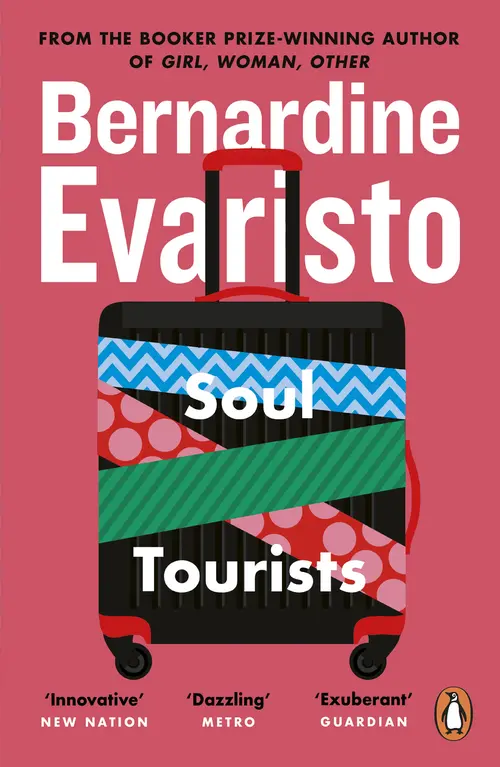
Soul Tourists
Cover


About the Author
Bernardine Evaristo is the award-winning Anglo-Nigerian author of several books of fiction and verse fiction that explore aspects of the African diaspora: past, present, real, imagined. Her novel Girl, Woman, Other won the Booker Prize in 2019. Her writing also spans short fiction, reviews, essays, drama and writing for radio. She is Professor of Creative Writing at Brunel University, London, and Vice Chair of the Royal Society of Literature. She was made an MBE in 2009.
As a literary activist for inclusion, Bernardine has founded a number of successful initiatives, including Spread the Word writer development agency (1995–ongoing), the Complete Works mentoring scheme for poets of colour (2007–2017) and the Brunel International African Poetry Prize (2012–ongoing).
PENGUIN BOOKS
SOUL TOURISTS
‘Free-wheeling, genre-busting, exuberant and sexy, this is not a novel for the faint-hearted’ Guardian
‘In Soul Tourists Bernardine Evaristo has mixed poetry and prose to produce a bouncy, sometimes touching novel about the search for love and belonging … The writing is fecund, stimulating and witty … Evaristo remains an undeniably bold and energetic writer, whose world view is anything but one-dimensional’ Sunday Times
‘Bernardine Evaristo’s dazzling Soul Tourists explores realms that are more than usually out of the ordinary … Evaristo, radically refusing to be confined by genres, has written the story of a love affair, a road trip and a detour into hidden aspects of Europe’s black history that manages to be thought-provoking, funky and funny’ Metro
‘The story is told in an inspired mixture of prose, blank verse and haiku, as it leaps energetically from interior to exterior, dialogue to monologue, containing moments of lucid imagery and sex-starved comedy’ The Times
‘A roller coaster road movie in print where the language twists and turns more than a path through the Pyrenees. Evaristo crosses the border between prose, poetry and film script and exposes the hidden face of black European history in the process’ Independent on Sunday, Books of the Year
‘One of Britain’s most innovative writers, Bernardine Evaristo always dares to be different. Soul Tourists is a reaffirmation of her unique and stimulating style’ New Nation
‘This odyssey is a book to pack for its gypsy spirit and its summer music’ Peter Forbes, Independent
‘Bernardine Evaristo is one of those writers who should be read by everyone, everywhere’ Elif Shafak
‘Bernardine Evaristo is the most daring, imaginative and innovative of writers’ Inua Ellams
‘Bernardine Evaristo … is one of Britain’s best writers’ Nikesh Shukla
Dedication
For my mother, Jacqueline Mary Evaristo, who is simply amazing
Epigraph
They say travel broadens the mind,
but you must have the mind.
G. K. Chesterton,
The Poet and the Lunatics


The Shipwreck, 1987
The Blackwall Tunnel is the birth canal forcing me underneath the pressurized gallons of the river that splits the city into north and south.
Every week I have to leave the Saturday-morning sky-view from my flat in the grand Georgian crescent of the Paragon, which faces the wide green flatland of Blackheath. The sky is the mother of all shape-shifters, but, whether tumultuous with rain and storms, washed out with cold or reflecting the brilliance of an imaginary blue, if I look long enough, I can attach my worries to an itinerant cloud and watch it drift away.
Every week, as I descend into the tunnel’s arched, prowling depths, headlights dipped, windows closed because of the damned fumes, I dread the moment when I’m finally pushed out, noiselessly screaming, tiny fists clenched, eyes all screwed up and gummy, face blue and bruised like a little boxer, into the thundering traffic and toxic air of the Isle of Dogs, and from there, it’s a short drive to the house where my father rots like a carcass of rancid beef.
I park outside the only house in the street visibly subsiding, switch off the engine and prepare in a moment’s silence. It’s like sitting on the ocean bed and looking out on to a long-forgotten shipwreck.
Sandwiched between identical one-storey terraces, all of which have gleaming windows and neatly pruned hedges, is my father’s roof with its mosaic of ill-matched tiles. Quartered window-panes, frames black and fissured, are streaked with the greasy residue of the tar of cigarettes. A pile of bricks taken from the crumbling street wall is stuck in the middle of his garden, rising like a triumphant ruin out of weeds and tall grass. The path to the front door has missing slabs, and my way is blocked, as usual, by a tall green wheelie-bin, standing where the dustmen left it the week before.
I climb the three steps, which are cracked and sink at a right angle, ring the bell and look through the letter-box. The stench of warm urine hits my nostrils, but thankfully not the aroma of a dead body, which I suspect I would recognize.
I turn the key in the lock, and let myself in.
My father moved here twelve years ago, but the top floor hasn’t been used at all and the ceilings are caving in. This is the house he bought because the ghost of Pearline was everywhere in our family home:
Pearline
whose voice still greeted him when he returned home at midnight from the Working Men’s Club
Oh! Yu remember yu have a yard?
Pearline
whose cooking aromas still filled the kitchen, fried garlic and onions hissing in a pan, curried goat in a pot on the stove, and his favourite – rum-soaked fruit cake baking in the oven
A likkle somet’ing for later, sweetie-pie
Pearline
whose antique cook’s knife, with its smooth ivory handle, gathered dust in a draw because when he used it he could feel her strong hands sawing deep into hundreds of succulent hams, the Sunday roast, gammon
Pearline
who told me I’d inherited The Gift, passed down through generations of her mother’s family: to see what others could not
They’ll find yu in time, Stanley
Pearline
who suspected what I already knew but did not want to admit, even to myself: that sometimes when I was on my own, I sensed I wasn’t
Pearline
whose votive candles for the dead ancestors she talked to left smoky streaks on the rosebud wallpaper over their bedroom mantelpiece
Pearline
whose favourite calypso song played itself in the middle of the night, waking Clasford in a cold sweat
Zombie jamboree, dat took place in a London cem-e-tery,
Dey were singing ‘Back to back, belly to belly,
Ah don’t care a damn, ah done dead already.’
When he hung up his flannel next to her threadbare green one, stiff and brittle as old cardboard, he heard her snap back,
When it get a hole, then I’ll get a new one.
When he opened the bathroom cabinet searching for aspirin, it was crammed full of her medicine bottles and lotions, ointments and tubes, bandages and plasters
When he rummaged in the wardrobe, placing the armpits of her clothes to his nose, he smelled the noxious legacy of perfume infused with chemicals that had escaped through her pores
Pearline
whose teeth still lay in a solitary clouded glass, like a deep sea shellfish, on the little table her side of the bed
Pearline
whose wig sat on its stand on the dressing table, bought when her hair fell out; and when he buried his face in it, he could still smell Jax’s scalp oil
Pearline
whose slippers were under the bed; and when he tried them on, he felt the lumpy misshapings of her feet, where she painfully walked on the sides of them, where the bunion on her left one made it stick out at the front
When he unrolled her nylon stockings, he saw the saggy stretches from knees and ankles that had swollen to twice their normal size; and when he walked along the hallway, he saw her emergency overnight case parked over by the coat stand, because it hadn’t made it to the hospital in time.
My father’s new bed remains in its plastic sheath. The new bath stands upended in the otherwise empty bathroom. Clothes spill out of scuffed suitcases. Towels and sheets are squashed into plastic bags. There’s a tower block of old boxes: official documents from the years of marriage, houses rented, bought; letters dating back to the 1940s; the passport dated 1956 that he was always going to get renewed for that migration back home that was always ‘next year’ away; the birth certificates, medical cards and dental cards; and, somewhere, a death certificate.
The weight of it all bearing down on us both.
A pot of congealed stew sits on the stove; beyond being unhygienic and an attractive proposition for flies, it’s now just a cold, hard, flavourless lump. The last meal he ever cooked for himself. The cooker’s four-eyed face is covered with grease. The garden is a nature reserve for foxes and rats, which are the subject of complaints by the neighbours to the council, which issues threats, which he ignores.
‘Hi, it’s only me. It’s Stanley,’ I call out with enforced cheerfulness, letting him know he can drop the hammer that he’s just picked up, that he’s slept with for decades in case the robbers he’s been expecting finally do break in. I step on to the local free newspapers, which I push to one side with my feet, aware that whatever state my father is in, his hearing is unimpaired and a row will ensue if he hears me moving things about. Nothing is to be touched, not even the stew, which is still good enough to be eaten one day, Mi na wasteful like you perishin’ youngsters with yer cash an’ carry, easy come easy trowaway ways.
He sits in a brown tweed armchair, where he also sleeps. He hasn’t gone upstairs for years, and, although I bought a single bed for the sitting room, he doesn’t use it. This is where he sits all day, watching the television but not taking anything in any more. The world in colourful miniature, reduced to a murmuring visual backdrop in a corner of the room: the cookery programmes and soaps, the quiz shows and chat shows, films from Hollywood, Ealing Studios, Bollywood, the make-over, managing-your-money, managing-your-mind, managing-your-relationships, managing-your-every-damned-ting-shows. Once they were a point of conversation. Now it’s just company that he ignores. He gets up only to let in Kathy from Meals-on-Wheels, who brings him a hot lunch at midday with a cold supper for later, which he barely touches; Raj from the off licence, who personally delivers his supplies of whisky, beer, cigarettes and chocolate; and the home help, Winnifred, whom I pay to clean up a little, but, unable to do much of this, and old enough and kind enough to humour the old man whose suspicious eyes follow her every move, she at least keeps an eye on him every Wednesday.
I walk with caution as I enter the sitting room, seeing first the commode that is only a few feet from him, and even then sometimes too far away. The gas fire is on. Winter. Summer. Spring. The windows are never opened. It’s beyond being stuffy. It’s an inferno.
He sits behind the door.
I feel the squelch of piss beneath my feet.
I sit down on the bed, which runs along the right-hand wall, placing a newspaper over it first.
‘How are you?’ Of course this is the most ridiculous question of all, but I can’t help myself.
‘Not good, not bad.’ Sometimes it’s ‘Not too bad’ or ‘Could be better’ or ‘Not bad, not good’ or, on really bad days, ‘Don’t ask!’
My immediate impulse is, as always, to embark on clearing everything up, to get one gargantuan black dustbin bag and chuck the whole bloody room in it – including him. There’s that old globe of his, for a start, sitting on the mantelpiece, all smoke-stained and sun-bleached from the days when he let daylight into the room. The countries and borders are about thirty years out of date. He made me memorize every country in the world when I was a boy and whacked me if I got one wrong. The bloody noses, the split lips, the purple eyes, the zipped-up lips, the chill in his voice, my head down. Thank you, for your words in my useless mouth, for your early-morning rises, your sacrifices. Yes, I promise to obey you unto kingdom come and I will never, ever let you down after all you’ve done, for thou art righteous and I am, well, I am only ca-ca. your son. Amen.
He resists every time I pick something up to be thrown away. Empty envelopes, cans, bottles, remnants of orange juice, cartons of meals, old newspapers. ‘Stop rushin’ me,’ he’ll say, because in the silent-movie space of this room, the energy of someone from the outside world of technicolour is overwhelming. After half an hour or so, I will attempt to empty the commode, then slowly drop detritus into a bag, shaking cans and bottles with great exaggeration first, right in front of him, to prove that there’s not a wasteful drop left, prompting him to say, ‘Doan be so blasted facetious.’
He’ll insist the bag should be used again, once the rubbish has been emptied into the bin outside.
He hasn’t washed in years; he won’t let me or anyone else touch him. His nails grow and grow and grow, until they break off into jagged edges. His hair and beard, no longer dyed black, grow and grow and grow, into tangled scouring brushes. His trousers are stained with urine, his mouth dehydrated, with the dead skin on his loose lips forming little molluscs. He doesn’t smell as much as the room, though, because, like the stew outside, the germs die after a while. They say that after the first few years the dirt doesn’t get any worse.
Should I wash him? Maybe I should force him. It is obscene, washing my father.
How can I, his son, wash his balls?
Reaching out to my father, but with each lunge his body drifts off out of my grip, floating upwards; his big bones have lost their fleshy padding.
I am calling him down, to come back to me, please come back to me, but my words are muffled by water and the current is drifting him away and the creatures of the deep are swimming around us, oblivious as they dart in and out of the sodden timbers
the floating net curtains, tentacles trailing like colourless ribbons, are Sea Wasps; shoals of Clupeid Fry are electrified flying nails recruited from all the fallen doors and creaking floorboards of this house
the weird colony of yellowy sac-like Sea Squirts resembles the tapioca pudding delivered by Meals-on-Wheels, which he hates and always leaves
on the floor are piles of fresh diarrhoea, the Sea Cucumber, which I sometimes have to scoop up for him; it eats sand, in the hope of finding edibles inside
the luminous pink wisps of the Sea Slug, the violet-tipped polyps of the amorphous beings of the living coral
then we enter the dark zone, the cold zone, the abysmal abyssal plane, I try to catch him, but he is lost to me now, as he disappears over the top of the largest mountain range in the world, beneath the continental shelf in the forbidding basin, his wasted legs paddling as his brown corduroy slacks fall down, his feet limp and crusty at the heels
I am no anchor; he is supposed to be mine, he is going, going …
and I am left only with the creatures of the deep that I watch on videos late at night when I can’t sleep, because I can lose myself in their magical world for hours
here mouth ulcers hover in the water like Christmas baubles with brilliant lights radiating from inside
unused condoms twirl around in a strange ballet with ET eyes, with a ballerina’s swirling tutu skirt of red skin for a behind, bought when he imported a woman from home, a ‘pen pal’ who never wrote once she left this house
here there are beings that need no hard protective skin because there are no solid surfaces; his brain cells are afloat in alcohol, creatures whose skeletons show like X-rays beneath a layer of fragile transparency
they are looking for prey; I am praying for him
and then he drifts back down, through the ceiling, head first like a deep sea diver, arms at his side, feet flapping, and finds his way back into his armchair, bubbles coming out of his nose, and he picks up a can of beer and pours its remains into the dirty mug that reads:
40 YEARS – PEARLINE & CLASFORD – RUBY
He lights a cigarette as if he’s been nowhere, nowhere at all, and suddenly, noticing the look of exasperation on my face, he snaps, ‘Is all I’ve got left.’
‘But it’s so bad for you. It’s killing you.’
‘Doan be ridiculous. Nuttin’ no wrong with it. Doan believe the papers. Go get my supplies, son.’
I get him to sign his pension book. His signature is all indecipherable swirls curling into each other, like an elaborate doodle – to deter counterfeit, although now it takes longer to create this intricate artwork.
Hidden in his signature is my father, somewhere.
Heaven, Really
Bone white, white lead, blond, blanc d’argent, blanc de fard, blanc fixe, antimony white, titanium white, strontium white, Paris white, zinc oxide, zinc sulphide.
Before I moved into this place and redecorated I never knew there were so many official shades of white. When I get back home, stepping into my flat is like stepping on to a moving cloud, into heaven, really. If I don’t watch it, I’ll fall down, because the floor is an optical illusion and hardly there at all. My place is just white with sloping attic ceilings and nothing on the walls or surfaces. No ornaments or adornments to show my wealth or taste, or lack of it. No magazines to show I’m hip to popular culture or my esoteric erudition. No books to show off my catholic literary interests. No letters, photos, sentimental mementoes, such as my first comic book or old school tie. No plants to show I’m a nurturing kinda guy, and certainly no moulting quadrupeds, thank you very much. (Though I sometimes think a limply aristocratic Dalmatian would fit in nicely – on a cream rug, just there underneath the window – so long as it doesn’t move.)
Pure emptiness. Just the way I like it. Cheap too. Sophistication on a budget. The bare minimum of soft furnishings in contrasting shades, well, in the words of my design manual, ‘subtle complementary tones of white’; while my two lounge windows, at this level, provide mutable art works that cost nothing. My favourite painting comes at least once a year: it’s called January Snow Blizzard.
There is nothing more beautiful than a marble mantelpiece and fire surround, offset by ivory painted walls, with the sun pouring in and splashing everything with a warm orange glow. Nothing more beautiful than squares of snow-white floorboards, pearl-white skirting and an eggshell sofa throw, with flake-white cushions on it. Nothing more exquisite than an occasional wooden table painted off-white and, upon this, my occasional deviant indulgence: a single Van Gogh sunflower in a slim glass vase. A solitary sunflower that draws you in while standing out, a potent symbol of life and, as the week progresses, decay. In other homes a great bunch of magnolias mixed with carnations mixed with roses mixed with tulips mixed with branches and leaves and whatnots is stuffed into an ostentatious vase and completely loses any possible charm amid all the chaos of clashing colours and a room full of things, things and things. I am ’cos I have bloody things!
Here, a single flower is what I call – resonant.
In my narrow kitchen everything is hidden in white cupboards, except a Chinese-white porcelain bowl of oranges, pears, apples and grapes. And when they go mouldy, brown or bruise, what is it? Pure modern art, man. The whole flat is a gallery and I am but a walking sculpture inside it. A solitary sculpture, yet to find its perfect match. And she’d have to look good lounging on my sofa. No one ever does – they just mess it up. Sometimes, months later, I’ll find evidence underneath the sofa or down in between the seat cushions, such as a thread of hair, split at the end – strawberry blonde at the bottom and chestnut at the top, or a thick straightened brown one going frizzy at the root, or just a tiny black curl in my palm, like a perfect circle drawn with ink. When they leave, I have to open the windows, straighten out the room and light candles.
The Paragon: ‘A model of supreme excellence, it was completed in 1807. The year that Blackheath achieved the status of a fashionable and elegant place to live. Replete with every convenience for use, comfort and elegance. A place to attract well-to-do professional and middle-class families who want to enjoy the air of the heath.’ So I’ve arrived, living in the upper echelons of this crescent of houses with its own secluded road.
I start to clean, wiping all the surfaces with a wet cloth, washing the windows on the inside; then I lean dangerously out on the ledge and clean the outside too. I polish the TV and sound system, and run a duster over the CD rack, all stacked away in a cupboard. I hoover the floor, before getting down on my hands and knees to give it a good sloshing with some hot soapy water and bleach. Next, the kitchen, the bathroom and my bedroom at the back with its semicircular window, just large enough for a double bed and a built-in wardrobe (all white).
When I’m done, my flat might not look much different but it certainly feels it. I draw a bath and soak in lavender oil, get up, drain it out and check to see if I’ve left a rim of scum behind. I like to see evidence that my dirt has gone. If not, I scratch off all the dead skin with a loofah, shower and then shampoo my hair until it squeaks. Finally, I put on my white cotton pyjamas, place all the clothes I’ve worn to my father’s house in the washing machine, hose down the soles of my pissy shoes and begin to cook. Well, I heat up something in the microwave, something ready-made from the supermarket, a cheesy tuna pasta today, and I make a lemon, garlic, mustard, honey, herb and oil dressing for a green leaf salad.
The Story Continues on BooksBarbecue!
Enjoyed this preview? ❤️ Do not stop here!
Read the complete book free online → 🔗
Continue reading now on BooksBarbecue and discover every page!
Love reading? Bookmark BooksBarbecue.com for more amazing books!
Happy Reading!