Sojourn
Cover
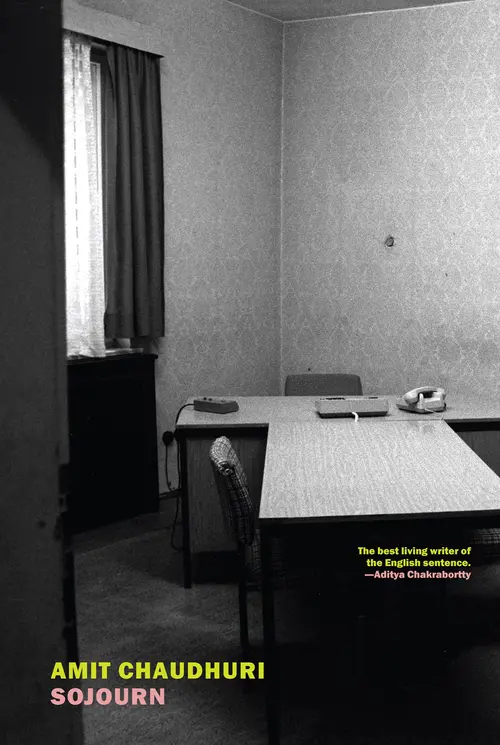
Sojourn
by the same author
fiction
A STRANGE AND SUBLIME ADDRESS
AFTERNOON RAAG
FREEDOM SONG
A NEW WORLD
REAL TIME
THE IMMORTALS
ODYSSEUS ABROAD
FRIEND OF MY YOUTH
non-fiction
CLEARING A SPACE: REFLECTIONS ON INDIA, LITERATURE, AND CULTURE
CALCUTTA: TWO YEARS IN THE CITY
TELLING TALES: SELECTED WRITING 1993–2013
THE ORIGINS OF DISLIKE
FINDING THE RAGA
as editor
THE PICADOR BOOK OF MODERN INDIAN LITERATURE
MEMORY’S GOLD: WRITINGS ON CALCUTTA
LITERARY ACTIVISM: A SYMPOSIUM
poetry
ST CYRIL ROAD AND OTHER POEMS
SWEET SHOP
RAMANUJAN
NEW AND SELECTED POEMS
Title Page
Sojourn
AMIT CHAUDHURI
 New York Review Books New York
SOJOURN
It was evening, and I didn’t know the name of the road I was taken to. It was as if I’d woken from a sleep: maybe because I’d arrived two days ago. I wasn’t tired; I was wide awake. But I’d have been lost without my contact. He told me which U-Bahn to take. I got off at Uhlandstrasse and climbed up the stairs. He’d been waiting for me.
•
At my talk, there was a furtive man. I haven’t decided if I mean ‘furtive’ or ‘entertaining’. There’s a kind of person who does dramatic things quietly, who pretends they’re invisible while blocking the view. It’s as if they believe that not being aware of themselves is a guarantee that others can’t see them. He was such a person. He stood out because he was Indian, but more because – as if he’d brought something to a wedding he’d now decided to pass off as a gift – he placed a mike on the table. It was as if only he could see the mike; it wasn’t the one that had been set up for me to speak into. I let it lie. He went and stood at the back. He had the deprecating manner of a man who knows everything is about himself.
•
At the end of the talk, four or five people came to speak with me, and he elbowed his way through with the air of someone who realises his train has arrived, apologetic, cheerful, pleased with himself.
‘Hello!’ he said. I heard a Bengali accent. He continued in Bengali. ‘Ami aar ki . . . That is, I recorded your talk but I want to ask you some questions. Can I see you tomorrow?’ I studied him, dazzled. ‘I am from Deutsche Welle!’ I didn’t know what Deutsche Welle was, but my contact gave it a gravitas-conferring nod. I relented. ‘When and where?’ I didn’t want to sound desperate, but I had few responsibilities. ‘I will call you,’ he said, without explaining how he had come by my number. He bent forward to give me his card. ‘Faqrul – my name,’ he said. On the card was ‘Faqrul Haq’. ‘Deutsche Welle’ was in italics.
The next morning I had a dark bread I’d never had before with coffee. I buttered it and ate it untoasted.
The flat was new to me. I’d moved into it the day before yesterday in a hurry. It wasn’t the flat I’d arrived into. That was smaller: a kind of studio. The drawing room and bedroom merged with the kitchen. In another mood I would have found it charming. The first evening, though, I was depressed especially by the lack of demarcation between shower and toilet. The bathroom was narrow. On another day, I would have warmed to this. Which space do you own more entirely than the bathroom? But, that evening, I stepped out of the shower and saw the toilet was wet. I called Jonas.
‘I hope everything is all right,’ he said.
‘Yes it is. Yes it is, thank you . . . There’s one thing.’
‘Please don’t hesitate to tell me.’
I tried to remember.
‘Isn’t it true . . . actually, I have the letter before me. Isn’t it true that the Böll Professor gets a two-bedroom flat?’
I could hear Jonas taking this in. I’d only entered the flat an hour ago. I’d embraced it inwardly. I’d taken to its twentieth-century quality – but then rapidly began to feel doubtful, to reconcile what I’d been asked to expect to where I’d been deposited by Jonas.
‘Yes, the Böll Professor gets a two-bedroom flat. That is right.’
‘But this is a one-bed, I think . . . or a studio.’ A silence.
‘Yes, yes. I see. Yes – I think they thought that since you don’t have your family with you, you won’t need a regular flat.’
‘Yes, I understand. The bathroom here is very small, Jonas. It’s not what I expected.’ I said, knowing he’d now dislike me, ‘I can’t be here for four months. I think I should get the flat I was promised. I’d rather go back if you can’t.’
‘No, no, no, no.’ I already had a sense that Jonas was courteous and unexcitable. He allowed himself a moment of urgency. ‘I will call Max right away.’
Max, who had invited me, was on sabbatical in Arizona.
‘Thank you, Jonas.’
I moved the next morning. The Böll Professor’s apartment was only two houses away.
It was spacious, with wooden floorboards. An expansive drawing room, with a TV near the window. The small bedroom had a bunk bed, presumably for children. I never went there. My room had a king-sized bed: unlikely to be put to full use. To not have a family felt like a wind-fall. The kitchen was to the left of the hall leading to the front door. There was surplus space here too. I registered this as I buttered my bread the first morning.
The bathroom was almost miraculous. It was wide but long, with a bath and shower. As in a golf course, you felt there was always more to come.
The toilet was a conundrum. I’d never seen anything like it, except in the studio flat. It was mostly a slab, like a dissection table. I decided to acclimatise myself. But I couldn’t bear to sit on it for very long. It stained easily because of the shape, and I started cleaning it as soon as I began using it. I wondered if it was part of an industrial heritage.
•
Using that toilet, my first thought was, ‘Oe must have sat here.’ He couldn’t have escaped it. And I felt a kind of empathy and embarrassment thinking of Kenzaburo Oe in this bathroom, seated where I was, of him then going out to the drawing room. Oe had won the Nobel Prize, but this is what it comes back to: our relief at amenities.
•
Jonas had told me that Oe had occupied the flat in the late nineties before it began to be assigned to Böll Visiting Professors. He’d spent six months in Berlin at the invitation of the German Academic Exchange Service. I had read one Oe novel – by chance, recently. It was about a man and his brain-damaged son, a seemingly insentient being who’s also a living conscience. It had been mentioned by a relative who himself was terribly bereaved: his son had killed himself. Oe’s novel was, I heard, drawn from life. All this – the relative; Oe’s suffering; my bum touching the seat that Oe’s had rested on – was on my mind in my first days in the flat.
The cell phone rang late in the morning. ‘Hello!’ said the voice. ‘Hello!’ I said. It was like an old-fashioned trunk call. ‘Hello kemon achho!’ I was rapt for a second. ‘Faqrul, aar ki.’ I’d forgotten our conversation. I’d forgotten about the talk last night. ‘We said we’d meet today?’ The reluctance in my silence may have been audible. He was a man who expected reluctance. He had a bridegroom’s thick skin. ‘I was thinking of getting some work done. What is it that you’d like to do?’ ‘Oh, nothing at all! An interview for Deutsche Welle, what else. We will have lunch. I will introduce you to a fantastic place. I will show you two or three fantastic places, but we can start today.’ My suspicion increased. ‘Fantastic place meaning . . . ?’ He brushed me off. ‘You wait and see! I’ll tell you how to get there.’
•
He said I should walk to Oskar-Helene-Heim and take the U-Bahn to Görlitzer Bahnhof. I made him spell the name, because the way he said it – ‘gollitza banhoff’ – had me guessing. He was clearly a local. A Bengali local.
•
Görlitzer Bahnhof is old. I don’t mean that it’s getting on in years. I mean it’s familiar. Just as when you say ‘He’s an old friend of mine’ you’re talking not about the friend’s age but that he’s been your friend for a long time, Görlitzer Bahnhof felt known to me. It was my second time in Berlin; I had little memory of the first visit. I should add that the U-Bahn is misleadingly named. It’s hardly an underground line. Much of it floats over the city. Görlitzer Bahnhof is itself elevated.
As I came down the stairs I saw a man in an ash-coloured plastic jacket smoking furiously. I’d for gotten what Faqrul looked like, but he smiled at me and I smiled back distantly. He had the huddled look of a man who likes snatching time to himself. ‘Be careful, they’re all pickpockets,’ he said. Africans had been waiting for me to descend. ‘Esho,’ he said, navigating. He was shorter and older than me. He wore thick glasses and had a moustache. He was strong.
We crossed the road. I wondered what we’d eat. He had a pre-emptive air: of someone who not only knew me for years, but could predict my questions. After seven or eight minutes, we came to an Indian restaurant. We went up the steps and entered a large yellow space. It had a luncher: an old man. Faqrul introduced me to a plump young man. ‘Here’s the person I was telling you about.’ The plump man ushered me in the way a prince of a small state might show the dignitary of a major nation his modest palace.
Pakoras and mango lassi arrived. ‘Should we do the interview now or later?’ asked Faqrul. ‘Thhaak, let’s eat first!’ ‘Yes, we can do it later. If we don’t fall asleep after the meal.’ Faqrul’s compact being shook with laughter. The plump proprietor asked pointedly: ‘Tandoori prawn khaiben?’ I don’t like prawns in Indian restaurants in Europe because they’re frozen, but they were his most prized gift and I nodded.
•
I admit I was a bit disappointed. I didn’t expect to be having Indian food in Berlin on my fourth day. I asked:
‘Have you heard of Himalaya Imbiss?’
‘Himalaya Imbiss?’
Faqrul had a deep voice – suited for radio.
‘A friend mentioned it.’
‘A friend? Achha?’
I was thinking of Adhir Roy; a sociologist and misfit. He’d been here in 1987. When I told him I was off to Berlin, he’d gone into a reverie. ‘You must go to Himalaya Imbiss,’ he said. ‘It’s a small place. Very nice. You can get curry there. I’d sit there for hours.’
‘His name’s Adhir Roy.’
‘Adhir Roy . . .’
Faqrul frowned with the authority of one who’s on firstname terms with everyone worth knowing in Calcutta, though he hadn’t visited it in forty years.
‘No, don’t know him,’ he said.
Then he addressed the proprietor, who happened to be passing:
‘Afzal! Do you know Himalaya Imbiss?’
‘Himalaya . . .’ said Afzal, with a practised blankness. In my head, Himalaya Imbiss had become the only place in West Berlin in 1987 that served Indian food. It came back to me that Adhir Roy hadn’t lived in Berlin in 1987, but 1989. But any history before November 1989 was so continuous that Adhir could be embedded in it in any point. That was eternity – with its Himalaya Imbisses, never to pass. Adhir was a film fanatic – he’d come to Berlin to pursue Alexander Kluge, both the man and his work. He told me that he’d been to dinner with a Left– Green group the day before people were given licence to clamber over the wall. ‘None of us knew,’ he said, ‘that it would end. When it did end the next day, it felt inevitable.’
•
There was a wave of food: chicken bhuna, daal, pilau rice, tandoori prawns. Soon I’d find out that lunch was gratis. Faqrul – I didn’t know it then – was a well-known exile. He was a poet, booted out of Bangladesh in 1975 for insulting the Prophet Muhammad in a poem. Buoyed by blasphemy, he’d gone to a careless extreme. His imagery was scatological. He found refuge in Calcutta. There, he became a literary scene regular. Then the West Bengal government, belatedly nervous, or realising the poem had denigrated every known deity, reconsidered his domicile. Around this time, Günter Grass was in Calcutta, discovering, Columbus-like, its garbage heaps and poor. He hung out with writers, heard of Faqrul’s tenuous situation. He must have liked him, because he began making arrangements for Faqrul to get asylum. Faqrul emigrated to Germany in 1977. I wasn’t nonplussed by the waiving of the bill, as I knew of the generosity of the Bangladeshis. I didn’t know then that Faqrul – despite his beliefs or lack of them, despite the infamy that had descended on him in 1975 or because of it – was held in awe by proprietors of Indian restaurants across Berlin, all God-fearing Bangladeshis. They periodically served lavish meals free to Faqrul and his distinguished visitors, among whom I suppose I was included.
After lunch, Faqrul held a large microphone while I spoke about modernity’s advent in the world – the subject of my last book and the next one.
Outside, the sky was pale. ‘This is Kreuzberg!’ Faqrul announced. ‘That way no man’s land,’ he said, wheeling around for a second. We resumed walking, staying parallel to the overhead bridge of Görlitzer Bahnhof. I stopped to study a Mercedes-Benz; it was a model I’d seen and even got into as a child, a 250. It looked un affected by the seasons. Behind it was a small car: the excitement of confronting something you don’t know is very like the excitement of recognising something you were familiar with long ago. ‘What is this?’ I asked. It was new to me, and incredibly old. Faqrul tried reading its name, but I think he was bluffing when he said: ‘It’s an East German model.’ There was a hint of pleasure in his words. It could have been a Soviet make. Self-sufficient, redundant.
‘Come,’ said Faqrul, beckoning. He’d stopped before a board. It had flyers pinned to it. ‘See,’ he said. I flinched. It was a photograph of a nude woman. I flinched not because it was obscene. But what did he have in mind? Was this an avuncular initiation? The photo was black and white. The woman’s outlines – breasts, shoulders – were rounded, soft. It was from 1923. I could guess at enough of the text to understand it announced an exhibition of erotic pictures from the time. ‘See?’ said Faqrul; I paused at the eyebrows, pale nipples, and navel. 1923 meant nothing; the woman was in a ‘now’ and all else was irrelevant. ‘And this one,’ he said, pointing to another poster. ‘Off-theatre. Something out of the way.’ I didn’t know what the poster said. I imagined what ‘off-theatre’ implied. ‘This board,’ he said, gesturing with a hand, ‘is for off-theatre.’
There was a U-Bahn to the university – the stop was named after it – but it was more straightforward to walk. Once out of the U-Bahn you had to get your bearings. With the road, you kept going till you came to a fork – then you went right.
The university had come up in the fifties, but large bits were recent. The long corridor felt like a provincial airport: constant arrivals, departures, long delays. Students could take seven years to do their MAs – a reaction against fascism’s timekeeping. I dawdled in twice a week. I usually stopped by Jonas’s office. He accompanied me to mine. Sometimes, because I was Böll Professor, he introduced me to a luminary in the department. History and Culture had eminent faculty. It was on the first floor.
My office had a telephone and computer and table, and a view of other windows. I used it a few times to meet students, but mostly it was a green room to my weekly lecture. Or it was a waiting room in which I filled in forms which I then handed to my neighbour, the department’s head of admin.
•
In my first weeks, I had lunches in the cafeteria. It was a huge space – even when it was crowded, it was never full. At the end of the first week, I was scanning tables, wondering where to sit, and a pretty girl smiled at me before she sat down with her boyfriend, who was eating, oblivious. It occurred to me that she’d smiled as I’d entered the doorway. I speculated if she was a student in History and Culture and had recognised me. Unlikely. It could be she was trying to make me feel at home.
I was a semi-student in the cafeteria. But, in my second week, I gave my inaugural talk, with faculty, students and – I expect – people who were neither in the audience. Jonas introduced me: as they’d invited me to be Böll Professor, they had to pretend I was a scholar of significance. I rambled on why India was a ‘modern’ idea, not a colonial or postcolonial one, while a woman in the front row nodded, eyes sparkling.
‘I teach postcolonial studies myself,’ she said – part confession, part dry observation – when she came up later. I realised I may have misread her nods.
‘I love your work. I taught your new book to my class last year.’
My heart beat faster, as it does when I hear such words. It’s like being caught out. You write for others, in theory; confirmation of the fact is disconcerting.
‘That’s kind of you,’ I said. I left a question unasked, but she picked it up.
‘I’m Geeta Roy,’ she said.
‘Geeta Roy . . .’ I weighed the foreignness of the words.
‘Yes, my father’s from Calcutta. My mother is German.’
That explained the eyes’ refracted quality, why they’d shone from a distance.
‘Look, there are others waiting to talk. Maybe we could meet later. My husband and I would love to take you to dinner.’
‘That would be wonderful.’
‘You live in Dahlem, don’t you? We need to take you out of Dahlem.’
I was discovering that the area I lived in was known for its dullness. You don’t make such distinctions on arrival; they’re reported to you. They sink in; you think, ‘They’re right.’ The dullness was historical. Dahlem had been created by the Americans to exemplify suburban tranquillity. But its edge intersected, Faqrul had pointed out to me, with Grunewald. I’d glimpsed the forest on my way in from the airport. ‘From there they sent Jews to the camps,’ he said, lighting a cigarette. Grunewald’s frozen beauty felt like it would melt and rush towards Dahlem.
I needed a new jacket. With oncoming autumn, the days were clear but no longer warm. The jacket I had was six years old, and I decided my Böll professorship’s stipend was an excuse to get a new one.
‘Bhabchhi ekta jacket kinbo,’ I said to Faqrul. He’d begun to call me every day.
‘You come to Wittenbergplatz,’ he instructed me.
•
‘Where are you?’ I said on the phone.
He was in front of a self-service tea shop.
‘Will you have tea first, or later?’
‘Later is fine. I’m a bit hungry now, but tea can wait.’
He gestured to me to pause and went in. He came out after five minutes with a doughnut.
‘Hold this,’ he said, handing me the paper bag.
Then he jumped back in at the entrance and said something to a man sitting on a stool, looking out on the street. ‘Bitte, bitte,’ he said, cigarette pointed. What I could overhear – ‘schön’, ‘ach so’, ‘danke’, other words I couldn’t follow – sounded exactly like Bengali.
‘I forgot the lighter at home,’ he chuckled, exhaling smoke.
‘Where’s the place?’ I asked him. I’d eaten half the doughnut.
‘Oh, nearby. Two minutes.’
Two evenings later he took me where, if you walked further up, the Brandenburg Gate and the Reichstag were visible. The road was bright with lights. Everywhere were flat stones, like rockery on an abandoned shore.
‘These,’ said Faqrul, ‘are to remember the Jews.’ He spoke in an offhand way, puffed up with a sense of accomplishment. In and out we went through the shadows of what was part graveyard, part playground.
‘I was beaten up here,’ he said – again, exuding satisfaction.
‘What? When?’
We paused at a stone.
‘1992. I was wandering around when a bunch of thugs came by. Oi – neo-Nazi . . .’
‘Where did neo-Nazis come from?’ I laughed in dis-belief. ‘Here of all places?’
‘Oi je,’ he said, turning his head towards Brandenburg Gate. ‘They lived not far away. The East was full of neo-Nazis.’
‘What happened?’
A couple walked past, politely looking away.
‘Oi aar ki. One of them said, “Was machst du hier?”’ He let a heavy Bengali cadence embrace the words. ‘Maaney, what are you doing here?’
He bowed and lit a cigarette.
‘I said, “Was geht’s dich an?”’ He mangled the syllables with relish. ‘Maaney, tor ki hoyechhe re? What’s it to you?’
‘What? Faqrul, don’t you know you should ignore people like that? You don’t make eye contact with Nazis, let alone respond to them!’
He ducked, incorrigible, in repentance. His body rocked. Because he was a smoker, the laughter was like a kettle’s hiss. It filled the dark space.
‘They beat me up,’ he said. ‘I remember nothing. When I woke up I was in a police station.’
‘At least they didn’t kill you.’
‘I lost all my teeth.’
‘Your teeth? What are those, then?’ I said, peering at his mouth.
We began to proceed from that faux-cemetery towards Tiergarten.
‘Dentures.’
‘Those teeth aren’t yours?’
‘No.’ Once more, a surge of self-satisfaction. ‘I lost mine in 1992.’
That jacket! A pale green that shone. When I say ‘shone’ I mean a subdued resplendence. Not quite tweedy, but textured, like a surface.
‘What do you think?’ I’d said, admiring my likeness.
The Story Continues on BooksBarbecue!
Enjoyed this preview? ❤️ Do not stop here!
Read the complete book free online → 🔗
Continue reading now on BooksBarbecue and discover every page!
Love reading? Bookmark BooksBarbecue.com for more amazing books!
Happy Reading!