So Far from God
Cover
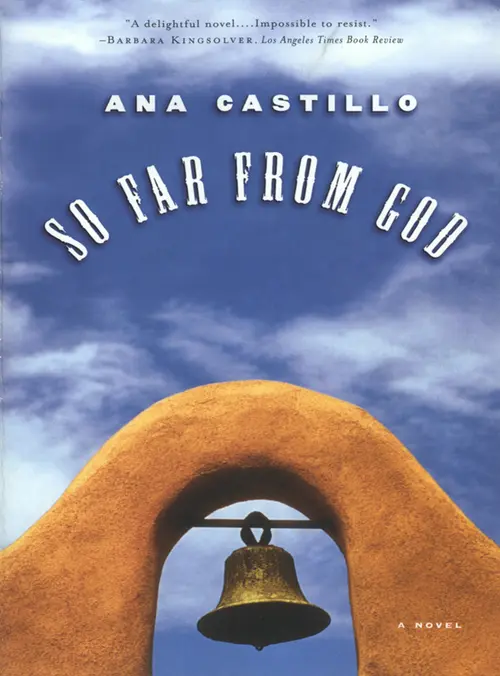
So Far from God
Also by Ana Castillo
I Ask the Impossible
Peel My Love Like an Onion
Goddess of the Americas
Massacre of the Dreamers
Sapogonia
My Father Was a Toltec
The Mixquiahuala Letters
Watercolor Women and the Opaque Man
Psst … I Have Something to Tell You, Mi Amor
Title Page
Dedication
To all the trees that gave their life to the telling of these stories
y
A m’jito, Marcel, y a las siguientes siete generaciones
Acknowledgments
I am indebted to the members of the Southwest Organizing Project who assisted in my research; above all, for the inspiration I received from their consciousness, ongoing commitment, and hope.
Muchos thank yous to my apreciado editor, Gerald Howard, and, as always, thanks Susan B.!
“So Far from God—So near the United States”
PORFIRIO DIAZ, Dictator of Mexico during the Mexican Civil War
So Far from God
1
An Account of the First Astonishing Occurrence in the Lives of a Woman Named Sofia and Her Four Fated Daughters; and the Equally Astonishing Return of Her Wayward Husband
La Loca was only three years old when she died. Her mother Sofi woke at twelve midnight to the howling and neighing of the five dogs, six cats, and four horses, whose custom it was to go freely in and out of the house. Sofi got up and tiptoed out of her room. The animals were kicking and crying and running back and forth with their ears back and fur standing on end, but Sofi couldn’t make out what their agitation was about.
She checked the bedroom with the three older girls: Esperanza, the eldest, had her arms wrapped around the two smaller ones, Fe and Caridad. They were sleeping strangely undisturbed by the excitement of the animals.
Sofi went back into her own room where her baby, the three-year-old, had slept ever since Sofi’s husband disappeared. Sofi put the baseball bat that she had taken with her when checking the house back under the bed—“just in case” she encountered some tonto who had gotten ideas about the woman who lived alone with her four little girls by the ditch at the end of the road.
It was then that she noticed the baby, although apparently asleep, jerking. Jerking, jerking, the little body possessed by something unknown that caused her to thrash about violently until finally she fell off the bed. Sofi ran around to pick her up, but she was so frightened by her little daughter’s seizure she stopped short.
The baby continued to thrash about, banging her little arms and legs against the hard stone floor, white foam mixed with a little blood spilling from the corners of her mouth; and worst of all, her eyes were now opened, rolled all the way to the top of her head.
Sofi screamed and called out “Ave Maria Purisimas,” and finally her three other precious children came running in. “Mom, Mom, what happened?” And then, everyone was screaming and moaning because the baby had stopped moving, lay perfectly still, and they knew she was dead.
It was the saddest velorio in Tome in years because it was so sad to bury a child. Fortunately none had died since—well, if memory served right, doña Dolores’s last son. Poor woman. Eleven children and one after the other passed on her until she was left with no one, except for her drunken foul-mouthed husband. It seems all the babies were victims of a rare bone disease they inherited through the father’s bloodline. What terrible misfortune for doña Dolores, suffering the pangs of labor through eleven births, all fated to die during infancy. Twelve years of marriage, eleven babies that did not survive, and to top it off, the husband drank up everything they owned.
A sad, sad story.
The day after the wake the neighbors all came out to accompany Sofi and the girls to the church at Tome, where Sofi wanted the little baby’s Mass to be held before they lay her into the cold ground. Everyone Sofi knew was there: the baby’s godparents, all of Sofi’s comadres and compadres, her sister from Phoenix, everyone except, of course, the baby’s father, since no one had seen hide nor hair of him since he’d left Sofi and the girls.
That marriage had a black ribbon on its door from the beginning. Sofi’s grandfather had refused to give the young lovers his blessing, the father had forbidden Sofi’s querido to step foot in their house during their three-year courtship, and the local parish priest joined the opposition when he refused to marry the couple in church.
Nobody believed that Domingo was good enough for little Sofi, not her sister, not her mother, not even her favorite teacher in high school, la Miss Hill, who had nothing but praise for Sofi’s common sense and intelligence. Nobody thought el Domingo would make a good husband because of the fact that he liked to gamble.
Gambling was in the man’s blood. And gambling is what Sofi did when she ran off with him, sheltered by the dark night of a new moon, and came back a señora. And then, nobody could say nothing about it but wait for the inevitable failure of Sofi’s marriage.
A month after he left, Sofi heard from her husband, a letter from El Paso with five ten-dollar bills and a promise to send more whenever he could. No return address. And no more news from Domingo ever again after that. After a year, Sofia was so mad, she forbade anyone to even mention his name in her presence.
It was 118 degrees the day of Sofi’s baby daughter’s funeral and the two pallbearers, upon the instruction of Father Jerome, placed the small casket on the ground just in front of the church. No one was quite certain what Father Jerome had planned when he paused there in the hot sun. Maybe some last-minute prayers or instructions for the mourners before entering the House of God. He wiped his brow with his handkerchief.
In fact, he was a little concerned about the grieving mother, who at that point was showing signs of losing it, trembling and nearly collapsing between two others. Father Jerome thought it perhaps a good idea to advise them all on funeral decorum. “As devoted followers of Christ,” he began, “we must not show our lack of faith in Him at these times and in His, our Father’s fair judgment, Who alone knows why we are here on this earth and why He chooses to call us back home when He does.”
Why? Why? That’s exactly what Sofi wanted to know at that moment—when all she had ever done was accept God’s will. As if it hadn’t been punishment enough to be abandoned by her husband, then—for no apparent reason and without warning, save the horrible commotion of the animals that night—her baby was taken away! Oh, why? Why? That’s all she wanted to know. “Ayyyyy!”
At that moment, while Sofi threw herself on the ground, pounding it with her rough fists, her compadres crying alongside her, saying, “Please, please, comadre, get up, the Lord alone knows what He does! Listen to the padre,” Esperanza let out a shriek, long and so high pitched it started some dogs barking in the distance. Sofi had stopped crying to see what was causing the girl’s hysteria when suddenly the whole crowd began to scream and faint and move away from the priest, who finally stood alone next to the baby’s coffin.
The lid had pushed all the way open and the little girl inside sat up, just as sweetly as if she had woken from a nap, rubbing her eyes and yawning. “¿Mami?” she called, looking around and squinting her eyes against the harsh light. Father Jerome got hold of himself and sprinkled holy water in the direction of the child, but for the moment was too stunned to utter so much as a word of prayer. Then, as if all this was not amazing enough, as Father Jerome moved toward the child she lifted herself up into the air and landed on the church roof. “Don’t touch me, don’t touch me!” she warned.
This was only the beginning of the child’s long life’s phobia of people. She wasn’t one of those afflicted with an exaggerated fear of germs and contagion. For the rest of her life, however, she was to be repulsed by the smell of humans. She claimed that all humans bore an odor akin to that which she had smelled in the places she had passed through when she was dead. Where she had gone she revealed from the rooftop that day within the limited ability of a three-year-old’s vocabulary, in Spanish and English. Meanwhile everyone below was either genuflecting or paralyzed, and crossing themselves over and over as she spoke.
“¡Hija, hija!” Father Jerome called up to her, hands clenched in the air. “Is this an act of God or of Satan that brings you back to us, that has flown you up to the roof like a bird? Are you the devil’s messenger or a winged angel?”
At that point Sofi, despite her shock, rose from the ground, unable to tolerate the mere suggestion by Father Jerome that her daughter, her blessed, sweet baby, could by any means be the devil’s own. “Don’t you dare!” she screamed at Father Jerome, charging at him and beating him with her fists. “Don’t you dare start this about my baby! If our Lord in His heaven has sent my child back to me, don’t you dare start this backward thinking against her; the devil doesn’t produce miracles! And this is a miracle, an answer to the prayers of a brokenhearted mother, ¡hombre necio, pendejo …!”
“Ay, watch what you say, comadre!” one of Sofi’s friends whispered, pulling Sofi from the priest, who had staved off her attack with his arms over his head. “Oh, my God!” others uttered, crossing themselves at hearing Sofi call the priest a pendejo, which was a blasphemy, crossing themselves all the more because although the verdict was still open as to whether they were witnessing a true miracle or a mirage of the devil, Sofi’s behavior was giving way to the latter—after all, calling the holy priest a pendejo and hitting him!
The crowd settled down, some still on their knees, palms together, all looking up at the little girl like the glittering angel placed at the top of a Christmas tree. She seemed serene and, though a little flushed, quite like she always did when she was alive. Well, the fact was that she was alive, but no one at the moment seemed sure.
“Listen,” she announced calmly to the crowd, “on my long trip I went to three places: hell …” Someone let out a loud scream at this. “To pulgatorio and to heaven. God sent me back to help you all, to pray for you all, o si no, o si no …”
“O si no, ¿qué, hija?” Father Jerome begged.
“O si no, you, and others who doubt just like you, will never see our Father in heaven!”
The audience gasped in unison. Someone whispered, “That’s the devil,” but refrained from continuing when Sofi turned to see who it was.
“Come down, come down,” the priest called to the child. “We’ll all go in and pray for you. Yes, yes, maybe all this is really true. Maybe you did die, maybe you did see our Lord in His heaven, maybe He did send you back to give us guidance. Let’s just go in together, we’ll all pray for you.”
With the delicate and effortless motion of a monarch butterfly the child brought herself back to the ground, landing gently on her bare feet, her ruffled chiffon nightdress, bought for the occasion of her burial, fluttering softly in the air. “No, Padre,” she corrected him. “Remember, it is I who am here to pray for you.” With that stated, she went into the church and those with faith followed.
Once the baby was able to receive medical attention (although Sofi took her child this time to a hospital in Albuquerque rather than to rely on the young doctor at the Valencia County clinic who had so rashly declared her child dead), it was diagnosed that she was in all probability an epileptic.
Epilepsy notwithstanding, there was much left unexplained and for this reason Sofi’s baby grew up at home, away from strangers who might be witnesses to her astonishing behavior, and she eventually earned the name around the Rio Abajo region and beyond, of La Loca Santa.
For a brief period after her resurrection, people came from all over the state in hopes of receiving her blessing or of her performing of some miracle for them. But because she was so averse to being close to anyone, the best that strangers could expect was to get a glimpse of her from outside the gate. So “Santa” was dropped from her name and she was soon forgotten by strangers.
She became known simply as La Loca. The funny thing was (but perhaps not so funny since it is the way of la gente to call a spade a spade, and she was called “La Loca” straight out), even La Loca’s mother and sisters called her that because her behavior was so peculiar. Moreover, La Loca herself responded to that name and by the time she was twenty-one no one remembered her Christian name.
Her sisters, all born exactly three years apart from each other, had each gone out into the world and had all eventually returned to their mother’s home. Esperanza had been the only one to get through college. She had gotten her B.A. in Chicano Studies. During that time, she had lived with her boyfriend, Rubén (who, during the height of his Chicano cosmic consciousness, renamed himself Cuauhtemoc). This, despite her mother’s opposition, who said of her eldest daughter’s nonsanctified union: “Why should a man buy the cow when he can have the milk for free?” “I am not a cow,” Esperanza responded, but despite this, right after graduation Cuauhtemoc dumped her for a middle-class gabacha with a Corvette; they bought a house in the Northeast Heights in Albuquerque right after their wedding.
Esperanza always had a lot of “spunk,” as they say, but she did have a bad year after Cuauhtemoc, who was Rubén again before she recovered and decided to go back to the university for an M.A. in communications. Upon receiving her degree, she landed a job at the local T.V. station as a news broadcaster. These were transitional years where she felt like a woman with brains was as good as dead for all the happiness it brought her in the love department.
Caridad tried a year of college, but school was not for her and never had been, for that matter. She was the sister of the porcelain complexion, not meaning white, but as smooth as glazed clay. She had perfect teeth and round, apple-shaped breasts. Unlike the rest of the women in her family who, despite her grandmother’s insistence that they were Spanish, descendants of pure Spanish blood, all shared the flat butt of the Pueblo blood undeniably circulating through their veins, Caridad had a somewhat pronounced ass that men were inclined to show their unappreciated appreciation for everywhere she went.
She fell in love with Memo, her high school sweetheart, got pregnant, and they married the day after graduation. But two weeks had not passed before Caridad got wind that Memo was still seeing his ex-girlfriend, Domitila, who lived in Belen; and Caridad went back home.
All in all, Caridad had three abortions. La Loca had performed each one. Their mother had only known about the first. They didn’t tell anyone else about it but said to Memo and his family that Caridad had miscarried from being so upset about Memo’s cheating on her. It was agreed by all that the marriage be annulled. It would have been a terrible thing to let anyone find out that La Loca had “cured” her sister of her pregnancy, a cause for excommunication for both, not to mention that someone would have surely had La Loca arrested. A crime against man if not a sin against God.
The occasions when La Loca let people get close to her, when she permitted human contact at all, were few. Only her mother and the animals were ever unconditionally allowed to touch her. But without exception, healing her sisters from the traumas and injustices they were dealt by society—a society she herself never experienced firsthand—was never questioned.
Caridad kept up with Memo for several years until he finally made his choice. It was not Domitila of Belen and it wasn’t Caridad of Tome. It was the Marines. And off he went to be all that he never knew he was. For while it was said that the Army made men, the Marines’ motto, he was told, was that they only took men.
Three abortions later and with her weakness for shots of Royal Crown with beer chasers after work at the hospital where she was an orderly, Caridad no longer discriminated between giving her love to Memo and only to Memo whenever he wanted it and loving anyone she met at the bars who vaguely resembled Memo. At about the time that her sister, who was definitely not prettier than her but for sure had more brains, was on the ten o’clock nightly news, you could bet that Caridad was making it in a pickup off a dark road with some guy whose name the next day would be as meaningless to her as yesterday’s headlines were to Esperanza la newscaster.
Fe, the third of Sofi’s daughters, was fine. That is, twenty-four, with a steady job at the bank, and a hard-working boyfriend whom she had known forever; she had just announced their engagement. With the same job since high school graduation, she was a reliable friend to the “girls” at work. Fe was beyond reproach. She maintained her image above all—from the organized desk at work to weekly manicured fingernails and a neat coiffure.
She and Thomas, “Tom,” Torres were the ideal couple in their social circle, if one could call a social circle a group of three or four couples who got together on weekends to watch football on wide-screen television at Sadie’s, or to go to a Lobos game at the university, or rent videos or once in a while got all dressed up and went to Garduño’s for dinner.
Tom ran one of those mini-mart filling stations, sometimes working double shifts. He did not drink or even smoke cigarettes. They were putting their money away for their wedding, a small wedding, just for family and a few close friends, because they were going to use their savings for their first house.
As it was, while Fe had a little something to talk to Esperanza about, she kept away from her other sisters, her mother, and the animals, because she just didn’t understand how they could all be so self-defeating, so unambitious. Although, by anyone’s standards it was unfair to call her mother unambitious, since Sofi single-handedly ran the Carne Buena Carnecería she inherited from her parents. She raised most of the livestock that she herself (with the help of La Loca) butchered for the store, managed all its finances, and ran the house on her own to boot.
But as for Fe’s antisocial sister, sometimes, when she came home from her job at the bank and saw La Loca outside the stalls with the horses, always in the same dirty pair of jeans and never wearing shoes, even in winter, she was filled with deep compassion for what she saw as a soulless creature.
She had only been six years old when La Loca had had her first epileptic seizure and her mother and community (out of ignorance, she was sure) had pronounced the child dead. She did not remember “El Milagro,” as her mother referred to La Loca’s resurrection that day in front of the church, and highly suspected that such a thing as her little sister flying up to the church rooftop had never happened.
Usually, Fe did not feel compassion for La Loca, however, but simply disappointment and disgust for her sister’s obvious “mental illness,” the fact that her mother had encouraged it with her own superstitions, and finally, fear that it was, like her own Indian flat butt, hereditary, despite everyone’s protest to the contrary.
Fe couldn’t wait until she got out—of her mother’s home as well as Tome—but she would get out properly, with a little more style and class than the women in her family had. Except for Esperanza these days, whose being on television every night was lending some prestige to Fe at the bank. Although when Esperanza was in college, being a radical and living with that crazy Chicano who was always speeding on peyote or something, Fe hadn’t known what to make of her older sister and certainly had no desire to copy Esperanza’s La Raza politics.
Fe had just come back from Bernadette’s Bridal Gowns, where she had had herself fitted for her dress, and the three gabachas (my term, not Fe’s) she had chosen from the bank as her bridesmaids, instead of her sisters, had met that Saturday to have their pink-and-orchid chiffon gowns fitted too, when La Loca, sweeping the living room, pointed with her chin to the mail as soon as Fe came in.
The Story Continues on BooksBarbecue!
Enjoyed this preview? ❤️ Do not stop here!
Read the complete book free online → 🔗
Continue reading now on BooksBarbecue and discover every page!
Love reading? Bookmark BooksBarbecue.com for more amazing books!
Happy Reading!