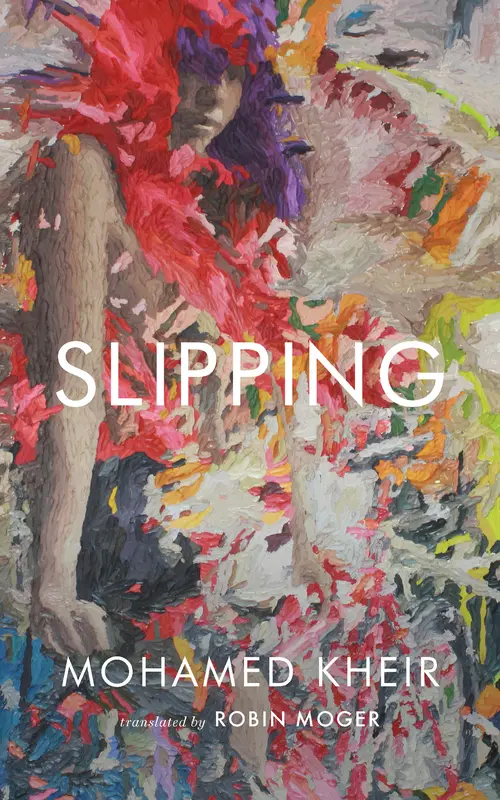
Slipping
Cover
PART ONE

WE WALKED ON WATER AND MET A STRANGER
1

HIS COMMANDS
From behind the glass the cold meat called to him, seemed to him in that moment—in the heat, midway through his fast—like a dollop of red Chantilly cream, set to melt in the mouth as soon as it was laid there. He thought he might cook it in the narrow alley outside his building, then tried to remember where he’d put the grill, and couldn’t. But when he got home there was a surprise: his mother, bustling about the kitchen between cutting boards and cooking pots. The first time she’d been in the kitchen since his father’s death.
She saw the bag of beef hanging from his hand. “Put it in the fridge,” she said wearily. “Your father said to cook duck.”
For one shaken instant Ahmed doubted his sanity. “He came to me in a dream,” his mother said simply. “He was sitting in the big chair in front of the television, wearing his Eid robe, and he tells me, ‘Let’s have a couple of ducks, Sayyida.’ I said, ‘Duck’s too rich when you’ve been fasting. It’ll give you indigestion.’ But he insisted: ‘I want ducks. They’re in season.’
“So I said, ‘Fine.’”
And his father had turned back to the television while she wept herself awake.
Then she’d gotten up, taken herself to the nearest town, collected the pensions (her pension and his), and, on the way back to the village, stopped by the window in the wall of the government store where she purchased the ducks and the ingredients she needed to cook them. Back home, she’d flipped the light switch in the kitchen and just stood there, knees trembling, in the doorway.
A whole life spent here, and now it felt as though she were a stranger to it; a newcomer.
Within minutes, though, the illusion of unfamiliarity had melted away, ceding its place to sweet and sweaty absorption in the cramped kitchen’s heat.
They broke their fast by wolfing part of the first duck, putting the rest in the fridge for later. The other duck she gave to a neighbor.
“He told you to do that, too?” Ahmed asked.
“No, no,” she said. “Raqiya’s been my rock. I promised myself she’d eat from the first meal I cooked.”
He nodded and went to his room to get some sleep before the night shift started.
Two days later he looked in on her to ask if he could get her anything, and she said, “What’s that shirt, Ahmed? Wear the blue one.”
She’d dreamed about him the night before. Him and his father. They had been laughing together and his father had taken something from his pocket and handed it to Ahmed, who’d peered down at the thing, a look of delight on his face. He had been wearing the blue shirt.
“Wear the blue, my boy,” she repeated, “God will bless your day.”
And so it was—starting the day of the ducks, some four months since his passing—that Ahmed’s father reestablished himself in the house: dictating what they ate, prodding them to visit this relative or that, sharing the location of old documents that lay hidden in drifts of loose paper and junk. And as time went on, these edicts started to touch on more serious matters. For instance, the demand—couched in the same coded language of dreams—that his son give up his night job. Ahmed was distraught at first, then settled into bitter resentment. His stomach problem, a constant companion while his father was still alive, came back. He kept expecting to see him sitting in the living room, or run into him on the way to the bathroom, and whenever he hung back from fulfilling these dream-conveyed commands, his mother would wail, “God protect you, my boy!” in a tone of genuine apprehension. And in those words, an insinuation: divine protection was entirely dependent on the father not being provoked, even in death.
The suspicion that she might be fabricating these dreams crept into his thoughts, then crystallized. Specifically, the time she interpreted a dream to mean he should stay away from a girl he was thinking of marrying, followed by another girl, soon after. Father wouldn’t care who I married, he told himself, his doubts growing. And though he lacked the courage to confront her, he had begun to think of her revelations as lies. At times, the waves of suspicion would swell and he’d be angry at her; at others, they’d settle, and the anger would turn on his father, lording over their household from the grave.
Just as he was considering leaving home altogether, his father came to him in a dream. It was the first time he had come to Ahmed: He stood mournfully at Ahmed’s bedroom door and nodded toward the room where he himself had once slept.
“Get up,” he said. “Wake your mother.”
2
THE PASSERS-BY DON’T CARE WHAT WE DO
Clouds inched across the sky as though afraid they’d spill, while down below I strained to keep up with Bahr’s short-legged but rapid clip.
In Muharram Bey, he led me down a narrow street with wide balconies beneath its windows before coming to a halt outside a huge, silent building which ran the length of a block, and there we lingered for a moment. Bahr appeared to be thinking. Then off he set again, trotting along until we came to a broad avenue aglow in the pale sunlight of early winter.
Alexandria’s aging buildings sagged into one another, yellowed and peeling. They were set back from the road on either side, and between them lay a great network of streetcar lines, crossing and recrossing like a tracery of veins. Bahr picked a path through the tracks, and cautiously I followed. I followed him over rail after rail, while he kept his gaze fixed on the ground as though trying to marry a memory to what he saw.
Suddenly, he stopped, whispered, “Here!” and tugged at me so that I was standing bolt upright, directly behind him. Then I heard it, the distant but distinctive metallic tick of streetcar wheels approaching, and as that grew louder, an identical ticking, echoing the first, started to close in from somewhere behind us.
From where I stood, looking out over the top of Bahr’s head, I could see one streetcar coming from our right, and another, its twin, running in from the left. Both were making straight for us, and my knees began to tremble involuntarily.
“Bahr?”
For a few seconds he said nothing, then:
“Shut your eyes if you want.”
But I couldn’t bring myself to shut my eyes, and once again I steeled myself to face the gathering madness of the mission ahead. The ticking grew louder and the ground trembled, flecks of gravel hopped and flew, and the approaching cars began to pick up speed. I wanted to run, but it was too late. I might lose my way amid the forest of tracks; might end up on the wrong line. I stayed put.
First to reach us was the streetcar to the right. Its ancient, dilapidated snout kinked our way ever so slightly, a deviation that brought it almost close enough to brush us as it passed, and I saw—or thought I saw—the driver on his raised stool, gazing down at us with absolute impassivity. And then the second arrived, rolling down rails that seemed only slightly set off from the tracks the first had taken, and it kinked too, a few millimeters away from us this time, and went on by, car after car looming over us, yellow as the shadows of the buildings lining the road. If we’d shifted even a centimeter we would have been run down.
We stood in a roughly circular and impossibly tiny clearing bracketed by the cars. The racket from the wheels was tremendous, Death was breathing very close, and the daylight vanished behind the roof of each passing carriage, then reappeared. And in the flickering light, I saw her: sitting at her sewing machine in a nightgown, squinting at me.
She said, “You’ve grown, Seif.” She sounded surprised.
Then she disappeared, a star winking out, and it felt as though the passing carriages would never come to an end. What if Bahr had miscalculated? What if the rails with their central jutting tooth were to shift, just a fraction? What if one—too old, perhaps, or poorly maintained—were to buckle or bend? Was this what suicides felt in the last seconds before impact? Did they see what I was seeing, or did shock claim them before the shock of steel?
And then, at last, the streetcars were gone. An “at last” that marked the end of no more than a few seconds, but even so I patted at my hair, perhaps to feel whether the patch of rougher gray had spread. But Bahr seemed invigorated. “The safe point,” as he called it, pointing to a page in his notebook, still existed. Was it the product of pure chance, or had some engineer put it there on purpose, as some kind of secret game? And who had first discovered it?
Before I could ask, Bahr laid his hand on my shoulder and nodded toward the place where we’d been standing, where the two lines parted and rejoined. He gave me a wink and asked, “Did you see anything, Seif?” Still pale, I stayed silent, so he asked again, his smile widening:
“ Who was it?”
My voice was a whisper, “My mother.”
He stared at me blankly for a second, then nodded slowly. His expression seemed to reflect a trace of disappointment and he opened his mouth as though to speak before seeming to reconsider. At last, lips thin, he muttered, “Typical!”
Still stunned, I didn’t reply. Just looked at him: the neat gray hair, the odd red glasses, the vigor I attributed to a life spent out of doors. Nothing at all like a man who would be gone within a month. Not that I knew that then, though I can’t now summon the memory without the fact of his absence surfacing through it.
Between dream and waking is where I see us, forever standing beneath that soft sunlight in Muharram Bey, my tongue too heavy to warn him.
3
WHERE WERE YOU, ALI?
The first thing he knew was that a great black rock was resting its full weight on his chest and head, and for a moment he assumed, as was usually the case in his nightmares, that he had died. For the briefest fraction of a second he thought it must be the sleep paralysis, which held his body in its grip whenever he went to bed too tired, but when he tried to wiggle his finger the tip responded, and so did his elbow when he tried to flex it, then his whole arm moved, and then he summoned his courage and cracked open a lid. A dazzle of sunlight. A scatter of flies hanging mid-air. Turning his head, he saw that he was lying in the dirt surrounded by garbage. A dump perhaps? He appeared to be lying in a shallow trench, scraped a few centimeters deep into the packed earth. Pain at the back of his head and in his joints. His chest was tight.
The ground beneath him began shaking and then there was a furious clanging as if of church bells, a sound which resolved itself into a train’s bell, the next instant supplanted by the din of a horn blaring at a tremendous pitch and drawing closer and more powerful every second. Seized with terror, he shut his eyes but then opened them again to see a train’s hulking mass rush by very close to his right, its horn battering his ears, and then, before his heartbeat could return to normal, the train was away into the distance, then gone. He pushed himself up from the ground and stood.
He looked around and saw no one. Some way off, the indistinct form of a bird dipped low to the ground then rose up and flapped away.
Where am I, and what now?
With a little effort he managed to remember his name, and checking himself all over he found no wounds, despite the pain. Another look around. Nothing but distant rooftops and the snaking tracks. Then, blossoming inside him without warning, a thought: Noha! What’s happened to her?
Then he remembered. Remembered everything but the one thing he needed to remember.
He had just finished trimming his hair and shaving over at his friend’s apartment. His family was at home, waiting for him, and Noha’s family was at her place, also waiting for him. He was due to go over to her place with his family, pick her up from the hair salon on the ground floor of her apartment building, then head over to the wedding venue, thus bringing an end to a journey of patience and longing and exhaustion and—for her—of terror. He wouldn’t leave her, would he? A thought she’d brooded over daily and which had made him laugh to hear, because his heart had been hers from the moment they met.
He’d left his friend and taken a shortcut home, where he put on the suit another friend had sold to him at a discount. Joy was nearly in his grasp; joy, or at any rate, relief.
Among the last things he remembered seeing: children running with metal hoops; a pickup being loaded from a small bar; a pair of young women walking together; another woman watering her plants on a balcony overhead and the water dripping to the ground.
He had gone around the back of the gray building on the corner of Awqaf Street, down a narrow lane without doors or windows, emerged on the far side, and turned right, starting to lengthen his stride. He had thought that he’d heard a woman’s voice calling out, but turning to look had seen only darkness.
Where are you, Ali? What time is it? There was his watch on his right wrist, miraculously unstolen. It was when he looked at it that the terror found him. Twelve-thirty, and the hot sun overhead told him that it was half-past noon, not midnight.
You left your friend’s apartment at five in the evening. A night’s gone by, Ali. A whole night has passed and left you here, in day. The watch must be right: the sun, and you’re famished. A whole night. Noha waiting for you, surrounded by her family. A whole night and you never came.
God!
He could feel his cellphone in his pocket and he took it out. It was off. When he tried switching it on, nothing happened—so thoroughly dead it might never have been charged at all—and inside he felt a new fear rise up that he quickly suppressed. He searched his pockets. Here was his wallet, his identity card. Everything where it should be, so what had happened? What am I doing here? He looked around. Where is here, anyway?
And where is everybody else? The question suggested itself because the buildings, which he had now reached, appeared to be completely empty, even of ghosts. Walking slowly, he saw not a single human being, young or old or in-between, and as he made his way between the buildings he started at the sound of doors clapping in the breeze. Building after building with nothing to hear, nothing to see.
Had the world come to an end?
But then he remembered the train.
Wandering along something resembling a highway, he spotted a sign lying on the ground and caked in dirt. He wiped the dust from the letters with his shoe and read the name of a place he’d never heard of. He kept walking. He sighed with relief when the first truck went by. But no one stopped for him and so on he went until, up ahead, he saw the outskirts of another town.
He felt better when he saw a child playing on the doorstep of a house, and then people began to appear, singly and in small groups, on foot and in vehicles. He still had no idea where he was. He became conscious of the fact that his clothes and face were covered with dirt, and he paused to brush it off.
There was a woman selling vegetables from a stall. He walked up to her, right up to the face behind its niqab, but then kept walking. He was afraid to tell anyone he was lost. They might take advantage of him. They might be suspicious.
He found a little coffee shop with a cart set up outside selling chopped liver, so he bought a couple of sandwiches and sat down. The man from the coffee shop brought him a glass of water, then a glass of tea, and the tiny television was on, so Ali shifted his chair closer to see what he could see, to try and understand what was going on, but the news reports told him nothing. Then he saw the date and realized that it was Sunday, and the legs that had carried him from his friend’s place on Thursday evening began to shake.
He’d lost three days, not one. What was happening? What had happened to him? To the world? Noha?
Later, he would hear everything. He would hear about the faintings and nervous breakdowns, the fury that raged through her household, about the humiliations and insults endured by his family. He would be told about the hours spent waiting in the apartments and at the venue, about the departure, first of the maazoun, then of the guests. About the shock of friends, the fretting of relatives. He would learn that they had disappeared, Noha and her family, the family apartment shut up and abandoned. He would meet his mother’s tears, his father’s silence, the deluge of his siblings’ questions and their demands for answers—some explanation for those three days gone. And it would seem to him then that the whole world had been reduced to just those four words: Where were you, Ali?
Not a cut or a bruise anywhere on his body. Nothing stolen. All the time he’d been gone, no stranger had come around demanding a ransom; there’d been no menacing calls. Something had happened to him. If it had killed him, it would at least have left his dignity intact. But nothing had happened to him. He’d emerged from an alley, heard a woman’s voice, and then come to on a patch of packed earth somewhere between Cairo and Alexandria. Then he had gone home: materializing on the corner of his street like a djinn, like a premonition of disaster.
And they had returned, dizzy from their rounds of the hospitals and clinics and police stations and homes of friends and acquaintances, to find the missing man in perfect health: not a scratch on him, and nothing to soothe their anger.
4
WE WALKED ON WATER AND MET A STRANGER
Where the corniche wall ran out, a great tree hooped over to drink from the river. Beyond the tree there was nothing: nothing between us and the water.
We walked by the light of the stars, to our left a scattering of buildings, silent as though abandoned and none more than two stories high. There was the soft howling of dogs in the distance, and the rustle of small things, some living, from the ground. All of a sudden, Bahr halted and pulled me to one side, right to the lip of the riverbank. For a moment it was as if he wanted me to leap into the Nile, but then I saw a flight of stone steps in the starlight, appearing as if from nowhere: narrow, running from the embankment where we stood down to the water’s surface, to where there was no jetty, no boat, no hut, nothing: as though inviting us under.
Without saying a word, Bahr cautiously began his descent and I followed. When he came to the second to last step, just before he reached the water, he sat down. I took the step above him, and we leaned back against the wall. Bahr said, “It was against a wall like this, on steps like these, that I kissed a girl for the first time.”
I listened, waiting for him to go on, but he was done. In that silence it felt as though the stars were humming for us, lullabying, soothing us to sleep.
Out in the heart of the river’s darkness there was a movement, and we sat up, suddenly alert. Then, to our astonishment—or at least, to mine—we saw him: a man coming across the river, walking on water. Bahr got to his feet. “Now,” he said, placing his feet on the final step so the water lapped at his shoes. Then he stooped and slipped them off and, without turning around, told me, “Take off your shoes, Seif.”
My quaking heart.
The man drew closer. He was wearing a robe with the hem held up over his knees and, like Bahr, seemed to be holding shoes or slippers in one hand. He stepped carefully, and I could see that with each step the water just covered the round of his heel.
The Story Continues on BooksBarbecue!
Enjoyed this preview? ❤️ Do not stop here!
Read the complete book free online → 🔗
Continue reading now on BooksBarbecue and discover every page!
Love reading? Bookmark BooksBarbecue.com for more amazing books!
Happy Reading!