Silent Disco


Playwright’s Biography
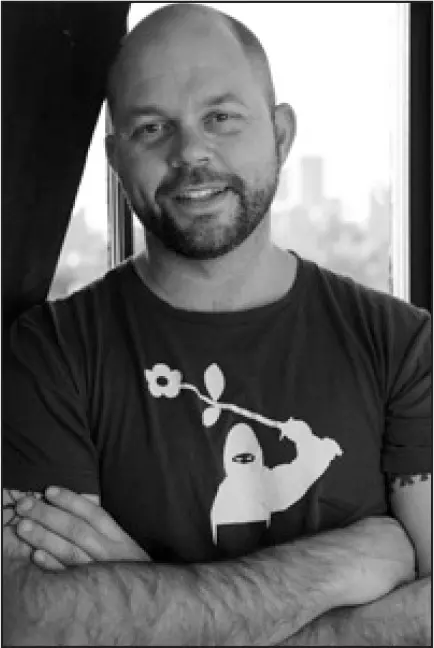
LACHLAN PHILPOTT is a theatre writer, director and teacher. He graduated from UNSW (BA Hons Theatre and Film), The Victorian College of the Arts (Post-Grad Dip, Directing Theatre) and NIDA Playwrights’ Studio. He was Artistic Director of Tantrum Theatre in Newcastle, writer-in-residence at Red Stitch in Melbourne and the Literary Associate at ATYP.
His plays have been performed across Australia as well as Ireland, the UK and USA. His plays include Air Torture, Bustown, Bison, Catapult, Colder, Due Monday, Running Under the Sprinkler and Truck Stop.
Lachlan’s play, Silent Disco, won the 2009 Griffin Award and the Stage Award at the 45th annual AWGIE Awards in 2012.
For Penny
who read to me
INTRODUCTION
The first draft I read of Lachlan Philpott’s Silent Disco was back in October 2008. At that time I was working as Producer, Young Audiences at Sydney Opera House. On first reading, the characters and the suburban landscape leapt from the page with immediacy and authenticity, and although at that time the House was not in a position to commission a subsequent draft, Lachlan and I spent the next year in dialogue—working together on the play at Playwriting Australia’s National Playwriting Workshop and quickly putting together a rehearsed reading with actors for an audience of school students at Sydney Girls’ High School. The young audience gave the play a resounding thumbs-up and afterwards we engaged in a lively discussion interrogating the moral compass of the play’s protagonists. Over time the text changed—Lachlan is never one to do massive rewrites after hearing the play read once or even multiple times over one week. Hearing the play read with the right voices is always crucial—never more so than here, with such demanding, rapid narration.
From the beginning Lachlan’s writing style was prominent. As Alyson Campbell observes in the introduction to Bison and Colder, Lachlan doesn’t rely on dialogue as the main element of his dramaturgy but more interestingly adopts ‘a range of linguistic devices to create a world that is both external and internal to its characters… particularly, a “scene-setting” narrative voice that often does not belong to a character, or voice their internal thoughts, but creates the atmosphere around characters’. Although this latter device is shared between characters in Silent Disco, it is the central voice of schoolgirl Tamara Brewster that frequently comments on, and in turn brings alive, the classroom atmosphere, as in this wonderful response to teacher Helen Petchall’s question on the importance of having an opinion and being able to express it:
Yawn/
…
Mexican yawn/
…
Mexican yawn flying round the shit box. (p.7)
The classroom environment of Lachlan’s Silent Disco is a world of boredom. Disengaged students look for any kind of distraction rather than engage in the here and now. It is a world peopled with long-suffering teachers who are constantly waiting; waiting for the attention of the classroom, for students to answer their questions, for the drone of the aeroplane flying overhead to pass, or for the bell signalling the end of another period. There is tedium and pointlessness to the events that occur within the walls of the classroom on a day-to-day basis; student after student passes through these four walls and, like Helen Petchall, we question what becomes of them.
Lachlan manages to capture this world directly and authentically—as an ex-teacher himself he has been there and knows the terrain only too well. He knows implicitly what Petchall faces each day—in particular, the never-ending battle to attract attention over an iPod. It is a confrontation with a generation that tunes out and retreats into its own pulsating soundtrack with a tiny piece of technology that allows them to remove themselves from the immediacy of their own experience. Confiscation becomes a tug of war, as the dreaded iPod is tucked under collars and hidden in hair, providing relief from the discussion of S.E. Hinton’s The Outsiders, unbelievably the same text that was taught in my high school in the 1970s.
The microcosm of the classroom and interaction between students and their teachers is a world where nothing ever changes, but everything changes. Lachlan’s analysis and reflection on this intensely structured world highlights its incredible impact over the shaping of all of our lives. Through Petchall’s frame, we consider the position of the teacher in this world. We wonder at the endless stream of students who have passed through the doors and disappeared without notice, leaving behind assignments uncollected and ambitions never realised. Through her we learn of the strange behavioural codes around students coming to the staffroom, career expo travesties, teacher conferences on how to keep challenging students in the classroom and staff meetings where bitter and angry teachers want to punish students by cancelling the school formal, potentially the only bright spot on an otherwise drab year.
With dry theatrical humour Lachlan also takes us into the lives of ex-students, through the droll character of Dezzie in her checkout job at GOLO. This hysterical scene provides a glimpse into the lives of students who have dropped out and whose most exciting years are possibly already behind them; who stare in wonder as they encounter ex-teachers as customers with children—‘Looks like he hates her’ (p.31)—and are forced to consider that teachers may have some life outside school. Lachlan’s informed observation is a damning indictment of so many state high schools staffed by teachers who ‘never grow up because they never leave school so they never get a chance to go out into the real world’ (p.59). Petchall at least represents teachers working within the system who care for their students—even if they are in danger of burnout.
Into this place of inertia and aimlessness comes a voice of remarkable energy, pace and rhythm: fifteen-year-old Tamara. Tamara is the student lurking at the back of many classrooms that shows some glimmer of potential, of talent; a writer in the making. She is also a smart-arse, quick-witted, with an incredible acerbic tongue. As the playground erupts into lockdown-drill chaos, Tamara wryly comments:
one girl looks like she is fuckin’ shitting her sports daks (p.10)
Tamara observes the world around her and narrates it to us with rich detail and texture. At the same time we are acutely aware that she is only fifteen, and from the opening scene, that she is ‘Three weeks, six days, seven hours’ (p.3) into her first relationship—with Jasyn Donovan, aka ‘Squid’. It is a relationship for which they have no positive role models, nor any guidance. Both mothers have shot through. Squid’s follows random men around the country and Tamara’s has left to start again with a new man of means. Over the course of the play we witness the inevitable destruction of this doomed first love. As appalling as it is, it feels inevitable, like a distant slow-motion car crash that we can neither prevent nor look away from. Lachlan masterfully divides the sympathies of the audience. Is any one person really to blame? Can one expect more or better for these young characters?
The first draft did not include the climatic classroom confrontation between Squid and Tamara. It was referred to but never seen. I felt as an audience we were being cheated of a great dramatic moment. I wanted to see Squid attacking Tamara about her devastating betrayal. With only a few references to what had occurred, Lachlan and I set up an improvisation with a group of gun actors to test whether our instincts for its inclusion were correct. In the highlight of our workshop we asked the actors to play out this moment. The public humiliation of Tamara in front of her class, having to accept her awful act of betrayal, is nothing less than tragic. What I didn’t expect, and something which the actors so wonderfully evoked, was the sadness and vulnerability surrounding Squid. Devastated by Tamara’s act he responds in the only way he knows how―by lashing out. The place of a teacher in this environment was also something of a revelation. Petchall also confronts the reality of Tamara’s flawed character whilst trying to protect her and Squid from the consequences of his actions. Our sympathies are tugged in three ways and we are left gasping.
It is a credit to Lachlan that he managed to recreate so clearly the words, atmosphere and complex character motivations that played out in this improvisation and translate them into a succinct passage of text. But of course he had led the actors to this point with such well-crafted characters that in some ways it was obvious what was going to occur. Not to detract from Lachlan’s ability, there is something so direct and powerful in, ‘She’s just a dumb slut who fucked your brother’ (p.67) shockingly delivered from the mouth of a teacher, that one wonders if it could only be discovered through improvisation.
I concur with Alyson Campbell’s statement that, ‘Philpott’s plays are connected by themes of love and loneliness, pierced with the idea that we can’t know anyone fully and that, in the end, we are always alone’. Both Squid and Tamara ‘try to do things right but they fuck up anyway’. Tamara’s father, Laurence, is one of the play’s most isolated and lonely characters. His wife, wanting more, has left him for Johan and ‘her second-chance kids’. At first we have little sympathy for him. His racist slurs in front of Jasyn are cringeable and his lack of parental care for Tamara borders on neglect. We therefore don’t judge Tamara’s, ‘Cragged-up old faggot. Hate him. What chance he give me?’ (p.36), in fact we almost rally with her against him. However Lachlan’s characters are always multi-faceted. The revelation of Laurence’s HIV status changes the course of the play and the characters’ behaviours. On one level it is a subtle commentary on the continuing presence of this disease in our society and on another, an exploration of the sexual identity of a man and father now perhaps exploring his options post-separation. The nurse’s announcement to Tamara is as dreadful to her as it is to us. Who is this man? Did she ever know him? Tamara’s ridiculous fear of catching the disease whilst living with her father reflect a society that should know better after thirty years, yet still demonstrates both ignorance and bigotry. The fact that Laurence’s true sexual identity is never fully analysed or revealed is appropriate. As in his earlier play, Bison, Lachlan reminds us of the ongoing presence of HIV-AIDS in all our lives.
Ironically, the scene from which the play takes its title is the one genuine moment of connection between its lead characters. Dancing silently in a carnival tent, hooked up to iPods, Tamara and Squid experience one pure moment of happiness. Dancing face to face, listening to music selected by the other, separate and at the same time intensely together, it is a moment of sheer theatrical beauty:
We face each other in the silent disco.
I look at your eyes—your tough eyes aren’t tough aren’t hard they’re smiling. Right there and then—everything else blown away—just you and me Squid.
You so close I feel you breathe. We’ve never danced like this before.
You reach out and pull me closer to you. The way you pull me in—makes me feel like I’m the best thing in the world. (p.62)
Finally, I return to a recurring line from the play, ‘wonder how I’ll remember this’. Whether it be through pop songs, items of clothing, smells, books, a look or even a tattoo, the characters in Silent Disco let us know that regardless of the boredom, they understand the importance of this time in their lives, and that they will always remember it. This gently-woven theme of memory elevates the drama and invites us all to consider the course of our own lives. What more could one ask of any play?
Noel Jordan
February 2011
Noel Jordan has extensive experience as an educator, director and producer utilising his particular area of expertise in theatre for children and young people.
ACKNOWLEDGEMENTS
Silent Disco has been developed with the support of The Aurora Theatre Company, Australian Theatre for Young People (atyp), Griffin Theatre Company and Playwriting Australia. Thanks to each of these companies and to the artists who to have contributed to the development of this play. I would also like to make special acknowledgement to Alastair McKinnon for his encouragement, belief and support.
THANKS
Mark Adnum, Joshua Barnes, Jane Bodie, Wendy Buswell, Alyson Campbell, Elena Carapetis, Fraser Corfield, Katrina Douglas, Susannah Dowling, Eamon Farren, Kate Gaul, Tanika Gupta, Josh Hecht, Laura Hopkinson, Adele Jeffreys, Gary Jones and David Smith from Smith and Jones Management, Noel Jordan, Belinda Kelly, Ian Lawson, Lee Lewis, Nick Marchand, Michael Minten, Chris Mead, Luke Mullins, Penny Philpott, Jenny Rohr, Graham Matthew Smith, Jonathon Spector, Sam Strong, Elizabeth Surbey and Ben White.
FIRST PRODUCTION
Silent Disco was first produced by Griffin Theatre Company, atyp and HotHouse Theatre at the SBW Stables Theatre, Sydney, on 27 April 2011 with the following cast:
| PETCHALL / DEZZIE / LEANNE / AUNTY | Camilla Ah Kin |
| TAMARA | Sophie Hensser |
| DANE / LAURENCE / TEACHER | Kirk Page |
| SQUID | Meyne Wyatt |
Director, Lee Lewis
Designer, Justin Nardella
Lighting Designer, Ross Graham
Sound Designer / Composer, Stefan Gregory
Production Manager, Glenn Dulihanty
CHARACTERS
TAMARA BREWSTER
JASYN (SQUID) DONOVAN
DANE DONOVAN
HELEN PETCHALL
LAURENCE BREWSTER
TEACHER
DEZZIE
LEANNE
AUNTY
CASTING NOTE
The actor who plays Dane can also play Laurence and Teacher.
The actor who plays Helen can also play Dezzie, Leanne and Aunty.
If actors double in this manner they will render the voice of these extra roles rather than attempting to embody them.
TEXT NOTE
/ indicates a point of interruption and/or overlap
SQUID/TAMARA indicates lines to be said simultaneously, with
assignment of lines to correspond to placement of character’s name
… indicates an unfinished sentence
[ ] bracketed words for actor’s information, not delivery
STAGING NOTE: SOUND
Audience to be provided with earphones which deliver a soundtrack more bearable than traffic, planes and school bells as well as the perfect song for dancing—so perfect it annihilates anything else you can hear, making you, even for the shortest time, dance with love in your head and your heart and your eyes. And in your pants.
ACT ONE
Around nine a.m., TAMARA waits in an inner-city laneway. She listens to music on her earphones, seems transported to another place. She is meant to be in Petchall’s classroom.
SQUID arrives.
TAMARA: You took your time. Ya bring ya paint?
SQUID: Yeah.
TAMARA: Red?
SQUID: Yeah.
TAMARA: Good. Clash with her house. Teach her a lesson.
SQUID: What did she do?
TAMARA: Told ya. She rang the school ’n’ dobbed on us for jigging.
This’ll shut her up.
Do it. Like I said. Come on.
SQUID: Keep watch.
SQUID begins spraying ‘DOG POUND’ on the fence.
TAMARA: I am. Hurry up.
See her face when she comes out and finds this on her precious pink cement.
Don’t spell it wrong.
Concentrate! Finish it. Go on.
Fuck!
SQUID: What?
TAMARA: She’s in there.
SQUID: She’s not.
TAMARA: Blinds moved in the front window.
SQUID ducks down, hides.
A bell rings in the distance.
Got ya.
PETCHALL: Move in quietly. You all know the rules, so show some manners.
Get them out of your ears. Now. Out. Earphones out.
How many times have I said this to you all?
I can still hear one. I’m waiting.
One.
Two.
Three/
TAMARA: Hurry up, you sped.
SQUID: Done. We going?
TAMARA: Get a pic first. Hold up your can/
SQUID: No.
TAMARA takes a photograph of SQUID with her phone.
PETCHALL: Silence. Just enjoy that for a moment.
TAMARA: Took it anyway.
SQUID: Delete it.
PETCHALL: Enjoy that quiet.
SQUID: We going or what?
PETCHALL: Honestly your ears’ll turn to/
SQUID: What are you looking at me like that for? Going to class. Delete that pic or I’m dead.
SQUID leaves.
PETCHALL: If I see an earphone I will snip it. If any iPods make their way out, I will confiscate them.
I don’t care about your rights or what your parents say.
A plane passes above.
TAMARA: Didn’t think much of him at first looks a bit mean not like other guys I like bit mean tough but hot but something wrong something going on inside his head seeping out something strange not sick but weird then one day I see him and he looks different something nicer—dunno maybe he’s just looking up ’stead of looking down. He smiles. That’s what it is. He smiles at me.
SQUID returns.
SQUID: Rowney’s at the end of the lane.
TAMARA: Late notes?
SQUID: Giving shit about uniforms.
TAMARA: Did he see you?
SQUID: Na.
TAMARA: Then/
SQUID: Might come down here.
TAMARA: Rowney?
SQUID: I’ll go the other way.
TAMARA: Past the shop? Get me a Coke?
Your shout?
SQUID: Na.
TAMARA: Go on. You’re my boyfriend.
SQUID: No.
TAMARA: Three weeks, six days, seven hours.
SQUID: Not this again.
TAMARA: It matters.
SQUID: Matters to you.
SQUID smokes.
TAMARA: Matters to you too, just don’t know how to say nothing.
You shouldn’t smoke, not if you play footy, how you gonna run? Give us one.
SQUID: Can we get out of here?
TAMARA: What were you smiling at before?
SQUID: Smiling?
TAMARA: Yeah, coming back up the lane.
SQUID: Wasn’t smiling.
TAMARA: You were. Whatever.
Did ya win yesterday, Jasyn?
SQUID: No. Ref was shit.
TAMARA: Good excuse. School team sucks—bunch of weeds.
SQUID: Used to be good.
TAMARA: Yeah? When?
SQUID: Couple of years back. Before everyone left. My brother/
TAMARA: You don’t talk about him much.
I knew him.
SQUID: He’s not dead.
TAMARA: Know him then. Dane.
He looks like Sonny Bill Williams.
SQUID: Sonny Bill’s a fag.
TAMARA: He still looks like your brother.
SQUID: He’s a fucking Islander.
TAMARA: So?
SQUID: How you know Dane?
TAMARA: Seen him round. Out after footy. Not school footy. Proper footy on the weekend.
He’s hot. Better than you.
SQUID: You reckon?
TAMARA: Yeah.
SQUID: Thanks.
PETCHALL: Shaniqua… Dmitri… Jessica C…
TAMARA: No worries.
PETCHALL: Jessica F…
TAMARA: You visit Dane in jail?
PETCHALL: Jessica L…
SQUID: Yeah. No. Not allowed to without adult supervision.
TAMARA: Like a nightclub or something.
PETCHALL: Jessica P… oh sorry Jess.
SQUID: He didn’t deal drugs.
TAMARA: No? He took them. Everyone said. That story about him and that footy slag after the grand final. That true?
SQUID: Wasn’t there.
TAMARA: Yeah? Gotta be dumb to touch that shit. See what it does to people.
PETCHALL: Who’s still missing then? Tamara Brewster? Tamara here?
SQUID: Delete the pic.
TAMARA: Make me.
In a playful way, he does.
Between the bins in jiggers’ lane things go still between us. We lean on bricks look at each other and something happens like in a movie.
Like what happened when we were alone together for the first time.
The traffic on the city bypass hushes.
We look at each other—into each other’s…
[To SQUID] You’ve got something on your mouth. Not there, there.
SQUID: Is it gone?
Can I kiss you?
TAMARA: Na.
They kiss.
PETCHALL: The AWOLs, the missing, the late ones, let’s hope they turn up.
SQUID: You talk too much.
TAMARA: Three weeks, six days.
PETCHALL: Jasyn?/
SQUID: Of nonstop talk.
PETCHALL: Jasyn Donovan? Here?
SQUID: Can’t believe you count.
TAMARA: It’s ’cause I can.
Know how many days until the formal?
SQUID: Na.
TAMARA: Seventy-nine.
SQUID: Yeah right.
TAMARA: Hey Squid—thanks.
SQUID: For what?
TAMARA: Messing up the doghouse. Looks sick.
Go get me a Coke.
Zero. See you in class.
A bell rings.

TAMARA: English Six don’t matter/ I’m late.
PETCHALL: You’re late, Tamara.
TAMARA: No Miss, yes Miss.
She stands there in front of them all.
All of them in the same thing—blue shit ’cept/
PETCHALL: Where’s your uniform today, Tamara?
TAMARA: Wearing it, Miss.
PETCHALL: That’s what you call that, is it?
The Story Continues on BooksBarbecue!
Enjoyed this preview? ❤️ Do not stop here!
Read the complete book free online → 🔗
Continue reading now on BooksBarbecue and discover every page!
Love reading? Bookmark BooksBarbecue.com for more amazing books!
Happy Reading!