Season of Storms
Chapters (33)
- Cover
- Season of Storms
- CHAPTER ONE
- INTERLUDE
- CHAPTER TWO
- CHAPTER THREE
- CHAPTER FOUR
- CHAPTER FIVE
- CHAPTER SIX
- CHAPTER SEVEN
- CHAPTER EIGHT
- INTERLUDE
- INTERLUDE
- INTERLUDE
- CHAPTER NINE
- CHAPTER TEN
- CHAPTER ELEVEN
- INTERLUDE
- CHAPTER TWELVE
- CHAPTER THIRTEEN
- CHAPTER FOURTEEN
- INTERLUDE
- CHAPTER FIFTEEN
- INTERLUDE
- INTERLUDE
- CHAPTER SIXTEEN
- INTERLUDE
- CHAPTER SEVENTEEN
- CHAPTER EIGHTEEN
- CHAPTER NINETEEN
- INTERLUDE
- CHAPTER TWENTY
- EPILOGUE
Cover
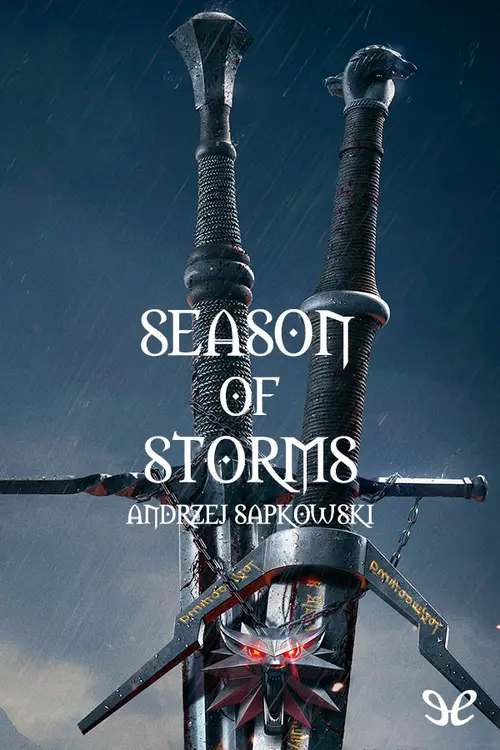
Geralt of Rivia is a Witcher, one of the few capable of hunting the monsters that prey on humanity. A mutant who is tasked with killing unnatural beings. He uses magical signs, potions, and the pride of every Witcher - two swords, steel and silver.
But a contract has gone wrong, and Geralt finds himself without his signature weapons. Now he needs them back, because sorcerers are scheming, and across the world clouds are gathering.
The season of storms is coming…

Andrzej Sapkowski
Season of Storms
The Wichter - 1.5
ePub r1.0
Watcher 23-05-2018
Original title: Sezon burz
Andrzej Sapkowski, 2013
Translation: David French
Cover design: Watcher
Digital editor: Watcher
ePub base r1.2

Battle not with monsters, lest ye become a monster; for if you gaze into the abyss, the abyss gazes back into you.
Friedrich Nietzsche, Beyond Good and Evil
I consider gazing into the abyss utter foolishness. There are many things in the world much more worth gazing into.
Dandelion, Half a Century of Poetry
CHAPTER ONE
It lived only to kill.
It was lying on the sun-warmed sand.
It could sense the vibrations being transmitted through its hair-like feelers and bristles. Though the vibrations were still far off, the idr could feel them distinctly and precisely; it was thus able to determine not only its quarry’s direction and speed of movement, but also its weight. As with most similar predators, the weight of the prey was of cardinal importance. Stalking, attacking and giving chase meant a loss of energy that had to be compensated by the calorific value of its food. Most predators similar to the idr would quit their attack if their prey was too small. But not the idr. The idr didn’t exist to eat and sustain the species. It hadn’t been created for that.
It lived to kill.
Moving its limbs cautiously, it exited the hollow, crawled over a rotten tree trunk, covered the clearing in three bounds, plunged into the fern-covered undergrowth and melted into the thicket. It moved swiftly and noiselessly, now running, now leaping like a huge grasshopper.
It sank into the thicket and pressed the segmented carapace of its abdomen to the ground. The vibrations in the ground became more and more distinct. The impulses from the idr’s feelers and bristles formed themselves into an image. Into a plan. The idr now knew where to approach its victim from, where to cross its path, how to force it to flee, how to swoop on it from behind with a great leap, from what height to strike and lacerate with its razor-sharp mandibles. Within it the vibrations and impulses were already arousing the joy it would experience when its victim started struggling under its weight, arousing the euphoria that the taste of hot blood would induce in it. The ecstasy it would feel when the air was rent by a scream of pain. It trembled slightly, opening and closing its pincers and pedipalps.