Scary Monsters
COVER - LILY
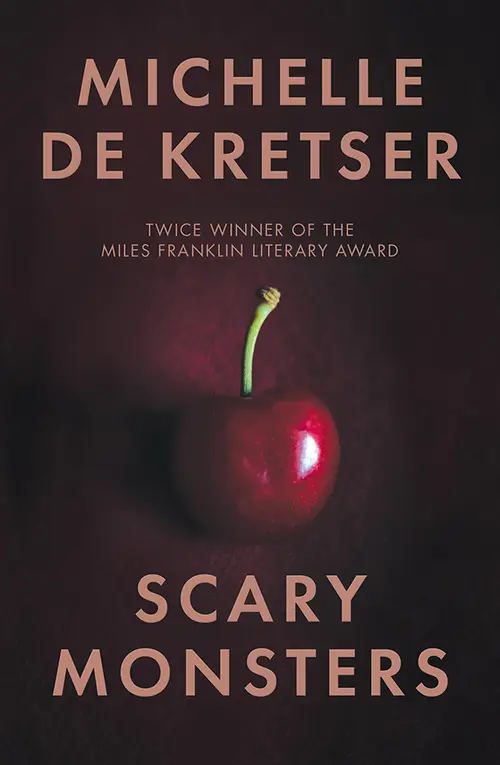
ABOUT THE AUTHOR
Michelle de Kretser was born in Sri Lanka and lives in Sydney. Her fiction has attracted numerous awards. She is an honorary associate of the English Department at the University of Sydney, and Scary Monsters is her sixth novel.
The state is the coldest of all cold monsters.
Nietzsche
How does it feel to be a problem?
W.E.B. Du Bois
WHO DECIDES HOW TO READ A NOVEL?
This one can be read in two ways and this e-book provides you with both. In one version, LILI precedes LYLE. In the other, LYLE precedes LILI.
Their stories are the same in both versions, just in a different order.
The choice is yours.


LILI

That was the year we went to Sardinia to meet John Berger’s mistress. The night train travelling along the Côte d’Azur was packed. The heating in our compartment was fierce, so Minna and I took turns to stand in the corridor, where the windows opened, and blocks of raw spring air moved in. People were sprawled there, most of them teenage soldiers with freshly shaved heads. It was necessary to step over their kitbags, and there was grumbling about that. The soldiers spoke louder than was required and shoved one another. I remember the impatience in their faces. One of them was a stocky Corsican – the others called him Bonaparte with good-natured jeers.
The train was running late, with long, mysterious halts between stations. Back in our seats, Minna and I shared a packet of chocolate-coated shortbread, leaning forward to pass it to and fro. Later, thick with sleep, I stumbled over someone’s legs and went out into the corridor. The soldiers were playing dice like soldiers from the Bible, and the toilet was foul.
The Corsican asked if I knew the red chestnut beer brewed in his village. He was offering me a cigarette when the train dragged to a stop. The window showed a Meccano city, its towers and cubes lit by big golden stars; a different soldier explained that it was an oil refinery. Napoleon said that to understand a man you had to know what the world looked like when he was twenty. I was twenty-two and Minna was twenty and it was 1981.

At the time of that trip, I’d been teaching at a high school in Montpellier for seven months. There were three assistants at the Lycée Jean Moulin: Felipe, Dieter and me. Like hundreds of other foreigners we were employed by the French government to help with the teaching of our native tongues. Dieter and I had contracts that ran from September 1980 to the end of the following May, but Felipe had been an assistant for longer than I’d been alive. In the last weeks of the Spanish Civil War, aged seventeen, he’d fled over the Pyrenees to France. Fascists, finding him gone, threw his sister down a well. Felipe could be observed in the staffroom drinking sour machine coffee with other old men. I was told that he had seven children. Someone else said five – the truth could have been one or none. Wanton procreation was expected of the Spanish, entrenched in French opinion as a backward, priest-ridden race.
The lycée put me up in its boarding house for the first few weeks of teaching, while I looked for somewhere to live. In accordance with the instructions I’d received in Sydney, I’d arrived in Montpellier a week into September. French students had snapped up all the cheap furnished places by then. At the tourist office, the clerk in charge of rentals couldn’t believe it: turning up after classes had resumed and expecting to find accommodation! He placed his palms on the counter and leaned forward to assess me, tossing up whether to despise a foreigner or take pity on a fool.
Dieter threw a party soon after we met. He lived in a hushed, Haussmann-style building with a slate roof. There was a lift in an iron cage, and a marble staircase whose lower steps flared. I took the stairs to the second floor, where one of the double doors to an apartment was open. Dieter’s mother was French, and the apartment belonged to a distant cousin. This cousin had married a diplomat, who was presently stationed in Amman. Their entrance hall was furnished with locked, glass-fronted cabinets that held Middle Eastern antiquities: clay tablets, unglazed figurines and small bowls. A girl in tartan dungarees with brassy pigtails was looking them over. The first thing Minna ever said to me was, ‘Pillage, obviously. I bet they got them out in a diplomatic bag.’ Her English voice was quiet and fierce. She said, ‘Have you seen the paintings? Through here.’ In the living room there were the Sex Pistols and tortured gilt chairs. Minna turned her back on three canvases: ‘Imagine having the money to buy Arcimboldos and buying Arcimboldos.’ She lit a cigarette, and I noticed that she bit her nails.
Johnny Rotten yelled that he didn’t know what he wanted but he knew how to get it. Dieter blew me a kiss and carried on talking to a boy with the small, sleek head of a dancer. Minna told me that she was an artist. She said that there were several assistant language teachers at the party, and led me to one of them, her boyfriend, Nick. He was talking to Deb, another assistante, who was teaching at a different school. Like me, Deb was looking for somewhere to live, but Minna and Nick had an apartment in the old town, le centre historique. They’d signed the lease in June, and spent the summer working in Toulon. Nick had a dark tan and very light blue eyes – a combination I found both creepy and sexy. He spoke kindly to Deb and me: ‘Look, you can’t leave finding a place until September. You have to know how to manage these things.’
Madame Bisset, the head of English at my lycée, had a room for rent in her house. She showed it to me one day. It was warm and bright and the head of a deer glared from one wall. The Bissets’ son had shot it to celebrate his divorce. Madame Bisset drew my attention to a hotplate: ‘You see, this is perfect for your omelette.’ Her house was a short walk from the school, which meant it was a long way from the centre of town, and the buses stopped running at eight.
In the jetlagged hours I’d spent in Paris before catching a train south, I bought a postcard of a Willy Ronis photo. It showed a naked woman washing herself at a basin, a ewer beside her on the flagstone floor. A window set deep in a wall stood open; it had no pane, only a shutter made of vertical planks. I had the boring version of Johnny Rotten’s problem: I knew what I wanted but I didn’t know how to get it. I wanted to live in le centre historique. What was leaving Australia for France if not a wish to live in le centre historique? At Dieter’s party, I said what I feared: ‘I might have to take the Bissets’ room.’
We were eating pretzels and drinking wine. The others, being English, had spent holidays and school exchanges in France. I heard that it was impossible to find decent potato crisps except in the Marks & Spencer in Paris. Deb pointed out that ‘crisp’ was a really super word because the French couldn’t say it. ‘You go around the class and they get their tongues in such a twist. It’s really sweet. You get through a good fifteen minutes that way.’
‘Jelly’s useful as well,’ said Nick. ‘You ask who’s been to England, and how they liked the food. Then they talk for ages about how horrible jelly is and how it made them feel. If you’re lucky, someone stands up and wobbles.’
Minna was wearing a rosary lengthened at the back of her neck with extra links. She was sucking on the crucifix – when she took it out, it had a red lipstick stain. Different music came on. ‘Scary monsters’ … I didn’t know the song but I recognised Bowie’s voice. He was a scary monster for sure, I said, citing the Thin White Duke’s admiration for Hitler. Deb said that Bowie hadn’t meant it like that. Every white Bowie fan I knew had told me the same thing. Deb’s skin was faintly blue like milk that’s been skimmed. She had a doll’s face, pretty and hard.
Dieter came up to us, twisting the end of a joint, saying, ‘Is everyone happy? Soon we will dance. Germans dancing – do not be afraid.’ He asked if we’d met Adalbert. ‘There, near the music. Mein Schatz.’ His beloved was a tall, severely beautiful man modelled from ice. He was old – possibly thirty! ‘I know,’ Dieter said. ‘You are thinking, He looks like a Nazi.’ He told us that Adalbert had once played an SS officer in a film. The director was up and coming, and the film screened at Cannes. Adalbert felt that his career was assured. The world would never tire of films about the Third Reich. He went to Paris and rented a suite at the George V. ‘He was rehearsing being a star, so that when it happened, he would know exactly what to do.’ At the end of a fortnight, Adalbert had spent all his money. Four years on, the best new role he’d had was in a commercial for an electric shaver.
When he wasn’t being a Nazi, Adalbert kept a photo of a house plant in his wallet. He dug it out to show me. His English, like my German, conveyed goodwill rather than meaning, so Dieter translated: ‘This is called elephant’s foot, and it is Adalbert’s favourite plant. Its name is Ramón.’ I said that a plant with leaves the size of platters grew in Sydney and was known as elephant’s ears. But Adalbert had no feeling for elephants. He ran an amorous thumb over the plastic protecting his Schatz.
The party went this way and that. Minna said, ‘The minute they switch to disco, I’m leaving.’ They switched to disco. Nick was humming the Bowie song under his breath as we left. The door of the lift clanged into place, and Minna said, ‘Adalbert – what a name! He’s probably got a sister called Waltraut. There’s only one question to ask about people like that: what did they do during the war?’
‘He’s not that old,’ said Nick.
‘His father’s Austrian – they’re the worst. They have swastikas under their lapels. As for the French, you’ve seen what Dieter’s thieving landlord is capable of. You know Dieter isn’t out to his family, don’t you? Adalbert isn’t allowed to answer the phone – they don’t know he exists.’
In the street, Minna zipped up her jacket. It was made of synthetic fur in a jubilant shade of green. I had to take a taxi back to the school, dipping into my vanishing savings. Minna and Nick walked me to the rank. When they said goodbye, they kissed my cheeks once, twice, three times in the southern way. ‘So stupid,’ said Minna. ‘It takes forever to leave anywhere.’ She rubbed at the lipstick she’d left on my face, saying, ‘Don’t take that room.’
A furnished apartment came up for rent in le centre historique, in a street near the cathedral that smelled of cold stones. The building, which was the smallest in the street and seemed to be the oldest, had blue wooden shutters at the windows. A date was engraved over the entrance: 1703. The landlord, Monsieur Laval, met me there, and I followed him up a twisting stair. It spiralled around a massive column of roughly plastered stone that rose up from the lobby. What purpose did it serve? When I asked, Monsieur Laval said that it was a very old building, unlike any other and altered over time.
The apartment was on the top floor. Its two thick-walled rooms were like rooms I’d visited in dreams. They contained a few essential things, chairs, a table, a big, high bed that jutted from an alcove in the main room – my search for somewhere to live had taught me that in France ‘furnished’ was only a label used to evict tenants without a fuss. The kitchen had hexagonal tiles on the floor, uneven with use and a soft, blurry red. There was a shower stall there, in a corner, and a round-shouldered fridge. The toilet was a cubicle at the top of steps that corkscrewed up from the landing. It had a small window above head height, a wooden seat, and an enamel W.C. sign on the door. Not so long ago it must have served the whole building, but Monsieur Laval said that it would be for my exclusive use. The other apartments had their own toilets inside.
He also told me that he’d inherited the property and was gradually doing it up. It contained only four apartments, one on each floor – it was ‘very calm, very quiet.’ He’d done all the renovations himself, he went on, and still had one apartment to tackle, on the floor below. He’d just completed this one – the fresh-plaster smell reached to the foot of the stairs.
Monsieur Laval was as twinkly and weathered as a farmer in a children’s book, with bright blue wrinkles for eyes. He lived on a few acres not far from Montpellier, he informed me, and he asked where I was from. That was a question that made me tense up. Seven years earlier, my family had immigrated to Australia from Asia. Where was I from? Monsieur Laval’s tiny eyes widened when I said Australia. ‘C’est loin!’ he exclaimed. It was what every French person said at the mention of Australia. I agreed that it was indeed far away. I didn’t tell him that the distance made it easier to say I came from Australia. As for ‘I’m Australian’, the span of the planet wasn’t great enough for me to claim that.
The apartment cost seven hundred francs a month, more than I’d hoped to pay, but Monsieur Laval explained that the cost of utilities was included in the rent. He said, ‘C’est intéressant.’ He repeated this at intervals in his singing Midi accent – c’est ang-ter-es-sung – as he showed me around. Intéressant was a word that I didn’t fully understand at first. It could mean ‘interesting’, as I’d been taught, but it also carried the shrewd French sense of ‘in one’s interest’. Monsieur Laval was telling me that here was a bargain, while I thought that he was referring to the romance of the place. Two days later, I propped the Ronis postcard beside the deep porcelain sink in the kitchen. The fridge ground its teeth in welcome. The key to the front door was cold and heavy and the length of my hand.
My favourite stallholder at the open-air food market always dressed in a cracked leather jacket and motorcycle boots. Sandrine dyed her hair a frank, hard black and wore it in a long ponytail to one side. She liked me and expressed it by drawing my attention to this or that vegetable: ‘C’est ang-ter-es-sung.’ What was interesting about potatoes, about cabbages? This small opacity held my attention like a dark figure in a snowy field. There was something brutal about being flung into a foreign language – something thrilling, too. In those early weeks, I sometimes stood aside from myself, watching my progress as if following a character in a novel. Asking the way or opening a bank account, I’d listen to myself reproducing sentences from grammar books. I relished the strangeness of it as I relished the square-ruled notebook I bought and the chalky ring deposited in saucepans by the hard water. Everything was proof that I was living a different life.
The main square in the centre had an official name, but because it was egg-shaped everyone called it L’Oeuf. A promenade lined with horse chestnuts led away from one end. The trees had ripened and changed colour, and that too, the spectacular intensity of a northern autumn, was new. On weekends, old people sat on benches under the astonishing trees. Small children rode their tricycles carefully into each other. One Sunday there were sideshows. I watched a man aiming rope rings at the necks of dazed, tethered geese. It struck me as a sight from another century, something Flaubert would have seen.
Nîmes was only half an hour away by train. I went there on a grey Sunday with a questing wind. There were Roman mosaics to inspect, and a Roman amphitheatre where bullfights were now held. The wall in the amphitheatre was just high enough to prevent someone leaping it to escape. That was something I didn’t notice at the time. My mind was busy with sums as I walked about the city under clouds of yellow leaves. My salary wasn’t generous, and I wasn’t used to budgeting by the month. Train fares were cheaper if bought in advance, so along with my ticket to Nîmes, I’d bought two returns to Paris. I had Australian friends there, and we planned to spend Christmas together as well as the three-day break coming up for Toussaint. There was a phrase I’d encountered in novels, un fin de mois difficile. It referred to running short of money at the end of a month – I knew that, but I felt the force of the expression for the first time when I added up my fares, the admission fees to the sites in Nîmes and the cost of the long cheese sandwich I’d bought for lunch.
Crusty flakes from the sandwich littered my coat as I walked the stern gravel paths of a park. If I were to sit on a bench, within minutes a man would sit beside me and ask my name. If I didn’t answer, he’d ask a different question or invite me to have a drink. He’d leave after a while, and almost at once another man would take his place. Men like that were familiar to me. They wandered around Montpellier as well, under the blazing wreckage of public trees. They were North Africans, formally dressed in pressed trousers and jackets that didn’t match. Their shoes had creases across the instep but had been polished until they gleamed. On Sundays, the French retreated to their villas and their families. The streets were left to foreigners who had nowhere to go. If I answered one of those men politely, he’d move up to sit with his thigh along mine.
In Montpellier a flea market was held every Sunday under the eighteenth-century aqueduct that still supplied the city’s fountains. I examined rust-spotted lawn nighties there, varnish-dim paintings, cracked faïence plates. Much of this trash was priced like treasure, but I kept going back. Madame Bisset had lent me bed linen, inherited from her grandmother, to spare me the expense of buying my own. The sheets were monogrammed and weighty, fit for a shroud, and they took two hours to dry. I’d feed coin after coin into a machine in the laundromat and head to the market over the road.
Sometimes a procession of dark blue vans tore up to the aqueduct. Gendarmes would swarm out, station themselves around the market and set about checking people’s papers. I was always asked for ID, but as soon as I showed my passport, I was waved on. Australians were not ang-ter-es-sung. It always ended the same way, with a group of North African men herded into a van. I began to see why they put such effort into looking respectable. The French can overlook a whole heap of things if you’ve taken trouble with your shoes.
In a cafe near my apartment, a hand-tinted photograph of a port hung on a wall. It was labelled ‘Algiers, 1938’. The owner noticed me looking at it and said, ‘The bay was so blue.’ He said, ‘Bloody Arabs!’ and went on polishing a glass. I thought of him, in the park in Nîmes, and I thought of the vans. Then I swore at the man who hissed when I paused to look at a statue. We were the same colour, the North Africans and I, and that counted for a lot, but it didn’t count enough.
Deb told me, ‘I keep a big hatpin handy. Anyone tries anything, I let him have it.’ She offered to procure me a pin. Deb was in my debt. She’d taken Madame Bisset’s room. When I asked how she planned to get around after the buses stopped, Deb said that she’d rented a moped. I was stunned by her efficiency and common sense. I pictured her speeding along boulevards, the wind slapping her pretty, blue face. I didn’t know how to manage these things. When my family emigrated it felt as if we’d been stood on our heads. Events and their meanings came at us from new angles. Seven years had passed, but the three of us were still trying to manage that.
The Story Continues on BooksBarbecue!
Enjoyed this preview? ❤️ Do not stop here!
Read the complete book free online → 🔗
Continue reading now on BooksBarbecue and discover every page!
Love reading? Bookmark BooksBarbecue.com for more amazing books!
Happy Reading!