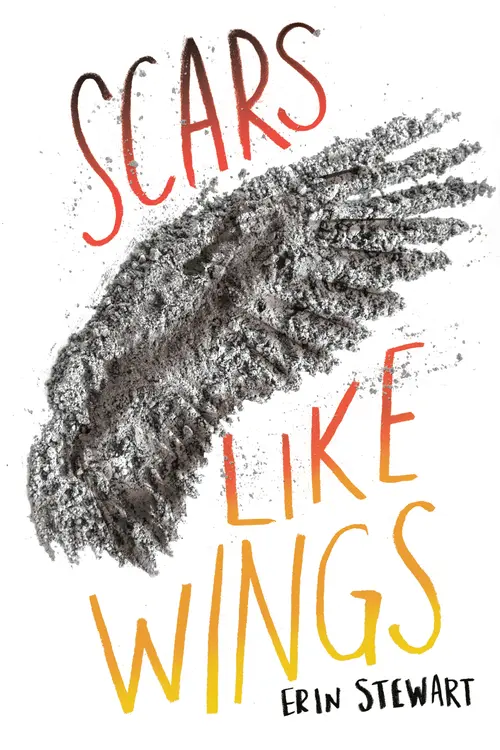
Scars Like Wings
Cover
Dedication
To Kyle.
You've made my life.
1
One year after the fire, my doctor removes my mask and tells me to get a life.
He doesn’t use those exact words, of course, because he’s paid to flash around lots of medical-degree terms like reintegration and isolation, but basically, the Committee on Ava’s Life had a big meeting and decided I have wallowed long enough.
My postburn pity party is over.
Dr. Sharp examines my skin grafts to make sure I haven’t inadvertently grown batwings in my armpits since our last monthly pat-down. Scars can be screwy little suckers, and since my body is 60 percent screwed up, it takes Dr. Sharp a full twenty minutes to check me over. The tissue paper covering the vinyl exam table crinkles beneath me as my aunt Cora watches attentively from the sidelines, scribbling notes in her gargantuan “Ava’s Recovery” binder while her eyes follow Dr. Sharp.
He removes the bandana from my head and then my clear plastic mask, his fingers grazing my scars.
“Everything’s healing beautifully,” he says, without even a hint of irony. The coldness of his fingers registers above my eyes but fades as he moves to the thicker grafts around my mouth.
“Well,” I say, “you can put lipstick on a pig, but it’s still a p—”
“Ava!” gasps Cora, who is not only my aunt but also the self-appointed CEO of the aforementioned committee on my life.
Dr. Sharp shakes his head and laughs, revealing two deep dimples on either side of his smile, which only makes him even more like one of those McHottie doctors on TV who bang each other in the on-call room between saving lives. I blame his smoldering eyes and strong jawline for the butterfly swarm in my stomach every time he touches my grafts. It also doesn’t help that I’m keenly aware he has seen me naked approximately nineteen times. Sure, it’s on an operating-room table, but naked is naked, even covered with gauze and nineteen surgeries’ worth of scars.
But we never address that awkward elephant in the room, just like I never mention the fact that he once literally took a chunk of my butt and stretched it across my face to make a new forehead.
Dr. Sharp hands me a small, salon-style mirror so I can admire his handiwork.
“No thanks,” I say, giving it back.
“Still having trouble looking?”
“Unless I grew a new face overnight, I already know what I’m going to see.”
Dr. Sharp nods while typing a note into my chart, and I sense a forthcoming committee meeting about my resistance to reflective surfaces. It’s not like I haven’t seen my face. I know how I look. I choose not to keep looking.
With a dimply smile, Dr. Sharp holds up my plastic mask.
“I think you’ll be happy to hear that you can get rid of this little guy.”
Cora squeals and awkwardly side-hugs me, careful not to apply too much pressure to disrupt the all-important healing process.
“You couldn’t have given us a better gift today, Dr. Sharp. It’s been a year, this week actually, since—” Cora pauses, and I can almost see her brain trying to come up with the right words.
“The fire,” I jump in. “One year since the fire.”
Dr. Sharp hands me the mask, which has been my constant companion every day, twenty-three hours a day for that year. Its one job: keep my face flat as it heals so my scars don’t bulge out in fleshy blobs. The doctors and nurses reassure me constantly that the mask has made my scars heal so much better, although I’m unconvinced it can get much worse than the patchwork of discolored grafts I call my face.
“You’ll still need to wear the body-compression garments until we’re sure the scars won’t interfere with your movements,” Dr. Sharp says. “But I do have one more piece of good news for you.”
Cora gives him the slightest nod, which tells me that whatever comes next is a direct result of an Ava’s Life meeting. My invitation must have gone straight to spam.
“Now that you don’t have to wear the mask, I am authorizing—and strongly recommending—that you return to school,” he says.
I flip the mask around in my hand without looking up.
“Yeah, that’s a hard pass,” I say. “But thanks.”
Jumping off the sidelines, Cora lays her massive binder by the sink and half sits on the patient chair with me, lightly tapping my thigh.
“Ava, I know you’re bored with those online classes, and you’re always saying how you wish things could go back to normal.”
Normal.
Right. Old normal. Ava Before the Fire normal. Normal normal.
“That’s Never. Going. To. Happen,” I say. “I’m not going to waltz back into my old school and have everything be the same.”
“You could go to the school by our house, like we’ve talked about. Or pick any school you want,” Cora says, undeterred. “You know, a fresh start? Make new friends and begin a life here.”
“I’d rather die,” I mumble.
I’ve been doing fine at home taking classes online in my pajamas. Where no one can see me. Where no one can point and stare and whisper as I walk by like I’m deaf as well as deformed.
“I know you don’t mean that,” Cora says. “You’re lucky to be alive.”
“Right. I’m a human rabbit’s foot.”
Why am I the lucky one because I survived? Mom, Dad, and my cousin Sara are probably dancing through a celestial meadow somewhere or happily reincarnated as monkeys in India while I face an endless loop of surgeries and doctors and stares from strangers.
But I can’t compete with tombstones. Death trumps suffering every time.
“If it were Sara, I’d want her to live a full life,” she says. “And I know your mother would want you to be happy.”
Her attempt to use dead people to win this argument irks me.
“I’m not Sara. And you’re not my mother.”
Cora turns away from me, and so does Dr. Sharp, pretending to concentrate especially hard on the computer screen rather than acknowledge the tension that fills the exam room like smoke. I hate that Dr. Sharp is here for this embarrassing toddler tantrum, but he’s partly to blame for blindsiding me with this development.
Cora sniffles quietly, and I wish I could take back my jab. She didn’t ask to be my makeshift mother any more than I asked to be her understudy offspring. We’re both trying to navigate this sick twist of “luck” the universe threw our way.
Dr. Sharp clears his throat. “Ava, the fact is, we’re concerned about your level of isolation. Reintegration is a major part of your healing process, and we all think it’s time to start,” he says. I refrain from asking him who this mysterious “all” includes, since my concerning hermit status is news to me. “What if you go to school for a trial period, and then we reassess our reintegration strategy? Say two weeks?”
Cora looks at me hopefully, tears still wetting her eyes, as the guilt of the lucky creeps into my chest. The guilt of the one who lived.
This week marks one year for her, too. One year without her daughter. One year taking care of me, the girl who survived instead.
I can’t give her Sara, but I can give her two weeks.
“Fine,” I say. “Ten school days. If it’s not a complete train wreck, then we’ll talk about more.”
Aunt Cora hugs me so tight that I act like it hurts more than it does so she’ll stop.
“It’s only two weeks,” I remind her. “And it is going to be a complete train wreck.”
“It’s a start,” she says.
I re-cover my scarred scalp with my red bandana as Cora and Dr. Sharp exchange a triumphant look. I toggle the transparent mask between what’s left of my hands, fighting the urge to put it back on.
—
Cora stops at the front desk to haggle about unpaid surgery bills while I meander down the hallway of the burn unit, looking at artwork from some Hospital Arts Initiative to bring beauty to dying people. I don’t even realize I’ve wandered into the regular hospital atrium until a little girl clinging to her mother’s skinny jeans emits a high-pitched scream.
Her chubby little finger points at me.
At my face.
The woman flushes red as she mutters an apology and yanks her child away by her arm. The girl continues to wail and crane her neck back toward me as her mom scurries away. A man in a pleather armchair shifts his eyes quickly back to his newspaper, but I can feel him watching me as I inch my way back to the hallway, trying to act casual.
I wait inside the safety of the burn unit, where people are used to faces like mine. The man with the newspaper steals glances at me from down the hallway, making me wish Cora had let me bring my headphones so I could turn on my music and tune out everything—and everybody—else. Instead, I turn to a 3-D art display called Starlight Reflections hanging in the window, and pretend to be immensely interested in the broken pieces of glass shaped like little stars, each five-pointed mini mirror shooting rainbow fragments of light across the hallway.
The cascading Milky Way of tiny mirrors distorts me, reflecting a Picasso reality in the shards that hang together as if one touch will send them splintering to the floor. I find myself in the glass, my red bandana framing my fractured face.
For a second, I allow myself to believe the broken glass is to blame for the broken girl.
Once I step away, my face will be fine.
Normal.
That’s what the committee wants. Go back to high school. Be normal again.
I know better.
Normal people don’t terrorize small children.
Normal sixteen-year-olds look in mirrors. Is my lipstick on straight? Is my hair doing that swoopy thing in the front? Their reflections reassure them, and if they don’t like what they see, they fix it.
For me, mirrors are a reminder.
I’m a monster.
Nothing in the world can fix that.
2
Cora spends the next week in a tizzy of back-to-school shopping, convinced that my successful return to normal teenage life hinges on whether I carry a backpack or an over-the-shoulder messenger bag.
The night before my official “reintegration,” she spreads a lineup of bags on my bed. Bold-printed tote bags, floral canvas backpacks, and nylon crossbodies stare up at me.
“What are the kids using these days?”
I shrug. “I’ve been wearing hospital gowns and pajamas, so I may not be the best style source.”
I don’t add that I highly doubt anyone’s going to be looking at my accessories. Cora’s eyes flick from the bagstravaganza to me, her eyebrows pushed together with the same look she gets doing the Sunday crossword. Like if she can just focus hard enough, she can find the solution.
But for all Cora’s efforts, I’m one puzzle she can’t fix.
“I think this one,” she says decisively, holding out a black messenger bag to me. “But try it just to make sure before I return the rest.”
Rather than modeling it, I tell her whatever she wants is fine and remind her that in two weeks, when I return to my glorious hermithood, I won’t need it.
Cora’s mouth turns downward, and for a second, her CEO-of-Ava’s-recovery mask slips and I see someone else, someone small and scared who wishes more than anything her own daughter were here, modeling backpacks and getting excited for new friends and rowdy sleepovers and all the other normal sixteen-year-old-girl things Cora wanted for Sara.
I sigh and take the messenger bag from her, slinging it over my head.
“It’s perfect, Cora, thanks.”
She adjusts the bag so it falls neatly by my side. The weight of it tugs on my already taut shoulders, but it’s good to see her smile.
Cora plucks a navy blue bandana from my collection and holds it up next to the blousy blue shirt she bought me. “Now, this is an outfit.” She doesn’t have money to throw at new clothes right now, but I’m grateful not to wear Sara’s hand-me-downs tomorrow. Luckily, it’s February, so I can wear long sleeves and jeans to cover most of my compression garments.
“You’re sure about no wig?” she says. “That nice lady from the hospital said we could call anytime. We could hop in the car right now and go get one.”
I shake my head. “Definitely not.”
A wig might cover my patchy scalp better than a bandana, but it’s not going to fool anyone. The lady who came armed to the burn unit with wigs and makeup and all sorts of other hide-your-scars paraphernalia was nice, but for all her efforts, fake hair and foundation couldn’t cover this. So why pretend?
After Cora leaves, I unzip my compression garments, carefully shedding the second skin that keeps my scars from puffing out like cotton candy.
I lie facedown on the bed in a tank top and shorts, the yarn from Sara’s quilt tickling my nose. Cora returns and starts our nightly slather-me-in-lotion routine. We begin on my right side. She gently straightens my arm, which from this angle looks freakishly thin. Like skin-and-bones, back-from-the-dead zombie thin. Who knew fat cells could burn up?
Cora works the lotion into all my cracks and crevices as the familiar medical/old-lady smell of the oily cream fills the room. My beige compression garments slump like snakeskin on my desk. After a year, they seem more me than the purply-pink swirling scars of my actual body.
I used to think of skin as one continuous unit, but mine is more like Sara’s bedspread beneath me—a morbid quilt stitched together. Some pieces are original, some are scarred over, and some are grafted in from other parts of my body after the doctors played epidermal musical chairs. During the early days, I even had some pig and cadaver skin stapled in while we waited for a lab somewhere to grow more of me from postage-stamp-size cutouts from my back.
Cora works my arm like it’s bread dough, her fingers pushing in and spreading the lotion. It’s the one time Cora doesn’t act like I’m an eggshell about to crack, probably because the nurses in the hospital told her the rougher she massages, the better for my scarring. And if it’s “aiding recovery,” Cora is all about it.
I lift my left leg before she even gets to it. After eight months of this full-body rubdown routine, we’re like a synchronized-swimming duo. I’m flexible enough now that I could do my own lotion lathering, but honestly, it’s nice to be touched by something other than Dr. Sharp’s icy fingers. Besides, the massaging relieves the itching, which is a side effect of the dryness, which is a side effect of having no oil glands. That domino effect culminates in a constant buzzing itch beneath my skin I can never quite reach.
“So I read an interesting article,” Cora says.
I almost laugh out loud at this utterly not shocking fact. Burn Survivor Quarterly comes to our house every few months to fill Cora’s head with ideas on how she can help me. She reads every word of every issue, often leaving cutout articles on my bed.
“It said how important it is for burn survivors to have a support group of peers who understand them.” Cora talks as she rubs. “And I just know tomorrow you will meet some new friends, and I think it’s really going to help you, Ava. I can feel it.”
I roll on my back so she can rub my knees.
“It’s two weeks. Don’t get your hopes up,” I say, although it’s clear her hopes have already rocketed out of the earth’s atmosphere.
“Well, you’re always saying how you don’t need friends—”
“Which I don’t.”
“And I’m saying, stay open to the possibility. Don’t let your fears stop you.”
“I’m not afraid.” I flex my puny arm muscles. “I’ve got my scar armor to protect me.”
Cora’s lips seal into a tight line as she rubs hard into my shoulders, working the lotion into my thickest scars. The wide bands of skin grafts pull in from my neck, my back, my arms, gathering like steel suspenders. Until recently, Cora had to help me put on my shirts because I couldn’t move my arms high enough.
I hold my arms out to let the lotion air-dry before we begin the task of getting my compression garments over my tacky skin. I snake each leg and arm through the tight fabric, and Cora zips me up. She rubs lotion on my face last, using one finger to spread it across the graft lines that dissect me.
“I hear Crossroads does a musical every year,” Cora says nonchalantly, like she didn’t make sure the school I’ll be going to has a stellar drama program. Like we both don’t know I haven’t sung a single note since the fire. Before, I couldn’t stop singing. Pouring my heart out to the showerhead microphone. On the highway with Sara with the windows rolled down. At the dinner table, subjecting my poor parents to my latest Broadway obsession.
With all the smoke and tubes and surgeries, who knows if I even can sing now. Dr. Sharp says my throat has healed and all, but I have my doubts. Not that it matters. The girl who loved spotlights and solos doesn’t exist anymore.
My eyes drift around the room where Sara and I used to have cousin sleepovers every few months. Even though I lived an hour south, in Utah’s farm country, we’d grown up in each other’s rooms, sharing each other’s lives. She called my mom Momma Denise, and I called hers Momma Cora.
Now I just call her Cora, and this room feels more foreign than familiar.
Most of Sara’s things were gone when I arrived from the hospital, but a few haunting echoes remain—clothes in the closet that fit me, Sara’s pointe shoes on a corner shelf as if she’s going to sashay in at any moment, and, of course, the vintage Barbie collection that stares at me from behind the glass of a massive curio cabinet. Apparently, the dolls are super valuable. Not that Cora and Glenn would ever sell them or anything else in here.
Cora’s tried in her way to make this space my own, though. Framed pictures of my parents on the desk. On the walls, Broadway musical posters like I used to have at home.
But this is not home.
And I’m an interloper—an impostor trying to fill the space of two girls when I’m barely even one.
Cora holds my chin so I’m looking right at her again.
“Promise me you’ll give this a real chance. That you’ll let people in.”
Cora’s earnest eyes search my face, and mine hers. Even in her pajamas with no makeup, she’s beautiful. Mom used to joke that her little brother didn’t stand a chance against Cora’s looks, which lured him all the way up to the city.
I sigh. “Cora, the only way I’m going to survive the next two weeks is if I’m as thick-skinned as humanly possible, and lucky for me, hypertrophic scars are about as thick as it gets.”
Cora’s lips press together again as I ba-dum-ching an imaginary drum set.
“Oh, come on,” I say. “I can either laugh or cry about it, and I’m about all cried out.”
Cora does neither. Instead, she holds my hands, my purply skin particularly alien against hers. At least my right hand still has fingers. Calling the stumpy, clawlike structure at the end of my left arm a hand is unspeakably generous. It’s more of a pincer now—fused fingers opposite a massive thumb that is actually my transplanted big toe.
Cora squeezes my hand—or claw, or whatever it is—tight. “It’s your junior year of high school. Make some friends. Enjoy it.”
I exhale long and slow. Cora doesn’t understand: even my old friends back home didn’t know how to be around me after the fire. Probably because I wasn’t really me anymore.
I doubt many people at this new school are looking for that one special burn victim to round out their squad, either.
So instead of a clan, I have a plan: do everything in my power to disappear. Not like a magic act or anything but more like a melt-into-the-background camouflage. The only way to get through these two weeks of feigned normalcy is to minimize exposure as much as possible—mine and everyone else’s.
“I almost forgot—” I grab my headphones off the desk and sling them over tomorrow’s outfit draped on the chair.
Cora tenses, probably using every ounce of willpower in her five-foot-three frame not to grab them off her perfect ensemble. She hates my headphones almost as much as I love them. Well, need them.
“You and your music,” she says.
I don’t tell her it’s not about the music. Most of the time I don’t even notice what’s playing. I wear them to block out the world.
To help me fade away.
Uncle Glenn stops at my doorway to say good night. Standing there with his signature awkward smile and the top of his nose turning slightly upward, he looks so much like my mom. Sometimes it makes me so sad I can barely look at him. Sometimes I can’t turn away. My mom was beautiful, too, but not in the porcelain-doll way Cora is. Mom’s beauty was more unbreakable—crow’s-feet by her eyes and calluses on her hands.
The Story Continues on BooksBarbecue!
Enjoyed this preview? ❤️ Do not stop here!
Read the complete book free online → 🔗
Continue reading now on BooksBarbecue and discover every page!
Love reading? Bookmark BooksBarbecue.com for more amazing books!
Happy Reading!