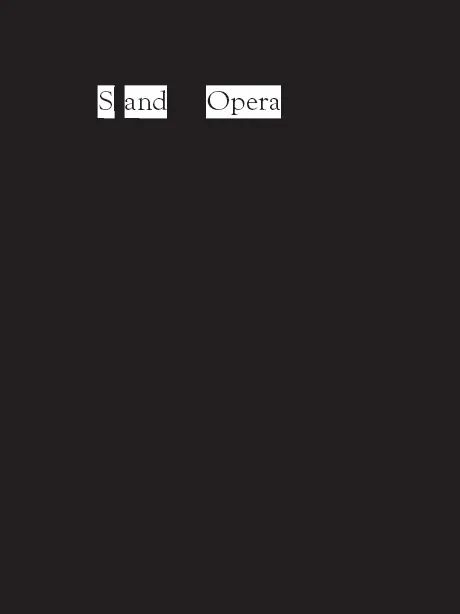
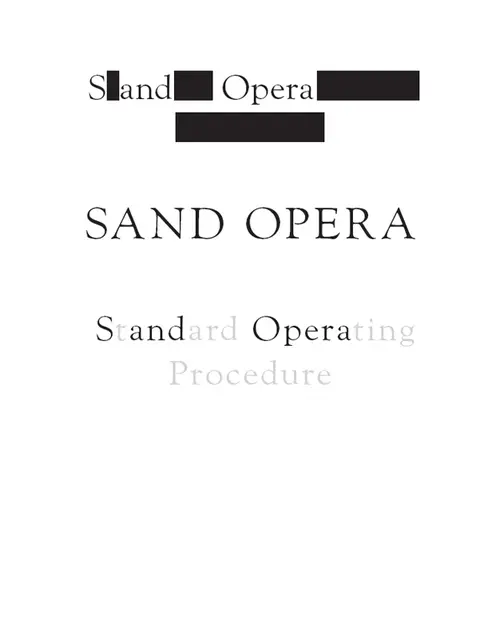
Sand Opera
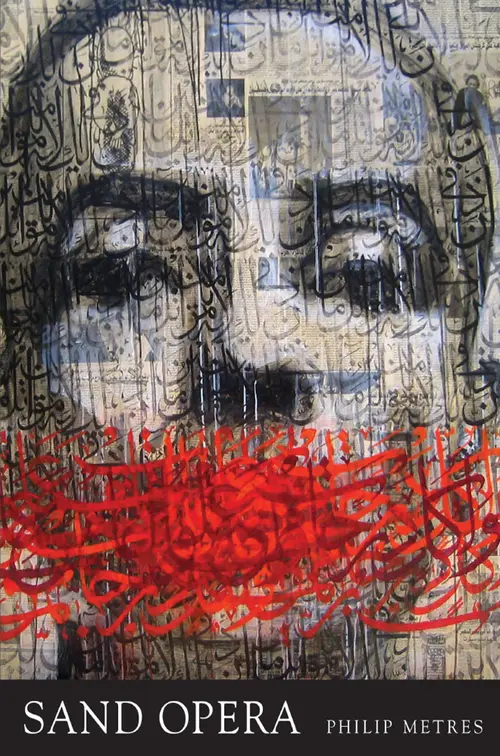
Cover

Note to the Reader
NOTE TO THE READER
Alice James Books encourages you to calibrate your e-reader device settings using the line of characters below as a guide, which optimizes the line length and character size:
in / this is the air / there is no other / we unseal & key / the same air /
Please take the time to adjust the size of the text on your viewer so the line of characters above appears on one line, if possible. Doing this will most accurately reproduce the layout of the text intended by the author. Viewing the title at a higher than optimal text size or on a device too small to accomodate the lines in the text will cause the reading experience to be altered considerably; single lines of some poems may be displayed as multiple lines of text. If this occurs, the line break will be marked with a shallow indent.
ALSO BY PHILIP METRES
Poetry:
A Concordance of Leaves (chapbook)
abu ghraib arias (chapbook)
Ode to Oil (chapbook)
To See the Earth
Instants (chapbook)
Primer for Non-Native Speakers (chapbook)
Translation:
I Burned at the Feast: Selected Poems of Arseny Tarkovsky
Compleat Catalogue of Comedic Novelties: Poetic Texts of Lev Rubinstein
Catalogue of Comedic Novelties: Selected Poems of Lev Rubinstein
A Kindred Orphanhood: Selected Poems of Sergey Gandlevsky
Criticism:
Come Together: Imagine Peace
Behind the Lines: War Resistance Poetry on the American Homefront Since 1941
ACKNOWLEDGMENTS
Grateful acknowledgment for publishing versions of these poems is due to Banipal (UK), Diode, FIELD, Indiana Review, Kenyon Review Online, The Massachusetts Review, Matter, Mizna, Narrative, New Letters, New Orleans Review, Ostrich Review, POEM: International English Language Quaterly (UK), Poetry, Seneca Review, Publication of the Modern Language Association (PMLA), and World Literature Today (WLT). Thanks as well to the anthologies Come Together: Imagine Peace (Bottom Dog Press, 2008), Eating the Pure Light: Homage to Thomas McGrath (The Backwaters Press, 2009), The New American Poetry of Engagement: A 21st Century Anthology (McFarland & Company, 2012), Obsession: An Anthology of Sestinas (Dartmouth, 2014), and With Our Eyes Wide Open: Poems of the New American Century (West End Press, 2014) for reprinting a number of these poems.
Selections prose sections from “Homefront/Removes” were published as “Home/Front,” which won the Anne Halley Prize for best poem by Massachusetts Review (2011). One of the sections appeared as a broadside.
Thanks to Sommer Browning and Tony Mancus at Flying Guillotine Press for publishing abu ghraib arias as a chapbook (2011), which won the Arab American Book Award for poetry in 2012. The first version of the chapbook featured a cover made from recycled army uniforms, thanks to Chris Arendt and the Combat Paper Project.
Thanks to the National Endowment for the Arts, the Community Partnership for Arts and Culture (Creative Workforce Fellowship), Cuyahoga Arts & Culture, the Ohio Arts Council, and John Carroll University for grants in support of the writing of this work. The Creative Workforce Fellowship is a program of the Community Partnership for Arts and Culture. The Fellowship program is supported by the residents of Cuyahoga County through a public grant from Cuyahoga Arts & Culture.

Thanks to Rebecca Black, Hayan Charara, Sarah Gridley, Anna Meek, and Mary Weems for their extensive remarks on the manuscript. Thanks as well to Kazim Ali, Danny Caine, Michael Croley, Ian Demsky, Michael Dumanis, Fady Joudah, Marilyn Hacker, Chris Kempf, Dave Lucas, E.J. McAdams, Mark Nowak, Radius of Arab American Writers, Inc. (RAWI), and Maria Smith and the Cleveland Nonviolence Network for your encouragement. For opening spaces.
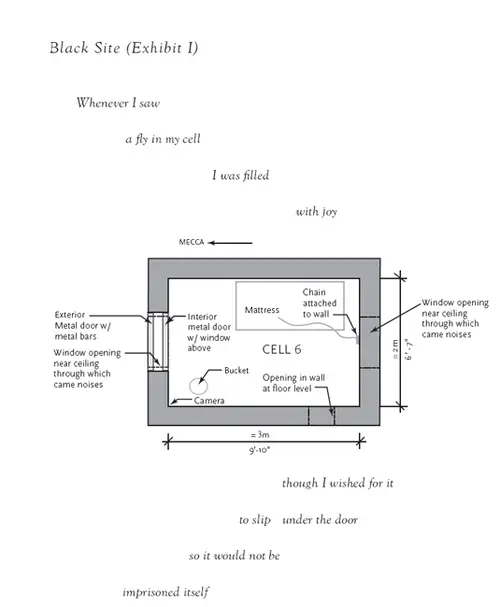
Thanks as well to Justin Petropoulos for creating renditions of Bashmilah’s hand drawings of black sites.
Thanks to everyone at Alice James Books—especially Carey Salerno, Stephen Motika, Alyssa Neptune, Mary Austin Speaker, Julia Bouwsma, and Meg Willing—for making this happen.
And most importantly, thank you to Amy Breau, to whom this work is dedicated, for her constant companionship, her careful reading, her nurturing of our children Adele and Leila, and her invitation to a greater opening.
…it took the war to teach it, that you were responsible for everything you saw as you were for everything you did. The problem was that you didn’t always know what you were seeing until later, maybe years later, that a lot never made it in at all, it just stayed there in your eyes.
—MICHAEL HERR, Dispatches
If the whole body were an eye, where would the hearing be?
—1 Corinthians 12:17
Illumination of the Martyrdom of St. Bartholomew
Illumination of the Martyrdom of St. Bartholomew
from the dried hide of calves
carved & sewn in quires
they bend & tend to him / as if
tailors or healers & not rending
skin from limb / their eyes
narrowing knives / he balances
naked on ankle / a single
arm aloft as if in flight
from body’s scything / O wholly
gold-haloed & yet-membered head
soothe the eye in which I am
thrown / hand without shield /
scissored out hymn / & if
the body’s flayed & displayed
in human palms / & human skin
scrolled open / the body still dances
& if the flesh is the text
of God / bid a voice to rise /
& rise again
I. abu ghraib arias
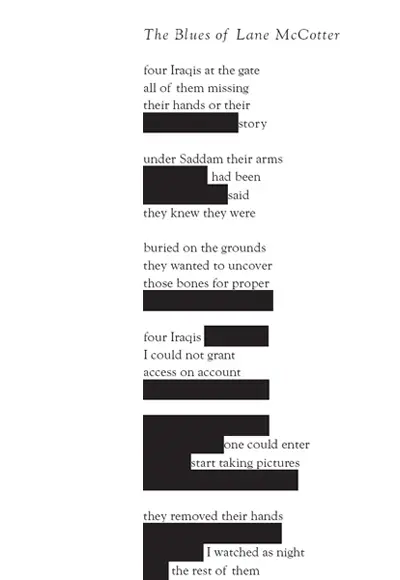
The Blues of Lane McCotter
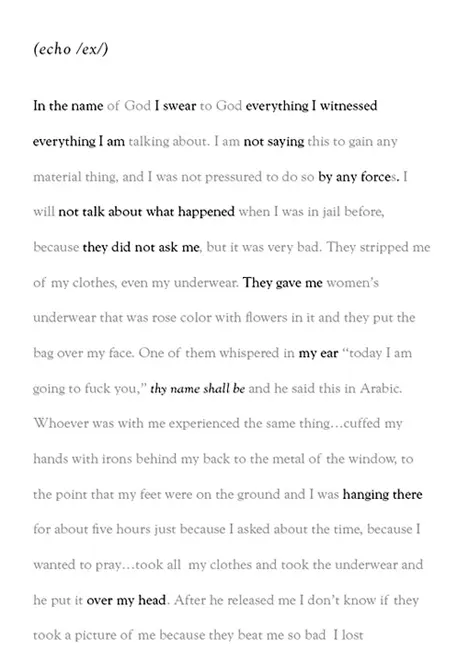
(echo /ex/): “In the name of God…”
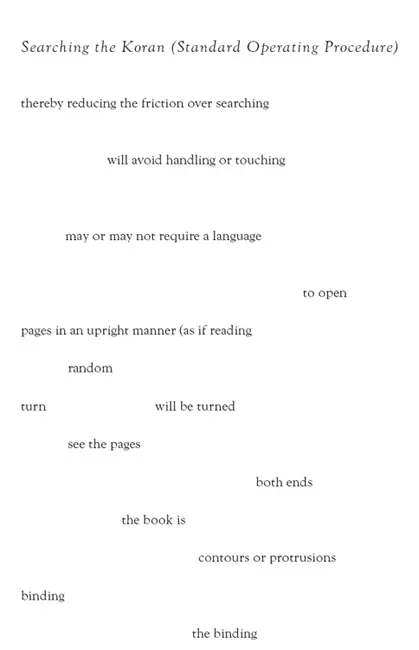
Searching the Koran (Standard Operating Procedure)
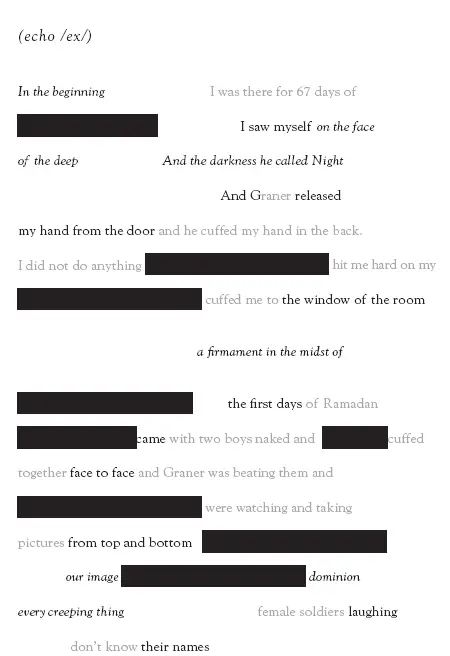
(echo /ex/): “In the beginning…”
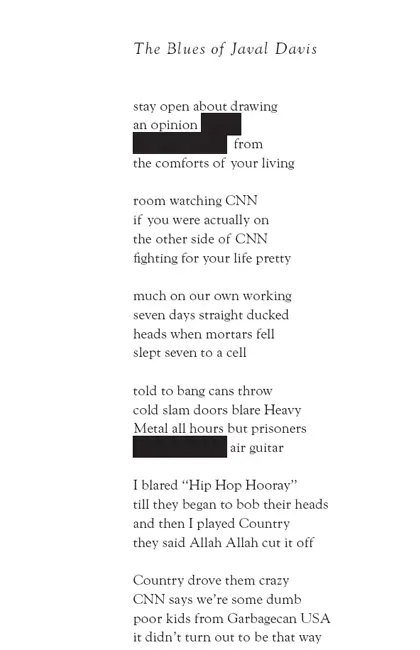
The Blues of Javal Davis
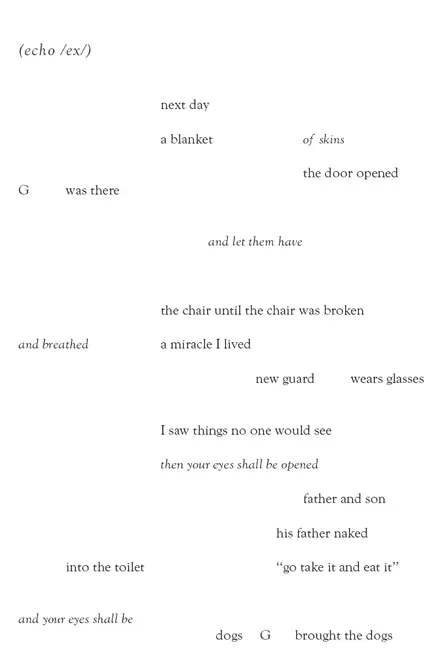
(echo /ex/): “next day…”
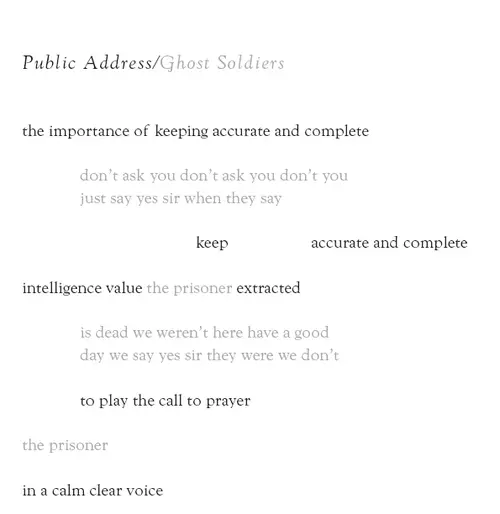
Public Address/Ghost Soldiers
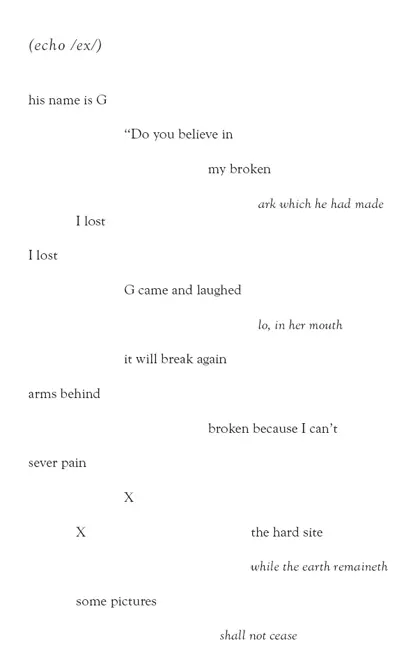
(echo /ex/): “his name is G…”
The Blues of Charles Graner
The Blues of Charles Graner
the Christian in me
knows it’s wrong
but the corrections
officer in me can’t
help but love
making a grown man
piss himself
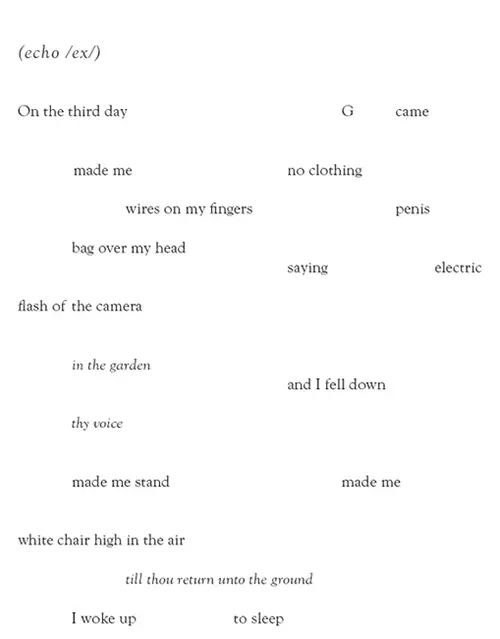
(echo /ex/): “On the third day…”
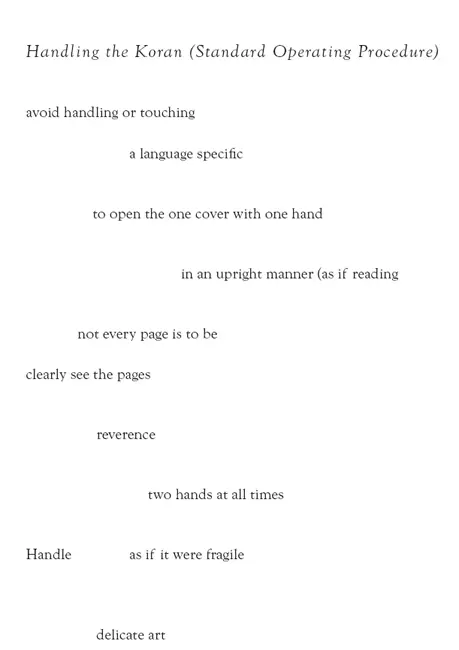
Handling the Koran (Standard Operating Procedure)
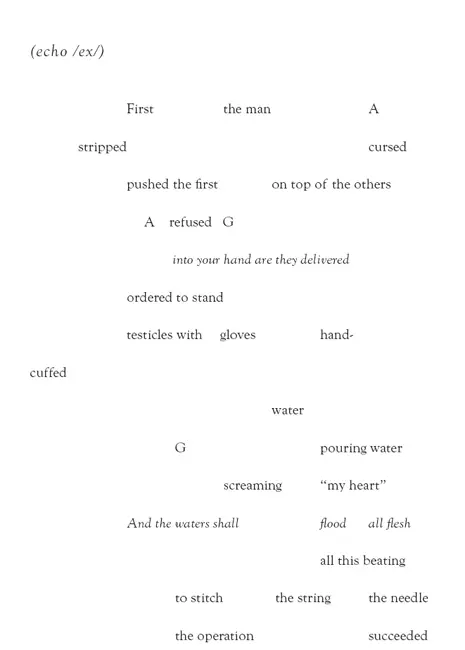
(echo /ex/): “First the man…”
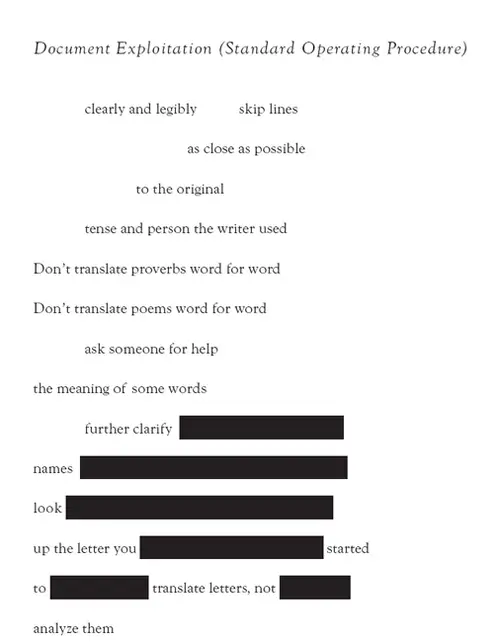
Document Exploitation (Standard Operating Procedure)
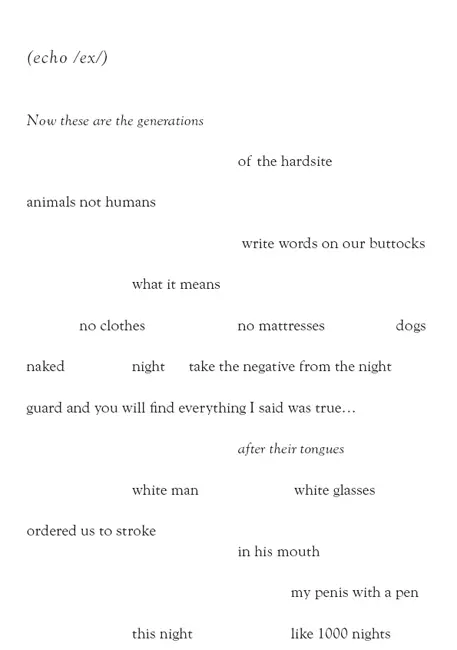
(echo /ex/): “Now these are the generations…”
The Blues of Lynddie England
The Blues of Lynddie England
[G] played me
I guess I was blind
by love
maybe it was
[ ]
for documentation
maybe it was
for his own
amusement
[ ]
I don’t know
what was going through
his head
but he took it
[ ]
it shows
he has power
over me
anything he asked
[ ]
he knew
I would do
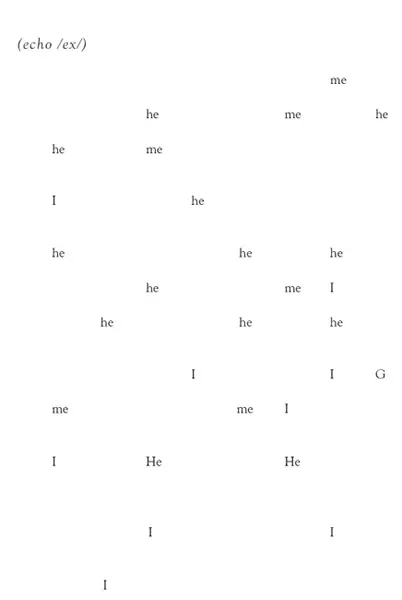
(echo /ex/): “me…”
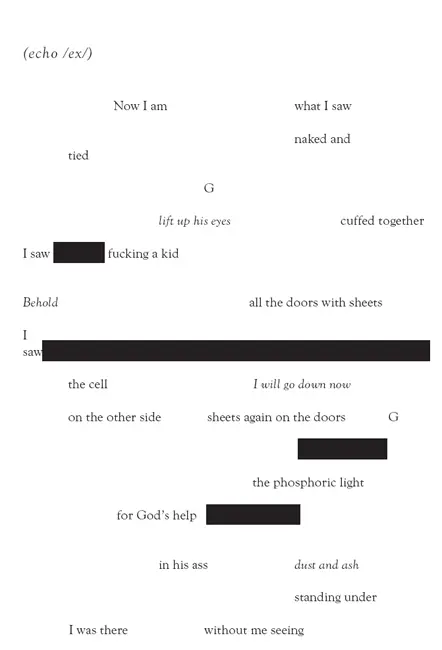
The Blues of Ken Davis
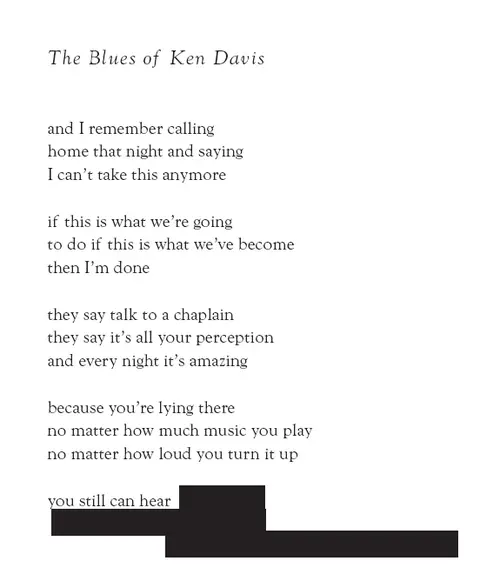
(echo /ex/): “Now I am what I saw…”
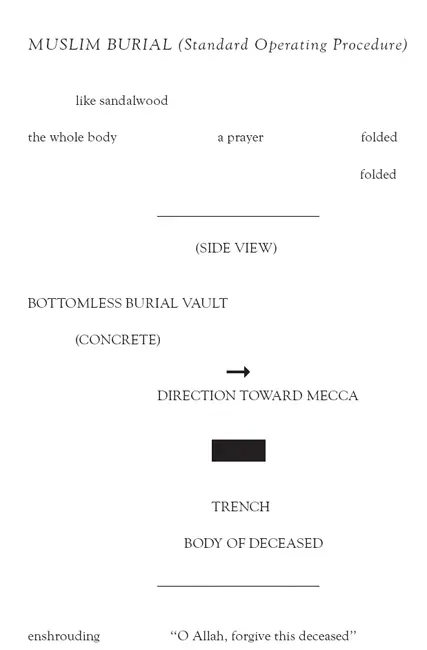
MUSLIM BURIAL (Standard Operating Procedure)
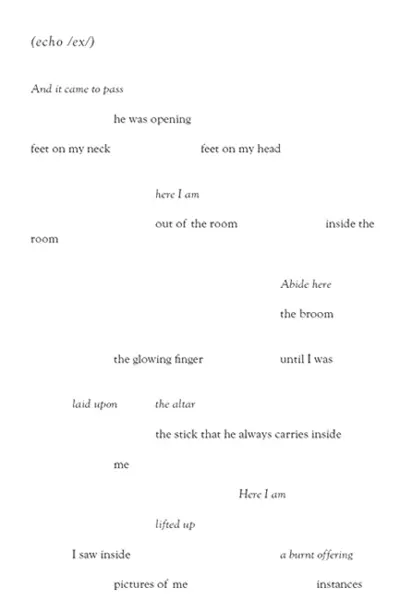
(echo /ex/): “And it came to pass…”
The Blues of Joe Darby
The Blues of Joe Darby
I laughed at first I did
not know what I was looking at
a bunch of bodies bending over
a pyramid of tumbling
They call me bulls-eye they call me traitor
the pictures were taken
the pictures I gave them
now they are everywhere and I
can’t go home again
They call me walking dead call me waking night
I dream they stand on naked
boxes again they back on each other’s
backs again they bloody mouth from flinch
of dogs they hands on sandbagged heads
call me talking dead call me waking eye
I gun to sleep again I closet night
no sleep but I would give them up again
I close exposed I wake and listen
I would give them up again
(echo /ex/)

II. first recitative
Woman Mourning Son
Woman Mourning Son
—Najaf
I pull up the blinds, they screech in retreat,
mad grackles beaking for space on the lawn.
I flip open the news and she flutters out,
trailing the blot of her shadow. I yawn,
her mouth yawns and yawns. Like wings, her chador
unfurls over a bare, bleached street. She looks
almost like she’s flying, one leg cut off
by the photo. The shape of her shadow’s
an F-16, the flat plane of her hand
the jet nose, the other hand a missile
tucked so gently beneath the wing. And now
the blot of that shadow’s a flailing bat,
a ragged flag—this black-clad woman’s hands
open and skyward, as if she wants to vault
the blot of this shadow. From above, it looks
just like whirling, a waltz with no one
but chadors and shadows. Now she’s lost
her face in the ink. The road is a white
sheet. Somewhere someone’s hands danced
over a keyboard to deliver the ordnance.
Recipe from the Abbasid
Recipe from the Abbasid
Skin & clean a fat, young sheep & open it
like a door, a port city hosting overseas guests
& remove its stomach. In its interior, place
surveyors in exploratory khaki, a stuffed goose
& in the goose’s belly, a stuffed hen, & in the hen,
machine gun nests, C rations, grenades, a stuffed
pigeon, & in the pigeon’s belly, a stuffed thrush,
& in the thrush’s belly, contractual negotiations
& subtle threats, all sprinkled with sauce. Sew the slit
into a smile, dispatch handshakes. Add Chevron,
Exxon, Texaco, Shell. Place the sheep in the oven
& leave until this black slimy stuff, excretion
of the earth’s body, is crispy on the outside,
& ready for presentation.
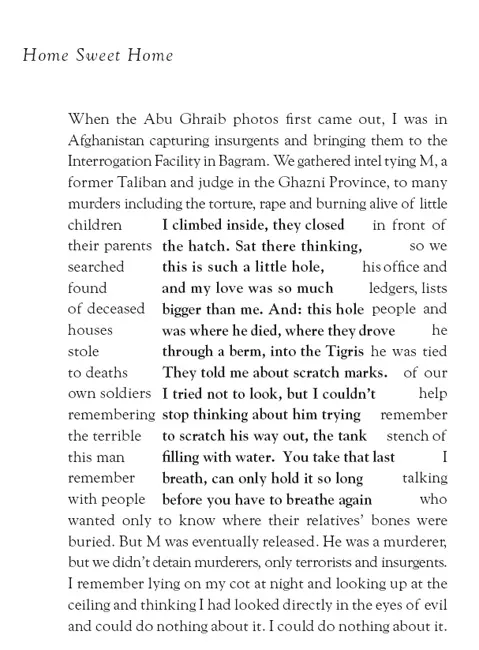
Home Sweet Home
The Iraqi Curator’s PowerPoint
The Iraqi Curator’s PowerPoint
You can see the footprints around the hole
The Iraqi Curator said. They smashed the head
Because they could not lift it from its base,
This statue of Nike. It’s still missing.
And this is Umma Al-Ghareb, my dig site.
The Mother of Scorpions, it means. Y’anni,
Next slide: more damage by looters. If the eyes
Are gems, they will be made into holes.
If the skin is gold, goodbye. Now this is a sight:
The bodies too heavy, so they took the heads
Of these terracotta lions. A slide is missing
Here. What I ask you is this: base
What you believe on what you can almost see.
For example: you hear the dogs bay
From the outskirts of the city. They head
Wherever they smell flesh. My eyes
Still see buildings that now are holes.
What you see is not what is missing.
Next slide. I’d heard that Etana, missing
For years, was in Damascus. Then in Beirut.
Then, I got a call from an art friend, a whole
Continent away. Does it have a scratch at the base
Of his hand and along his chest I said he said yes
Of course I said and it is headless
And writing on the shoulder beneath no head
And he said yes and yes the right arm missing
And I said my God I said John take my eyes
And let me see. I was blind and now had sight
Though I could not see it. This is the basis
Of art, sadiki. There’s something beyond the hole
Which each must face. Missile sites. Army bases.
The hole in the ground where thousands climbed
Into sky. Missing heads of state. Eyes.
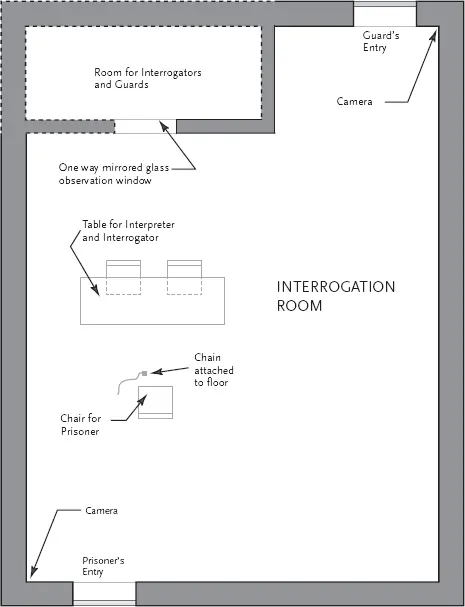
Black Site (Exhibit Q)
Asymmetries
Asymmetries
Longing to grasp the familiar, names
against the anonymous
appendages & naked flesh, a nipple the eye
could nuzzle, to hide in
dark islands of hair, I near the photo—
as if the body erotic
could shield against the camera’s scalpel.
In its distance, the bodies
without faces line a riverbank, shade
into some darker shadow,
obeying the desire of gravity. I’m thinking
of Iraq, how they lay out
each disinterred nest of femurs & ribs
on separate sackcloths,
trying to punctuate the run-on sentence.
After making love, once,
you said every face, split in half, fit
so precariously, so comically,
we spent the next half hour shading one side
of our faces in the mirror,
then the other. This world is centaur: half
daydream, half nightmare,
not knowing if we’re awake or dreaming.
Wandering the gallery, we drift
onto an imagined balcony
& gape at the traffic
of bodies jamming the crossroads, im
-mobile sculpture of
pure fact, dangling odd-angled & earth
-bound us.
Salaam Epigrams
War Stories
War Stories
The fitful sleep of steak and silver. We
man the monitors of dreaming, on this outpost
of fatherhood. The battlements of silence.
A friend opens a bottle of red. We’ve lived
in this dome so long it seems like freedom.
We know the crackle of distant gunfire
heightened by stereo, the plith of dust,
each stray bullet pirouetting in slo-mo.
Our fathers and brothers wear the flak jacket
of medal and shrapnel. We don the softness
of palms, the odor of diaper wipes. Somewhere
outside, someone’s brother’s buried
a box he won’t tell us where. Inside the box
is. We gird the landscape in the soundtrack
of earbuds, but inside the box is a baby
radio hissing. Inside is the rattle unjawed.
In the rings of our suburbs, outside the zone
of ground zeroes. The baby is stirring, not
crying. Inside the well of our glasses,
the smutch of discernable breathing.
III. hung lyres
“The new theory: not to praise too much…”
@
The new theory: not to praise too much, lest the child lose her inner
sense of what pleasures, the listening tuned inward.
In silence before sleep, looking up to her ceiling, four years in her
mind, she says: someone is telling the story of our life.
I see her great-grandmother in her brown eyes, in her roil of curls.
I don’t know who it is.
In the woods of her wander, she.
They will be telling it our whole life.
“When the bombs fell, she could barely raise…”
@
When the bombs fell, she could barely raise
her pendulous head, wept shrapnel
until her mother capped the fire
with her breast. She teetered
on the highwire of herself. She
lay down & the armies retreated, never
showing their backs. When she unlatched
from the breast, the planes took off again.
Stubborn stars refused to fall…
“you mute you without openings…”
@
you mute you without openings
enwombed you greedy to eat the fruit of light
to swallow elixirs of sound
marooned you in that watery egg that mother
voice a constant hum above
this is the air you could & ample be
everyone waking to sirens
the arc & com
motion of glass released from its bottle
this is aria of nightfall that sets the anvil
to tremble the temple behind the temples
when you emerged not mouth or fingers but cries
& whorls & folds to hold sound in
the first thing I saw was your ear
“Is the ear…”
“in the cell of else…”
@
In the cell of else / in the pitch-white
someone’s hands shackled between ankles
in the nights & sunny days keeping the clouds
shaking the rib cage & no way
to keep the music from entering & breaking
the bodies hit / Let the bodies hit the / Barney
is a dinosaur / this is the touching without being
touched / this is the being without
silence / from our imagination / in wave upon
wave / in a shipping container & I love you
in a box of shock you love me / in a cemented
dream / we’re a happy family /
with a great big hug and chains that leave no mark
Won’t you say you love me too?
“this is the air we script to lips…”
@
this is the air we script to lips / air we usher in lungs / that ushers us
in / this is the air / there is no other / we unseal & key / the same air /
hair of the fathers / shoulder of the mothers / air of laughter & air
of slaughter / air / of wrecks & reliquaries / of wasp & papyrus
barbed wire & hung / lyres & this is the air we draw in / air we expel
sphere that spires in us / spears us into us / stories we find ourselves
in / the middle of something / a building we did not build
& this is the air of ozone & benzene / that quickens the blood /
clarifies the eye / this is the air / there is no other / nesting in us /
then beaked & breaking / a sudden flutter / ring / out of us /
this is the air we gather / there is no other / lower / nature / field
this the clearing / this the threshing / floor the flesh’s door / unseen
seething song that fills the nautilus that the little hammer wields
to drum / aria of the air sculpting the thinking bone
“I had no names to blazon their tender…”
@
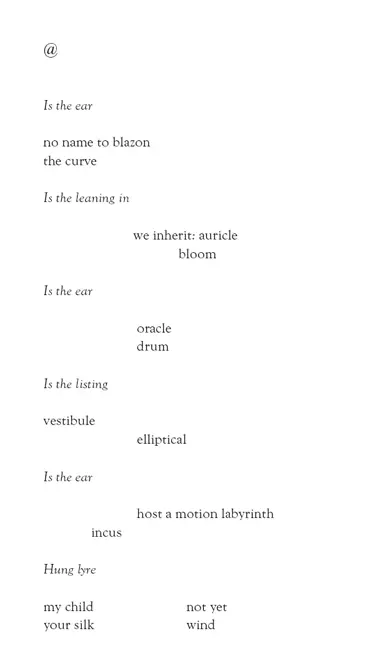
I had no names to blazon their tender
curves, their riverine curves
so took the ones we inherit: auricle
to name the human bloom—
what does it mean, amputee?
lobed trumpet that listens to the oracle
of cymballed world: canal & drum
vestibule to the oceanic home
where windows are elliptical & circular
is there such a thing as “orphan”?
& we host a motion labyrinth, a squid.
Maleus, incus, stapes. Cover your ears
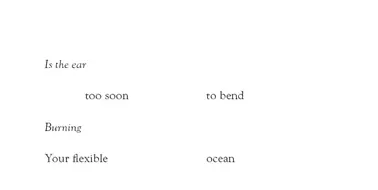
dear child, your cartilage is not yet hard—
it’s too soon to know to hear is to bend.
Your silk purses will sow the wind.
Your flexible shells haul their own ocean.
“She asks, is that man crying…”
@
She asks: is that man crying
or singing? How should I answer?
War takes him in its fingers,
raises his body, a punctured bone
flute, to its lips, and breathes
the living dust
to dust alone—
this is the air we scull
air of ancestors & ashpits
just five, the child’s baptized into this
unhappiness:
she corrects the voices
she hears butcher
the name of the country she’s never
seen—it’s “ear-rock,”
not “eye-rack.”
“What does it mean, I say.”
@
What does it mean, I say. She says, it means
to be quiet, just by yourself. She says, there’s
a treasure chest inside. You get to dig it out.
Somehow, it’s spring. Says, will it always
rain? In some countries, I say, they are
praying for rain. She asks, why do birds sing?
In the dream, my notebook dipped in water,
all the writing lost. Says, read the story again.
But which one? That which diverts the mind
is poetry. Says, you know those planes
that hit those buildings? Asks, why do birds sing?
When the storm ends, she stops, holds her hands
together, closes her eyes. What are you doing?
I’m praying for the dead worms. Says, listen:
IV. second recitative
Breathing Together
Breathing Together
Bear with me. I want to explain why it took so long, the strange and hard ways this mss. hit me. Weeks ago, a close friend who worked for the State Department killed himself, apparently leaping from the Taft Bridge. It was shocking, but also unbelievable—truly, we did not believe it at first. P— was in no way suicidal. He and I had had a conversation where he scoffed at those who ended their lives. He’d seen a lot of godawful things, had interviewed hundreds of Holocaust survivors, and felt it was his duty to bear witness. No obit was released for a long time, the family wasn’t talking, and no police reports of a suicide on that day. I tracked down that the news came through a woman who had been staying with P—. It sounds like a conspiracy movie, but on the day of his death, two federal officers came to the apartment at 6 am and interviewed him privately for an hour. She was asked to leave. When she returned, the officers confiscated P—’s home computer. They made plans for dinner, and he left for work—the last anyone saw him. P— had been interviewing people in Iraq and Afghanistan, soldiers and detainees. He was a research phenom, intensely moral—self-righteously so. Perhaps he stumbled onto information he shouldn’t have and was considering releasing it….We’re all being cautious about how we talk about this. You don’t have to say anything back about it, but I wanted you to know a little of the story.
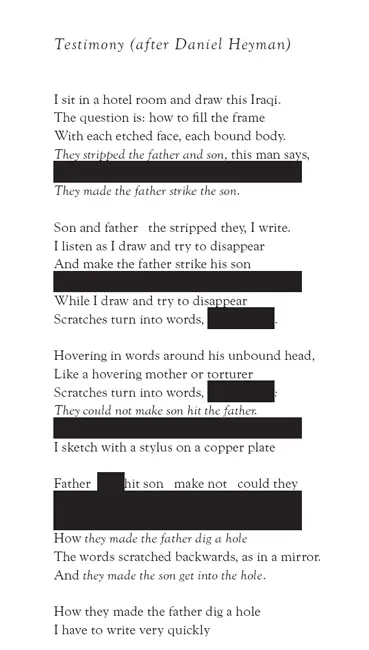
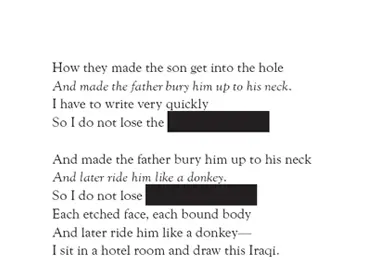
Testimony (after Daniel Heyman)
When I Was a Child, I Lived as a Child, I Said to My Dad
When I Was a Child, I Lived as a Child, I Said to My Dad
Saint Paul was a jackass, my father muttered,
keystroking his tank into position in The Mother
of All Tank Battles. I turned back to the screen,
maneuvering pixilated tanks. Each arrow key
altered trajectory, each cursor tap a tank blast. Fast-
forward two decades: in a cubicle outside Vegas,
Jonah joysticks his Predator above Afghanistan,
drone jockey hovering above a house on computer screen.
He knows someone’s inside. Is it his target? Who else
inside—cooking, crawling—will not outrun his digital will?
He is cross hairs and shaking frame. Stone implosion.
He watches the collapse replay on-screen, then
heads home. Pizza. Diaper rash. Removes a thumb
from his toddler’s sleeping mouth. Again, no sleep.… Our game’s
quaintly obsolete. On mailboxes around our neighborhood,
our beagle would sign his line of piss, which said: it’s good
to be alive and eating meat. He was adding to the map
our eyes can’t see, nor throats can speak. Our shield and our help
at Great Lakes Naval Base, my father imagined permutations
of disaster. We were Region Five. Coordinates run,
scenarios conceived, New Madrid fault lines, the possible
flood of Des Plaines, a tornado’s blinding spiral
rolling its dozer across the plain. No preparing for it,
just to pick up what remained. If a nuclear bomb hit
Chicago, the epicenter here, he’d draw concentric circles
radiating, a pebble disturbing the mirror of a lake. Each circle
meant a slower death. Between us and them, the Wall
was a mirror reflecting us and nothing beyond. The whole
world was what the mirror hung upon. He showed me how
to hold a blade, how to watch my reflection for every nick, how
to cut my face without bleeding. I bled. I hooked my glasses
over teenaged ears. Outside, the blur of lawn became grass,
each blade stabbing upward to light. I thought I knew
we see as through a glass, darkly.… My frames have narrowed
to lenses eye-sized. My myopia grows. To see
what’s happening, I open a laptop, lean into the screen:
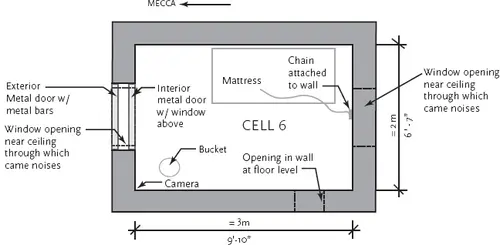
Black Site (Exhibit I)
Love Potion #42
Love Potion #42
Before you, I slept on a bayonet.
Bided my time in clothing. Neither experience
nor innocence kept me
from bleeding. Before you, I held
an invisible sign: please touch this abyss.
How pleasing to have you sieve me
through your lungs, leave me essential
dregs and seeds. Since there’s no place
a grain of sand cannot hide, deserts
and strands now travel the world
with us, in shoes. Let me kind you in two
tongues. Habibti, two decades ago,
we fell off a cliff, each holding a wing,
each holding a hand, and have yet to land.
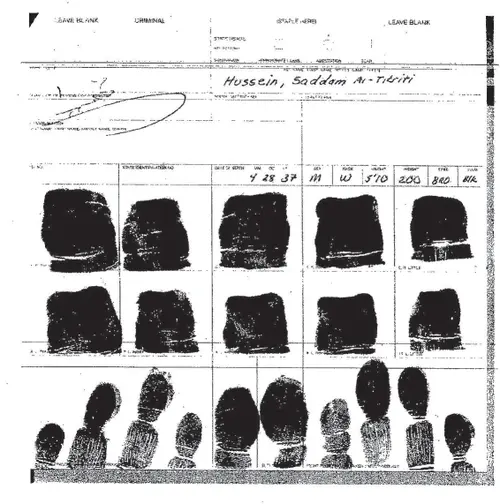
Saddam’s Fingerprints
Etruscan Cista Handle
Etruscan Cista Handle
How peaceful he looks, the gates of his face
now shut for good, facing the ground. His body’s
hoisted horizontal, his arms embrace
the air, his penis a slack finger of gravity.
Two winged soldier-angels must stoop, stagger
to cradle his naked inhuman weight.
Their heads torqued, as if listening to the lead
of the body, they bear it in bent tender shoulders,
in the balked leaning and strain of their gait,
and struggle against falling. Their maker is dead.
And still the war continues, though it takes
other names. Sarpedon bronzed not breathing, the angels
bronze stumbling, all burned into a single handle.
To open the jewelry box, you have to grasp the corpse.
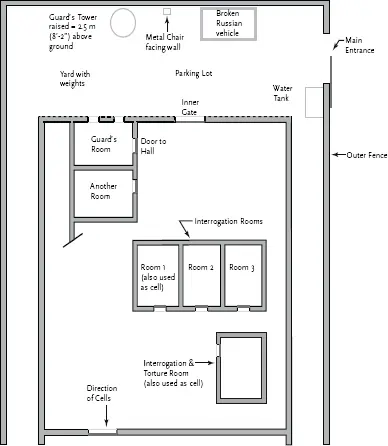
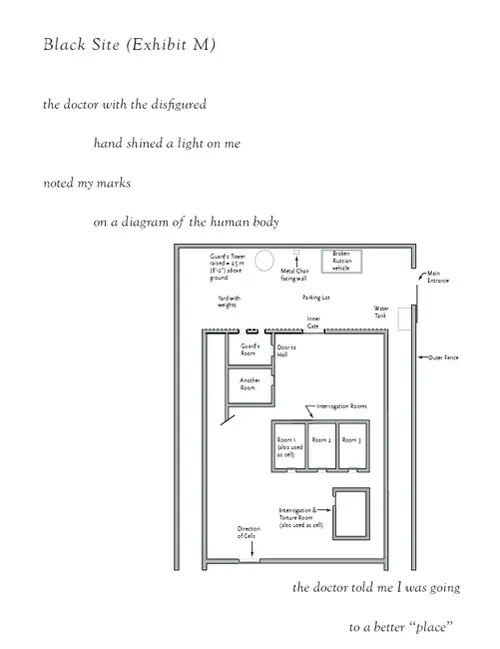
Black Site (Exhibit M)
A Toast (for Nawal Nasrallah)
A Toast (for Nawal Nasrallah)
Chair legs screech across the banquet floor
above us, a wedding feast
of people pulling themselves closer, closer
to the constellation of tables
while here underground, alone with our ears,
The Story Continues on BooksBarbecue!
Enjoyed this preview? ❤️ Do not stop here!
Read the complete book free online → 🔗
Continue reading now on BooksBarbecue and discover every page!
Love reading? Bookmark BooksBarbecue.com for more amazing books!
Happy Reading!