Salvation Army
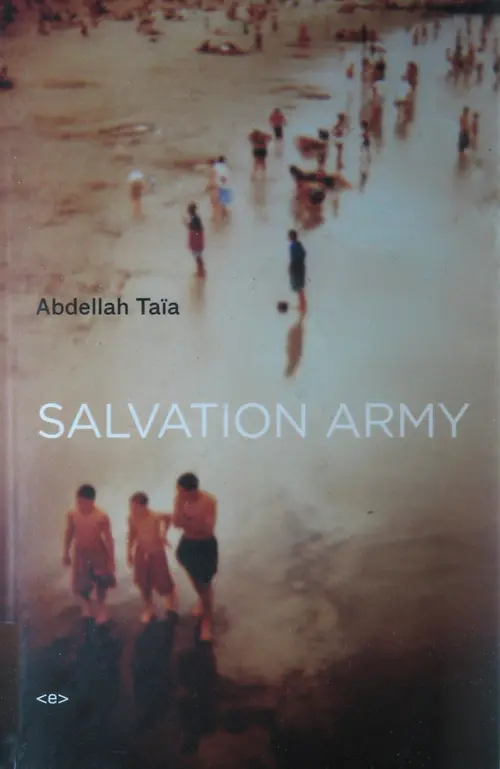
SALVATION ARMY
Abdellah Taïa
Introduction by Edmund White
Translated by Frank Stock

“Abdellah Taïa is a brilliant young Moroccan living in France. In this novel, appropriately, he talksabout his first contacts with Europeans. Welearn about the traditional Moroccan family, aboutSwiss sex tourists, about the Salvation Army inGeneva, about the first burgeoning of desire in ayoung Arab, about family love and carnal love.Taïa has a captivating way of taking us into hisconfidence and telling us essential truths.”
— Edmund White
ï

SEMIOTEXT(E) NATIVE AGENTS
SALVATION ARMY
SEMIOTEXT(E) NATIVE AGENTS SERIES
© 2009 by Semiotext(e)
© 2006. Originally published by Éditions du Seuil in Paris, France, under the title L’armée du Salut.
Cet ouvrage, publié dans le cadre d'un programme d'aide à la publication, bénéficie du soutien financier du ministère des Affaires étrangères, du Serviceculturel de l'ambassade de France aux Etats-Unis, ainsi que de l'appui deFACE (French American Cultural Exchange).
This work, published as part of a program providing publication assistance, received financial support from the French Ministry of Foreign Affairs, theCultural Services of the French Embassy in the United States and FACE(French American Cultural Exchange).
All rights reserved. No part of this book may be reproduced, stored in a retrieval system, or transmitted by any means, electronic, mechanical, photocopying, recording, or otherwise, without prior permission of the publisher.

Published by Semiotext(e)
2007 Wilshire Blvd., Suite 427, Los Angeles, CA 90057
“Cette traduction est dediée à toi, Bob Whiteman: Tu m’aimes, donc, je suis.”
—Frank Stock
Special thanks to Clélia Casagrande, Robert Dewhurst, Ariana Reines, Michael Silverblatt, and Noura Wedell.
Cover Photography: Ulf Andersen/Gamma
Back Cover Photography: Abdellah Taïa by Ulf Andersen
Design: Hedi El Kholti
French Voices Logo designed by Serge Bloch
ISBN: 978-1-58435-070-5
Distributed by The MIT Press, Cambridge, Mass, and London, England
Printed in the United States of America
Abdellah Taïa
For Mohamed, my father
Love and Loneliness—
Abdellah Taïa’s Salvation Army
This is a novel about love in all its forms. A Moroccan boy’s love for his mother. That woman’s love for her husband,despite the violence of his passion, the stinging ardor of hisjealousy. The boy’s love for his older brother, for the traces ofsperm on his underpants, for his kindness and remoteness,for his bookishness, for his womanizing, for his gentle help.
This is a book about love, about a boy’s love of his family, as intertwined as a pack of dogs, as intimate and snarling andcozy, all imbued with the same enticing smell. About theboy’s love of the French language and literature, which he isdetermined to master though he can’t really afford to buybooks, though his native language is Arabic. This is, almostparenthetically, a book about the love of men for men, aboutanonymous sex in the Geneva public toilets or the sudden,quick threesome shared with a young Pole and a young German on a train bound for Madrid.
This is a novel about a boy’s love for his past, for his great tribe of an extended family, for the look and variety and tastesand bedeviling charms of Morocco, this country so vast and incomprehensible that he puts its name in quotation marks(“Morocco”) as if it truly exists only on posters aimed at tourists,as an abstraction despite its very real and disparate pleasures.
This is also a novel about fear. A young Moroccan arrives in Geneva to finish his studies at the university and the middle-aged Swiss academic who has invited him to live with himisn’t there. The Moroccan (the narrator of the book) has nomoney and no place to go. Fortunately he is told by a kindlystranger to go to the Salvation Army, where he’s given a bedby a man who resembles Michel Foucault and who isabsorbed by his reading of Benjamin Constant’s great novel ofpassion, Adolphe.
Everything in this book is odd, even the administrator at the university in charge of his dossier, an alcoholic womanwho is by turns giddy with merriment and erupting intofierce rages. The Moroccan sits on a park bench, a quickie sexpartner gives him an orange to eat, he takes a sip from a fountain—and recognizes it as a Wallace fountain from his Frenchtextbooks about Paris. If the secret to great fiction, as theRussian Formalists argued, is defamiliarization, makingeverything known seem strange, then nothing could be moreaccomplished and persuasive than this mysterious novel. Theboy himself is foreign to us, our world is foreign to him,everyone is a foreigner in love with the “other” (whether thatbe a Swiss man or an older brother).
This is a book about someone at a moment of transition between being a nice Moroccan boy, one of nine children,someone enamored of his own parents and big brother, a good kid—and becoming a French intellectual, a Parisian and a published novelist. Despite the extreme simplicity and clarity ofTaïa’s style, we sense how sophisticated he is—that this is a simplicity that only intelligence and experience and wide readingin several languages can buy. Not only has the language beenchastened, but the selection of scenes to show and to excludehas also been subjected to a draconian editing process.
Finally, this is a book about poverty. About sexual tourism, its benign side (an older Swiss man offers a Moroccan boy the chance to escape his milieu and to realize hisfantasies) and its cruel side (the same Swiss man casually,greedily, buys the favors of another Moroccan while on holiday). The boy is proud, quick, adaptable, almost feminine inhis desire to please, boyish in his enthusiasm and trustingnature—but he is also without resources, easy to manipulate,terribly easy to exploit. I’m convinced that there is an up sideto every human relationship, even pedophilia and sexualtourism, but only in one case out of a hundred. In all theother ninety-nine cases there is finally nothing but an abuseof power, a deforming imbalance of wealth, a facility on thepart of the First World tourist for forgetting that the youngperson from the Third World is also a human being, not justa “cheap whore” (to use the language repeatedly on the lips ofthe Swiss man, Jean). Money is an obsession in a third worldcountry such as Morocco where the average wage is minisculeand a man feels like a man only when he can bring home abasket full of vegetables and meat.
But the people in the First World also know Perfectly well the impact of their purchasing power. They know how to buyanother human being, or how to “rent” him, even thoughthese crude transactions are disguised as acts of friendship.The Swiss don’t go to Germany as sexual tourists, after all; no,they go to North Africa or Southeast Asia. Sex in these casesis all about money, about the exchange rate, about tradingcertain numbers (age, waist size, penis size, income size) forother numbers.
But Abdellah Taïa doesn’t spell all this out. His is an ecstatic and generous nature who lives in the particular, who shies away from generalizations. He accepts each person into hislife not as a representative but as a unique individual. Nomatter how often he might be disappointed or wounded, heis ever an optimist and prepared to receive that wonderful,transforming thing: reciprocal affection. This book is a clearstream; drink from it deeply.
I
_________
She always slept with us, in the middle, between my little brother Mustapha and my sister Rabiaa.
She would fall asleep very quickly, and night after night, her snoring would punctuate her sleep in a natural, almostharmonious manner. It used to bother us in the beginning,keep us from a peaceful entry into dreams. Over time, hernocturnal music, her noises, became a benevolent breathingthat accompanied our nights and even reassured us when wewere racked by nightmares that wouldn’t let go until we wereexhausted, wiped out.
For a long time, Hay Salam our house in Salé, was nothing more than a ground floor dwelling with three rooms, one formy father, one for my older brother Abdelkébir, and the lastone for us, the rest of the family, my six sisters, Mustapha, mymother and I. In that room, there were no beds, just threebenches that served as our living room couch during the day.
We spent all of our time in that room, where there was also this monstrous, gigantic old cupboard, all packed intogether: we ate there, sometimes made mint tea, went overour lessons, entertained guests, told stories that never ended.And, yes, that’s where we’d argue, politely or violently dependingon the day, our mental state and, most importantly, ourmother’s reaction.
For several years, my childhood, my adolescence, the essential part of my life occurred in that room facing thestreet. Four walls that didn’t really protect us from outsidenoises. A small roof to live under, storing in our memory,beneath our skin, what made up our life, experimentingeverything, feeling everything and later, remembering it all.
The other two rooms were almost beyond limits, especially Abdelkébir’s. He was the oldest, almost the king of the family. My father’s room was at once the reception room, thelibrary where he stored his magnificently-bound Arabicbooks, and his love nest. That’s where my parents made love.And they did it at least once a week. We knew. We kneweverything that happened at home.
To communicate his sexual desire to my mother, my father had perfected his own techniques, his own strategies.One of them consisted simply in spending the evening with us,in our room. My father, who was a great talker, who commented on everything, would suddenly fall silent. He wouldnot say anything, no word or sound would cross his lips. Hewouldn’t even smoke. He’d huddle in a corner of the room,alone with the torments of his desire, in the first stages of thesex act, already in a state of pleasure, his arms around his body.His silence was eloquent, heavy, and nothing could break it.
My mother would get it pretty quickly, and so would we.
When she accepted his silent proposition, she’d enliven the evening with her village tales and outbursts of laughter.Tired, or angry, she would be silent as well. Her refusals wereobvious, and my father would not insist. Once, upset, hetook his revenge on her, and on us by the same token(although we maintained complete neutrality in terms oftheir sexual relations, or at least tried to) by cutting off theelectricity to the entire house. He thus cruelly kept us fromthe international variety shows that we followed with greatinterest every week on television. He made us as frustrated ashe was. Nobody complained. We understood perfectly: nopleasure for him, no pleasure for us.
M’Barka would wait until we were asleep before going to his reception room. She’d leave us then, her mind at ease, to carryout her conjugal duties and make her man happy. Severaltimes I tried to stay awake to witness this magic moment: herheading out into the darkness towards love. In vain. Backthen I had no trouble sleeping. I’d climb into bed and thedarkness inside me would almost immediately become amovie screen. It was a talent I inherited from my mother.
On love-making nights, my mother’s snoring was no longer there to accompany us, cradle us. To love us. Gettingup the next day was hard, something was missing, butM’Barka would have already returned, in her spot, betweenRabiaa and Mustapha.
My dreams at night weren’t sexual. On the other hand, on certain days my imagination would easily, and with a certainlevel of arousal, tread on torrid and slightly incestuousground. I would be in bed with my parents. My father insidemy mother. My fathers big, hard dick (it couldn’t have beenanything else but big!) penetrating my mother’s enormousvagina. I’d hear their noise, their breath. At first, I wouldn’tsee anything, everything would be black, but eventually I’d bethere beside them, closely watching these two bodies that Iknew so well and at the same time didn’t know. I’d be readyto lend a helping hand, aroused, happy and panting alongwith them. Mohamed would take M’Barka right away, sometimes without even undressing her. Their sexual couplingwould last a long time, a very long time. They never spoke,and they always presented themselves to one another withtheir eyes closed. A perfect sexual harmony naturallyachieved. They were made for one another, sex was clearly thepreferred language through which the image of the couplethey formed could be expressed. Even after bringing ninechildren into the world, their desire for one another remainedintact, mysteriously and joyously intact.
In my mind, my family’s reality has a strong sexual quality, it is as if we have all been one another’s partners, we blendedtogether ceaselessly, without guilt. Sex, regardless of who wehave it with, should never scare us. My mother, her life, herpleasure and her tastes, has taught me this lesson I shall neverforget and that I sometimes, naively, try to put into practice.
My parents lovemaking nights often ended in a noisy uproar. My parents fought after sex. Noisily. Violently. It wasalways the same story, a story that never died.
My mother’s screams, hysterical, possessed, beyond herself, would wake us up in the middle of the night.
“You’re going to drive me crazy! I’ve sworn to this a hundred, a thousand times. He was here because of you, not because of me. He came to see you, not me. Don’t youremember? Really? He wanted to ask you to help him cultivate his land. God! My God! How long do I have to put upwith this, the pain, these accusations, always these sameaccusations? All my life? No, no, no ... I’ve had enough,enough, enough ... There are limits to what you can take. Ican’t put up with everything, take everything in. I’m not asstrong as you think. How many more years is it going to takebefore you believe me? Why do I always have to justifymyself? Why must I always go over the same things, the samestory? You know that I’ve never been unfaithful to you, notwith him, not with anybody. Do you want me to swear tothat? Is that it? Anyway, I’ve already done that. It wouldn’tphase me to do it again ... Is that what you want? Don’tcome near me ... No ... Leave me alone. I’ve already givenyou what you wanted. My body belongs to you but that’s noreason to mistreat it so. Why are you so hard on me all thetime, what have I ever done to you? After all, I am themother of your children, or have you forgotten that? ... Besensible! Think about God, think about the Prophet! All ofthat happened a long time ago, a very long time ago, almostin another lifetime ... I don’t even remember when, exactly,and what does it matter anyway ... Don’t come near me ...Leave me alone ... No, not the belt, you know you can’t beatme, you’re not that kind of man. Let me out of here ... Let me leave ... Help, help me!”
They had just gotten married. My father wasn’t always home. He would look for work in the other villages. M’Barkawould be alone for days at a time in the house at the OuladBrahim settlement, not far from her brother-in-laws “farm.”It wasn’t a first marriage for either of them. Mohamed hadbeen married to three other women before he met my mother.None of them seemed suitable to his sister Massouda, whomade all his decisions for him. M’Barka was already a widowand the mother of a year old daughter when Mohamedshowed up at her fathers house to ask for her hand. Both ofthem had a good understanding of life and its pitfalls. Theyhad already experienced love and its problems. Apparently,they couldn’t be fooled by anything. Now they wanted afamily, for real and for ever.
One day, Mohamed came home earlier than expected. It was market day, a Wednesday. He carried with him a basketfull of vegetables and fresh fruit, red meat and mint. He washappy and proud. He would be with his wife again. He hadearned some money. He felt like a man, M’Barka’s man.Unfortunately for him, Saleh, my mother’s cousin, was there,right in his own home. Even worse: He had also brought abasket crammed full of provisions. Mohamed had never beenable to stand Saleh, that he found vulgar and spiteful.M’Barka and Saleh were sitting next to one another. Theirknees were touching. They were drinking mint tea. They werelaughing. They were almost playing make-believe, the waylittle kids play house. M’Barka slightly inched away from hercousin when Mohamed made his entrance. He noticed. Heimmediately concluded that something had gone on betweenthem while he was gone. Their intimacy bothered himintensely, it immediately disgusted and sickened him. But hehad to face this unpleasant surprise, this terrible situation,this doubt, the jealousy that sprang up when he surprisedthem sitting so close. And yet, he had to welcome Saleh, hewas a relative. A member of the family that Mohamed notonly didn’t like but never invited over. Saleh took the libertyof making himself at home and that drove Mohamed crazy.
“Salam alikoum, cousin of my wife!”
“ Wa alikoum salam, husband of my cousin!”
“You both seem happy ... The neighbors could probably even hear you laughing ... and suspect something fishy ...especially since I am not supposed to be home.”
“We’ve always been very close, M’Barka and I. We grew up together, played together, got into trouble together.”
“And what made you laugh so loud? Tell me so I can laugh along with you!”
“Oh, this and that, anecdotes from the village ... our childhood games, memories ... Well, you know, the douarstories are so funny. M’Barka and I, we’ve gone through somuch together, we could spend days on end going throughour shared memories.”
“Well, I see you don’t need me, I’ll leave you to your funny stories, leave your collusion intact ... My head hurts,I’m going to bed. Goodbye.”
Mohamed went into the bedroom, closed the windows violently and slammed the door. The message was clear.M’Barka took refuge in silence. Saleh left at once for hisdouar. He would never again come to visit his cousin in myfathers house.
I never knew Saleh. Nevertheless, he was very much present in our lives. His name, very beautiful and sweet, still resonatesin the Hay Salam house, because it was so often brought up,shouted, insulted, cursed. Saleh was the source of an absolutemisunderstanding, a wound left open forever, a definitivesorrow. In my father’s mind, it was a betrayal. The end of acertain idea of love and the start of an unbridled, violentsexuality without decency.
Since that cursed day, M’Barka never stopped justifying herself, never stopped telling her version of the story, explainingit, analyzing the smallest details, and, faced with my father’saccusations, insisting on her “innocence” again and again.Mohamed discovered the world of jealousy which he wouldinhabit his whole life.
“No, no, and no ... I didn’t sleep with Saleh. Never. Stop torturing me, smearing me like this in front of the children.What will the neighbors, good and bad, think of me now?They’re going to tell themselves: Who would have believedthat about her? Well, you know what they say: still water runsdeep and dirty ... Me, a disgraced woman? A woman whodeceives, a whore? Not on your life, do you hear me, do all ofyou hear me, no, not on your life! You don’t believe me? Doyou want me to swear on my father’s soul? Is that what youwant? What good will that do? I’ve already done that and it hasn’t stopped you from bringing up your old accusation,from unsheathing your assassin’s tongue, killing me slowlybut surely ... Well, maybe he wanted to fuck ... but I didn’t,not me, do you understand ... Do you want me to say itagain ... NOT ME ... I never gave him a chance to makeadvances, not him and not anybody else either ... You aregoing to make me crazy ... and you’re crazy, crazy, crazy ...Calm down ... let your temper cool. Please, don’t let the devilcome between us, split us up. Think of our saint Sidi MoulayBrahim ... Come here ... Nothing ever happened ... I swearon my father’s soul. I would swear to it on Sidi MoulayBrahim’s grave if that’s what you wanted.”
We would hear everything. M’Barka’s loud voice filled every void and carried far, the smallest details of her storywere revealed to all, to those nearby and to those far away, tofriends as well as enemies. In the beginning, we didn’t dareintervene, get involved in this story, so ancient, so intimate,so complicated. But when Mohamed took off his belt to beatM’Barka, at that very moment, alerted by my mother’s terror-stricken cries, we’d all come running to her rescue. We wouldgather on the patio, red eyed, ashamed, frightened, on theverge of tears, trying to decide what to do. We were all afraidof the same thing, that he’d kill her in a fit of madness.Abdelkébir would try to force the door open. It was lockedevery time.
My mother would scream as if she were about to surrender her soul, as if my father were going to plunge that big knifeused to sacrifice the sheep for Aïd el-Kébir into her heart,making our worst fears come true. We were always on thebrink of tragedy. From drama to tragedy is a short step. Fortunately, the saints that M’Barka always invoked would finallyintervene in our favor and grant us a portion of their peace.
The Story Continues on BooksBarbecue!
Enjoyed this preview? ❤️ Do not stop here!
Read the complete book free online → 🔗
Continue reading now on BooksBarbecue and discover every page!
Love reading? Bookmark BooksBarbecue.com for more amazing books!
Happy Reading!