Salt Crystals
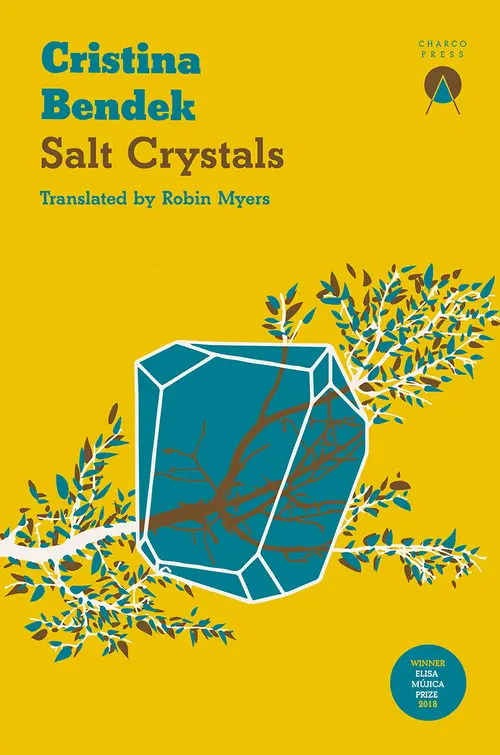
Salt Crystals
First published by Charco Press 2022
Charco Press Ltd., Office 59, 44-46 Morningside Road,
Edinburgh EH10 4BF
Copyright © Cristina Bendek, 2018
First published in Spanish as Los cristales de la sal (Laguna Libros)
English translation copyright © Robin Myers, 2022
The rights of Cristina Bendek to be identified as the author of this work and of Robin Myers to be identified as the translator of this work have been asserted by them in accordance with the Copyright, Designs and Patents Act 1988.
Work published with support from the Reading Colombia Translation Support Programme / Obra editada con apoyo del programa Reading Colombia, cofinanciación a la traducción
All rights reserved. This book is copyright material and must not be copied, reproduced, transferred, distributed, leased, licensed or publicly performed or used in any way except as specifically permitted in writing by the publisher, as allowed under the terms and conditions under which it was purchased or as strictly permitted by the applicable copyright law. Any unauthorised distribution or use of this text may be a direct infringement of the author’s and publisher’s rights, and those responsible may be liable in law accordingly.
A CIP catalogue record for this book is available from the British Library.
ISBN: 9781913867331
e-book: 9781913867348
Edited by Fionn Petch
Cover designed by Pablo Font
Typeset by Laura Jones

Salt Crystals
Cristina Bendek
Salt Crystals
Translated by
Robin Myers

Contents
I. THE DAMNED CIRCUMSTANCE
II. NOTEBOOK OF A RETURN
III. DIVISIONS
IV. LICKLE GOUGH
V. BOWIE GULLY
VI. THE PAPERS OF TIME
VII. NORTH END
VIII. SALT CRYSTALS
IX. IGUANAS ON THE ROOF
X. THE SOUTHWESTERN CARIBBEAN
XI. CREOLES AND RAIN
XII. OTTO
TRANSLATOR’S NOTE
For the islands, for their powerful spirit.
For Aura María, who rests in the sea.
Pretend that this is a time of miracles and we believe in them.
—Edwidge Danticat, Krik? Krak!
If we want everything to stay as it is,
then everything must change.
—Giuseppe Tomasi di Lampedusa, The Leopard
I. THE DAMNED CIRCUMSTANCE
I. THE DAMNED CIRCUMSTANCE
I’m from this island in the Caribbean.
I was born twenty-nine years ago on a curious coral formation, home to all sorts of people who have converged here, some against their will. I’m only just beginning to recognise the surreal nucleus from which I banished myself fifteen years ago, taking off like a shot after high school, which is when anyone who can escape will do. The mosquitos haven’t recognised me yet, or the sun; I’ve become more foreign than native. The expressions, the accents, the way people move and act – they all seem exotic to me now, no longer ordinary, as they once were. Every mispronounced word sets off an alarm. Every sign of overconfidence, every thrown-together plan, the lack of initiative, the sense that everything’s half-done. It all feels like knocking on closed doors, trying to wake a horde of unknown and slumbering inhabitants inside me.
My home is a tiny island in an enormous archipelago that isn’t even shown properly on maps of Colombia. Life here is a continual conversation between lethargy and longing. You can feel the passing of time in the rusty metal, in the palm trees bare of coconuts, in people’s leathery faces. I reencountered those faces, those questioning eyes, right after I got back, when I took the wrong road south. Against all expectations, I lost my way in an hour-long oval that leads you right back to where you started. The bus left me somewhere along the ring road, between Morgan’s Cave and the Cove. I had some time to think, walking three kilometres in the blistering heat, until another bus turned off the Tom Hooker route and came my way. The afternoon sun made it feel as if I’d walked three times the distance. As if the island expanded with every step I took, mocking my smallness, the sea perpetually beside and behind me.
The itchy bites on my legs, huge pink circles that shocked me on the first day, are easing after two weeks of attacks. The breeze is damp and cool at this hour. The second-floor balcony in back is my refuge, sheltering me from the heat of the house. I don’t have air-conditioning, but I have whisky. Cheap whisky, Black & White. It’s what they had in the shop. My makeshift table is an old wood-lined speaker. There’s a liquid circle left by the bottom of the glass, wetting a couple of sheets of loose paper I’ve decided to scribble on. I’m just another resident over the course of a long summer, someone else stepping onto the terrace to wipe the sweat off her face as the cicadas start to sing and the wind stirs up the dust from the crowded streets.
A cold sip trickles down my throat. The clink of ice melting in the glass. It’s a sound that brings me modest pleasure now, a calm that unclenches my aching back, slackens my arms. I hear neighs and snorts. The neighbour’s rooster crows at this time of day and any other. He sings whenever he feels like it. The animals announce the darkness and I receive it, drinking so I can drift off among the noises and the little flecks up above, the constellations that stare down at us as they always have, visible here, far from the city.
The city, my new version of hell.
A month ago, I was staring out my double-height window at the gringo café across the street, on Calle Río Balsas in Mexico City, when the intercom buzzed. Five floors down, the doorman said I’d received a package. I asked him to let the messenger in and waited at the door to my flat. My ex’s driver emerged from the elevator. He’d come to deliver a box of letters sent before I moved, accompanied by a childish note in clumsy handwriting that asked if I had time to talk. I told the driver to wait and wrote on the same piece of paper: ‘No’. I went back inside, tossed the box to the floor, pulled on some faded jeans, a white t-shirt and trainers, and left to take a walk around the city, not bothering to shower. I wanted to walk patiently, like when I first arrived, when I was still awestruck by neo-colonial façades, art deco, and monuments to History.
My divorce, as I’ve dubbed it, overlapped with a call from the woman who was taking care of this house on the island. From six thousand kilometres away, speaking in the accent my childhood taught me to associate with affection, she said she was selling her things and leaving San Andrés for good. Her mother was ill and alone in a village in Sucre; besides, island life was getting more and more stressful. She asked me where she should leave the keys in mid-July. I said I’d call her back on Monday and hung up. My mind raced every which way, but it wasn’t hard to connect the dots.
That Saturday after she called, I started counting my steps, which I felt pounding in my temples. I was still dazed in the aftermath of a recent relapse. I walked and walked, taking in the cafés and empty restaurants. Unlike the rest of the city, the neighbourhood was still quiet at that hour. I didn’t greet anyone in passing, even though every face looked familiar to me. After a while, after a certain number of contacts and routines, any place begins to feel like a village, no matter how vast.
I walked until I lost count. I could have walked all the way to the Basílica de Guadalupe, to the Cerro del Tepeyac, but I turned back towards Avenida Juárez at the roundabout and monument to Cuitláhuac. I passed the Palacio de Bellas Artes and the lavish old Post Office building and headed down the Francisco I. Madero pedestrian street to the Zócalo. I kept seeing the same people over and over, as if my surroundings were unspooling, unfolding like a sheaf of papel picado, to my right, to my left, revealing identical, symmetrical figurines against a sterile concrete backdrop. The melody of the organ-grinders on the street corners, activated by the beggar’s tired arm turning a crank, made the city feel like a spoof of a tawdry circus. After a glimpse of the Mexican flag rippling in the Plaza de la Constitución and the white tents of protesters occupying the square, protesting the forced disappearance of the students from Ayotzinapa, I retreated to my neighbourhood, Cuauhtémoc. I took Paseo de la Reforma towards the Korean district, gazing once again at the goddess Nike atop her pillar, the monument planted in the middle of the roundabout at the intersection with Avenida Florencia. I remembered the wonderment I’d felt at my first glimpse of the gilded angel. It was like I’d been a completely different person then: someone who felt such peace on those nights, who found a seat and gazed transfixed by the goddess bathed in purple light, by the imposing shadow of the bronze lion cast onto the façades of the skyscrapers. The goddess, whose voice I’d once heard in my head, had fallen silent; she didn’t interrupt my unease or my doubts, as if that part of my consciousness had given me permission to surrender. I shot her a sidelong glance, submissively sad, too listless to be angry.
I took out my phone and inserted my earbuds. I called a co-worker from my branch who lived nearby, and we arranged to meet at a chain café. I needed help with an insurance claim and a couple of renewals. I told her I’d be gone a few weeks, maybe a few months, and offered her a percentage of my commissions for managing the portfolio while I was away. ‘Wait, how long is this trip again? What about Roberto?’ she asked in her heavy Mexico City accent. She looked at me with her large, dark, meek eyes. Who knows how long, I said. We chatted for a couple of hours. On my way home, I called someone I knew would be interested in sub-letting my flat, where I’d just renewed the lease. It had two bedrooms and an enormous living room, and it was in a beautiful functionalist building, an architectural jewel. It had taken me ages to find something I liked: partially furnished, eclectic décor, quiet despite its central location. I’d just rent a storage unit so I could keep some furniture there, along with some clothing that would be of no use to me in the Caribbean.
I was torn when I left, although the city didn’t put up much of a fight. Of course I heard from friends, co-workers, new would-be lovers. Of course I could have hung in there. But what for? Just because I could, just to prove that I could – to break myself in obeisance to the past and its decisions, to keep a few promises to myself, rigid as a straightjacket, to stay busy and distracted, to save myself from the fear I’d felt after my parents’ accident and my diagnosis. Years ago, I would rather have died than retrace my steps and return to San Andrés, which is what you do when you don’t know what the fuck you really want.
The glass sweats thickly and the final bits of ice flounder into dissolution. Instinctively, I keep scanning the skirting board and the corners of the ceiling. But I don’t find anything this time, and there are no cockroaches on the terrace, just a couple of salamanders chirping away. I return to my stopgap table, to the speakers that haven’t played any music in at least twenty years. I don’t need it, either. In the distance, at the farthest limits of my hearing, beyond the roar of the turbines, an accordion plays.
The flight back to Colombia was the most pleasurable experience I’ve had in a long time, no doubt about it: better than flying to conferences or commercial triumphs, better than Roberto’s pleas or saying goodbye to my friends. As we took off, I saw, through my aching, swollen eyes, the Valley of Mexico’s two volcanoes, the two mythical lovers: the warrior and the princess. Sleeping Iztaccíhuatl was craggy and stripped of her snow; Popocatépetl spouted steam. Bidding them farewell from a distance, I felt the magic again, like when I first fell in love with the modern ruin that sprawls at the lovers’ feet. When did it lose its lustre in my eyes? I really couldn’t say. Mexico City rejuvenated me. I learned to live with my chronic illness, to drink mezcal without my blood sugar skyrocketing and to love a stranger who offered what he could.
Then, little by little, the city swallowed me whole: its vices, its machismo, its acid rain, its omnipresent film of smog, its hypocritical people, Roberto and his lies. One day I bought a magazine and an insert about the Caribbean fell out. Out of the blue, I remembered this was where I came from, this world of outlandish beauty. After my worst attack of hypoglycaemia since my parents’ death, after a nightmare day that culminated in a fainting spell in rush-hour traffic, I decided I need to be here: isolated, alone.
Dogs bark.
The cicadas help me forget: I’m lulled by their sweet cadence, and for a moment I stop thinking about how my blood sugar levels have to stay under 130 milligrams per decilitre, but that if they drop below seventy I could pass out, that I learned all of this as if to distract myself from my years-old grief so I wouldn’t die, too. But my mind repeats it again, like a lightning bolt, a survival kit. I pricked my fingers every day, all day long; I developed tiny calluses on the tips; every single one of my three daily insulin injections was sheer torture. They don’t hurt anymore. I don’t even feel them. Then came the sensor I use now: I can check my levels by scanning a little black monitor. It has said 100, stable, for the past two hours. I have to count all the time. It’s an automatic operation by now: how many grams of sugar and carbohydrates, how many insulin units, how many hours I fast, calories, how many minutes of physical activity. Now that I think about it, my life was easier here.
In one way, San Andrés is just as I remembered it when I saw that issue of Forbes Travel: it’s not luxurious nor manicured like Curaçao or the British Virgin Islands. The ocean is captivatingly beautiful, unchanged since my last glimpse of it through the window of the plane that took me to Bogotá. Now that I’ve broken the habit, I’m sure I’ll fall in love with the landscape again. I also know that the Caribbean, at least this Caribbean, is a total disaster. I know it’s slow, that it moves to its own rhythm. Complaining doesn’t accomplish much. No one cares about missing appointments, cancelling at the last minute or two hours after the fact. As for builders, forget it. Making plans is sheer bullheadedness; people do it more as a formality than because they actually intend to see them through. Something extravagant can happen at any moment. I may as well keep an open mind so I won’t lose my patience, if only for sanity’s sake.
It was a moving experience to fly over the archipelago again. I was exhausted from leaving Mexico, from all my half-endings, from the layover in Bogotá. After an hour and a half in the air, I felt the shift of the initial descent, and green streaks appeared in the dark blue expanse. I closed my eyes and started to imagine my body immersed in salt water. Soon the southeast cays appeared. From above – I didn’t remember, or maybe I’d never noticed – they form an enormous butterfly edged with the white foam of waves breaking against the reef. The plane veers to the right, descends a little lower, and something incredible emerges from the clouds: the famous seahorse, surrendered to its element, outlined by the coast of rocks and beaches. The island looks like a tiny animal, a sailor, a piece of this archipelago and its fantastical coincidences. It’s so tiny. The plane cruises along the eastern part, over the ocean, until it touches down and brakes immediately on the short runway of the northern tip. The passengers applauded the landing that day: they’d reached paradise at last. Although, flanking the runway on both sides, the little brick houses look flayed, the streets dusty and exposed. When the doors opened, I was hit by that singular smell: salt, coconut, the fishy whiff of a fresh catch. I grumbled: would we still have to take the stairs off the plane, stumbling around with our carry-ons? I glanced to my right, to the house of triangular roofs that is the airport. Both boarding bridges hung flaccid from the shoddily painted building. I felt a surge of irritation. Then I looked in front of me and saw the canoes and motorboats stationed beyond the little fishermen’s wharf, the road past the end of the runway, and Johnny Cay, the islet, which looked enormous to me, as if it had drifted closer to San Andrés. I forgot my annoyance and stared out at the wheeling seagulls and frigatebirds. I was soon flooded with a sense of gratitude so fierce I nearly wept. Two more planes released their passengers onto the unmarked platform. Three men clumsily lowered a wheelchair-bound old woman down the staircase of an Airbus operated by an airline I didn’t recognise.
After I walked down the ramp and overtook the Colombian tourists using selfie sticks to capture themselves with the plane in the background, the tall woman choreographing new arrivals invited me to join the queue of passengers from the previous flight. I attempted a smile that was more like a flippant grimace and kept inching my way towards the cubicle where residents and Raizals are registered.
The Story Continues on BooksBarbecue!
Enjoyed this preview? ❤️ Do not stop here!
Read the complete book free online → 🔗
Continue reading now on BooksBarbecue and discover every page!
Love reading? Bookmark BooksBarbecue.com for more amazing books!
Happy Reading!