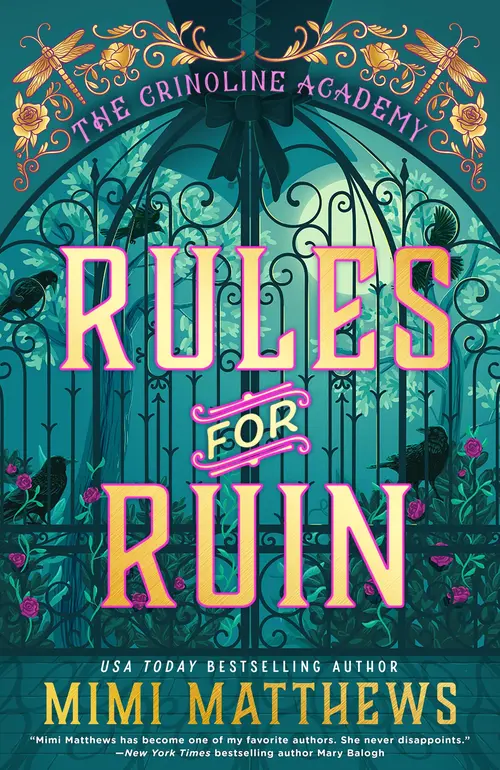
Rules for Ruin
Cover
Praise for
Mimi Matthews
“Shiveringly gothic…. Watching Julia blossom away from prying eyes is almost as satisfying as seeing Jasper Blunt pine for her from nearly the first page…. For best effect, save this one for a windy night when trees scrape against the windowpanes.”
—The New York Times Book Review
“No one writes Victorian romance like Mimi Matthews, and her Belles of London series just keeps getting better! No-nonsense Lady Anne has renounced marriage and devoted herself to two things—her band of equestrienne friends and her widowed mother still locked in deepest crepe-veiled mourning. But a dashing former suitor blasts back into Anne’s shuttered world, bringing passion and change in his wake, and Anne must decide if she will embrace life or remain safe in her chrysalis. The Lily of Ludgate Hill made me smile from beginning to end.”
—New York Times bestselling author Kate Quinn
“Mimi Matthews never disappoints, with richly drawn characters and couples whose individual shortcomings become strengths when paired together. In this ‘Beauty and the Beast’ retelling, we get to root for two underdogs who get to rewrite their own stories.”
—#1 New York Times bestselling author Jodi Picoult
“Mimi is truly a national treasure. All of her books are filled with such delicious chemistry and heart, and her writing is superb. This one is another winner. Highly recommend.”
—#1 New York Times bestselling author Isabel Ibañez
“Mimi Matthews has become one of my favorite authors. She never disappoints.”
—New York Times bestselling author Mary Balogh
“What I love about Mimi Matthews is that in the crowded field of historical romance, she always finds new and interesting slants for her plots and characters. That, along with her wonderful writing and meticulous research, makes every book she puts out a rare treat to enjoy and savor. Highly recommended!”
—New York Times bestselling author Kate Pearce
“Mimi Matthews just doesn’t miss. The Belle of Belgrave Square is exquisite, a romance that delivers the perfect balance of passion, tension, and tender moments.”
—USA Today bestselling author Evie Dunmore
“Lush, seductive, original—The Siren of Sussex drew me in from the first page and wove its magic. A fresh, vibrant, brilliant Victorian romance, making it an unforgettable read.”
—New York Times bestselling author Jane Porter
“Mimi Matthews is a master at combining rich historical detail with an emotionally tender love story. Watching Anne come into her own while Hart’s long-denied flame for her nearly burns him alive was absolutely delightful. I loved The Lily of Ludgate Hill, and I hope this series never ends.”
—Harper St. George, author of The Stranger I Wed
“I’ve long been a devoted fan of Mimi Matthews, and with The Lily of Ludgate Hill, the delightful continuation of her Belles of London series, my admiration of her work has only increased. Her command of historical detail is faultless…. I loved Anne and Hart, was instantly and completely consumed by their tangled past and seemingly impossible future.”
—International bestselling author Jennifer Robson
“This story unfolds like a rose blooming, growing more and more beautiful as each delicate layer is revealed. A tender, luminous romance. I loved it more and more with every chapter!”
—USA Today bestselling author Caroline Linden
“Absolutely enthralling: an endearing, novel-reading heroine who’s in dire danger; a swoonworthy war hero with a scandalous past; and secrets, lots of secrets. Mimi Matthews’s The Belle of Belgrave Square is a thrilling, emotion-packed read from start to finish. I loved it!”
—USA Today bestselling author Syrie James
“The best book I’ve read in a long time: gorgeously written, thoughtfully considered, swoonily romantic, and unafraid to examine issues of class, race, and gender.”
—National bestselling author Olivia Dade
“A moving love story and a vivid re-creation of Victorian life, The Siren of Sussex by Mimi Matthews is a treat of a book for the historical romance lover.”
—Award-winning author Anna Campbell
Titles by Mimi Matthews
Belles of London Novels
The Siren of Sussex
The Belle of Belgrave Square
The Lily of Ludgate Hill
The Muse of Maiden Lane
The Crinoline Academy Novels
Rules for Ruin
Dedication
For Daisy Mae
Epigraph
They tell us, again, in a bustling street
Our Crinolines hurt their poor legs or feet.
Not badly, I trust,—’twere the doctor to pay,
My recipe is, keep out of our way.
—Leichter Hock, Crinoline in Its Bissextile Phases, 1864
Prologue

April 1864
Euphemia Flite stood outside the iron gates that formed the fortresslike entrance to the bleak stone manor house beyond. The institution’s name was wrought in heavy black filigree letters in the arch above: Miss Corvus’s Benevolent Academy for the Betterment of Young Ladies.
Spring storm clouds drifted overhead, darkening an already gray sky. They lent an ominous air to the sprawling estate’s barren gardens and high weathered granite walls. To the public, it was nothing more than a charity school—the dignified remains of a once grand property outside of London, where ragged orphans and street urchins were taught the skills necessary for honest employment.
Effie had been one of those urchins. The first one. To her, the Academy hadn’t been a school. It had been a prison. Her stomach trembled on an uncharacteristic quiver of anxiety to see it again.
It had been more than five years since she’d last passed through its gates. Then, she’d been leaving—a headstrong girl of eighteen, cast out by the Academy’s proprietress, Artemisia Corvus, herself. But it hadn’t been an absolute expulsion. It had only ever been an exile. Effie had understood then, as surely as she’d understood anything, that one day, whether she liked it or not, Miss Corvus would summon her back.
A week ago in Paris, that day had finally arrived.
Setting her shoulders against the chill, Effie waited for someone to let her in. She’d come straight from the railway station. She was still in her black silk traveling dress, a veiled bonnet perched atop her stylishly arranged ebony hair, and a heavy carpetbag clutched in her gloved hands. Her small black poodle, Franc, was comfortably ensconced within.
Sensing her uneasiness, he poked his beribboned head out of the bag’s opening. He looked at her briefly, as if to reassure himself she had the situation in hand, before turning to peer through the gates. His lip twitched in a preemptive snarl.
Effie gave him an absent scratch to soothe him.
Miss Corvus employed no gentleman porter. During Effie’s time as a student, the gates had been manned by the junior teachers. Several minutes passed before a door at the side of the house opened and one of them finally emerged. The young woman advanced slowly down the pebbled drive, a heavy shawl drawn around her narrow shoulders, and a large ring of keys in her hand. A pronounced limp marred her gait.
It was Penelope Trewlove. Nell, as she was called by her intimates. There was no mistaking that glossy flaxen hair and beguiling heart-shaped face.
Catching sight of Effie, Nell’s angelic countenance was transformed by a roguishly dimpled smile. “I confess, I didn’t truly believe you’d come,” she said as she drew closer. “Not even when we received your wire from Calais.”
Effie smiled in return. It was genuine, not artifice. A rarity with her. So much of her conduct these past several years had been studied instead of spontaneous.
But this was Nell, not an adversary. A version of Nell remarkably unaltered by the passage of time.
Granted, she may have grown taller, and her cheeks were slightly less plump, but her eyes had retained their mischievous sparkle, and her figure was still something to be envied. Above all, she was familiar. Far more emblematic of home than the cold, unwelcoming structure that loomed behind her.
“Nell,” Effie said warmly. “I’d hoped yours would be the first face I saw.”
“Never mind my face.” Nell’s gaze swept over Effie in glowing approval as she came to a halt on the opposite side of the gates. “How well you look! Lovelier even than when you left us. That’s Paris’s doing, I’ll wager.” Her smile broadened, revealing a glimpse of her crooked front tooth. “And this must be the famous Franc!”
Franc stared back at Nell through the bars. He offered none of his usual grumbles. He seemed to sense she was an ally rather than a foe.
“Franc,” Effie said, introducing him as formally as if he were a gentleman acquaintance. “This is Miss Trewlove.”
“How do you do, Franc?” Nell’s dimples appeared again. “Oh, what a little dear he is. And what a continental air he has about him! I feel as though he’s judging the unfashionableness of my gown.” Her attention fell to the barren ground at Effie’s booted feet. “But where are all the rest of your things? Have you not brought any trunks with you from Paris?”
“I left them at Waltham Station. I shall send for them directly after I speak with Miss Corvus.” Effie paused. “Providing you let me in.”
Nell gave an eloquent grimace. “Yes, yes. Of course. I’m sorry I kept you waiting. Especially in this weather. It’s bound to rain any moment.” She shuffled through the key ring, selecting a large black iron key. “I trust you haven’t been standing here long?”
“The hackney cab set me down not ten minutes ago.”
“Ten minutes? Upon my word. I’m surprised you didn’t pick the lock.”
Effie’s smile dimmed. “Is that what the Academy’s students have been reduced to in my absence? Parlor tricks?”
Nell slid the heavy iron key into the lock, opening the tall gates with a grating scrape of metal on metal. “What you call parlor tricks, I call useful skills.”
Effie didn’t doubt it. Nell had always believed in Miss Corvus’s questionable aims. It was one of the primary reasons Nell had agreed to stay on as a junior teacher. Indeed, on coming of age, Nell and Effie had both been given that option—a five-year contract, after which they could either remain at the Academy permanently or depart, with a small stipend, to seek their fortunes.
Miss Corvus liked to keep her special girls close. And, as the first and second members of the inaugural class of the charity school, Effie and Nell had been the most special of all.
The gates swung open with a creaking groan. Effie walked through them to embrace her old schoolmate. “Some skills are more useful than others,” she said.
Nell hugged her tight in return. “Had you no cause to pick any locks while you were companion to Madame Dalhousie?”
“Not a one, thank heaven.” Effie’s duties had been confined to accompanying the eccentric widowed madame to art and literary salons, lavish balls, stately dinners, and other social events of both the respectable and unrespectable variety. Such was the life of a lady’s companion, even one lucky enough to live in the City of Light.
“Pity,” Nell said. “You’ll be out of practice for what lies ahead.”
Effie drew back, brows notched in a frown. She searched Nell’s face. “It’s like that, is it?”
“Naturally.” Nell released her. “You must have realized it when you received my sampler.” She moved to lock the gates behind them, visibly proud of herself. “Clever, was it not?”
The sewing sampler had arrived at Madame Dalhousie’s apartment in Paris last week. A masterpiece of advanced embroidery, it had been composed of delicate colored threads stitched into a rectangle of coarse cloth, depicting a stone house and gardens, a jumbled alphabet, and a flock of birds circling above. Four ravens, to be precise, one of which had a white-tipped wing. The latter was the unofficial symbol of the Academy, and a necessary component of any secret message. Taken altogether, it had been a simple enough code. Effie had used it to spell out the unmistakable command: FLY HOME.
“Ridiculous, more like.” Effie’s tone held no malice. Among all the residents of the Academy, Nell was the only one whom Effie counted as a friend. They had corresponded semi-regularly during Effie’s exile.
Together, they returned up the pebbled path to the house. Nell’s leg hitched with every step. Effie felt the motion as much as saw it. The guilt she nurtured over her part in the childhood accident that caused Nell’s injury sprang anew. It never really left her, that guilt, despite the fact that Nell had long professed to hold no resentment over the past.
“You might simply have written a letter to me,” Effie said, “rather than making a riddle of it.”
“How dull that would have been.” Nell linked her arm through Effie’s. “It was far more amusing to practice my stitchery.”
Their full skirts pushed against each other as they walked. It was impossible for them not to, given the respective size of their wire crinolines. Miss Corvus wasn’t a lady to entertain the whims of fashion, but she had made an exception for the controversial, and seemingly impractical, cage-like undergarment. All of her teachers donned them, and most of the older orphans, too. Both Effie and Nell wore theirs like armor.
No one could easily get close to a girl wearing a wire crinoline, not without thoroughly disarranging her. Its sheer circumference provided a modicum of protection. But its daunting size had another purpose. A crinoline made even the smallest female an intimidating creature. She took up space for herself—demanded space—in a world where ladies were too often diminished and ignored.
“People never trouble to examine samplers too closely, I find,” Nell continued. “And when they do, they’re only searching for the flaws, never the meaning. It makes them an ideal vehicle for sending secret messages.”
“You’re a modern-day Madame Defarge,” Effie remarked.
Nell’s eyes twinkled. “Except my messages are all for the good.”
Effie gave Nell a speaking glance as they ascended the front steps to the house. “That remains to be seen.”
Like the exterior of the house, the interior of the formal entry hall was composed of aged stone, worn over the centuries to a buttery sheen. Faded carpets covered the floor, and moth-eaten tapestries adorned the walls, along with two large, gilt-framed oil paintings. One was an excellent reproduction of Gentileschi’s Judith Slaying Holofernes. It had been there since Effie had first arrived at the Academy as a girl. A terrifying painting for a child to behold.
The other painting had been there as well. It was a portrait of a dark-haired woman in a lusterless black dress, standing tall and strong in the silhouette of a doorway. But it was no ordinary rendering, made to flatter its subject. The woman in this portrait had her back to the viewer. Her face was completely hidden from view.
Effie had once heard Miss Corvus offer an explanation of the portrait to a questioning gentleman who had come to inspect the premises on behalf of the parish council. “The modest woman conceals her face,” she’d told him.
It was as good a story as any, and one that had well satisfied the pious man. But it wasn’t the truth, as Effie would learn.
She deftly removed her bonnet with one hand, still holding her carpetbag in the other. Franc scanned the hall, his liquid brown eyes unblinking as he took in his strange surroundings. He offered another low growl.
There was no one about to inspire it. At this time of day, the inmates of the Academy would all be in their classes, sectioned off into the various rooms of the house like busy little bees in a hive.
But what of the Queen Bee?
When last Effie had faced her, Artemisia Corvus had been in her fourth-floor study—a remote tower room filled with books, antiquated papers corded with ribbons, and a bewildering filing system, the secret of which was known only to its equally secretive inventor.
“Where is she?” Effie asked, moving toward the broad, blackened oak staircase at the edge of the hall. “In her study?”
“Not there.” Nell set a hand on Effie’s sleeve, gently arresting her step. “She’s in her private quarters.”
Effie’s brows lifted. Miss Corvus never received any of the girls in her private rooms. Not even the teachers. At least, she hadn’t during Effie’s tenure. Miss Corvus’s rooms had always been sealed off, as impenetrable as a tomb, behind an impassable set of tall, iron-banded wooden doors. Not even the canniest members of the Academy had dared attempt entry.
Nell directed Effie down the hall. “She caught a fever some months ago. It weakened her considerably. Stairs have become difficult.”
Effie’s already uneasy stomach jolted at the news. She couldn’t fathom Miss Corvus being weakened by anything. To Effie, the Academy’s proprietress had always seemed invincible. “Is she—?”
“She’s recovering,” Nell said. “But slowly.” She guided Effie down the long corridor and through the high stone archways that led past the library and the old conservatory. A right turn into a narrow passage brought them to the very set of iron-banded doors that separated the public rooms from the private.
Nell’s expression sobered as she stopped in front of them. “I won’t go in. Miss Corvus insists on speaking with you alone.”
“Does she, indeed?” Effie lifted Franc from his carpetbag and set him down on the stone floor. He gave a perfunctory shake before springing into motion. Effie caught hold of his lead before he could gallop off. Franc was a loyal companion, but he was also a rogue. He couldn’t resist wandering.
She handed the lead to Nell. “If you would be so good as to take him for an airing? And pray don’t let him loose. He’s swift as a greyhound when he chooses to be. You’d never catch him.”
Nell didn’t ask any questions. She knew all about Franc’s little foibles from Effie’s letters. “I shall take him to visit the hedgerow,” she said. “Look for me when you’re done.”
Effie waited until Nell had gone before rapping twice on the door. There was a taut moment of silence before Miss Corvus answered from within.
“Come,” she said.
The clipped, frost-edged voice had its usual effect on Effie. It was a reaction borne from a memory too distant to recall as anything more than primitive emotion. It made Effie long to shrink back into herself. To make herself invisible. Maybe then Miss Corvus wouldn’t see her. Wouldn’t take her away.
But Effie had never excelled at being invisible.
Stiffening her spine, she opened the door.
• • •
Effie was met by the unsettling prospect of a darkened sitting room. The curtains had been drawn shut, and no candles had been lit. There remained only enough light to see the heavy mahogany furnishings, the vases filled with crumbling bouquets of dried flowers, and the shrouds of black fabric that covered the pictures on the walls and the mirror hanging over the fireplace.
For all Miss Corvus’s progressive views, for all her insistence on looking to the future, this was a chamber firmly enshrouded in the past. A veiled room, all stale darkness and decay.
Miss Corvus had been similarly veiled the first time Effie had seen her that fateful day eighteen years ago in the London slum of St. Giles.
But Miss Corvus wasn’t veiled now.
She sat in a green damask–upholstered armchair by the window, her uncovered face as white as wax. She was clad in stark black, just as Effie was—a plain, but impeccably tailored, silk dress worn over an abundance of petticoats and a formidable wire crinoline. A jet brooch gleamed at her throat, and an embroidered lace handkerchief was clutched in her pale hand.
There was a low inlaid malachite table beside her chair. A tray sat upon it, holding a pitcher of water, a single glass, and a small, stoppered brown bottle with a label pasted on it. Some sort of medicinal tonic, Effie suspected.
Shutting the door behind her, she crossed the room to join her former teacher.
Miss Corvus watched her come with a raptor-like intensity. In appearance, she was all but unchanged from the enigmatic lady who had entered her life when Effie was a child. Only the threads of silver in her hair, the fine lines at the corners of her eyes, and the grooves bracketing her perpetually disapproving mouth betrayed the truth of Miss Corvus’s age. She was approaching fifty. A great age for a woman, especially an unmarried one whom the years had made peculiar.
Effie stopped in front of her. She dropped a graceful curtsy, honed to a perfect degree of fashionable elegance in the drawing rooms of Paris. “Miss Corvus.”
“Miss Flite,” Miss Corvus replied in the same icy tones. “I see my money has not been wholly wasted.” She motioned for Effie to step back. “Let me look at you.”
Effie remained standing, back straight and chin lifted, silently submitting to Miss Corvus’s cold perusal. She examined Effie from top to bottom. The thick ebony hair worn back in a stylish plaited roll. The catlike blue eyes so dark they might be mistaken for violet. The solemn face, with its black arching brows, high cheekbones, and wide, voluptuous mouth. And the figure—lithe and athletic, but not lacking in curves.
Taken along with Effie’s striking complexion (a clear rich hue that lingered somewhere between dark ivory and olive), the whole of her appearance made her less a traditionally pretty girl and more a compellingly seductive mystery. People couldn’t help but stare. Couldn’t help but wonder. Who was she? they whispered. Where did she come from?
The very questions Effie had begun to ask herself. The ones that had resulted in her being sent away five years ago.
“I rarely get things wrong,” Miss Corvus said when she’d finished taking Effie’s measure. “But I readily own my mistakes.” She signaled for Effie to sit with an impatient flick of her hand.
Effie gave Miss Corvus a sardonic bow of acknowledgment before taking the seat across from her. She was confident enough in her own attributes to recognize the hidden compliment in her former schoolmistress’s words.
“You were a pretty child, but had no promise of great beauty,” Miss Corvus went on. “Not like Miss Trewlove. It was she who was meant to grow into my Aphrodite incarnate.”
“Hence her name,” Effie said.
“While you…You were meant to soar.”
The Story Continues on BooksBarbecue!
Enjoyed this preview? ❤️ Do not stop here!
Read the complete book free online → 🔗
Continue reading now on BooksBarbecue and discover every page!
Love reading? Bookmark BooksBarbecue.com for more amazing books!
Happy Reading!