Rites of Passage
Cover

Sanjoy Hazarika
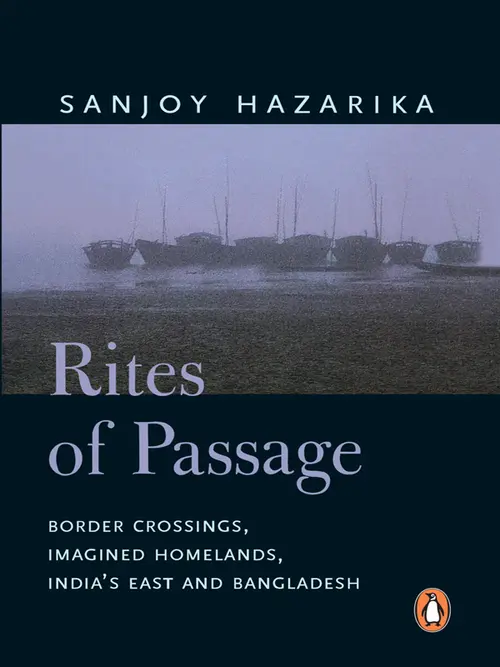
Rites of Passage
Border Crossing, Imagined Homelands, India’s East and Bangladesh

PENGUIN BOOKS
PENGUIN BOOKS
RITES OF PASSAGE
Sanjoy Hazarika was born in Shillong, then capital of the undivided state of Assam, in 1954. He studied at Shillong, London and Cambridge, Massachusetts, at Harvard University, and was a correspondent for the New York Times out of South Asia between 1981–1996. Formerly a member of the first National Security Advisory Board, he is now part of the National Commission to Review the Working of the Constitution. He has also set up a Centre for North East Studies and Policy Research. A Senior Fellow at the Centre for Policy Research in New Delhi, Sanjoy Hazarika is a columnist for several newspapers. He also makes documentaries, especially on the North East, and is completing a film on the Brahmaputra. Sanjoy Hazarika divides his time between the North East and New Delhi where he lives with his wife and daughter.
Dedication
For Myron Weiner, friend, scholar, social historian, well-wisher of India and its North East
Foreword
Over the past years, Sanjoy Hazarika, a former reporter for the New York Times and currently a Senior Fellow at the Centre for Policy Research, has been engaged in a study on an extremely relevant issue in eastern India which has defied a solution. The question of migration has spread much bitterness and, tension in the North East of India, not to speak of violence, and troubled relations between India and Bangladesh. But many of the substantial issues have been lost in rhetoric and political posturing.
Bangladesh’s official position is that there are no illegal migrants and that India is deliberately pushing out its principal religious minority. India says that Bangladeshis are pouring into its territory. What is the truth? Why do people move? What are their stories, beyond the debris of statistics and sharp rhetoric which obfuscate the real issues?
The phenomenon of illegal migration is not limited to the geographical area of South Asia, or even Asia taken as a whole. It is an international problem that has led to conflicts in different parts of the world and an exacerbation of social, economic and environmental pressures. The Centre for Policy Research has long taken an interest in issues of population and population movements and this book is part of a larger concern in CPR about peace, development and security in the South Asian region.
The reasons behind migration, where people move from and where they are headed, the lack of a comprehensive strategy to tackle the economic and social roots of these difficulties, the use of religious radicals for purposes of ideology and destabilization, and the personal stories of tragedy, despair and hope—these combine to make an extremely readable book, written in a non-academic style that will make it appeal to a wider audience.
Rites of Passage’s passionate style and rich narrative prose plus rigorous research, are typical of Mr Hazarika’s despatches as an international reporter for the New York Times out of South Asia, and his earlier acclaimed books, Strangers of the Mist: Tales of War and Peace from India’s North East; and Bhopal: The Lessons of a Tragedy.
The voices of the unheard in the entire debate on migration are heard through this book. These are what should help determine policy on a subject as difficult as the movement of people.
Migration has resonance for the subcontinent. It raises extremely touchy emotional issues, for India and Pakistan were born in the bloodshed of Partition, and Bangladesh had a similar, bloody birth.
In parts of India, especially its North East, migration is not just an emotive question but one that is seen as related to the very survival of communities. The Assam students’ movement of the 1970s and 1980s, and other agitations elsewhere have forced even national political parties to take the issue on board. This is an important part of democratic change and debate, to bring greater understanding on a sensitive issue. Unfortunately, much of the discussion has become bogged down in rhetoric. This is where Mr Hazarika’s work comes as a breath of fresh air in policy advocacy.
There are numerous innovative ideas in Rites of Passage. Not only do they shed light on macro issues which need discussion, but they point to the direction of strategies at the ground level which can transform extremely complex problems, in a very difficult area, into opportunities.
Mr Hazarika is acknowledged as a specialist in issues relating to the North East and its neighbourhood. Through other initiatives, he also seeks to promote dialogue and understanding in civil society in that region.
The CPR is glad to have given him a base for this study. We wish to acknowledge the role of the Population Foundation for India as well as HIVOS, the Humanist Institute for Cooperation with Developing Countries, of the Netherlands, both of which funded the research.
Dr V.A. Pai Panandiker
President
Centre for Policy Research
New Delhi
21 November 2000
Chapter One
Introduction
For more than three years, I have been working on issues relating to the demographic and cultural crisis arising out of the migration of people from Bangladesh into Assam. Constituting a wedge of fertile land in India’s North East which is watered by the Brahmaputra, Assam is hemmed in by Bangladesh, Bhutan, Tibet/China, and other Indian states of the region.
This project and other associated ones have taken me several times to Bangladesh and various parts of Assam as well as elsewhere in the North East. And as my knowledge of the area and its issues has grown, so has despair at the realization of how much more needs to be done, urgently, desperately, beginning with making available better information about the area. Home to nearly 150 million people, set amid the stunning landscapes of fertile valleys, here we find back-breaking poverty and a rich cauldron of ferocious and ancient ethnic divisions and feuds. Yet, for the rest of the world, this geographical and cultural entity may as well not exist, so little is the interest in or knowledge about it. And this indifference is well known among the local people. It is a wound that festers and worsens with every passing day. After more than fifty years of independence in India, people in its North East now realize how marginalized they have become in relation to the policy-making apparatus in New Delhi and their own ruling elites at home, and how great remains the ignorance of officials, and politicians who govern them, despite all attempts to educate them. The mindsets in Delhi and Dispur remain largely unchanged.
My present concerns also flow out of interactions with villagers, scholars, professionals, politicians and bureaucrats during the course of my research, as well as with non-governmental groups and the media. Though a detailed study of relevant documents, and other theoretical literature on the subject has been done, my approach is not purely academic—anyway I am not particularly qualified to pursue such an enquiry. Our knowledge of the depth of the problems discussed here and their inter-connectivity with other concerns is limited; they need to be understood through a multidisciplinary approach. The mere collection of data or compilation of interviews is inadequate for this task. Alejandro Portes writes: ‘Data, whether quantitative or qualitative, may accumulate endlessly without producing any significant conceptual breakthrough. Indeed, much of what we do as part of our everyday work is simply to produce information on one aspect or another of social reality within the intellectual frameworks already in place, without altering them to any significant extent. Ideas, especially those of a broader reach, are few and far between and certainly do not emerge out of masses of data.’1
If the problems are multidimensional, so also must be the search for answers. A purely humanist or purely scientific and theoretical approach will not do.
I stumbled along in this search, looking for a concept that would encapsulate my longing for a multi-dimensional set of answers. Late one night, I looked at a review of the brilliant work of that great scientist and philosopher Edmund O. Wilson in a special number of World Watch. And I knew that I had found what I wanted.
A professor at Harvard and a devout Baptist as well as a dedicated biologist, Wilson talks about the unity of knowledge, or consilience (a concept that was given this name by the scientist William Whewell as far back as 1840), which is essential in the logical study of any complex issue in today’s world. He urges us to span disciplines, and jump across the boundaries of fact and theory.
It is an exhilarating thought—that the ‘experts’ do not have the answers. That it is only through the weaving together of many strands by different disciplines of work, study and thought, that we will be able to break away from the deadening influence of fragmented knowledge. Wisdom is never piecemeal—it is complete, and rounded.
According to Wilson, it is that leap across the frontiers that will enable us to address long-term problems by following the path of interconnectivity, not of separate sciences and disciplines. Thus, for example, we have to look at land degradation and crop loss in the context of the fragility of our ecosystems, the instability of political groupings, the gross over-exploitation of water resources, the need to educate all levels of society on these questions, and the need to integrate this knowledge into information systems.
These are seemingly disconnected strands. But they appear disconnected since we have made them so. Problems will remain intractable so long as we divide them into comfortable and neat compartments and rationalize ways of tackling them. Take, for example, migration.
It is the outcome of a series of factors which, as in the case of Bangladesh, a focus of this book, appear to be disconnected. Some of these factors are slow to develop, like land degradation; others are dynamic and immediately visible, such as devastating floods. The reasons for migration thus range from population density, land pressures and land-carrying capacity, erosion of river banks, to even a drop in fish catch and the pull of those who have gone before. There are religious anxieties among smaller groups. These are multidimensional issues.
People may also move because they are attracted by the prospects of ‘a better life’, not necessarily because they believe they will actually have one. They know that while life may be ‘better’, it may not be easier, at least as far as social interaction with the host community is concerned. The latter may be hostile, at least for an initial period. For example, locating Bangladeshi migrants in Assam was not an easy task. Few would acknowledge that they had come from across the border because of fear of harassment by the local police and anti-immigrant activists.
This book is an effort to place the Bangladeshi migrations into India, especially into Assam, in a perspective that seeks to reflect a multidisciplinary, multidimensional approach. The book has been organized into fourteen chapters. In the first six, we look at the problem of thresholds—of what comprises ‘carrying capacity’ in nations: the thresholds of population, land and water as well as food and energy. The pressures that make people move, the places where they go to and how they are received there, are examined. We look at the scale, scope and concepts of migration, differentiate between refugee flows and migratory movements, and then view the disasters that overtake societies when these basic problems are ignored or not understood adequately. Chapters seven to thirteen analyse the dynamics, and tragedies of the Bangladesh-Assam/North East situation. Built on extensive fieldwork and conversations in Bangladesh and Assam, they tell the stories of both those who move and others who stay behind. The last chapter addresses policy alternatives, questions of nationality and citizenship from the perspective of the people as well as that of government. It looks at what, in my view, can and must be done—now and in the near future.
The telling of this story has been shaped both by my personal experiences and views, as well as by the facts of the situation. I have deliberately avoided placing large chunks of statistics in the body of the book. Readers will find extensive statistical material in the appendices and in footnotes.
As with my other books, I have chosen to follow the narrative style of writing here, one with which I am comfortable. There may be obvious drawbacks with such a style but I risk taking this approach because I want the book to engage people and provoke them, not to languish in some distant library. I want it to force a debate, to shake up governmental and societal approaches to the issue of migration. Perhaps that is being too ambitious—but innovative thinking must shape the agenda of our governments, whether it is the result of inputs by people outside the ‘system’ or those who are in it.
We need to think with our heads. For too long we have thought with our hearts.
This approach becomes even more important when we look at the literature of migration. This can be broadly organized into two segments: one, academic writing, focusing on theory and using case studies as opportunities to establish a particular legal, philosophical or political point; two, documents from international conferences, seminars and ‘projects’. In much of this literature, the people who move, who are at the heart of this phenomenon, are mere footnotes, if even that. They are statistics not stories as they should be: voices of people resonating across time and distance, telling us of their tales, forcing us to listen and heed. They do not form the core upon which a ‘project’ rests but only ‘materials’ to forge a case and develop an idea.
Rites of Passage is an effort to give migration a human face, merging narratives and analysis. It is based on my own background as a reporter for the New York Times and other publications, my travels, especially over the past eighteen years, and the research material I developed and gathered from Assam, Bangladesh and other parts of the world. I have been engaged in this process of dialogue and policy development through my columns and lectures, seminars and workshops over the past several years, as well as through my work with the National Security Advisory Board, the newly-formed Centre for North East Studies and Policy Research and the National Commission for the Review of the Working of the Constitution. In the present work I have sought to stitch together this body of work, built up over the years.
People are on the move and their movement tells the story of a changing world.2
For migration, forced and unforced, is our history. The latter encompasses those who move, voluntarily, across state borders in search of livelihoods and cultural compacts. The former are those who have been pushed out by governments or political and social groups hostile to their very existence. They leave because they fear for their lives.
Bangladesh is an extraordinary example of a nation that has seen both trends. The best known was the 1970-71 outflow of more than nine million refugees who fled a brutal Pakistani crackdown on pro-liberation East Pakistan in 1970-71 before Indian army troops and Bangla guerrillas brought freedom to that land. But preceding and consequent to that tragic chapter in the life of the subcontinent, the movement of people for economic and environmental reasons was (and continues to be) a factor in the Brahmaputra, and Barak valleys, in tiny Tripura, not to speak of West Bengal and even across India. Visibly reshaping and transforming the demographic, ethnic, linguistic and religious profile of large parts of the population in these areas, it stirred a potent brew of hatred, suspicion and fear.
The social, demographic and political tensions spawned by this problem are too deep to gloss over or to seek quick-fix solutions like ‘throwing’ foreigners out. Some extreme, parochial groups take refuge in the Italian political philosopher Niccolò de Bernado Machiavelli, without knowing that it is him that they quote. Many ideologues of the extreme right-wing who accuse Bangladesh of trying to swamp the North East and take it over demographically, and thence politically (not to speak of economically), indirectly quote Machiavelli when they raise these fears. The Italian had declared in the sixteenth century that ‘sending immigrants is the most effective way to colonize countries because it is less offensive than to send military expeditions and much less expensive.’ It is doubtful if there is an active ‘conspiracy’ to Bangladeshize Assam and the North East, as some would have us believe. There are different reasons why people are moving and triggering the fears, hopes and concerns that they do. The fundamentalist surge in the lower districts of Assam is one of the factors for worry, but not the only one.
We need to look at the issues dispassionately and find out what solutions will work. Can anything be resolved given the complexities of the issues? During the course of our fieldwork, my researchers and I met extremely pragmatic people on either side of the border. They knew what they wanted, how it could be achieved, but they had little hope that political leaders could do it. They saw the benefits of local choice, local decisions being translated into national and regional realities. Their views as much as, if not more than, those of scholars, social theorists, politicians and officials must direct policy-formation.
Rites of Passage seeks to record and affirm their voices, besides my thoughts, and to span boundaries in a leap across disciplines, and a vision born of history.
Chapter Two
Mahesh: Encounters of the First Kind
The first ‘migrant’ I met was Mahesh, our bandy-legged cook who was fond of going ‘O mai go!’ whenever he wanted to emphasize a point. Stretched a bit, it could sound like ‘O, my God.’ But translated from Bengali into English, this means ‘Oh, my mother!’
Mahesh Chandra Das was born in Sylhet, a Muslim-majority area of the then East Pakistan that was dominated by Bengali speakers. This chunk of territory had, even before Partition, voted to be part of the separate Muslim-majority provinces, instead of staying with Assam. To this day, there are Sylhetis who like to talk about their close connections with Assam and especially with the former capital of Shillong, where many went to school—even after Partition.
Nostalgia is a hopelessly all-encompassing vice; and it is hopeless, because it constructs a world that is never a ‘now’ but one that ‘was’ or ‘could have been’.
Mahesh had moved to Shillong, the capital of Assam province to find work. He ended up as a cook at the Reid Chest Hospital, the main tuberculosis treatment centre of the North East. My father was the superintendent or chief administrator at the time. But how Mahesh got in is a story I don’t know.
Mahesh is central to this book not because he has a great story, but because he doesn’t. He was illiterate, yet, could sign his name with a flourish. Many of the people who move from nation to nation, village to city, often illegally and silently, are simple folk with simple tales, often faceless and voiceless. Often, they do not even exist as statistics because they are not enumerated. Until perhaps much later. By then they have developed a fiction of their lives: one identity in this land, another in the nation of their birth and growth. You won’t know who they are until you engage them in a conversation and that too after winning their confidence, a process that could take weeks, if not months. Because they’re always afraid that the sarkar would be watching their every step, waiting to harass, extort, pressure and oust them through its many agencies. Or worse, the sarkar would turn its back on harassment, extortion, pressure and ousters by local thugs and dalals.
Which of the two is preferable? Which is worse?
Mahesh was a Bengali-speaking Hindu, which did not really matter to us. Growing up and studying in an Irish missionary (Roman Catholic to boot) school, with a classful of other boys from all communities, labels of caste, religion and language did not really matter. I think I learned more about secularism just by being at St Edmunds’ all my school life than by reading about it, or later, through observing majoritarian or minority chauvinists at work in India and abroad.
Mahesh was a great cook; everyone used to rave about his ilish (hilsa) curry. I preferred his chicken and mutton, not being much of a fish-eater those days. It’s only now that I realize how much I missed.
If there was one thing I found obnoxious about Mahesh, it was the horrible-smelling biris which he smoked. He had this rather unsettling habit of sucking in the smoke with a long hissing sound. His cheeks would cave in, his lips would disappear and he would, ostensibly, savour the moment. Then, at the right time, with a sibilant hiss, the smoke would flow out of his nostrils and mouth. Life would be normal again, except that his lips remained stained from the last paan.
The Story Continues on BooksBarbecue!
Enjoyed this preview? ❤️ Do not stop here!
Read the complete book free online → 🔗
Continue reading now on BooksBarbecue and discover every page!
Love reading? Bookmark BooksBarbecue.com for more amazing books!
Happy Reading!