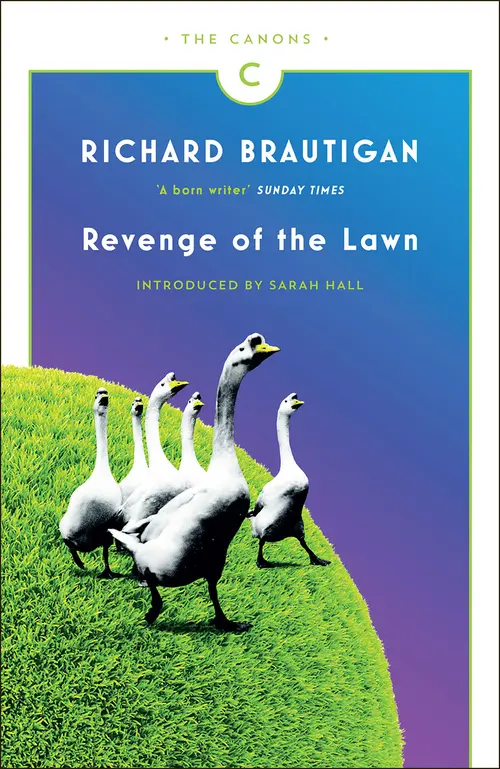
Revenge of the Lawn
Cover
Praise
Praise for Richard Brautigan
‘One of the last of the beat generation, Brautigan’s frequently autobiographical work contains strikingly poignant childhood memories and even the occasional foray into magic realism – quite wonderful.’ The Times
‘The verbal humour and zany charm of the book remain quite irresistible.’ Daily Telegraph
‘A collection of what the Americans call short shorts, or sudden fiction, by a master of the art. Poignant and surreal and laugh-out-loud funny.’ Alan Spence, Scotsman
Often defies reality with complete success – an original and charming view of the world.’ J.G. Farrell, The Listener
‘He has such a lovely touch: a born writer – he can’t be dull.’ Maurice Wiggin, The Sunday Times
‘The verbal humour and zany charm of the book remain quite irresistible.’ Daily Telegraph
‘Brautigan gets you drunk on similes, knocks you out with exquisite turns of phrase and leaves you with an ending that hits the entire novel out of the ballpark. Amazing.’ Uncut
‘His writing manages to conjure up a feeling of relaxation and well-being, somehow existing in our reality without being touched by it. Easy to fall into and over far too soon. After reading this you’ll feel like you’ve been on holiday with a friend.’ Time Out
‘Charming … the stories have memorable or beautifully handled moments of observation.’ London Review of Books
Title Page

Contents
Introduction
Revenge of the Lawn
1692 Cotton Mather Newsreel
1/3, 1/3, 1/3
The Gathering of a Californian
A Short Story about Contemporary Life in California
Pacific Radio Fire
Elmira
Coffee
‘Rembrandt Creek’ and ‘Carthage Sink’
The Weather in San Francisco
Complicated Banking Problems
A High Building in Singapore
An Unlimited Supply of 35 Millimeter Film
The Scarlatti Tilt
The Wild Birds of Heaven
Winter Rug
Ernest Hemingway’s Typist
Homage to the San Francisco YMCA
The Pretty Office
A Need for Gardens
The Old Bus
The Ghost Children of Tacoma
Talk Show
I Was Trying to Describe You to Someone
Trick or Treating Down to the Sea in Ships
Blackberry Motorist
Thoreau Rubber Band
44:40
Perfect California Day
The Post Offices of Eastern Oregon
Pale Marble Movie
Partners
Getting to Know Each Other
A Short History of Oregon
A Long Time Ago People Decided to Live in America
A Short History of Religion in California
April in God-damn
One Afternoon in 1939
Corporal
Lint
A Complete History of Germany and Japan
The Auction
The Armoured Car
The Literary Life in California/1964
Banners of My Own Choosing
Fame in California/1964
Memory of a Girl
September California
A Study in California Flowers
The Betrayed Kingdom
Women When They Put Their Clothes on in the Morning
Hallowe’en in Denver
Atlantisburg
The View from the Dog Tower
Greyhound Tragedy
Crazy Old Women are Riding the Buses of America Today
The Correct Time
Holiday in Germany
Sand Castles
Forgiven
American Flag Decal
The World War I Los Angeles Aeroplane
Introduction
Over the years, I’ve lived in a variety of places, including America, but I was born and raised in the Lake District, in Cumbria. Growing up in that rural, sodden, mountainous county has shaped my brain, perhaps even my temperament. It’s also influenced the qualities I seek in literature, as both reader and writer. In my early twenties, connecting with fiction was a difficult process. There seemed to be little rhyme or reason to what was meaningful, what convinced, and what made sense. There was a lot of fiction I did not enjoy, whose landscapes seemed bland and un-evocative, the characters faint-hearted within them, the very words lacking vibrancy. This was no doubt empathetic deficiency on my part. I wouldn’t say it was lack of imagination – if anything, roaming around moors and waterways solo can lead to an excessive amount of making-things-up, a bizarreness of mind. I suppose what I wanted to discover was writing that served these functions, and I was in danger of quitting books.
Around this age I first read Richard Brautigan. When I learned that he was from the Pacific Northwest – an equally wet, rustic, upper corner of America – the coordinates struck me as significant, I sensed a geographical cousin. True enough: this formative territory is carried within his work, not as Romantic vastification, but a sort of regional echo, possession of an underlying spirit. Though Brautigan moved to California, wrote about California, and California’s hip, sexy, psychedelic tropes become superimposed on his writing, beneath the berserker elements there remains trickling sadness, a wide-open loneliness, psychological rain. Such sensibility might partly be personal or social – the poverty of his youth and, later, mental illness. But its roots are perhaps Oregonian. In his collection of short fiction, Revenge of the Lawn, Brautigan describes the Pacific Northwest as, ‘a haunted land, where nature dances the minuet with people and danced with me in those old bygone days.’ The stories set in this territory, about hunting and fishing, childhood play and damp weather, display a kind of sobriety and straightness that the San Francisco tales often don’t; the narrator is an isolated self, on a bridge, up a river, hitchhiking home in a soaked coat. Though these pieces aren’t necessarily bound by conventional physics or literary laws, something earnest and ‘real’ rises to the surface in them, like trout in the author’s lost forest streams.
And then there are the stories where reality bends and warps, stories that seem to explode off the page. It’s also true that in my early twenties I was looking for prose with big personality – vivification and invention. Brautigan is a high stylist; his lines can be astonishing and have neon-grade memorability . . . ‘I sounded as if I had stepped in a wheelbarrow-sized pile of steaming dragon shit’ . . . ‘she opened her purse which was like a small autumn field and near the fallen branches of an old apple tree, she found her keys’ . . . ‘The way he lit a cigar was like an act of history’. But it’s very hard to label his work. Fairytale meets Beat meets Counterculture? Surrealism meets Folk meets Scat? The writing is bursting with colour, humour and imagery, mental flights of fancy, crazed and lurid details. There are wild inaccuracies and fever-dream occurrences. Bees living in hives made of liver. Bears dressed in nightgowns. Whisky-drinking geese. Heart-broken friends set fire to radios and the love-songs being played melt into each other. People pay 237 cheques into the bank at once while the narrator waits, thinking of the skeleton buried in his garden holding a can of ‘rustdust’ money. Men in debt have the shadows of giant birds attached to them.
The more you read, the less there seem to be regulations and governing forces, ways of qualifying Brautigan. The mind of the author is simply too unbound, too child-like in its enormous, regenerative capacity to imagine. I often give one of his short stories, like ‘Homage to the San Francisco YMCA’, to a creative writing student on the first day of a course. Suspecting I want them to write like Balzac or Woolf, the relief on their face is palpable. Not just relief, but sheer delight. Plumbing replaced by poetry! A man forced out of his own home by John Donne’s sonnets, Emily Dickenson, Mayakovsky, et al! Many creative writing lessons are pointless, but this one is not. Even in adulthood, and no matter our circumstances, the imagination is a phenomenally powerful device, perhaps the most powerful. Brautigan knew it; he was a master-practitioner, a high-wire act.
Though he did occasionally fall. His metaphors can be widely off the mark, some too gnomic to comprehend. Where the brutally brief length of ‘The Scarlatti Tilt’ makes it one of the best flash fictions ever written, other pieces feel boil-in-the-bag, or half-formed, more musings than anything else. A feminist Brautigan was not – women often occupy wistful sexual and aesthetic space only in the tales, are expected to get on board with men’s desires, be compliant when a character wants to get laid. He does better with old ladies and daughters, where the complicated business of sex is moot. Here there are acute character studies and even heroines. Possibly the wisest person in the entire collection is the little girl in ‘A Short History of Religion in California’, who rejects the piece of cake given to her by a Christian in the campsite where she is staying with her father. ‘I’ve already had breakfast’, she explains. She’s previously expressed a desire to be a deer, to have antlers and hooves, which, in the scheme of the story, makes perfect metaphysical sense.
If you think things work a certain way, think again, Brautigan’s stories encourage, and quite rapidly the reader does forget the normal arrangements. The shifting perspectives and playful reversals, the activation of inanimate objects, the sudden sentience of things we believe to be unthinking, the unusual possibilities of life, in the end might provide some consolation for the fact of Brautigan’s tragic death and the lessening of interest in his work over the years. ‘Perhaps the words remember me’, he writes in ‘Banners of My Own Choosing’, as if there is, or could be, a world where the letters and sentences produced by an author are capable of nostalgia, even affection. I love this idea.
Certainly the words in Revenge do justice to the writer. Perhaps because I first read him when young and those associations remain, when I go back to Brautigan I always half expect the naïve and imperfect aspects to slightly disappoint. I’m never disappointed. Those same virtuoso characteristics of limitless creativity, the lambent glower of the old country and the iconoclastic energy of the period, shine through. It still rains evocatively over the woods and valleys of the Pacific Northwest. The quotidian and the impossible walk hand in hand. There’s exceptional originality and levity to the phrase making. I’m reminded of the fundamental qualities I sought out in literature, connections that were so vital at the time, and still resonate now.
Sarah Hall
April 2014
Revenge of the Lawn
My grandmother, in her own way, shines like a beacon down the stormy American past. She was a bootlegger in a little county up in the state of Washington. She was also a handsome woman, close to six feet tall who carried 190 pounds in the grand operatic manner of the early 1900s. And her specialty was bourbon, a little raw but a welcomed refreshment in those Volstead Act days.
She of course was no female Al Capone, but her bootlegging feats were the cornucopia of legend in her neck of the woods, as they say. She had the county in her pocket for years. The sheriff used to call her up every morning and give her the weather report and tell her how the chickens were laying.
I can imagine her talking to the sheriff: ‘Well, Sheriff, I hope your mother gets better soon. I had a cold and a bad sore throat last week myself. I’ve still got the sniffles. Tell her hello for me and to drop by the next time she’s down this way. And if you want that case, you can pick it up or I can have it sent over as soon as Jack gets back with the car.
‘No, I don’t know if I’m going to the firemen’s ball this year, but you know that my heart is with the firemen. If you don’t see me there tonight, you tell the boys that. No, I’ll try to get there, but I’m still not fully recovered from my cold. It kind of climbs on me in the evening.’
My grandmother lived in a three-storey house that was old even in those days. There was a pear tree in the front yard which was heavily eroded by rain from years of not having any lawn.
The picket fence that once enclosed the lawn was gone, too, and people just drove their cars right up to the porch. In the winter the front yard was a mud hole and in the summer it was hard as a rock.
Jack used to curse the front yard as if it were a living thing. He was the man who lived with my grandmother for thirty years. He was not my grandfather, but an Italian who came down the road one day selling lots in Florida.
He was selling a vision of eternal oranges and sunshine door to door in a land where people ate apples and it rained a lot.
Jack stopped at my grandmother’s house to sell her a lot just a stone’s throw from downtown Miami, and he was delivering her whiskey a week later. He stayed for thirty years and Florida went on without him.
Jack hated the front yard because he thought it was against him. There had been a beautiful lawn there when Jack came along, but he let it wander off into nothing. He refused to water it or take care of it in any way.
Now the ground was so hard that it gave his car flat tyres in the summer. The yard was always finding a nail to put in one of his tyres or the car was always sinking out of sight in the winter when the rains came on.
The lawn had belonged to my grandfather who lived out the end of his life in an insane asylum. It had been his pride and joy and was said to be the place where his powers came from.
My grandfather was a minor Washington mystic who in 1911 prophesied the exact date when World War I would start: 28 June 1914, but it had been too much for him. He never got to enjoy the fruit of his labour because they had to put him away in 1913 and he spent seventeen years in the state insane asylum believing he was a child and it was actually 3 May 1872.
He believed that he was six years old and it was a cloudy day about to rain and his mother was baking a chocolate cake. It stayed 3 May 1872 for my grandfather until he died in 1930. It took seventeen years for that chocolate cake to be baked.
There was a photograph of my grandfather. I look a great deal like him. The only difference being that I am over six feet tall and he was not quite five feet tall. He had a dark idea that being so short, so close to the earth and his lawn, would help to prophesy the exact date when World War I would start.
It was a shame that the war started without him. If only he could have held back his childhood for another year, avoided that chocolate cake, all of his dreams would have come true.
There were always two large dents in my grandmother’s house that had never been repaired and one of them came about this way: In the autumn the pears would get ripe on the tree in the front yard and the pears would fall on the ground and rot and bees would gather by the hundreds to swarm on them.
The bees somewhere along the line had picked up the habit of stinging Jack two or three times a year. They would sting him in the most ingenious ways.
Once a bee got in his wallet and he went down to the store to buy some food for dinner, not knowing the mischief that he carried in his pocket.
He took out his wallet to pay for the food.
‘That will be 72 cents,’ the grocer said.
‘AAAAAAAAAAAAAAAAAAAAAAA!’ Jack replied, looking down to see a bee busy stinging him on the little finger.
The first large dent in the house was brought about by still another bee landing on Jack’s cigar as he was driving the car into the front yard that peary autumn the stock market crashed.
The bee ran down the cigar, Jack could only stare at it cross-eyed in terror; and stung him on the upper lip. His reaction to this was to drive the car immediately into the house.
That front yard had quite a history after Jack let the lawn go to hell. One day in 1932 Jack was off running an errand or delivering something for my grandmother. She wanted to dump the old mash and get a new batch going.
Because Jack was gone, she decided to do it herself. Grandmother put on a pair of railroad overalls that she used for working around the still and filled a wheelbarrow with mash and dumped it out in the front yard.
She had a flock of snow-white geese that roamed outside the house and nested in the garage that had not been used to park the car since the time Jack had come along selling futures in Florida.
Jack had some kind of idea that it was all wrong for a car to have a house. I think it was something that he had learned in the Old Country. The answer was in Italian because that was the only language Jack used when he talked about the garage. For everything else he used English, but it was only Italian for the garage.
After Grandmother had dumped the mash on the ground near the pear tree, she went back to the still down in the basement and the geese all gathered around the mash and started talking it over.
I guess they came to a mutually agreeable decision because they all started eating the mash. As they ate the mash their eyes got brighter and brighter and their voices, in appreciation of the mash, got louder and louder.
After a while one of the geese stuck his head in the mash and forgot to take it out. Another one of the geese cackled madly and tried to stand on one leg and give a W.C. Fields imitation of a stork. He maintained the position for about a minute before he fell on his tail feathers.
My grandmother found them all lying around the mash in the positions that they had fallen. They looked as if they had been machine-gunned. From the height of her operatic splendour she thought they were all dead.
She responded to this by plucking all their feathers and piling their bald bodies in the wheelbarrow and wheeling them down to the basement. She had to make five trips to accommodate them.
She stacked them like cordwood near the still and waited for Jack to return and dispose of them in a way that would provide a goose for dinner and a small profit by selling the rest of the flock in town. She went upstairs to take a nap after finishing with the still.
It was about an hour later that the geese woke up. They had devastating hangovers. They had all kind of gathered themselves uselessly to their feet when suddenly one of the geese noticed that he did not have any feathers. He informed the other geese of their condition, too. They were all in despair.
They paraded out of the basement in a forlorn and wobbly gang. They were all standing in a cluster near the pear tree when Jack drove into the front yard.
The memory of the time he had been stung on the mouth by that bee must have come back to his mind when he saw the de feathered geese standing there, because suddenly like a madman he tore out the cigar he had stuck in his mouth and threw it away from him as hard as he could. This caused his hand to travel through the windshield. A feat that cost him thirty-two stitches.
The geese stood by staring on like some helpless, primitive American advertisement for aspirin under the pear tree as Jack drove his car into the house for the second and last time in the Twentieth Century.
The first time I remember anything in life occurred in my grandmother’s front yard. The year was either 1936 or 1937. I remember a man, probably Jack, cutting down the pear tree and soaking it with kerosene.
It looked strange, even for a first memory of life, to watch a man pour gallons and gallons of kerosene all over a tree lying stretched out thirty feet or so on the ground, and then to set fire to it while the fruit was still green on the branches.
1692 Cotton Mather Newsreel
O 1939 Tacoma Washington witch, where are you now that I am growing towards you? Once my body occupied a child’s space and doors had a large meaning to them and were almost human. Opening a door meant something in 1939, and the children used to make fun of you because you were crazy and lived by yourself in an attic across the street from where we sat in the gutter like two slum sparrows.
We were four years old.
I think you were about as old as I am now with the children always teasing and calling after you, ‘The crazy woman! Run! Run! The witch! The witch! Don’t let her look at you in the eye. She looked at me! Run! Help! Run!’
Now I am beginning to look like you with my long hippie hair and my strange clothes. I look about as crazy in 1967 as you did in 1939.
The Story Continues on BooksBarbecue!
Enjoyed this preview? ❤️ Do not stop here!
Read the complete book free online → 🔗
Continue reading now on BooksBarbecue and discover every page!
Love reading? Bookmark BooksBarbecue.com for more amazing books!
Happy Reading!