Reflections
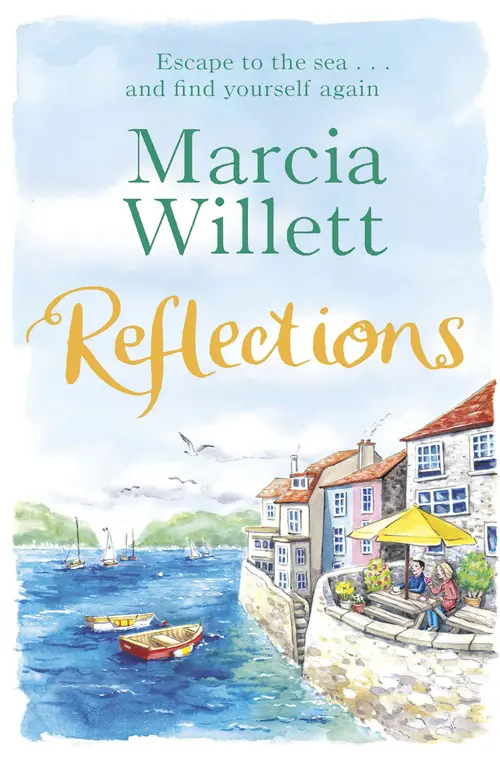
COVER
ABOUT THE AUTHOR
Marcia Willett’s early life was devoted to the ballet, but her dreams of becoming a ballerina ended when she grew out of the classical proportions required. She had always loved books, and a family crisis made her take up a new career as a novelist – a decision she has never regretted. She lives in a beautiful and wild part of Devon.
ALSO BY MARCIA WILLETT
Also by Marcia Willett
FORGOTTEN LAUGHTER
A WEEK IN WINTER
WINNING THROUGH
HOLDING ON
LOOKING FORWARD
SECOND TIME AROUND
STARTING OVER
HATTIE’S MILL
THE COURTYARD
THEA’S PARROT
THOSE WHO SERVE
THE DIPPER
THE CHILDREN’S HOUR
THE BIRDCAGE
THE GOLDEN CUP
ECHOES OF THE DANCE
MEMORIES OF THE STORM
THE WAY WE WERE
THE PRODIGAL WIFE
THE SUMMER HOUSE
THE CHRISTMAS ANGEL
THE SEA GARDEN
POSTCARDS FROM THE PAST
INDIAN SUMMER
SUMMER ON THE RIVER
THE SONGBIRD
SEVEN DAYS IN SUMMER
HOMECOMINGS
DEDICATION
To Vivien
PART ONE
CHAPTER ONE
The town is waking and stretching, gearing up for the day ahead. No traffic moving. No tourists. It’s a warm, golden September morning: shreds of mist lying along the estuary, white wings skimming low over the water; the trees’ canopies touched to flame with early sunlight. Outside the house in Buckley Street, Cara closes the front door quietly behind her, crosses the road and goes quickly down the flight of stone steps beside the Fortescue Inn. Pausing for a moment on the quay, she gazes across the harbour to the smooth sands and wooded coves on the further shore, and then, impulsively, turns and makes her way along Fore Street. At the bottom of the Ferry Steps the small passenger ferry is already waiting and Cara boards, pays her fare and goes forward to sit in the bows. Several more locals join her on their commute to work, the engine throttles up, and the boat heads out across the harbour to East Portlemouth.
It’s odd, she thinks, how being only a few feet away from land seems to bring a sense of freedom, of detachment from reality.
She glances towards the mouth of the estuary where the silvery, silken skin of the sea stretches towards the misty, indistinct horizon. A small boat is heading for harbour, hugging the deeper channel as it crosses the hazardous spit of sand called The Bar.
The ferry’s engine cuts to a purr as it slides alongside the wooden pontoon and Cara waits her turn to climb ashore. No sooner has she stepped down on to the sand than she pauses to slip off one shoe, then the other. The tide is making, but above the high-water mark the sand is soft between her toes. Carrying her shoes, she walks along the beach and then perches on a rocky outcrop. In all the thirty years since her older brother, Max, bought the house in Buckley Street, it seems to Cara that Salcombe never changes. Time is irrelevant. Sitting here she is able to imagine that she is not alone, that Philip might come strolling along the beach, that she has not sold their house in London and that she still has somewhere to live.
The waves ripple along the sand and, on her second impulse of the morning, Cara bends forward, rolls up her jeans and gets to her feet. She walks down the beach and treads cautiously into the water. It is warm on her bare skin and she stands, feeling it ebb and flow around her ankles, watching a dinghy being rowed out to one of the yachts at anchor further up the river.
Presently she will put on her shoes and catch the ferry back to Salcombe, to Buckley Street; back to Max and breakfast. Just for this moment, however, she will remain caught up in her memories; listening to the cry of the sea birds, the hush of the sea, and the sounds of Salcombe waking up across the river.
Cosmo Trent drives slowly in these steep, narrow lanes behind Salcombe. This is not because he is nervous, but because he has discovered that through nearly every farm gateway, or round an unexpected bend in a lane, a photographic opportunity might be revealed. Here is one. A miracle of composition. Cosmo brakes and reverses to find the exact perspective. Between high banks of alder, thorn and hazel, the brackish waters of a narrow creek flow right up to the lane’s edge. On the bank above the creek a house is almost hidden by the trees but a flight of steps leads down to a landing stage. A wooden footbridge spans the stream and on the far bank, amongst the reeds, a sign has been thrust into the mud: ‘Private. No fishing’. A small dinghy, which has floated upstream of its mooring, is now wedged by the rising tide beneath the rickety footbridge. Beyond this scene, downstream, a swan is sailing gracefully towards the wider reaches of the estuary.
As he sits, turned sideways to look through the passenger window, Cosmo is aware of a movement in the back of the car. He glances round to see Reggie watching him. Framed by his long, floppy ears, his brown spaniel’s eyes manage to look both patient and reproachful.
‘Sorry, old boy,’ Cosmo murmurs, putting his camera back on the seat. ‘You’ve got to remember that this is all new to me. It’s OK for you. You’re used to it.’
If Reggie could sigh and roll his eyes he’d be doing it now.
Cosmo laughs. ‘I can take a hint,’ he says cheerfully. ‘Home it is.’
Home. His home for the next few months is a contemporary miracle of stone, wood and glass. The converted barn is set near the head of the creek and Cosmo loves the barn’s light and space, its heavy wooden crossbeams high in the roof, and the floor-to-ceiling windows. He drives on, thinking about the circumstances that have brought him here: the decision to take a few months’ sabbatical from his job as a risk assessment analyst with an investment bank in London; his colleague Alistair telling him that his parents were trying to find a house-and-dog-sitter.
‘They had someone lined up,’ Al said, ‘but she’s cried off and they’ve got the cruise booked and everything. You’d love it down there.’
He and Al have been friends for the last five years, ever since they both joined the bank as graduates. When his parents invited Cosmo to Salcombe for a taster weekend, Al drove them both down from London. His parents, newly retired to their dream home, were delightful, Reggie was well behaved and benign, and even the problem that Cosmo doesn’t own a car was quickly set aside.
‘Mum’s old Suzuki is insured for the dog-sitter,’ Al told him. ‘And Dad has an account with the local wine merchant.’ He laughed. ‘Three months’ paid holiday in a dream location, mate. What’s not to like?’
There is nothing, yet, not to like. Two weeks in and London has become unreal. As Cosmo descends the wooden staircase each morning, seeing from those huge windows the ever-changing creek, it’s almost impossible to imagine the rush and bustle of the city, the noise and clamour of the Tube. At low tide the mud shines, smooth and soft as toffee, an egret paces at the margins and gulls bicker; at high tide the reflections are breathtaking. On fine mornings Cosmo makes coffee and carries it out on to the apron of lawn with Reggie at his heels. Sometimes it’s so early that the whole scene is in monochrome. Then the sun rises slowly out of huge grey pillows of cloud and the creek is transformed.
Now, as he drives, Cosmo is aware of the last crowns of pale honeysuckle trailing in the hedgerows, the rosy flush of hawthorn berries and the ripening blackberries. Four small fields, neatly divided by hedges, are spread like a flag on the side of a hill. Each field is a different colour: rich red earth, pale gold stubble, brilliant green grass, and dull brown mud. Cosmo brakes and leans from the window to take another photograph.
‘Whatever do you do all day?’ Rebecca asks each time they speak. Her voice is a calculated mix of incredulity and sarcastic amusement. The subtext reads: ‘What person in his right mind could stand the boredom?’ He won’t allow himself to be influenced by her distant attempts to control. If he’s honest he’s rather surprised at how little he’s missing Becks, and at the extent of his relief that she has no desire to travel west to visit him.
‘Much too busy,’ she says when he invites her for a weekend. ‘You know what it’s like at the moment.’
Her slightly impatient response implies that he should know better than to imagine she could possibly get away. Rebecca is a junior barrister and is tied up with a complicated case that she hopes will result in plaudits and consolidation in her career. Though she has made it clear that he could move in permanently with her, Cosmo still maintains his small flat in Hackney. They have fun together, she’s attractive and clever, yet some instinct keeps him from making the final commitment. He’s hoping that the sabbatical will help him to clear his mind.
Cosmo swings the Suzuki on to the track that leads past the farmhouse and down to the barn. A small part of one of the fields has been sold with the barn, and shrubs and saplings have been planted to form a new hedge. He drives through the gateway, into the lean-to shed, which also houses a big pile of logs, and climbs out. Reggie jumps down and goes to check his territory. Cosmo watches him, enjoying the sunshine and the peace. Here at the head of the creek there are a few houses clustered above the lane, which winds away, round the point and on into Salcombe, but there is no one about. The morning is clear and hot. Cosmo knows that these remnants of summer will not last long. Perhaps, when the evenings draw in and the westerlies bring rain, he might find it lonely and depressing, but meanwhile he’ll fetch Reggie’s lead and they’ll walk into Salcombe. He’ll sit in the sun outside the pub with a beer and a sandwich and watch the boats. Cosmo thinks of Al, and he smiles: what’s not to like?
He and Reggie climb down the steps from the garden, out into the lane, and set off round the head of the creek. Dinghies swing at their moorings as the tide begins to turn and a swan rears up, beating the surface of the water into a flurry of spray with its powerful wings so that the scattered drops flash in the sunlight. Reggie potters ahead, glancing back from time to time to check that Cosmo is keeping up, pausing to wait for him.
‘Sorry,’ says Cosmo, hurrying to catch up, putting his phone back in his pocket and regretting that he hasn’t brought his camera.
As they pass the boatyard Cosmo clips Reggie’s lead to his collar and they walk on together, turning into Island Street. Cosmo is fascinated by the old boatyards and sail lofts, the smell of salt and varnish and tar, and the unusual shops and cafés. Most of the summer visitors have vanished away but there are still people around, enjoying the sunshine, eating pasties on the waterfront, idling in Fore Street.
It’s early for lunch and Cosmo decides to have a double espresso in the Coffee Shop in Fore Street. The tables outside are occupied but there’s room inside so he settles Reggie and goes to the counter to order his drink. The staff are friendly, seeming to recognize him, and an elderly man smiles and pauses on his way out to make a fuss of Reggie, so that Cosmo feels as if he is already becoming a local.
As he sits down, Cosmo reflects on this atmosphere of friendliness, the way strangers smile and say ‘Good morning’, or comment on the weather. He is not used to eye contact and brief exchanges, and he likes this easy-going cheerfulness. The words ‘Dolce far Niente’ chalked up on a board above his head make him smile, too. ‘The sweetness of doing nothing’ suits the mood perfectly. He gazes out through the open doorway, at the sunny street and the people moving in and out of his line of vision, and wonders whether Becks would like it here. She would be restless until she had an itinerary: her phone showing her places to go, things to see, galleries to visit. Not for Becks the sweetness of doing nothing.
The sunshine is suddenly blocked as a figure comes in, just a silhouette at first against the brightness outside and then clearer as the girl comes right into the café. Her long dark curly hair is caught up in a series of clips and she is wearing white dungarees splashed with paint. Someone behind the counter calls a greeting to her and she smiles back, glancing around her and briefly catching Cosmo’s gaze. Cosmo bends to stroke Reggie, not wanting to look as if he is staring. His espresso arrives, there is a little flurry of new arrivals, and the girl leaves with her takeaway coffee. Feeling irrationally disappointed, Cosmo sips his own coffee, ruffles Reggie’s ears and settles back to enjoy the moment.
From the next table Cara watches him. The little thump of shock she experienced when she first saw him come in has made her heart beat fast. How strange that this thin, elegant, young stranger should bring Giovanni so forcibly to her mind after nearly forty years. He has Joe’s dark, Italian colouring, that oddly familiar energy; his grace of movement, and the wide mouth ready to smile.
Cara lifts her cup to drink, holding it with both hands to steady it and resting her elbows on the table. Nevertheless, her hands tremble a little and she sets the cup down again very gently. She remembers Joe’s little Fiat rushing them through the traffic from Fiumicino Airport, the heat, sex in the high bedroom looking over the city … Her mind clamps down on these memories and she sees that the young man, who is not Joe, has glanced towards her. The discipline of years kicks in and she relaxes, dropping her shoulders, lifting her chin and smiles politely at him.
His answering smile is friendly, humorous, and he gestures to the message chalked on the beam above their heads.
‘Dolce far Niente,’ he quotes. ‘I love it.’
That his first words should be in Italian is another shock, but Cara continues to hold on to her self-possession and nods.
‘It says it all,’ she agrees. ‘From which I gather that you’re on holiday here.’
‘Sort of,’ he answers, and indicates the dog lying at his feet. ‘House-and-dog-sitting for a couple of months. What about you? Are you on holiday here?’
‘Sort of,’ she answers, deliberately mimicking him. ‘I’m staying with my brother, Max. He and his wife have owned a house in Salcombe for years and now they’ve retired to it.’
‘It’s just great here, isn’t it?’ he says almost wistfully. ‘I mean, it’s not a bit like London.’
‘No,’ she agrees, amused. ‘Salcombe is definitely not like London. You’ll notice that especially when the winter kicks in. But by then you’ll probably be heading back to the bright lights.’
The dog is struggling to sit up, encouraged by this interchange, and Cara reaches to fondle the brown silky ears.
‘His name is Reggie,’ volunteers the young man. ‘And mine is Cosmo.’
Cara keeps her head lowered, stroking Reggie, not wanting to reveal her own name but knowing she must return his friendly gesture.
‘And mine is Cara,’ she tells him.
‘Cara.’ He laughs delightedly. ‘We’re having quite an Italian morning, aren’t we?’ he exclaims. ‘How odd, although there is an Italian connection on my father’s side of the family.’
She experiences a swift stab of panic but luckily Reggie is standing up now, encouraged by Cara’s attention, wagging his tail and causing a disturbance amongst the tables. Cosmo gets to his feet.
‘Better be moving,’ he says. ‘I expect we’ll meet again.’
‘I expect we shall,’ Cara answers.
She watches him go out and then picks up her cup again. Her coffee is almost cold but she sips it anyway, willing down the symptoms of a full-on panic attack. During these last few months, since Philip died, she has become subject to these episodes. He was her refuge, her rock, her co-conspirator; for nearly forty years he held the mirror that reflected her life. ‘We need to be seen by others to be convinced of our existence.’ She can’t remember where she has read the words but she believes them to be true. Who will hold the mirror for her now?
Cara finishes her coffee. She remembers Giovanni, the way he used to call her ‘Cara, Cara’ – ‘darling, darling’ – and she always called him ‘Joe’. She met him at a party in a friend’s house in Kensington. She was nearly twenty and he was four or five years older. His friends, like his own family, were wine exporters and they were sophisticated, well travelled and great fun. He spoke English fluently and when she tried out her small stock of Italian words, he laughed at her and said the most important one was her name. How attractive he was: how easy to fall in love with him.
Cara pushes her cup aside. These thoughts, so long denied, are unnerving her. They’ve caught her with her guard down. She’s still not used to being alone, to having nobody else to consult or consider, and it seems so strange: so lonely. The café is busy now and Cara reaches for her bag and stands up. She’ll buy some bread and then go home to Max.
Max is standing just outside the doorway that leads out from the kitchen on to the small balcony, arguing with his wife.
‘It’s just for a few weeks, Judith, whilst she finds somewhere to live. Good grief, surely it’s the least we can do.’
‘Such an irresponsible offer,’ his wife answers sharply. ‘What would she do if you weren’t there?’
‘But I am here.’
‘Nevertheless, I dislike these open-ended arrangements. So typical of Cara. And it will probably be a great deal longer than a few weeks, mark my words.’
Her voice is assured, irritated, and he sighs silently, watching Cara climbing up the steps beside the Fortescue Inn just below him.
‘I agree that in an ideal world she should have had something lined up,’ he agrees pacifically, withdrawing further into the kitchen so that Cara can’t hear him, ‘but the house sold so quickly. Philip hasn’t been dead a year and she’s not firing on all cylinders yet. Cut her some slack, for God’s sake. How’s everything your end?’
The distraction works. Judith’s voice quacks on as she reports on the situation in Oxford where their pregnant daughter-in-law has broken her ankle. Their son Paul is lecturing abroad and Judith has rushed away to look after Freya and their two-year-old granddaughter. Max’s suggestion that he should accompany Judith was refused. She must be the good fairy; the practical, capable one. He is a helpless male who will only be in the way. And, besides, there is Oscar, the black Lab, who is presently stretched out on the kitchen floor fast asleep. Oscar would not be welcome in the small terraced house in Jericho. Max is used to Judith’s reminders of her ability to cope, of managing without him all those years as a naval wife, moving house, making decisions, coping with the boys. Now that he is retired he is careful to respect this. Much though he would like to see his family, especially small Poppy, he understands that he will be de trop on this occasion, but he feels guilty at a fleeting awareness of relief, of gratitude to Oscar, and his pleasure at the idea of spending quality time with Cara. However old they both get she will always be his little sister, eight years his junior; the small girl who was there to welcome him home from boarding school, to be rescued from scrapes. Each week their father hurried away from the big old house in Sussex to his work in the City, and to his mistress, whilst their reclusive, dysfunctional mother worked out her frustration on the gin bottle. Away at school, Max worried about Cara, neglected, exposed to their mother’s crying jags and fits of temper. She died when Cara was nearly fourteen and Max was twenty-one and a midshipman at Royal Britannia Naval College in Dartmouth. Philip Grey was his closest friend and, even after he moved on to Cambridge and then to the Foreign Office, Philip was always ready to spend a part of his holidays in Sussex. It amused them both to visit Cara at school and take her out to tea, and, when she was older, to vet her boyfriends; take her to the theatre when she was in London. Max had just been made up to lieutenant commander, the engineer officer on a nuclear submarine, and Judith was pregnant with their second son, when Cara and Philip decided to get married. Philip was First Secretary in the British Embassy in Rome and Cara was barely twenty-one. Max was now spending a great deal of time at sea, and he felt a huge sense of relief knowing that Cara would be looked after and also that his friendship with Philip would remain a close one. He’s going to miss Philip.
‘Well, give them all my love,’ Max says to Judith when he gets a chance to speak. ‘Freya must be very glad to have you there. I can come up if you need me.’
The Story Continues on BooksBarbecue!
Enjoyed this preview? ❤️ Do not stop here!
Read the complete book free online → 🔗
Continue reading now on BooksBarbecue and discover every page!
Love reading? Bookmark BooksBarbecue.com for more amazing books!
Happy Reading!