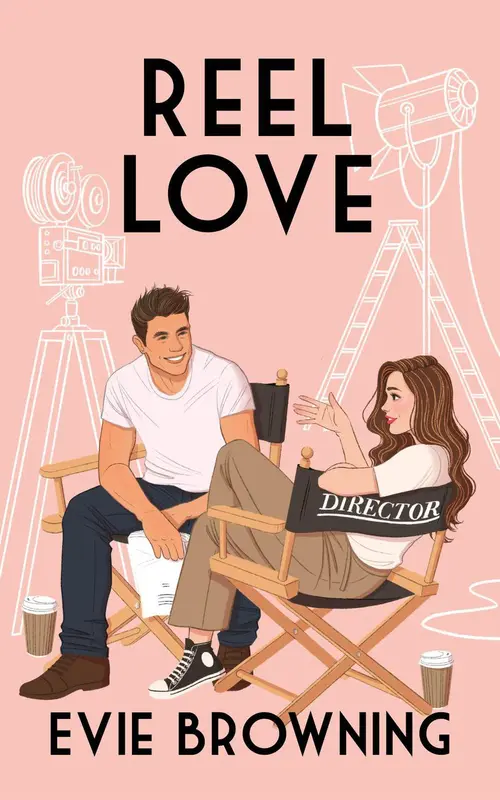
Reel Love
Dedication
To me, I wrote a book.

|

|

Chapter One

Anna couldn’t hear the bartender. Indie music and discussions of home brew assailed her ears. Ironic T-shirts and brightly colored sneakers surrounded her. It had finally happened. Her favorite forgotten Hollywood bar had been overrun by an invading bearded horde in beanies. Hipsters lounged in the booths and leaned against every available surface.
“Can you repeat that?” Anna asked.
The bartender was new too. Anna had noticed him when she arrived an hour ago. Even in the dull sunlight filtering through the small front window, he was worthy of study. Tousled brown hair hid dark eyes, and he had full lips with a bit of scruff on his jaw. His come-join-me-in-my-werewolf-pack, I’m-the-nice-one look was enhanced by his threadbare white T-shirt, torn black jeans, and scuffed leather boots. He placed his hands on the bar and leaned forward. Anna stopped herself from trying to discern what he smelled like. As heavenly as it was, she should focus on what he was saying.
“—your credit card.” His breath tickled her ear.
Anna shivered from the low, captivating rasp of his voice. Something about her bar tab. She blinked up at him.
“Ma’am.” The bartender held up her credit card. “It’s been declined.”
Anna unnecessarily straightened the pages of the script in front of her. It wasn’t the first time her credit card had been declined, but it hadn’t happened in about a decade. Before this moment, it hadn’t been a bad afternoon. She’d spent it drinking beer and reading. Well, not so much reading as trying to understand the space shenanigans of this incomprehensible sci-fi pilot and contemplating the life choices that had led her to this exact moment—which was worse than she’d previously realized.
The bartender gave her a tight smile.
“Please run it again.” Two beers couldn’t have put her over the limit.
The bartender crossed his arms over his chest. “I’ve run it three times.”
Anna ignored his tanned forearms flexing in front of her. Well, she tried to ignore them. Focus, Anna.
The bartender set her credit card on the counter and pushed it toward her with his index finger. Clearly, he had mastered the irritated-hot-guy look. Anna imagined casting him as a second-in-command vampire or an irredeemable best friend, the guy who advises the hero to forget about the heroine and find someone less independent.
“My shift is ending.” The bartender rubbed the back of his neck, letting out a breath. “If you don’t have the cash, it’ll get taken out of my pay.”
Anna’s stomach churned. She couldn’t stiff this guy. She used to be a bartender, and the way things were going, she might be one again. Tugging on her ponytail—a nervous gesture she hadn’t been able to quit, even on a movie set—Anna scrambled to come up with a solution. “I’ll call someone.”
“You sure they’ll come?” the bartender asked, frowning.
Picking up her bomber jacket, Anna fished into a pocket and grabbed her phone. The small, outdated screen taunted her.
“Definitely,” she said with too much enthusiasm.
The bartender shook his head and walked away, going to close out with his other customers.
Anna tapped her fingers on the bar. Shouted conversations and loud guffaws intruded on her thoughts. She had never left without paying a tab. She wasn’t going to start now, no matter how dire her financial situation. Anna spied her reflection in the tarnished mirror behind the bar, like a smudged copy of the real thing. Her black cap obscured her face, and her faded striped T-shirt appeared ghostly. Ignoring her own image, she turned to look at the autographed black-and-white photos of long-forgotten Hollywood stars lining the back of the bar. Aristocratic men in sharp tuxedos and dazzling women in clinging gowns, they beamed glamourous smiles, giving off an aura of carefree nonchalance. No troubles on their side of the screen.
There were no pictures of female directors. We’ve always been a rare commodity. But before she could focus on her dim career prospects, she needed to pay her bar tab.
Anna knew plenty of people in Los Angeles. Certainly during her marriage, a number of people in this town would’ve been happy to help her. Now was different, though. She wasn’t sure who would take her call in the middle of the day.
She picked up her phone and called her best friend—her only friend, if she were being honest.
“You’re back from London,” Jenny exclaimed. “Are you on your way over here?”
“I stopped to get a beer and read a TV pilot.” Anna spit out the words, wincing like Jenny could see her through the phone.
“Wait a minute,” Jenny mused.
Anna easily pictured the expression on Jenny’s face—green eyes narrowed in concentration, long red hair framing her freckled cheeks, fingers paused on the keyboard as she considered the facts.
“Did your credit card get declined? Again?”
That was the terrible thing about old friends. They knew each other, and Jenny had known Anna a long time.
“An Oscar nomination is worth two beers,” Anna said casually, as if she’d never mentioned it before.
“When you came to me in a panic,” Jenny said then laughed at the memory. “I saved your movie.”
They weren’t quite friends at that time, more like wary colleagues. As two of the few women in their film program, they’d been inevitably thrown together, even if Anna’s ripped tights and Goodwill T-shirts didn’t quite fit with Jenny’s flowered dresses and brightly colored cardigans. Running her hands through her hair and worrying she was about to be kicked out, Anna had dropped the pages in front of Jenny on the small café table where she had sat, drinking an iced coffee and working on her own project. Fortunately, Jenny had been intrigued by the basic premise, and the two had collaborated on the film The Castro, which had brought them to Hollywood.
“It was our movie,” Anna insisted. “We all have to play to our strengths. I’m good at telling people what to do. You’re good at making words go.”
“One of us—and I’m not going to say who, because I’m too big of a person—won an Independent Spirit Award for that movie,” Jenny said in a conspiratorial tone.
Jenny had crafted a poignant film out of Anna’s rambling dialogue and jumbled scenes. She deserved the many accolades the screenplay had earned.
“You should’ve won.”
“You’re going to have to let that go at some point.”
“Never.”
Jenny took a deep breath. “I know I owe you for Paris—”
“You don’t owe me for anything.”
“I don’t know about that,” Jenny said, “but the next time I text you on your birthday, text me back, okay? All the kids are doing it these days.”
“Being divorced and turning thirty-five was traumatic enough. I couldn’t combine that with emojis.”
Jenny laughed. “I can’t drink with you today. I’m on a deadline.”
“What are you working on?”
“Vampires.”
“Seriously?” Anna couldn’t believe it. No one made movies about vampires these days. It would cycle back. Everything did. But... “Are you doing rewrites on that production in Rome?”
Even the entertainment press in London had picked up the story of a vampire movie that needed course correction in the middle of shooting.
“Yup, Remington Pictures hired me. They need to cut costs, so I’m removing the big outdoor battle scenes and replacing them with interior dialogue-heavy scenes.”
“Are they really going to fire the director?”
Removing the director in the middle of a shoot was so unusual Anna could only think of two instances where it had happened. She didn’t envy the incoming director. The cast and crew would either be loyal to the outgoing regime or have lost so much faith in the production that they would half-ass working with the new team.
“They have too much money invested at this point to shut it down. They might send me to the set.”
A writer on set meant the production was in worse shape than the studio had admitted publicly. “How quickly do you need to turn a draft?”
“Yesterday.”
“Holy shit, Jenny, why are you talking to me?”
“How often do you call?”
Anna hadn’t always been the best at staying in touch. “Thanks for your texts. London was... It was a shit job on a terrible TV show, and I—”
“You realize this whole industry is better if you talk to your friends?” Jenny paused. “And go with them to premiere parties this Thursday?”
Jenny had been one of many screenwriters to turn a draft on a new superhero film. Anna wanted to support her friend, and she needed to rebuild her contacts in Los Angeles. If nothing else, Anna could practice networking. It had never been one of her strengths.
Anna glanced down at her ripped jeans, faded striped T-shirt, and scuffed checkerboard Vans. “All right, but I’ve got nothing to wear.”
“I have a plan for that.” Jenny sounded confident. “What are you going to do about your bar tab?”
Anna couldn’t ask Jenny to leave her apartment when she was past a deadline on a well-paying job. Anna studied the bartender. She should be immune to the charms of a pair of warm brown eyes, broad shoulders, and the stance of a man who looked like he didn’t suffer fools. But even in a city filled with some of the most handsome men in the world—and Anna had met a few of them—the bartender still left an impression. He continued to take drink orders and manage the bar tabs for the growing crowd. As far as Anna could tell, no one new had clocked in. “I’ll figure something out. Good luck with the vampires.”
Anna put her phone back in her jacket pocket. The bartender gave her a questioning glance. She picked up her bottle and finished it in one swig, ignoring the taste of the warm, flat beer. He walked over to her.
“I’m sorry about the credit card.” Anna’s cheeks felt hot. “I just got back into town, and I don’t have any cash.”
“Whatever.” The bartender sighed, not meeting her gaze. “Look, I’m not going to spot you any more beers.” He moved on to speak to another customer.
“Wait,” she pleaded. “Do you need help behind the bar or washing dishes? Those are pretty much my only skills, unless you have a movie you want me to direct.”
The bartender paused and turned back to her. The other patron hung his head in annoyance.
“Anything I’ve heard of?”
“Probably not.” The Castro had been released ten years ago. The bartender appeared too young to have seen the indie movie, even one with a few festival wins and award nominations. “I’ve got this TV pilot.” She gestured to the script in front of her. “But it doesn’t make a lot of sense. If I’m going to direct it, I should understand it.”
“Good luck.” He glanced down at the cover. “You might want to start with the title.”
“One of its many problems. You don’t even want to know about the magical orange goo.”
“Who’s producing it?”
She named the small studio, which had few credits to its name.
The bartender grimaced. “Those guys don’t always pay on time.”
Given his good looks and his recognition of the obscure TV production company, Anna guessed he must be an actor.
“What else have you worked on?” he asked with genuine interest.
“Two romantic comedies for Rialto Brothers.” Anna didn’t elaborate. Last Night in Cincinnati and Here We Go! were best forgotten.
“Those jobs don’t just come out of nowhere.” He gave her a questioning look before glancing at the clock above the bar.
“No one’s arrived to work since you said your shift was ending.” Anna happily changed the subject from her prior movies. “Can I help?”
The bartender wiped his hands on the bar towel and regarded the other patrons clamoring for his attention.
Anna couldn’t leave without doing something. “I’ve tended bar. I’ve waited tables. I’ve been a cater waiter. Have you ever cleaned up after an entire bar mitzvah got sick with food poisoning?”
The bartender laughed. His dour face opened into an expressive smile, cute in that way of incredibly attractive people doing anything other than their best blue-steel gaze. “No, and I do need help. You sure you know what you’re doing?”
|
|
|
Chapter Two
If Anna couldn’t get a job washing dishes, she wasn’t sure what was left for her at this point. “If it makes you feel better, I worked as a dishwasher long before I worked in movies.”
“Me too,” he said, appraising her. “My dad’s restaurant.”
“Cafeteria at the College of San Francisco. My mom signed a waiver so I could work at fourteen.”
He raised an eyebrow. “Okay, I’ll show you the setup in the back.”
Anna stood up and stashed the script in her bag, slinging it over her shoulder. “I’m Anna Kovács.”
“I know.”
“You do?” It had been so long since anyone had recognized her. She thought those days were long gone. They belonged with the designer gowns and high-heeled shoes stashed in the storage unit in the Valley.
“I ran your card three times.”
Oof. She chastised herself for thinking that her name meant anything more to him than a woman who couldn’t pay her bar tab.
With a wry smile, he held out his hand. “I’m John Mills.”
Anna shook his hand. She’d never found herself attracted to a man’s hands before, but apparently a woman could change at any age. He had really nice hands, large, warm, capable.
John cleared his throat.
Anna removed her hand from his grip.
He put a hand on the swinging door. “You sure you know what you’re doing?”
“Washing dishes? It couldn’t have changed that much.” She walked around the bar, following him to the kitchen.
Humid air greeted her, and the small space felt almost as familiar as a movie set. The double sink on the left looked normal, piled high with pint glasses. That wasn’t the problem. The problem was the electronic panel on the dishwasher. With its flashing lights, knobs, and levers, it resembled the controls on a rocket ship. “What the hell?”
“It’s been a while.” He chuckled. “Some things do change.”
John’s grin was just a touch smartass, and she liked him more for it. She felt the same uptick in her pulse as she had when his breath had ghosted her ear. How long has it been since that happened?
She couldn’t remember, and for a moment, she was grateful to her over-the-limit credit card. Thankfully, he handed her a clean apron from the hook on the wall. She needed something to do with her hands other than wring them like a nineteenth-century heroine.
“All right, Yoda me on all this stuff.”
“Washing dishes, you will be learning.”
Anna followed him to the sink.
#

JOHN SHOULD HAVE BEEN focused on the patron repeating his order, but he glanced through the clear panel of the swinging door to the kitchen instead. He grinned. Anna tucked stray strands of her hair that had escaped under her cap. Even muffled by the cacophony at the bar and the sound of the industrial dishwasher, he heard her creative swearing at the electronic panel.
John couldn’t believe Anna Kovács was washing dishes in the back kitchen. He had thought her name was familiar when he ran her credit card, but after she mentioned her profession, he’d realized she had directed one of his favorite movies.
Initially, he had just noticed her grimace while reading the script. He knew the feeling. He had read plenty of terrible scripts in his day. She’d stood out, sitting alone at the end of the bar, nursing two beers, and ignoring the noise around her.
“Hey, can I get another drink?”
Why couldn’t she pay for her beer? She had made an award-winning film and directed two movies for Rialto Brothers.
“Hey, buddy.”
John missed the days before this place had been discovered by every influencer needing some Hollywood kitsch for their selfie. He didn’t have time to daydream about Anna’s prospects or lack thereof. He definitely didn’t have time for her plush red lips or her chestnut hair he wished was down around her shoulders.
“Buddy.”
I’m not your buddy. John grabbed a beer for the guy. It was going to be a long afternoon.
Two hours later, one of the regulars was sleeping it off in a booth in the back, and the sound of his snoring was the only noise in the empty bar. The next rush would begin in an hour. Linda was on her way, and she’d apologized for being late. He didn’t blame the woman for not leaving until her mother’s caretaker arrived at their apartment.
Anna pushed through the swinging doors, carrying a rack of clean pint glasses. She smiled up at him as he took it from her. Even in an apron and baseball cap, she looked pretty. “I forgot how good it is to do a normal job.”
He set the glasses on the counter with enough force that they clanked. “You wouldn’t say that if this was your only job.”
“You’re right. That was incredibly dumb.” Anna dried her hands on her apron. “It’s going to be my only job soon, so I may need you for a reference.”
“Come on, you must have plenty of contacts.” Her first movie had received numerous award nominations back in the day. Why is she being coy?
“I used to, I guess.” She shrugged, eyeing him up and down. “You must do well.”
It wasn’t quite a casting director look. It wasn’t quite a look that said “I know where to have this guy take his shirt off,” but it was pretty damn close.
“With what?”
She hesitated. “Acting.”
“And why do you think I’m an actor?”
“Your whole deal.” She made a vague gesture with her hand.
John didn’t think a director would be so awkward, but it did nothing to diminish the irritation that everyone in this town thought he was desperate to get in front of a camera.
Anna cleared her throat. “You recognized the name of a production company that’s only made two pilots, neither of which have been picked up. You aren’t a crew member. You would be in a union by now—I’ve seen how hard you work—and you aren’t a director.”
“How do you know I’m not a director?”
“Movie directors tell everyone they’re directors. They tell their waitress and their Uber driver. No one escapes them.”
“You didn’t tell me right away.”
“I don’t have a job, and I can’t cover a tab for two beers.”
“Well, you got me there.”
“So, what do you do? I mean, apart from bartending. Maybe you understand that sci-fi script.”
“I’m guessing no one understands that script.”
Anna laughed, throwing her head back. She had an honest-to-God smile on her face. Despite her assumptions, he wanted to keep it there.
“I’m glad it’s not just me,” she said. “I was worried I was losing my touch and Space Agent Alpha might signal the end of my capacity to stomach bad scripts.”
“The production company is terrible,” John said. “I was a second lead in one of the prior pilots that never went anywhere.”
“So does that mean you are an actor?”
That’s the question, isn’t it? John had asked that of himself many times. Why not make as much money as he could at the one thing this industry enthusiastically wanted from him? “Someone’s got to play shirtless guy on the left.”
“I shouldn’t have assumed, and I’m sorry about that.”
Women in front of the camera were treated worse than men, so he supposed she understood. But taking short-term acting gigs paid better than other part-time jobs, and they left him with enough time to do what he really wanted to do.
“Also...” he said. Should I tell her? “I’ve got a script.”
“You’re a writer?”
“Yes, but I really want—”
“To be a director.”
“—to direct.” John waited for her reaction.
“It’s harder than everyone thinks.” Anna tossed the towel on the counter.
“I’ve been an assistant director on a couple of productions. I get it.”
“Trust me, there are better and easier ways to make money in this business.”
“Don’t say that.” He walked over to the fridge and pulled out a beer. “Everyone says that.”
She eyed the beer. “I can’t pay for that.”
“Linda will be here in a few minutes, and I owe you.” He popped the cap.
“You don’t. Besides, I still need to figure out what’s going on with that TV show if I want to get a job.”
“Well,” he drawled, handing her the beer. “Here’s the thing...”
He grabbed his laptop bag from beneath the bar and pulled out the pages of his script.
She held up a hand and took a swig as if preparing herself for what came next.
“I don’t really have the time today,” Anna said, eyeing the bound pages warily.
“Seems like it, with your busy schedule.”
“You’re going to ask me to read that.” She pointed to the pages with her beer.
John had been planning to tell her he loved The Castro. If the conversation went well, then he would ask for her opinion on his screenplay. Perhaps it wasn’t the smoothest transition he’d ever made, but it was rare that he ran into someone—at this bar, of all places—whose opinion he thought would be worthwhile.
“You just carry your script around in case you find someone to read it?”
“You’ve lived in LA, right?”
Anna smiled as if she couldn’t help herself, and her whiskey-brown eyes sparkled.
“Come on, you do owe me.”
“Listen, you’re obviously a smart guy, and I would love to help you.”
John rolled his eyes. A classic. He had heard that many times when he pitched his script. He didn’t need more vague platitudes.
The Story Continues on BooksBarbecue!
Enjoyed this preview? ❤️ Do not stop here!
Read the complete book free online → 🔗
Continue reading now on BooksBarbecue and discover every page!
Love reading? Bookmark BooksBarbecue.com for more amazing books!
Happy Reading!