Raphael, Painter in Rome: a Novel
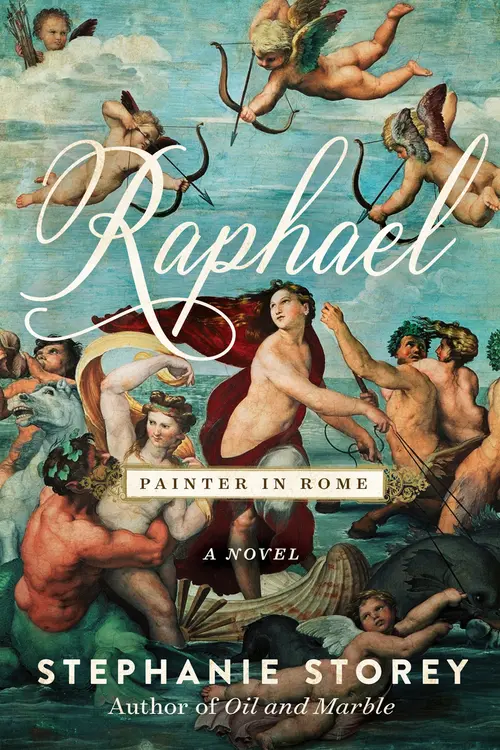
Front Cover
Half-Title Page

Also by Stephanie Storey:
Oil and Marble: A Novel of Leonardo and Michelangelo
Title Page
Copyright Page
Copyright © 2020 by Stephanie Storey
All rights reserved. No part of this book may be reproduced in any manner without the express written consent of the publisher, except in the case of brief excerpts in critical reviews or articles. All inquiries should be addressed to Arcade Publishing, 307 West 36th Street, 11th Floor, New York, NY 10018.
Arcade Publishing books may be purchased in bulk at special discounts for sales promotion, corporate gifts, fund-raising, or educational purposes. Special editions can also be created to specifications. For details, contact the Special Sales Department, Arcade Publishing, 307 West 36th Street, 11th Floor, New York, NY 10018 or [email protected].
Arcade Publishing® is a registered trademark of Skyhorse Publishing, Inc.®, a Delaware corporation.
10 9 8 7 6 5 4 3 2 1
Library of Congress Cataloging-in-Publication Data is available on file.
Cover design by Erin Seaward-Hiatt
Cover photo credit The Triumph of Galatea, courtesy Accademia Nazionale dei Lincei/Villa Farnesina in Rome.
ISBN: 978-1-950691-27-2
Ebook ISBN: 978-1-950691-31-9
Printed in the United States of America
Dedication
Dedicated to
my parents, Steve and Kathy Storey,
for always holding the kite strings
*
A Note from the Author
Although this book is fiction, the story is based on decades of research into the art of the Italian Renaissance and the real life of Raphael Santi of Urbino, painter for popes and Michelangelo’s fiercest rival during the Sistine ceiling years.
Since the experience of this book is greatly enhanced with visuals, the author has personally placed hyperlinks throughout this ebook; click on those links if you'd like to view the referenced works of art. For your reference, the cover of this novel is Raphael’s fresco The Triumph of Galatea, painted in Agostino Chigi’s palace, today known as the Villa Farnesina.
Prologue
Prologue
Rome. March 1520
Why does Michelangelo always get to be the hero?
A struggling sculptor, not trained in the art of fresco— forced by a temperamental pope to abandon his precious marble and paint a wretched ceiling—overcomes agony and obstacles to create a divine masterpiece . . .
Sì certo, you’re moved by the story. I’m moved by it.
But you don’t honestly believe that he painted that ceiling while lying on his back, do you? How would he crawl in and out— his body only an arm-length from the ceiling—without smearing the paint all the time? And how would he have moved? Wriggled about on his shoulder blades and hindquarters? Perhaps once or twice, when he was up against a particularly steep curve of a spandrel, he had no choice but to lie on his back for few moments, but let’s bury the myth right now: Michelangelo painted—like the rest of us—standing up. Don’t believe me? Look at his own drawings. He sketched himself painting that ceiling: head tilted back, arm stretching overhead, standing on his feet. So, no, Michelangelo was not some subjugated hero forced to lie on his back by an intransigent pope.
I’m not angry with him for the story. I only wish I’d thought of it.
And tell me, per favore, that you don’t believe that he hates to paint. Yes, he repeats the lie often as the Nicene Creed, but that doesn’t make it true. During the four years when he was painting the Sistine—not carving any marble at all—he still insisted on signing his letters “Michelangelo, sculptor in Rome,” as though he hates to paint so much that he’s incapable of calling himself a painter. But have you ever walked into the Sistine on a quiet Tuesday morning and looked up at those colors? Santa Madonna, those colors. Were you moved to tears, too? Now, tell me that he could’ve painted such a thing while hating it. Is that what you tell your children? Find something you hate, force yourself to do it, and Ecco! A masterpiece!
I know what people say about me. They say that Raphael Santi of Urbino is the ideal courtier: polite, generous, humble. They say I was born with such happy countenance that nothing ruffles me. They say my good looks reflect the beauty on the inside. They say my talent comes easily; they say everything comes easily. But don’t strip me of my humanity because I’m good at playing a part. You do it, too, I’ll wager, put on a smile sometimes even when you’re feeling foul, so don’t deny me those same basic human talents. In real life, no one could be as generous and loyal and charming as I pretend to be. No one.
You imagine me—if you imagine me at all—the way he describes me, don’t you? Standing in the background, easy to forget, an easy rival to vanquish. When I look back on those years, I picture the events the way he tells them, too: him in the center, me in the corner . . .
Maria Vergine, that’s what I do, isn’t it? All he does is make himself the hero of his own story—can I blame him for that?—but why do I insist on making him the hero of mine? How can I expect anyone else to say I’m the greatest painter in history, if I can’t say so myself? Is there a version where I get to be the hero? Or does he end the victor every time?
Chapter I
Chapter I
February 7, 1497
Florence
The first time I saw Michelangelo, I don’t remember seeing him, but he swears that we saw each other, and we’ve been ’round and ’round about this so many times that I don’t want to argue about it anymore. So, if you’ll do me a kindness, somewhere during this next part, insert his face and, if you get the chance, tell him that’s how I remember it because the only face that I recall clearly from that night is the face of that woman in that portrait landing in that fire.
She was painted in profile with wavy umber hair tied up in blue ribbons. Her dress was the color of opals—lime white softened with hints of indigo and red ocher. She was young, alluring, and so graceful . . . “Is that a Botticelli?” I asked.
“Andiamo,” Perugino said, voice so thick with fear that I would’ve painted it flat black.
“Why are they burning it?”
“Now. We have to go, now.”
“I’m going to save it.” I pulled my arm free and slipped through the crowd. I was only fourteen but already knew that there was no way to bring a thing back once it was destroyed.
It was crowded in Florence’s Piazza della Signoria that night. As I approached the fire, I had to strain to see the top of the flames—yellow with sparks of cinnabar—casting a devilish halo across the night sky. A line of men and women approached the bonfire, holding armfuls of . . . what? It was too smoky to see well, but once they stepped up to the flames, I could see a man tossing a lute into the fire, a boy throwing in a deck of playing cards, and a woman adding a pile of embroidered wool dresses; what would keep her warm come winter? After sacrificing, they dropped to their knees, raised their arms, and wailed as though they could— somehow—throw their voices into the fire, too.
“Burn your mirrors, your dresses, your paintings, your books,” a grim voice called over the crowd. “If you don’t repent, this city shall be no more than a well of blood, a den of thieves, a house of poverty.” Standing atop a platform next to the bonfire was—did you guess?—Fra Girolamo Savonarola. (Mi dispiace, that name makes a lot of people uneasy. If you don’t like it, I won’t repeat it again. I promise.) Did you ever visit Florence during that madman friar’s rule? Ah, you missed quite a spectacle. That night, he was wearing dark robes with a heavy hood pulled low over his forehead, shadowing deep-set eyes, long nose, angular cheeks. He waved his arms like a conductor and spoke in a melodious rhythm. “If we do not cleanse ourselves of sin, the sword of the Lord will come down upon us all, quickly and soon!”
I pressed my hands over my ears to keep from being entranced and pushed toward the flames. Where was that Botticelli? There. The wood panel looked thick and hard like oak. That was good, but flames were clawing at the wood, digging ragged caves of orange cinder around the edges. I reached for the portrait. Flames tickled my fingers. I yanked back. Burned arm hair smells a lot like dead ermine.
“The line for atonement is there, son,” a woman said, face smudged with ash.
“I’m not here to . . .” thankfully, I swallowed the word “atone” and instead said, “I don’t have anything to give.” I turned back to the Botticelli. A crack filled with bubbling orange cinder was splitting the portrait in two.
“But your pictures . . .” The woman grabbed the strap of my traveling bag.
“These are nothing,” I said, making my voice calm as creamy white brushed flat on treated wood. “Only crude drawings.”
“Sinner.” I swear that woman’s tongue flicked out, purple and forked, like a snake. (All right, perhaps that was only my imagination, but that’s how I remember it, so that’s the way I tell it.) In that moment, oh, how I regretted coming to Florence.
I’d lived most of my life in Urbino. Have you been? Yes, it’s remote—a walled city on the eastern edge of the Apennines, takes several days to get there—but worth the trip. Terraced hills, cypress trees, Roman ruins. After a winter snow, the sky turns lavender with a little extra blue—ultramarine, not azurite—and the buildings glow in shades of copper, rust, and ale. When you visit, don’t miss the Ducal Palace. With its bell tower and dome prominently positioned high upon the hill, it looks more like a church than a palace, which is appropriate because in many ways our court is our religion. When you think of the peninsula’s great courts, you think of Milan, Venice, and Ferrara, don’t you? Va bene, but don’t forget Urbino. Our court was and still is a paragon of poetry, fashion, and jousting of swords and words alike. It’s also the court where my father served.
Giovanni Santi spent his days making pretty pictures for the duke and his nights teaching me to make pretty pictures of my own. Before I could walk, I used to sit atop his feet as he swayed back and forth while painting. I learned the rhythm of the paint through those feet.
What I remember most about my father’s death was his paint-brush. It wasn’t a family heirloom. The duke hadn’t bestowed it during some special ceremony. My father hadn’t made it; he never made his own brushes. He’d probably picked it up at some market or another. It had a long, wooden handle splattered with dried specks of indigo and lead-tin yellow. The bristles were extralong horsehair and caked with malachite green. The apothecary tried to take that brush from his hand, but my father wouldn’t let go.
A nun nudged me into the room. It smelled of poppies, earwax, and blood—the scents of men trying to cure things that can’t be cured. The windows were covered with red velvet curtains—red like ochre, not orange like vermillion. I wondered, why shut out the sun if you’re only going to light so many candles? The room was crowded, not only with doctors and nuns, but furniture. My mother had crammed too many tables, chairs, and chests into the house, and my father hadn’t removed a single piece, not even after she died.
Three years before, when my mother and sister got sick, I hadn’t known what the word “deathbed” meant, but by age eleven, I was old enough to understand.
“You weren’t born on Good Friday for nothing,” my father said, taking my fingers in the same hand as the paintbrush. The wooden handle dug into my flesh. “God wouldn’t have blessed you with such charm and talent unless you were destined to rise.”
I looked at my shoes. They were worn leather, splattered with blue paint. There was a hole over my left toe. I regretted not putting on a fresh pair.
My father whispered. “Promettimi . . .”
My mother had said the same. “Promise me you’ll take care of your father.”
I replied to him the same way I’d replied to her. “Anything.”
“Promise me you’ll never give up the paint.”
“But I want to go with you.” I resented that my voice cracked like a boy’s.
“You must stay, Rafa, stay and become the greatest painter in the world. The greatest painter in history.”
“Giovanni,” Evangelista da Pian di Meleto—my father’s most trusted assistant, tall and stout as a bell tower—said from the opposite side of the bed. “The boy doesn’t need that now.”
“Anything less, my son, will be a disappointment to God. And to me.”
“Your father’s delirious,” a priest whispered.
“Time for childhood is over.” My father’s eyes fluttered. “Promettimi.”
I’d failed my mother’s promise: I hadn’t taken good enough care of my father. I wouldn’t fail this one. I replied, “I promise.”
“See,” he said to Evangelista. “I told you this wouldn’t destroy him.” He turned back to me. “So, my son, you have plenty of work to do. For I’ve given you a job, so you must do it. There will be no time for grief. You will have to work hard, but never with sadness or anger. God has given you life, so you must embrace it. Beauty springs from joy. If you remember that, you’ll keep your promise to me. And keep your promise you must.”
I wish death were like an altarpiece, contained in a single scene, don’t you? Instead, it’s panel after panel after panel . . . If I could repaint the moment of death, here’s what I’d choose: a father limp in bed, hand open and empty, nuns raising arms in prayer, and a boy—off to the side—crouching at the foot of an old cabinet to pick up off the floor a long-handled, long-bristled paintbrush. That’s how death should come. Shouldn’t it?
The night my father finally slipped into the great sea, I returned to his studio—my studio. His assistants had packed up their things and left. The maestro was dead, they had families to support, and a boy of eleven couldn’t help. They’d taken everything: jars of paint, stacks of panels, ropes, tarps, two studio chickens, all gone. The little they’d left was a mess. Empty bottles toppled over, bristleless paintbrushes strewn across the floor, a three-legged chair leaning against an old wooden table. I looked for a bucket of water, but those were gone, too. Kneeling in the doorway, I took my father’s long-handled paintbrush out of my pocket (in real life, I’d pried that brush out of my father’s rigid fingers as a priest tried to drag me away while I wept, not an ideal scene at all). I dipped that brush into a puddle of muddy rainwater and scrubbed the bristles. I scrubbed and scrubbed but still couldn’t make the green tint disappear.
At the funeral (a gracious affair for which I would still owe the duke and duchess a great debt, if they were still alive to accept it), I thanked the Duke of Urbino, Guidobaldo da Montefeltro, for gifting me with one of my father’s best paintings—a Virgin and Child, beautifully framed. The next morning, the duke sent me to apprentice for the greatest painter in our region, Pietro Perugino. My father had used mainly tempera paints for his panel pictures, but Perugino taught me to stop mixing pigments with egg and start mixing them with linseed oil instead. Perugino helped me master oil paints—the medium of the future, of the great Northerners, of Leonardo da Vinci. Tempera is thin; oils are rich. Tempera dries fast; oils slow. Tempera relies on flat blocks of color, while oils live in shadow. I went to bed late, rose early, and mixed so many colors that my mortar and pestle began to wear thin.
When I was fourteen, Perugino agreed to take me to Florence to study the masters. I thought I was so important, crossing those mountains on that slow six-day ride. I’d heard the rumors that Florence had fallen on dark times. The Medici family had been the de facto rulers of Florence for—what? Over a hundred years? After they were exiled, someone had to fill the power vacancy, so in strode that madman friar. Whereas the Medici had preached the gospel of greed, that friar parabled poverty and the wrath of God. But I didn’t take the warnings seriously. No preacher, no matter how good, could preach a city like Florence out of its love of art.
I was wrong, sì certo.
Proof was that woman trying to wrench my sketchbook from my hands, as flames wrapped around that Botticelli portrait. I was running out of time to save it, so I looked up at the woman and offered my best smile—the crooked one where only one of my dimples shows—and said, “These are devotional images, my lady. Madonnas, mainly.”
“Madonnas?” Several men crowded around. I felt like I was standing in the bottom of a well with walls made of strange followers of that madman friar.
“What else would a boy draw?” I pulled out my sketchbook and riffled through the pages. I was telling the truth—sort of. It was a book of Madonnas—mostly. I stopped where I knew there were several pretty Madonnas in a row. “Nothing but drawings of the most perfect woman in the world.”
“And nudes!” that woman cried, pulling a page out of the back.
The drawing was a study of the pagan Greek goddess Aphrodite, not exactly proper subject matter for such a religious gathering. “That’s how you draw a Madonna,” I said, backing into a thick man blocking my escape. “You draw the natural body first and add clothes later.”
“One way or another, those drawings are going in.” The woman grabbed my neck and pushed me toward the fire.
If she made me burn my sketchbook, could I re-create the drawings inside? No. A drawing doesn’t only capture a scene, but a particular moment in an artist’s career, and that moment is always changing. As Leonardo said, it’s like stepping into a river as the water rushes by; it’s never the same river twice. (All right, yes, Leonardo was paraphrasing Heraclitus, but so what if I prefer to credit the master from Vinci over a notoriously malcontent Greek?)
I glanced toward the Botticelli—where is it? There. A glimmer of her pale face. I could still save it, but how many people were ahead of me in that line, waiting to throw their belongings into the flames? Fifteen, twenty? Why was the line moving so slowly? And why was the fire burning so hot? Smoke seeped into my nose and mouth. My eyes started to sting.
At the sight of tears on a boy’s cheek, the woman softened. “Where are your parents?”
I turned my large, round eyes up—I knew that they would reflect the fire quite dramatically—and sighed. “Both gone into the great sea, signora.”
“Why . . .” Her eyes filled with tears. “You don’t have anyone to show you better.”
I shook my head.
She took my face in her hands and said, “Give your sinful things to God. Only then will He will save you—save us all—in a sea of miracles.” Her face shone bright with faith. Those tears in her eyes were tears of hope. I felt sorry for her.
The Story Continues on BooksBarbecue!
Enjoyed this preview? ❤️ Do not stop here!
Read the complete book free online → 🔗
Continue reading now on BooksBarbecue and discover every page!
Love reading? Bookmark BooksBarbecue.com for more amazing books!
Happy Reading!