Ramona the Brave
Title Page
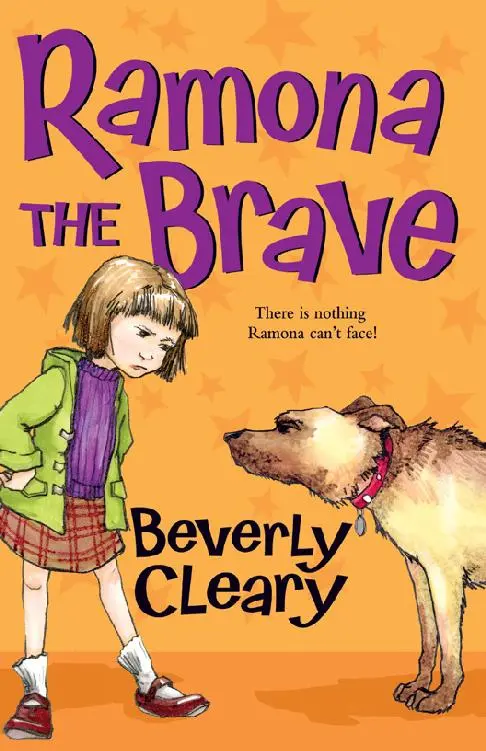

Beverly Cleary
I L L U S T R AT E D B Y
Tracy Dockray
viii
Contents
1. Trouble in the Park 1
2. Mrs. Quimby’s Secret 19
3. The Hole in the House 35
4. The First Day of School 48
5. Owl Trouble
64
6. Parents’ Night
84
7. Alone in the Dark 107
8. Ramona Says a Bad Word 128
9. Mr. Quimby’s Spunky Gal 150
About the Author
Other Books by Beverly Cleary
Credits
Cover
Copyright
About the Publisher
viii
1
Trouble in the Park
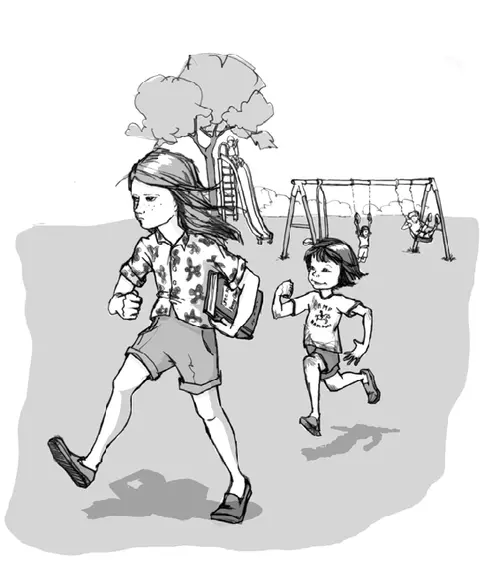
Ramona Quimby, brave and fearless, was
half running, half skipping to keep up
with her big sister Beatrice on their way
home from the park. She had never seen her
sister’s cheeks so flushed with anger as they were this August afternoon. Ramona was
sticky from heat and grubby from landing in
the sawdust at the foot of the slides, but she was proud of herself. When Mrs. Quimby
1
had sent the girls to the park for an hour, because she had an errand to do—an
important errand, she hinted—she told
Beezus, as Beatrice was called, to look after Ramona.
And what had happened? For the first
time in her six years Ramona had looked
after Beezus, who was supposed to be the
responsible one. Bossy was a better word, Ramona sometimes thought. But not today.
Ramona had stepped forward and defended
her sister for a change.
“Beezus,” said Ramona, panting, “slow
down.”
Beezus, clutching her library book in her
sweaty hand, paid no attention.The clang of
rings, the steady pop of tennis balls against asphalt, and the shouts of children grew
fainter as the girls approached their house
on Klickitat Street.
Ramona hoped their mother would be
2
home from her errand, whatever it was. She
couldn’t wait to tell what had happened and
how she had defended her big sister. Her
mother would be so proud, and so would
her father when he came home from work
and heard the story. “Good for you,
Ramona,” he would say. “That’s the old
3
fight!” Brave little Ramona.
Fortunately, the car was in the garage and
Mrs. Quimby was in the living room when
the girls burst into the house.“Why, Beezus,”
said their mother, when she saw the flushed
and sweaty faces of her daughters, one angry and one triumphant.
Beezus blinked to hold back the tears in
her eyes.
“Ramona, what happened to Beezus?”
Mrs. Quimby was alarmed.
“Don’t ever call me Beezus again!”
Beezus’s voice was fierce.
Mrs. Quimby looked at Ramona for the
explanation, and Ramona was eager to give
it. Usually Beezus was the one who
explained what had happened to Ramona,
how she had dropped her ice-cream cone
on the sidewalk and cried when Beezus
would not let her pick it up, or how she
tried, in spite of the rules, to go down a slide 4
headfirst and had landed on her face in the sawdust. Now Ramona was going to have a
turn. She took a deep breath and prepared
to tell her tale. “Well, when we went to the park, I slid on the slides awhile and Beezus sat on a bench reading her library book.
Then I saw an empty swing. A big swing,
not a baby swing over the wading pool, and
I thought since I’m going to be in the first grade next month I should swing on the big
swings. Shouldn’t I, Mama?”
“Yes, of course.” Mrs. Quimby was impa-
tient. “Please, go on with the story. What
happened to Beezus?”
“Well, I climbed up in the swing,”
Ramona continued, “only my feet wouldn’t
touch the ground because there was this big
hollow under the swing.” Ramona recalled
how she had longed to swing until the
chains went slack in her hands and her toes
pointed to the tops of the fir trees, but she 5
sensed that she had better hurry up with her story or her mother would ask Beezus to tell it. Ramona never liked to lose an audience.
“And I said,‘Beezus, push me,’ and some big
boys, big bad boys, heard me and one of
them said—” Ramona, eager to be the one
to tell the story but reluctant to repeat the words, hesitated.
“Said what?” Mrs. Quimby was baffled.
“Said what, Ramona? Beezus, what did
he say?”
Beezus wiped the back of her wrist across
her eyes and tried. “He said, ‘J-j-j—’ ”
Eagerness to beat her sister at telling what had happened overcame Ramona’s reluctance. “He said, ‘Jesus, Beezus!’ ” Ramona
looked up at her mother, waiting for her to
be shocked. Instead she merely looked sur-
prised and—could it be?—amused.
“And that is why I never, never, never want to be called Beezus again!” said Beezus.
“And all the other boys began to say it,
6
too,” said Ramona, warming to her story now that she was past the bad part. “Oh,
Mama, it was just awful. It was terrible. All those big awful boys! They kept saying,
‘Jesus, Beezus’ and ‘Beezus, Jesus.’ I jumped out of the swing, and I told them—”
Here Beezus interrupted. Anger once
more replaced tears. “And then Ramona
had to get into the act. Do you know what
she did? She jumped out of the swing and
preached a sermon! Nobody wants a little
sister tagging around preaching sermons to a bunch of boys. And they weren’t that big
either. They were just trying to act big.”
Ramona was stunned by this view of her
behavior. How unfair of Beezus when she
had been so brave. And the boys had seemed big to her.
Mrs. Quimby spoke to Beezus as if
Ramona were not present. “A sermon! You
must be joking.”
Ramona tried again. “Mama, I—”
7
Beezus was not going to give her little sister a chance to speak. “No, I’m not
joking. And then Ramona stuck her thumbs
in her ears, waggled her fingers, and stuck
out her tongue. I just about died, I was so
embarrassed.”
Ramona was suddenly subdued. She had
thought Beezus was angry at the boys, but
now it turned out she was angry with her
little sister, too. Maybe angrier. Ramona was used to being considered a little pest, and
she knew she sometimes was a pest, but this
was something different. She felt as if she
were standing aside looking at herself. She
saw a stranger, a funny little six-year-old girl with straight brown hair, wearing grubby
shorts and an old T-shirt, inherited from
Beezus, which had Camp Namanu printed
across the front. A silly little girl embarrassing her sister so much that Beezus was
ashamed of her. And she had been proud of
8
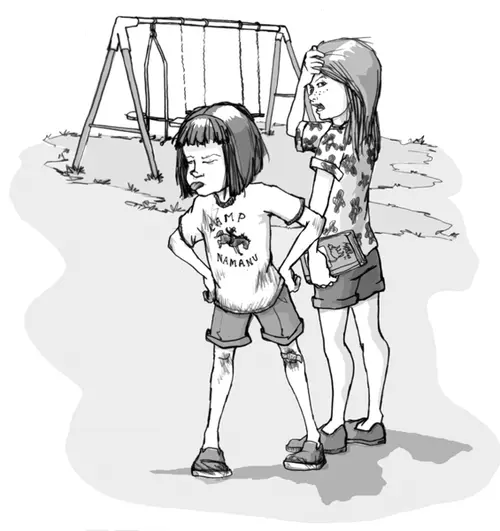
herself because she thought she was being
brave. Now it turned out that she was not
brave. She was silly and embarrassing.
Ramona’s confidence in herself was badly
shaken. She tried again. “Mama, I—”
Mrs. Quimby felt her older daughter
deserved all her attention. “Were they boys
you know?” she asked.
9
“Sort of,” said Beezus with a sniff. “They go to our school, and now when school
starts all the boys in the sixth grade will be saying it. Sixth-grade boys are awful.”
“They will have forgotten by then.” Mrs.
Quimby tried to be reassuring. Beezus
sniffed again.
“Mama, I think we should stop calling her Beezus.” Even though her feelings were
hurt, and her confidence shaken, Ramona
had a reason of her own for trying to help
Beezus.
Whenever someone asked Beezus where
she got such an unusual nickname, Beezus
always answered that it came from Ramona.
When she was little she couldn’t say Beatrice.
Now that Ramona was about to enter first
grade, she did not like to remember there
was a time when she could not pronounce
her sister’s name.
“Just because I have an Aunt Beatrice, I
10
don’t see why I have to be named Beatrice, too,” said Beezus. “Nobody else has a name
like Beatrice.”
“You wouldn’t want a name like every-
one else’s,” Mrs. Quimby pointed out.
“I know,” agreed Beezus, “but Beatrice.”
“Yuck,” said Ramona, trying to be help-
ful, but her mother frowned at her. “How
about Trissy?” she suggested hastily.
Beezus was rude. “Don’t be dumb. Then
they would call me Sissy Trissy or something.
Boys in the sixth grade think up awful names.”
“Nobody ever calls me anything but
Ramona Kimona.” Ramona could not help
thinking that an awful nickname might be
interesting to have. “Why not just be
Beatrice? Nobody can think up a bad nick-
name for Beatrice.”
“Yes, I guess you’re right,” agreed Beezus.
“I’ll have to be plain old Beatrice with her plain old brown hair.”
11
“I think Beatrice is fancy,” said Ramona, who also had plain old brown hair but did
not take it so hard. Agreeing with Beezus—
Beatrice—gave Ramona a cozy feeling, as if
something unusually pleasant had taken
place. Beezus honored Ramona with a
watery smile, forgiving her, at least for the moment, for preaching a sermon.
Ramona felt secure and happy. Agreeing
was so pleasant she wished she and her sister could agree more often. Unfortunately,
there were many things to disagree about—
whose turn it was to feed Picky-picky, the
old yellow cat, who should change the paper
under Picky-picky’s dish, whose washcloth
had been left sopping in the bathtub because someone had not wrung it out, and whose
dirty underwear had been left in whose half
of the room. Ramona always said Beezus—
Beatrice—was bossy, because she was older.
Beatrice said Ramona always got her own
12
way, because she was the baby and because she always made a fuss. For the moment all
this was forgotten.
Mrs. Quimby smiled to see her girls at
peace with one another. “Don’t worry,
Beatrice. If the boys tease you, just hold your head high and ignore them. When they see
they can’t tease you, they will stop.”
The two sisters exchanged a look of
complete understanding. They both knew
this was the sort of advice easy for adults to give but difficult for children to follow. If the boys remembered, Beezus might have to
listen to “Jesus, Beezus” for months before
they gave up.
“By the way, Ramona,” said Mrs.
Quimby, as Beatrice went off to the bath-
room to splash cold water on her face,“what
did you say to the boys in the park?”
Ramona, who had flopped back on the
couch, sat up straight. “I told them they
13
were not supposed to take the name of the Lord in vain,” she said in her most proper
Sunday School voice. “That’s what my
Sunday School teacher said.”
“Oh, I see,” said Mrs. Quimby.“And what
did they say to that?”
Ramona was chagrined because she knew
her mother was amused, and Ramona did
not like anyone to be amused when she was
serious.“Wasn’t I right? That’s what I learned in Sunday School.” She was filled with
uncertainty by her mother’s amusement, as
well as by her sister’s anger over the incident.
“Of course, you were right, dear, although
I don’t suppose a bunch of boys would pay
much attention.” Mrs. Quimby’s lips were
not smiling, but amusement lingered in her
eyes. “How did the boys answer?”
Ramona’s confidence wilted completely.
She was seeing that little girl in the park
who was not the heroine she thought she
14
was after all. “They laughed,” Ramona admitted in a small voice, feeling sorry for herself. Poor little Ramona, laughed at and
picked on. Nobody understood how she
felt. Nobody understood what it was like to
be six years old and the littlest one in the family unless you counted old Picky-picky,
and even he was ten years old.
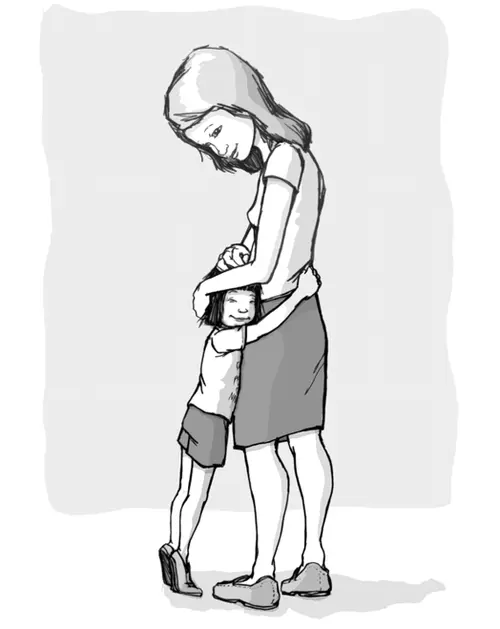
Mrs. Quimby gave Ramona a big hug.
“Well, it’s all over now,” she said.“Run along and play, but please don’t play Brick Factory this afternoon.”
“Don’t worry, Mother. I don’t have any
bricks left.”
Ramona felt that her mother should be
able to see that running along and playing
was impossible on a hot summer afternoon
when everyone Ramona’s age had gone to
the beach or the mountains or to visit a
grandmother. The two weeks the Quimbys
had spent in a borrowed mountain cabin in
15
July now seemed a long time away. Who was she supposed to play with?
Summer was boring. Long and boring.
No bricks left for the game of Brick Factory, which she and her friend Howie had
invented, nobody to play with, and Beezus
with her nose in a book all day.
Not having any place to run along to,
Ramona sat looking at her mother, thinking
that her fresh haircut and touch of eye
shadow made her look unusually nice this
afternoon. She wondered if her mother
would tell her father about the incident in
the park and if they would have a good
laugh over it when they thought Ramona
could not hear. She hoped not. She did not
want her father to laugh at her.
Seeing her mother looking so nice made
Ramona recall the reason for the trip to the park.“What was your errand that you didn’t
want to drag us along on?” she asked.
16
Mrs. Quimby smiled a different smile,
exasperating and mysterious. “Sh-h-h,” she
said, her finger on her lips. “It’s a secret, and wild horses couldn’t drag it out of me.”
Ramona found secrets hard to bear. “Tell
me, Mama! Mama, please tell me.” She threw her arms around her mother, who had a
good smell of clean clothes and perfumed
soap. “Please, please, please! ” Learning a big juicy secret would help make up for
Ramona’s unhappy afternoon.
Mrs. Quimby shook her head.
“Pretty please with a lump of sugar on
it?” Ramona felt she could not bear not
knowing this very minute.
“If I told you, it wouldn’t be a secret any-
more,” said Mrs. Quimby.
That, Ramona felt, was just about the
most exasperating sentence ever spoken by a
grown-up.
18
2
Mrs. Quimby’s Secret
Mrs. Quimby, wearing a dress instead
of old slacks, had gone off on
another mysterious errand. She promised
not to be away long, and Beezus and
Ramona promised to stay out of trouble
while she was out, a promise easier for
Beezus to keep than for Ramona. Beezus
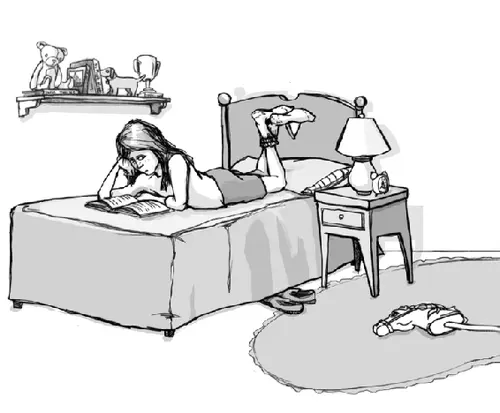
disappeared with a book into the room the
girls shared. Ramona settled herself at the
19
kitchen table with paper and crayons to draw a picture of the cat on the label of a
can of Puss’n Boots cat food. Ramona
loved that jaunty booted cat, so different
from old Picky-picky, who spent most of
his time napping on Beezus’s bed.
The house was quiet. Ramona worked
happily, humming a tune from a television
commercial. She used a pencil to draw cat
fur, because she could draw finer lines with it than she could with a crayon. She used her crayons for Puss’n Boots’s clothes, but when she came to his boots, she discovered her red crayon was missing. Most likely she had left it in her room.
“Beezus, have you seen my red crayon?”
The girls had made an agreement that
Ramona could call her sister Beezus at
home, but in public she had better remem-
ber to call her Beatrice or look out!
“Um-hm.” Without looking up from her
20
book, Beezus waved her hand in the direction of Ramona’s bed.
Peace between the sisters could not last.
Ramona saw the broken remains of her red
crayon lying in the middle of her bed.“Who
broke my crayon?” she demanded.
“You shouldn’t leave your crayon on
other people’s beds where it can get sat on.”
Beezus did not even bother to look up from
her book.
Ramona found this answer most annoy-
ing. “You should look where you sit,” she
said, “and you don’t have to be so bossy.”
“This is my bed.” Beezus glanced at her
sister.“You have your own half of the room.”
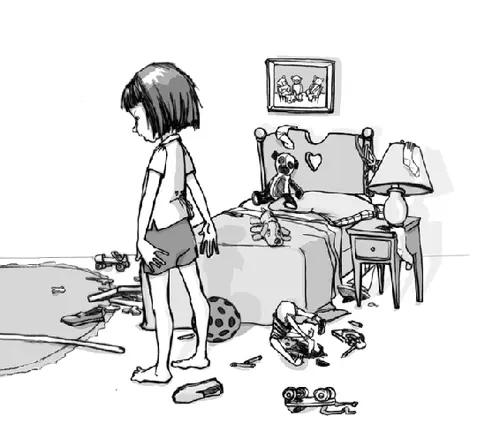
“I don’t have anyplace to put anything.”
“Pooh,” said Beezus. “You’re just careless
and messy.”
Ramona was indignant.“I am not careless
and messy!” Picky-picky woke up, leaped
from Beezus’s bed, and departed, tail held
21
straight. Picky-picky often made it plain he did not care for Ramona.
“Yes, you are,” said Beezus. “You don’t
hang up your clothes, and you leave your
toys all over.”
“Just because the clothes bar is easy for
you to reach,” said Ramona, “and you think
you’re too big for toys.” To show her sister that she did pick up her things, she laid the 22
pieces of her broken crayon in her drawer on top of her underwear. She had lost interest in crayoning. She did not want to color boots
with the rough ends of a broken crayon.
“Besides,” said Beezus, who did not like
to be interrupted when she was deep in a
good book, “you’re a pest.”
Pest was a fighting word to Ramona, because it was unfair. She was not a pest, at 23
least not all the time. She was only littler than anyone else in the family, and no matter
how hard she tried, she could not catch up.
“Don’t you call me a pest,” she shouted, “or I’ll tell Mama you have a lipstick hidden in your drawer.”
Beezus finally laid down her book.
“Ramona Geraldine Quimby!” Her voice
and manner were fierce.“You’re nothing but
a snoop and a tattletale!”
Ramona had gone too far. “I wasn’t
snooping. I was looking for a safety pin,” she explained, adding, as if she were a very good girl, “and anyway I haven’t told Mama yet. ”
Beezus gave her sister a look of disgust.
“Ramona, grow up!”
Ramona lost all patience. “Can’t you see I’m trying?” she yelled at the top of her voice. People were always telling her to
grow up.What did they think she was trying
to do?
24
“Try harder,” was Beezus’s heartless
answer. “And stop bothering me when I’ve
come to the good part in my book.”
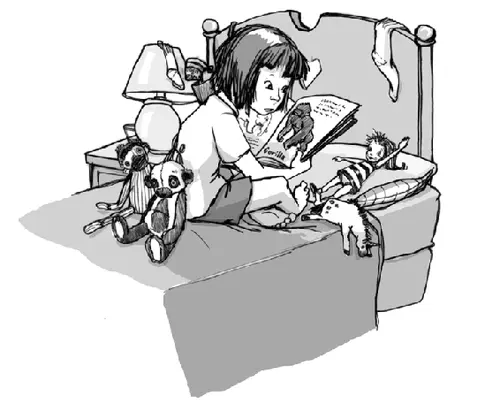
Ramona shoved aside her stuffed animals
and threw herself on her bed with Wild
Animals of Africa, a book with interesting pictures but without the three grown-up
words, gas, motel, and burger, which she had taught herself from signs but was unable to
find in books. The book fell open to the
page that she had looked at most often, a full-page colored photograph of a gorilla.
Ramona stared briefly and intensely at the
gorilla, taking in his mighty body covered
with blue-black hair, his tiny eyes, the dark caves of his nostrils, his long and powerful arms with hands like leather that hung
almost to the ground. With a satisfying
shiver, Ramona slammed the book shut.
She wouldn’t want to meet that old gorilla
coming down the street or swinging through
the trees of the park. She let the book fall open again. The gorilla was still there, staring out of the page with fierce little eyes.
Ramona slammed the gorilla in again.
When Ramona was bored, she enjoyed scar-
ing herself.
“Ramona, do you have to keep slamming
that book?” asked Beezus.
Ramona slammed the book a few more
times to show her sister she could slam the
26
book all she wanted to.
“Pest,” said Beezus, to show Ramona she
could call her a pest if she wanted to.
“I am not a pest!” yelled Ramona.
“You are too a pest!” Beezus yelled back.
Ha, thought Ramona, at least I got you
away from your old book. “I’m not a pest,
and you’re just bossy!” she shouted.
“Silence, varlet,” commanded Beezus.
“Yonder car approacheth. Our noble mother
cometh.” People talked like that in the books Beezus was reading lately.
Ramona thought Beezus was showing
off. “Don’t you call me a bad name!” she
shouted, half hoping her mother would hear.
In a moment Mrs. Quimby appeared in
the doorway. She looked angry. Beezus shot
Ramona an it’s-all-your-fault look.
“Girls, you can be heard all over the
neighborhood,” said Mrs. Quimby.
Ramona sat up and looked virtuous.
27
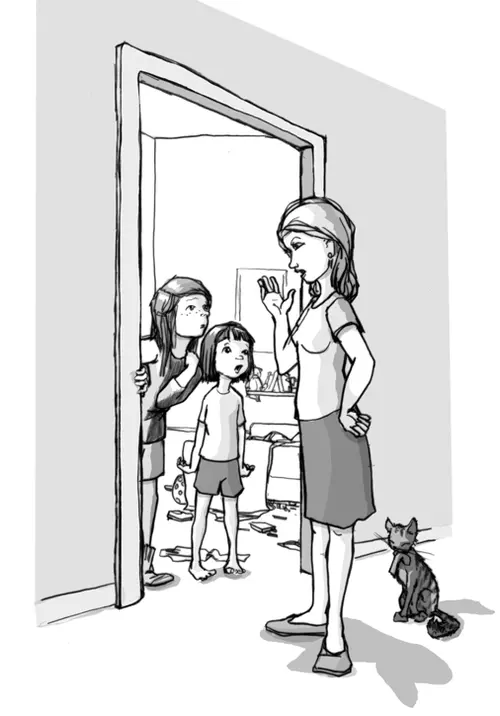
“Beezus called me a bad name.”
“How do you know?” asked Beezus.
“You don’t even know what varlet means.”
Mrs. Quimby took in the two girls on
their rumpled beds, Ramona’s toys heaped
in the corner, the overflowing dresser. Then, 28
when she spoke, she said an astonishing thing. “I don’t blame you girls one little bit for bickering so much. This room is much
too small for two growing girls, so of course you get on one another’s nerves.”
The sisters looked at each other and
relaxed.Their mother understood.
“Well, we’re going to do something
about it,” Mrs. Quimby continued. “We’re
going to go ahead and build that extra bed-
room onto the house.”
Beezus sat up, and this time she was the
one to slam her book shut. “Oh, Mother!”
she cried. “Are we really?”
Ramona understood the stress on that last
word.The extra room had been talked about
for so long that neither sister believed it
would actually be built. Mr. Quimby had
drawn plans for knocking out the back of the closet where the vacuum cleaner was kept
and extending the house into the backyard
29
just enough to add a small bedroom with the closet-turned-into-a-hall leading to it.
Ramona had heard a lot of uninteresting
grown-up talk about borrowing money
from a bank to pay for it, but nothing had
ever come of it. All she understood was that her father worked at something that sounded
boring in an office downtown, and there was
never quite enough money in the Quimby
family. They were certainly not poor, but her parents worried a lot about taxes and college educations.
“Where will we get the money to pay
back the bank?” asked Beezus, who under-
stood these things better than Ramona.
Mrs. Quimby smiled, about to make an
important announcement.“I have a job that
begins as soon as school starts.”
“A job!” cried the sisters.
“Yes,” said their mother. “I am going to
work from nine in the morning till two in
30
the afternoon in Dr. Perry’s office.That way I can be here when Ramona gets home from
school.And on my way home from talking to
Dr. Perry, I stopped at the bank and arranged to borrow the money to pay for the room.”
“Oh, Mother!” Beezus was all enthusi-
asm. Dr. Perry was the woman who had
given the girls their checkups and their shots ever since they were born. “Just think!
You’re going to be liberated!”
Ramona was pleased by the look of
amusement that flickered across her mother’s face. Ramona wasn’t the only one who said
things grown-ups thought funny.
“That remains to be seen,” said Mrs.
Quimby,“and depends on how much help I
get from you girls.”
“And you’ll get to see all the darling
babies!” Beezus loved babies and could
hardly wait until she was old enough to baby-sit. “Oh, Mother, you’re so lucky!”
31
Mrs. Quimby smiled. “I’m going to be Dr. Perry’s bookkeeper. I won’t be taking
care of babies.”
Ramona was less enthusiastic than
Beezus. “Who will take care of me if I get
sick?” she wanted to know.
The Story Continues on BooksBarbecue!
Enjoyed this preview? ❤️ Do not stop here!
Read the complete book free online → 🔗
Continue reading now on BooksBarbecue and discover every page!
Love reading? Bookmark BooksBarbecue.com for more amazing books!
Happy Reading!