Ramona Forever
Title Page

Beverly Cleary
I L L U S T R AT E D B Y
Tracy Dockray
viii
Contents
1. The Rich Uncle 1
2. Ramona’s Problem 29
3. Being Good 47
4. Picky-picky 64
5. “IT”
81
6. A Surprise, Sort Of 100
7. The Chain of Command 119
8. The Families Get Together 132
9. Ramona Saves the Day 146
10. Another Big Event 167
About the Author
Other Books by Beverly Cleary
Credits
Cover
Copyright
About the Publisher
1
The Rich Uncle
“ Guess what?” Ramona Quimby asked
one Friday evening when her Aunt
Beatrice dropped by to show off her new
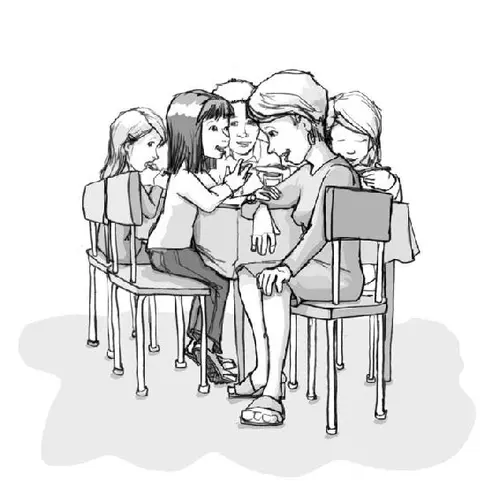
ski clothes and to stay for supper. Ramona’s mother, father, and big sister Beezus, whose real name was Beatrice, paid no attention and went on eating. Picky-picky, the cat, meowed through the basement door, asking to share the meal.
1
Aunt Beatrice, who taught third grade, knew how to behave toward her third-grade
niece. “What?” she asked, laying down her
fork as if she expected to be astounded by Ramona’s news.
Ramona took a deep breath and an-
nounced, “Howie Kemp’s rich uncle is
coming to visit.” Except for Aunt Bea, her family was not as curious as Ramona had
hoped. She plunged on anyway because she
was happy for her friend. “Howie’s grand-
mother is really excited, and so are Howie and Willa Jean.” And so, to be truthful, was Ramona, who disliked having to go to the
Kemps’ house after school, where Howie’s
grandmother looked after her grandchildren and Ramona while the two mothers were at
work.A rich uncle, even someone else’s rich uncle, should make those long after-school hours more interesting.
“I didn’t know Howie had a rich uncle,”
said Mrs. Quimby.
2
“He’s Howie’s father’s little brother, only now he’s big,” explained Ramona.
“Why, that must be Hobart Kemp,” said
Aunt Beatrice. “He was in my class in high school.”
“Oh, yes. I remember.That boy with the
blond curly hair who played baseball.” Mrs.
Quimby motioned to her daughters to clear
3
away the plates. “All the girls said he was cute.”
“That’s the one,” said Aunt Bea.“He used
to chew licorice and spit on the grass to make the principal think he was chewing tobacco like a professional baseball player, which was what he wanted to be.”
“Where’s this cute licorice-chewing uncle
coming from, and how did he get so rich?”
asked Ramona’s father, beginning to be interested. “Playing baseball?”
“He’s coming from—” Ramona frowned.
“I can’t remember the name, but it sounds like a fairy tale and has camels.” Narnia? Never-never-land? No, those names weren’t right.
“Saudi Arabia,” said Beezus, who also went to the Kemps’ after school. Being in junior high school, she could take her time getting there.
“Yes, that’s it!” Ramona wished she had
remembered first.“Howie says he’s bringing 4
the whole family presents.” She imagined bags of gold like those in The Arabian Nights, which Beezus had read to her. Of course,
nobody carried around bags of gold today,
but she enjoyed imagining them.
“What’s Howie’s uncle doing in Saudi
Arabia?” asked Mr. Quimby. “Besides spit-
ting licorice in the sand?”
“Daddy, don’t be silly,” said Ramona. “I
don’t know exactly.” Now that she was the
center of attention, she wished she had more information.“Something about oil. Drills or rigs or something. Howie understands all
about it. His uncle earned a lot of money.”
The Quimbys were a family who had to
worry about money.
“Oh, that kind of rich,” said Mr. Quimby.
“I thought maybe a long-lost uncle had died and left him a castle full of servants, jewels, and rare old wines.”
“Daddy, that’s so old-fashioned,” said
5
Ramona. “That’s only in books.”
The conversation drifted off, leaving
Ramona behind. Her father, who would earn
his teaching credential in June, said he was inquiring around for schools that needed an art teacher, and he also told about the problems of the men who worked in the same
frozen-food warehouse where he worked on
weekends at below-freezing temperatures.
Mrs. Quimby told about two people who
got into an argument over a parking space at the doctor’s office where she worked. Aunt Bea talked about a man named Michael
who had invited her to go skiing and was
the reason she had bought new ski clothes.
Beezus wondered aloud if Michael would
ask Aunt Bea to marry him.Aunt Bea laughed at that, saying she had known him only two weeks, but since this was January, there were several months of skiing left and there was no telling what might happen.
6
No more was said about Howie’s uncle that evening. Days went by. Uncle Hobart
didn’t come and didn’t come. Every evening Mr. Quimby asked, “Has Old Moneybags
arrived?” And Ramona had to say no.
Finally one morning, as Ramona and
Howie were waiting for the school bus,
Ramona said,“I don’t think you have a rich uncle at all. I think you made him up.”
Howie said he did too have a rich uncle.
Even little Willa Jean, when Ramona went
to the Kemps’ after school, talked about
Uncle Hobart and the presents he was bringing. Ramona informed Howie and Willa Jean
rather crossly that her mother said it wasn’t nice to talk about other people’s money. They paid no attention—after all, he was their very own uncle, not Ramona’s—and went right
on talking about Uncle Hobart this and
Uncle Hobart that. Uncle Hobart had landed in New York. He had actually telephoned,
7
live and in person. Uncle Hobart was driving across the country. Uncle Hobart was delayed by a storm in the Rockies. Ramona wished
she had never heard of Uncle Hobart.
Then, one day after school, Ramona and
Howie saw a muddy van parked on the
Kemps’ driveway.
“It’s Uncle Hobart!” Howie shouted, and
began to run.
Ramona took her time. Somehow she
had expected Uncle Hobart to arrive in a
long black limousine, not a muddy van. She followed Howie into the house, where the
famous uncle turned out to be a medium-
young man who had not shaved for several
days and who was wearing old jeans and a
faded T-shirt. He was holding Willa Jean on his lap. The warm, sweet smell of apple pie filled the air.
“Down you go, Doll,” said Uncle Hobart,
lifting Willa Jean to the floor and grabbing 8
Howie in a bear hug. “How’s my favorite nephew?” he asked, and held Howie off to
look at him while Mrs. Kemp hovered and
Willa Jean embraced her Uncle Hobart’s
knee.
Ramona was embarrassed. She felt she
was in the way because she was not related.
She sat down on a chair, opened a book, but did not read. She studied Uncle Hobart,
who didn’t look rich to her. He looked like a plain man—a big disappointment.
Willa Jean let go of her uncle’s knee.“See what Uncle Hobart brought us,” she said,
and pointed to a pair of objects that looked like two small sawhorses, each holding a red leather cushion. Willa Jean sat astride one.
“Giddyup, you old camel,” she said and
informed Ramona,“This is my camel saddle.”
“Hey, a camel saddle!” said Howie when
he saw his present. He imitated Willa Jean.
After a few more giddyups, there was nothing 9
more to do with a camel saddle except sit on it.
Pooh, who wants a boring old camel
saddle, Ramona wanted to say, at the same
time wishing she had a saddle to sit on these winter days when she liked to read by the
furnace outlet.
Finally Uncle Hobart noticed Ramona.
“Well, who’s this young lady?” he asked.
“Howie, you didn’t tell me you had a girl-
friend.”
Both Ramona and Howie turned red and
somehow felt ashamed.
“Aw, that’s just old Ramona,” Howie
muttered.
To Ramona’s horror, Uncle Hobart began
to strum an imaginary guitar and sing:
“Ramona, I hear the mission bells above.
Ramona, they’re ringing out our song of love.
I press you, caress you,
And bless the day you taught me to care.”
10
Ramona knew right then that she did not like Uncle Hobart and never would. She had heard that song before. When Grandpa
Day lived in Portland, he used to sing it to tease her, too. “I’m not Howie’s girlfriend,”
she said in her most grown-up manner. “I
have to stay here until my mother is through work. It is”—could she get the words out
right?—“strictly a business arrangement.”
Uncle Hobart found this very funny,
which made Ramona dislike him even more.
“Cut it out, Uncle Hobart,” said Howie, a
remark much appreciated by Ramona, who
pretended to read her book while inside she churned with anger. She was glad she didn’t have an Uncle Hobart. She was glad she didn’t have any uncles at all, just Aunt
Beatrice, who never embarrassed children and who always came when the family needed
her.
“Did you bring us any more presents?”
asked Willa Jean.
11
“Willa Jean, that isn’t nice,” said Mrs.
Kemp, smiling because she was so happy to
have her youngest son home at last.
“Willa Jean, how did you guess?” asked
Uncle Hobart. “Come on out to the van,
and I’ll show you.”
“Me, too?” Howie quickly forgot his
annoyance.
“Sure.” As he went out the door, Uncle
Hobart said,“It’s great to be back in a country full of green grass and trees.”
Ramona heard Howie ask, “What do
camels eat if there isn’t any grass?”
When they returned, Ramona lost her
struggle to be interested in her book. Uncle Hobart was carrying a small accordion.
“Grandma, look!” Howie was wheeling
what appeared to be part of a bicycle. “It’s a real unicycle!”
“Is it broken?” asked Willa Jean.“It has only one wheel.”
12
“Hobart, whatever were you thinking of ?”
Mrs. Kemp frowned at the unicycle.
“I was thinking of the unicycle you
wouldn’t let me have when I was Howie’s
age,” said Uncle Hobart. “Now, Mom, don’t
you worry about a thing. I’ll help him. He’s not going to break any bones.” He set the
accordion on the floor by Willa Jean. “And this is for you,” he said.
Willa Jean eyed the accordion.“What does
it do?” she asked.
“You can play music on it,” answered her
uncle.“It’s a Viennese accordion. I bought it from one of the men I worked with and even learned to play it a little.”
“Isn’t that lovely, Willa Jean?” said Mrs.
Kemp. “Your very own musical instrument.
We’ll put it away until you’re old enough to learn to play it.”
“No!” Willa Jean put on her stubborn
look. “I want to play it now!”
13
Uncle Hobart took the accordion and began to play and sing:
“Ramona, I hear the mission bells above, Ramona, they’re ringing out our song of love.”
Ramona stared at her book as she thought
mean, dark thoughts about Uncle Hobart.
He stopped playing and said, “What’s the
matter, Ramona? Don’t you like my music?”
“No.” Ramona looked the uncle in the
eye. “You’re teasing. I don’t like grown-ups who tease.”
“Why, Ramona!” Mrs. Kemp was most
disapproving. “That’s no way to talk to
Howie’s uncle.”
“Now, Mom, don’t get excited,” said Uncle
Hobart. “Ramona has a point. I was teasing, but I’ll reform. Okay, Ramona?”
“Okay,” agreed Ramona, suspecting he
might still be teasing.
14
“Uncle Hobart, Uncle Hobart, let me play it,” begged Willa Jean.
The uncle placed Willa Jean’s hands
through the straps at each end of the accordion. “You squeeze in and pull out while
you press the little buttons,” he explained.
Before he could give any more instruc-
tions, Howie grabbed his uncle by the hand and dragged him outdoors. Mrs. Kemp, sure
that bones were about to be broken, followed.
Ramona watched through the window.
Uncle Hobart hopped on the unicycle and,
waving to his audience, pedaled to the corner and back.“See, nothing to it,” he said.“Once you know how.”
“Hobart, where on earth did you learn
to ride that thing?” his mother called out from the front steps.
“In college,” answered her son.“Come on,
Howie, it’s your turn.” Holding the unicycle upright with one hand, he helped Howie
15
mount the seat over the single wheel. “Now pedal,” he directed. Howie pedaled; the unicycle tipped forward, setting Howie on the sidewalk.
Indoors, Willa Jean struggled with the
accordion, too heavy for her, and made it
give out a loud groan, as if it were in pain.
“No, not that way,” Ramona heard Uncle
Hobart say. “It’s like riding a bicycle, only instead of balancing sideways, you have to balance back and forth at the same time.”
With a flushed and determined face,
Howie mounted the unicycle again. If he
learns to ride it, maybe he’ll let me ride his bicycle, thought Ramona, who longed for
a bicycle, even a secondhand, three-speed
bicycle. Howie tipped over backward into
his uncle’s arms. The accordion squawked.
Ramona felt rather lonely, left out and in the way.
“Hobart, do be careful,” shouted Mrs.
16
Kemp above the squawk and screech of Willa Jean’s playing.
Ramona could see that learning to ride a
unicycle was going to take time, so she
turned her attention to Willa Jean and the accordion.
Willa Jean set her gift on the floor and sat down on her camel saddle with a scowl.“It’s too big and it won’t play music.”
“Let me try.” Ramona was sure she could
make music come out of the accordion. It
looked so easy. She slipped her hands through the straps. The only song she could think of was, unfortunately, “Ramona.” She pumped
and pushed the buttons, only to produce the cry of a suffering accordion. She tried push-ing different buttons while she pushed the bellows in and out. Hee-haw, hee-haw. This was not the music Ramona had in mind.
“Maybe your uncle can show you how when
he has more time,” she told Willa Jean as she 17
set the accordion down carefully on Howie’s camel saddle.
From outside, Mrs. Kemp’s warnings con-
tinued. “Hobart! Howie! Be careful!”
Ramona and Willa Jean stood by the
window to watch Howie, protected by his
uncle, actually ride a few feet before he
pitched forward onto the sidewalk.“I did it!”
he shouted.
He’s going to learn to ride it, thought
Ramona, and then I’ll get to ride his bicycle.
Willa Jean returned to the accordion as if it might have learned to play while she let it rest, but no, it went right on shrieking and groaning.“I know how I’ll make it play,” she said.
Ramona turned from the window in
time to see Willa Jean set her accordion on one end on the floor. Holding it down with one foot through the strap, she used both
hands to stretch it up as high as she could 18
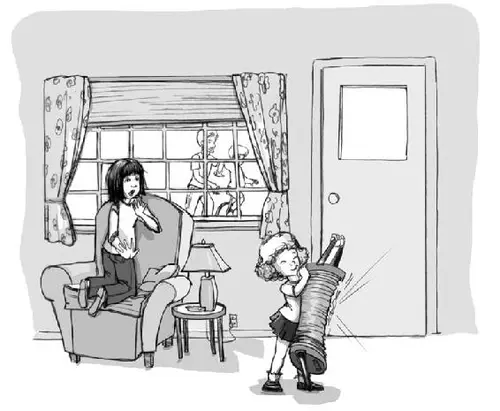
pull it. Then, as Ramona understood what
she was about to do and tried to grab her, Willa Jean quickly took her foot out of the strap, turned, sat on the upended accordion, and lifted both feet from the floor. As she sank down, the accordion uttered one long
screech, as if it were dying in agony.
“Willa Jean!” cried Ramona, horrified and delighted by the dreadful piercing noise that left her ears ringing. Willa Jean jumped up beaming. The accordion, Ramona could see,
would never rise again. Its bellows had split, silencing it forever. “You broke it,” Ramona said, knowing she might have done the same thing at Willa Jean’s age.
“I don’t care,” said Willa Jean.“I made a big noise, and now I don’t want it anymore.”
Mrs. Kemp burst in to see what had hap-
pened. “You naughty girls!” she cried when she saw the remains of Uncle Hobart’s
present.
“But I didn’t do it,” protested Ramona.
“It’s not my fault.”
“An expensive musical instrument ruined,”
said Mrs. Kemp. “You’re a big girl, Ramona.
You should know better than let Willa Jean break it.” She turned to her granddaughter.
“Aren’t you ashamed of yourself ?”
20
“No,” said Willa Jean.“It’s a dumb old thing that wouldn’t play.”
“Willa Jean, go to your room,” ordered
Mrs. Kemp, who usually felt that anything
Willa Jean did or said was cute, sweet, or adorable.“I’m ashamed of you, spoiling your nice uncle’s homecoming.”
Scowling,Willa Jean did as she was told.
Mrs. Kemp turned to Ramona. “As for
you, young lady, you sit on that chair until your mother comes for you.”
Ramona sat, and Ramona seethed, angry
at the unfairness of all that had happened.
Why should she have to look after Willa
Jean when her mother paid Mrs. Kemp to
look after Ramona? And Uncle Hobart was
just plain stupid to give a little girl something she couldn’t use until she was older, but then, grown-ups were often stupid about presents.
Ramona knew. She had been given books
“to grow into,” and by the time she had
21
grown into them, they had lain around so long they no longer looked interesting. But an accordion—growing up to an accordion
would take forever.
Outside, other children had come to watch
Howie learn to ride his unicycle. Ramona
could hear shouts and laughing, and once in a while, a cheer. It isn’t fair, Ramona told herself, even though grown-ups were always telling her life was not fair. It wasn’t fair that life wasn’t fair.
Ramona watched Mrs. Kemp lovingly
polish her new brass tray and coffee pot from Saudi Arabia. Ping-ping-ping went the timer on the kitchen stove. Howie burst in crying, one knee of his jeans bloody. Uncle Hobart followed with the unicycle. The afternoon
was not fair, but neither was it boring.
“Oh, my goodness,” cried Mrs. Kemp.“I
knew this would happen. I just knew he
would get hurt on that contraption.”
22
Ramona could hear Willa Jean singing from her room:
“This old man, he is dumb.
Knick-a-knack paddywhack,
Give a dog a phone,
This old man comes rolling home.”
Ramona smiled.Willa Jean never got the
words to songs right.
Ping-ping-ping insisted the timer.“Hobart, turn off the oven and take out the pie while I attend to Howie,” directed harassed Mrs.
Kemp.Willa Jean stalked into the living room, picked up her camel saddle, and stalked out again. In spite of her bitterness, Ramona
found the whole scene most entertaining to watch, better than TV because it was live.
When Howie limped back to the living
room with one leg of his jeans rolled up and a bandage on his knee, he sat on the couch 23
feeling sorry for himself. Ramona felt sorry for him, too.
“M-m-m.” Uncle Hobart inhaled.“Smell
Mom’s apple pie. Just what I dreamed of
every night when I was overseas.” He gave
his mother a smacking kiss.
“You’re not fooling me.” Mrs. Kemp was
delighted. “You can’t make me believe you
dreamed of my apple pie every night. I know you better than that.”
Uncle Hobart noticed Ramona impris-
oned on a chair. “What’s the matter with
Howie’s girlfriend?” he asked.
Of course, Ramona did not answer a man
who did not play fair. He had promised to
reform and not tease.
“Hobart, what do you think of a big girl
who sits and watches while a little girl breaks her accordion?” Mrs. Kemp, Ramona understood, did not want an answer. She wanted to shame Ramona.
24
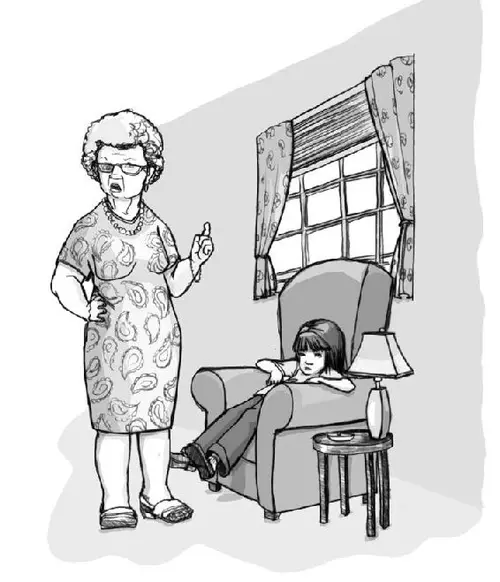
Ramona was suddenly struck by a new
and disquieting thought. Mrs. Kemp did not like her. Until this minute she had thought all adults were supposed to like all children.
25
She understood by now that misunderstandings were to be expected—she had had
several with teachers—and often grown-ups
and children did not agree, but things somehow worked out. For a grown-up to actually dislike a child and try to shame her, she was sure had to be wrong, very, very wrong. She longed for Beezus to come, so she could feel someone was on her side, but Beezus found
more and more excuses to delay coming to
the Kemps’ after school.
Uncle Hobart apparently thought he was
expected to answer his mother’s question.
“What do I think of Ramona? Since she’s
Howie’s girlfriend, I think she’s a great kid.
Don’t you, Howie?”
“Oh, shut up, Uncle Hobart.” Howie
scowled at the carpet.
Good for you, Howie, thought Ramona.
You’re on my side.
“Howie!” cried Mrs. Kemp.“That’s no way
26
to talk to your uncle.”
“I don’t care,” said Howie. “My knee
hurts.”
“Really, I don’t know what got into you
children this afternoon.” Mrs. Kemp was
thoroughly provoked.
Ramona could have told her in one word:
grown-ups. Instead, she stared at her book and thought, I am never going to come back here again. Never, never, never. She did not care what anyone said. She did not care what happened. She was not going to be looked after by someone who did not like her.
“Poor Mom,” said Uncle Hobart. “How
about a piece of your apple pie.”
Poor us. Ramona included Howie and
Willa Jean in her pity as she wished that
someday, just once, she too could sit on an accordion. She knew she never would, even
if she had the chance. She had grown past
Willa Jean’s kind of behavior, which had been 27
fun while it lasted. Ramona smiled as she recalled the happy afternoon she had spent, when she was Willa Jean’s age, boring holes in the garage wall with her father’s brace and bit—until she was caught.
28
2
Ramona’s Problem
At dinner the evening after the accor-
dion incident, the members of the
Quimby family were silent and thoughtful,
as if they all had serious problems on their minds.They really were thinking about their problems, but they looked thoughtful because they were trying to avoid the bones in the fish they were having for supper. Eating fish with bones without looking thoughtful is
29
impossible. Picky-picky, meowing for his turn, wove himself around their legs.
Ramona, who did not care for fish and
was willing to let Picky-picky have her
share, wished her mother would say,
“Ramona eats like a bird,” as if Ramona
were unusually delicate and sensitive. Some mothers were like that, but not Mrs.
Quimby, who would only say cheerfully,
“Eat it anyway,” if Ramona complained that she did not like fish.
Since she could not get away with eating
like a bird, Ramona poked her fork through her fish to remove every single bone before taking the first bite, and while she pushed, she worried. How was she going to inform
her family that she was never going to stay with Mrs. Kemp again? Never, and then
what? If she did not stay at the Kemps’ after school, her mother might not be able to
work in the doctor’s office, her father could 30
not go to college, and the whole family would fall over like dominoes pushed by
Ramona.
Mr. Quimby laid a fishbone on the edge
The Story Continues on BooksBarbecue!
Enjoyed this preview? ❤️ Do not stop here!
Read the complete book free online → 🔗
Continue reading now on BooksBarbecue and discover every page!
Love reading? Bookmark BooksBarbecue.com for more amazing books!
Happy Reading!