Rain on the River
Cover
Title Page
Jim Dodge

Selected Poems and Short Prose

Dedication
for
Victoria Stockley Dodge
covivant for over thirty years, the last seven as wife;
nerve of my soul, love of my life
Contents
Notes and Acknowledgments
Selected Poems and Short Prose
Learning to Talk
The Cookie Jar
Things Thought Through
On Balance
Decomposition
Psycho Ecology
Life of the Spirit
Aweigh
Tao-to-Tao
To Be
Practice, Practice, Practice
Wisdom and Happiness
Red Sails
Squall & Commotion
Slow Learner
Bathing Joe
Mahogany China
The First Cut Is the Deepest
Waiting for Houdini to Come Up
The Countessa
Venison Stew
Winter Song
On Humor: On Mating Donkeys and Onions
Watering the Garden on the Hottest Day of the Summer
Palms to the Moon
A Firmer Grasp of the Obvious
The Work of Art
Steelhead Fishing, Smith River, January
The Third Bank of the River
Green Side Up
One Thing After Another
Unnatural Selections: A Meditation upon Witnessing a Bullfrog Fucking a Rock
Fishing Devil’s Hole at the Peak of Spring
Getting After It
How to Catch the Biggest Fish
Hard Work
There It Is
Knowing When to Stop
Vacation Expenses
Basic Precepts and Avuncular Advice for Young Men
Killing
Death and Dying
New Poems and Short Prose
The Banker
The Real Last Words of Billy the Kid
The Moving Part of Motion
How About
Necessary Angels
Prayer Bones
Magic and Beauty
Day Moon
Karma Bird
The Tunnel
Hagerty Wrecks Another Company Truck
Obsession
Love Find
Flux
Thanks for the Dance
The Stone
Woman in a Room Full of Rubber Numbers
Reason to Live
Scratch
Salvage
An Epithalamium for Victoria
Falling into Place
Play-By-Play
Job Application
The Mouth of the River
The Prior and Subsequent Heavens
Old Growth
Three Ways to Get the Carrot on the Stick
Eurydice Ascending
The Drought of ’76
True Account of the Saucer People
About Time
Smithereens
Jack o’ Hearts Shopping Mortmart
Holy Shit
Notes and Acknowledgments
With few exceptions, the selected work in this volume appeared in limited edition letterpress broadsides, cards, and chapbooks published by Jerry Reddan’s Tangram Press in Berkeley, California, who also designed this volume. I’ve worked almost exclusively with Jerry for two decades, always with a sense of privilege, delight, and gratitude.
The first group of poems in this book, from “Learning to Talk” through “Bathing Joe,” constitutes annual Winter Solstice cards mailed to friends and colleagues, and also includes a few broadsides and occasional verse.
The poems from “Mahogany China” through “A Firmer Grasp of the Obvious” are selected from Palms to the Moon, a loose group of love poems published in 1987 in an edition limited to 100 copies and given away to friends and fellow practitioners.
Bait & Ice, a small gathering of poems on fishing, philosophy, and nature, was released in 1991 in an edition of 175, and includes the poems from “The Work of Art” through “Fishing Devil’s Hole at the Peak of Spring.”
The final chapbook from which work for this volume was drawn (“Getting After It” through “Death and Dying”) is Piss-Fir Willie Poems, a suite of persona poems offered as an homage to the vernacular of Pacific northcoast working people, particularly loggers, restoration workers, commercial fishers, ranchers, and those, like my father, in the building trades. I tried to capture the idiom–the diction, cadence, phrasing–as well as that combination of aesthetics, attitude, and turn-of-mind that constitutes cultural style. To my sense of it, I was successful enough that I can’t honestly claim the poems as my own. Whatever virtues of language, wit, or wisdom the reader might find, praise should accrue to the speakers from whom I borrowed; any liabilities, alas, are likely mine. Piss-Fir Willie Poems was published by Tangram in 1998 in an edition of 200 copies.
Before 1980, I also published two other chapbooks– da Vaca in a Vanishing Geography and (with Robert Funt) Sollla Sollew–but because these Mad River Press productions were published anonymously and pointedly anti-copyright, I haven’t included that work.
New poems, written or substantially revised in the past decade, make up roughly the second half of this volume.
A few of the new and selected works have appeared in other books and journals:
A version of “Green Side Up” was first published in Dalmo’ma VI: Working the Woods, Working the Sea (Empty Bowl, 1986) under the title “Treeplanting in the Rain.” The poem, under the latter title, was also published in Paperwork (Harbour 1991) and Propriety and Possibilities (Harrish Press, 1996).
“Aweigh” appeared in From the Island’s Edge: A Sitka Reader (Graywolf Press, 1995) and Northcoast View.
“Unnatural Selections: A Meditation upon Witnessing a Bullfrog Fucking a Rock,” “The Banker,” and “Mahogany China” were published in Terra Nova (Volume 3, Number 4, Fall 1998).
“Hard Work” appeared in Forest News (Winter 1999).
“Learning to Talk” and “Bathing Joe” appeared in Wild Duck Review, Casey Walker’s excellent journal of literature, necessary mischief, and news.
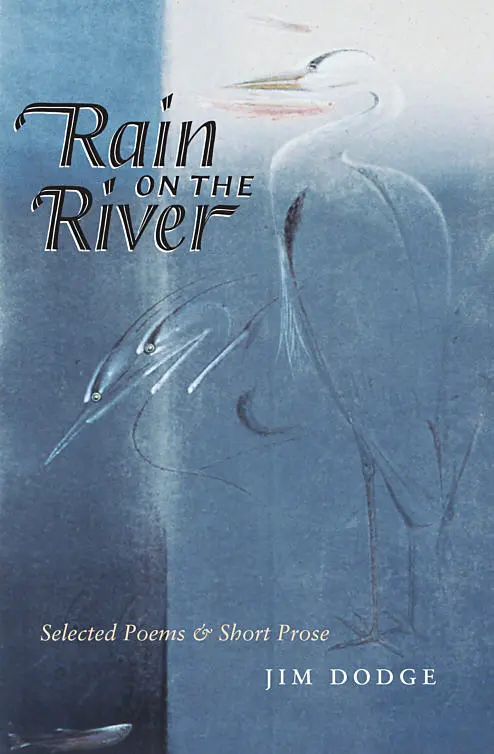
All books are more than the writer’s words, and in that spirit I’d like to acknowledge Jerry Reddan for his design of this volume; Pete Stoelzl for his impeccable typesetting; Christopher Stinehour’s calligraphic designs; and Shannon Dixon at Proof Positive for his work in helping create the cover. The cover art is the second panel of a triptych from my mentor and friend Morris Graves’ The Great Blue Heron and the Great Rainbow Trout Yogi in Phenomenal Space, Mental Space and the Space of Consciousness (tempera on paper, 1979), used with the kind permissions of Morris’ archive executor Robert Yarber and the Humboldt Arts Council. I also wish to thank the production directors at Grove/Atlantic and Canongate Books, Muriel Jorgensen and Caroline Gorham respectively, as well as the copy editors and art directors involved.
Three bows to Gary Snyder for his usual tough reading of the manuscript and his suggestion for the title.
I also offer special thanks to my editors, Morgan Entrekin at Grove/Atlantic and Jamie Byng of Canongate for their steadfast support of my literary work.
Melanie Jackson, my agent, deserves particular mention for her unstinting efforts and merciful acumen on my behalf.
Finally, my deepest gratitude to family and friends for their unflagging faith, encouragement, and forbearance.
Selected Poems
Short Prose
Learning to Talk
Whenever Jason said “beeber” for “beaver”
or “skirl” for “squirrel”
I secretly loved it.
They’re better words:
The busy beeber beebing around;
the grey squirrel’s tail
like a skirl of smoke along a maple branch.
I never told him he was saying
their names “wrong,”
though I did pronounce them conventionally.
One time he noticed, and explained,
“‘Beeber’ is how I say it.”
“Great,” I told him, “whatever
moves you.”
But within a week
he was pronouncing both “properly.”
I did my duty
and I’m sorry.
Farewell Beeber and Skirl.
So much beauty lost to understanding.
The Cookie Jar
Coddington Mall was clogged with Christmas shoppers as I waited in line at the Cookie Jar, a bakery devoted to my favorite confection.
It was just after noon–lunch break–and a single clerk was left to work the counter, a young woman with a strained, scattered smile. She was working as fast as she could, but the line moved slowly. I was passing the time with the sports page, idly considering whether the 49ers were worth $100 and three points against the Rams, when my attention was drawn to the elderly woman in front of me in line. By her stoop and wrinkles I figured she was in her early 70s, or a hard 65 at least. She was wearing a grey dress, but it was nearly obscured by a heavy black sweater that hung almost to the hemline. She was leaning forward, weight on her cane, her nose to the display case, examining the cookies with the calm, fierce attention of a hawk. Taken by the force of her concentration, I folded the sports page and said pleasantly, “It’s always tough to decide.”
Her gaze didn’t flicker.
I couldn’t blame her for ignoring me. Why should an old woman, in a culture of muggers, rapists, and rip-off artists, encourage the idle conversation of some bearded and obviously half-demented hippie from the hills, where he probably grew tons of marijuana and did Lord-knows-what to the sheep. I felt the little wash of sadness that comes when your good intentions are blanked by cultural circumstances. I didn’t persist.
When it was the old woman’s turn, in a thick Slavic accent she ordered three chocolate chip cookies. “The big ones,” she specified, tapping the glass to indicate her choice.
The harried clerk dutifully plucked out three of the saucer-sized cookies with a confectioner’s tissue. I noticed one of the cookies had a small chunk broken off its side. So did the old woman: “None that are broke!” she commanded.
The clerk gave her a smile on automatic pilot and replaced the defective cookie, slipping them into a white sack and placing it on the counter. “A dollar-seventy-six please,” she told the old woman.
The old woman turned her back to me and began fumbling in her purse, which was the size of a small knitting bag. After much muttering she finally produced two dollar bills rolled together and neatly bound with a yellow rubber band. She addressed the clerk with a staunch formality: “Also I would like some peanut butter cookies. The little ones. Twenty-four cents of them.”
The clerk, with a look that pleaded God, I wish my period would start, scooped out three small peanut butter cookies and, without bothering to weigh them, slipped them in the bag with the others. The old woman rolled the yellow rubber band off the two bills and spread them out on the counter, pausing to smooth them flat before she secured the white sack in her knitting-bag purse, dropped in the yellow rubber band and the receipt, and left at a brisk shuffle. I lost sight of her in the flow of the crowd as I stepped forward to place my order.
About a half hour later, however, while I was sitting on a bench at the other end of the mall, still pondering the money and points as I polished off a last hot dog, the old woman appeared and, after considerable maneuvering, plopped herself down on the far end of the bench.
Without any acknowledgment of my presence, she opened the white bag from the Cookie Jar. At a bite each, with slow and luscious enjoyment, she ate the three small peanut butter cookies. When she’d finished, she peered into the bag to check the other three, the big ones, and then, as if to confirm their existence, their promise of delight, she named them one by one:
“Friday night.
Saturday night.
Sunday with tea.”
Things Thought Through
The path of water is not noticed by water,
but is realized by water. –DōGEN
Thinking things through.
Thinking through things.
Things through thinking.
Through thinking things.
On Balance
At fifteen,
the imagination
torments;
at fifty,
it consoles.
Another transformation
changing nothing.
Decomposition
I don’t know
and I don’t know
what to do about it.
I simply hit a point
where I lost heart for judgments
and was swept
into the voluptuous, harrowing
complexities composing a single breath.
Psycho Ecology
AN HOMAGE TO WALT WHITMAN
Reality is the work of imagination.
Imagination, the flume of emotion.
After all the tears and laughter,
emotion empties into spirit,
and spirit condenses on reality
like dew on a leaf of grass.
Life of the Spirit
A salmon leaps.
Transcend what?
Aweigh
Vicky and I were steelhead fishing on a secret riffle of a nameless Pacific Northwest river, perhaps the best iron-head water between the Russian and Bella Coola, to which you may receive directions for a thousand dollars cash. It was late afternoon, the sky the color of wet ashes, the river high but beginning to clear. I was drifting a roe-glo through the upper stretch of the run when I felt a slight pause in the tick-tick-tickity rhythm of the pencil-lead sinker bouncing along the stony bottom. I set the hook. The rod tip bowed and began to pulse, the heavy, solid throb running through my shoulders.
“Fish on!” I hollered to Vicky forty yards downstream.
She turned and looked at me, yelling back, “Really?”
For some reason, this is the usual response of my fishing companions, leading me to believe they regard me as either an astonishingly inept fisherman or an insanely reckless liar.
“Really!” I assured her at the top of my lungs, lifting my doubled rod as proof before turning my attention to the battle.
Actually, it wasn’t much of a battle. The fish was sulking in the strong mid-channel current. I tightened the star drag slightly and applied some pressure; the fish turned lethargically and headed downstream. I lightly thumbed the spool; at the added resistance, the fish swung toward shore down by Vicky, who had just reeled in and started walking my way, no doubt to offer encouragement, counsel, and general assistance.
As my line sliced toward her, she stopped and peered into the water, then shook her head. “Hey,” she called, “you’ve got a big ol’ sore-tail salmon.”
“No,” I begged her.
She pointed emphatically a few feet offshore. “I can see it. Big, beat-up sore-tail.”
I took the Lord’s name in serious vain–no wonder the fish wasn’t fighting–then tightened the drag to reel in the fish for quick release. The fish offered little resistance until it was about twenty feet away, then made a sullen move toward swifter water. When I clamped down, it swung back, passing in front of me. Sure enough, it was a spent salmon, its rotting fins worn to nubs, the battered body mottled with patches of dull white fungus.
But something wasn’t right. The sore-tail was languidly corkscrewing along the bottom, a movement that didn’t match the steady quiver I felt through the rod. Then I saw why: The sore-tail, in blind expression of the spawntill-you-die imperative, was engaged in a last-gasp courtship of the fish actually connected to my line, a steelhead longer than a yardstick and as deep as a Dutch oven.
Hearing Vicky move up behind me, I whispered, “That sore-tail you saw isn’t the fish I have on. It’s trailing my fish, which is one humongous hog of a steelie, putting on some spawning moves.”
“Sure it is,” Vicky said.
I worked the steelhead a few feet closer, telling Vicky without turning my head, “Step up easy and see for yourself.”
Vicky stepped up easy, very easy, but not easy enough.
The riffle was about fifty yards wide. With the power of a nitro-fueled dragster, the steelie crossed it in one second flat, leaving me blinded by the mist sprayed from the spool mingled with smoke from the drag. Struck dumber than usual, I simply stood there as the whopper steelie made a sharp right at the opposite shore and streaked downstream. I watched the line melting from the spool. I felt like my nervous system was being stripped from my body through my solar plexus, a rush beyond sensation toward something as clean and empty as my spool was about to be if I didn’t stop the fish. But I didn’t want to stop the fish. I didn’t want the feeling to end.
The spool was almost down to the backing when the steelie abruptly swung back into the heavy current and dove to the bottom, slowly lashing its head.
I wanted to tell Vicky to go home and pack some grub because I was going to be there all night, but when I finally got my slack jaw working I discovered I couldn’t utter the few words I could remember.
Train wreck in the cerebellum. Synaptic bridges collapsed.
I concentrated on the basic sounds, managing something close to “Biffeegaaaagh.”
Vicky cocked her head. “You what?”
“Big,” I gasped. “Godzilla.”
At the moment, though, it felt more like I was hooked to Godzilla’s heart, thirty pounds of pure throbbing force, the rainbowed rod pulsing steadily as the fish hung in the current, gathering power for another slashing run.
Then the hook pulled out.
I felt like a lover had just hung up the phone after telling me, “I’m sorry, but it’s over.”
Like I do when the Dream Joker whispers, “You won 100 million in tonight’s lottery,” and I wake up broke as usual.
Unplugged a heartbeat short of Divinity, a nanosecond shy of Solid Full Circuit. Lost. Looted and left behind. Mentally exhausted, emotionally gutted, spiritually bereft.
Vicky helped me back to the car.
But as I fell asleep that night, I remembered the wild power of the steelhead’s cross-river run, remembered it from my bones out, in nerve-meat and blood, that rush of glory as I emptied into the connection, joined for a moment, each other’s ghost, then blown away like mist on the wind. And my gratitude for that moment’s nexus overwhelmed the despair of its loss–as if one can truly possess or lose anything, or the connection ever break.
In fishing, as the moment of experience enters the future as memory, it’s prey to seizures of enlargement and general embellishing. I feel sure, however, that that steelhead weighed close to twenty-eight pounds. It’s possible–and, given a few more years of voluptuous recollection, almost certain–that the fish would have tipped the Toledoes at over thirty, making it easily conceivable that I’d hooked what would have been a new state-record steelie. But even taking the distortions of time and memory into account, ruthlessly pruning any possibility of exaggeration, carefully considering the Parallax Effect, the Water Magnification Variable, the Wishful Thinking Influence, and the El Feces del Toro Predilection, I would lay even money in the real world that that steelhead weighed at least twenty-six pounds, and would gladly wager a new car of your choice against a soggy cornflake that it was twenty-four minimum.
In that spirit, I trust you will understand that I offer a blessing when I wish for our coming years that a big one always gets away.
Tao-to-Tao
The way is
The way it is
Because that’s the way
It is,
And why.
To Be
ODE
Loins and breath.
Moonlight melting
In the throat of a calla lily.
Thickets of young maple
Just breaking bud.
All you have to be
Is who you are,
Naked beyond the body,
A touch at a time.
PALINODE
All you have to be
Is who you are?
What could have I possibly
Meant by that
If part of you
Is who you dream you could be
If you weren’t the piddling little dimwit
You actually are,
As if the “real you”
Is the one who sits around wondering who
The real you is–
Or if you’ve ever wished you were
Someone else, anybody–
An accountant in Coronado,
A dishwasher in a second-rate Omaha steakhouse–
Or if you can follow this,
Or still care,
You’re probably really screwed up
Or close enough
To be welcomed as a friend.
Practice, Practice, Practice
It exacts the strictest discipline
To truly take it easy
Yet still retain the minimal
Quiver of ambition
Required for consciousness.
That’s what I’ve been working on all morning,
Stretched out on the couch
By the cabin window at Bob’s,
Watching the rain,
Without pattern,
Fall on the pond,
Just me and the dogs.
Wisdom and Happiness
The wet crescents left by the dogs’ tongues
licking spilled cat kibble from the cabin floor;
the strand of light, finer than spider-spun,
unspooling from the center of my chest
as a 20-pound steelhead slashes downstream
through the celadon waters of the Smith;
the gleam of water on Victoria’s flanks
in that moment of stepping
from the sauna into a wild Pacific storm–
vapor-wreathed shimmer, body gone;
the elegance of an elk track
cut in sandy streamside silt;
red alder bud-break in early March;
venison stew and fresh salmon,
garden corn coming on;
Jason asleep on a school night,
his bare right leg dangling from the bed
(geez, he’s getting big);
sliding a chunk of madrone
into the firebox on a snowy night,
damping the wood heater down
for coals to kindle the morning’s fire;
the way the terriers sneeze and leap and race
deliriously through the orchard
when they know we’re going on a walk;
raindrops still cupped in huckleberry leaves
hours after the rain has stopped:
I made 55 years today, still hanging on,
and though only fools lay claim to wisdom
I don’t know what else to call it
when every year
it takes less to make me happy,
and it lasts longer.
Red Sails
I sit at my desk
and for no apparent reason
start singing, badly,
Red sails in the sunset…
sing it until I sail out of myself,
whatever a self is,
crazier than shit,
you bet,
and deeply grateful.
Squall & Commotion
You’ve reached bottom
when you understand
there is no bottom
to reach.
And just rock there drenched
on the ship’s bow,
watching the rain
fall on the ocean.
Slow Learner
Know the plants.
–GARY SNYDER
It’s been 50 years, most oblivious, but now,
if only in glimpses, I can look at plants
and feel the light composing them.
Falling asleep, I comfort myself
with a little prayer of their names:
alder, larkspur, thimbleberry, salal.
Bathing Joe
AN ELEGY FOR BOB, 1946–1994
The summer of ’94 at French Flat, on a scorching afternoon in mid-July, my brother Bob suggested we bathe his dog Joe, a sixteen-year-old Kelpie. Since Bob held intractably to the notion that bathing dogs more than once a year destroys their essential skin oils, I hustled to gather the leash, towels, and doggie shampoo before he changed his mind.
Joe–112 in human years–truly needed a bath. He suffered every affliction of elderly canines: deaf as dirt; a few glimmers short of blind; lumpy with warts and subcutaneous cysts; a penis pointing straight down; a scrotum so saggy his testicles banged against his hocks; prone to drool; given to a seemingly constant flatulence that would be banned under the Geneva Accords; and possessed of what the genteel call “doggie odor,” which in Joe’s unfortunate case ranged between gaggingly rank and living putrefaction. When Joe dozed by the wood-heater on a winter’s eve, enjoying dinner was difficult– considering one’s watering eyes and the instinct to cover the food.
The Story Continues on BooksBarbecue!
Enjoyed this preview? ❤️ Do not stop here!
Read the complete book free online → 🔗
Continue reading now on BooksBarbecue and discover every page!
Love reading? Bookmark BooksBarbecue.com for more amazing books!
Happy Reading!