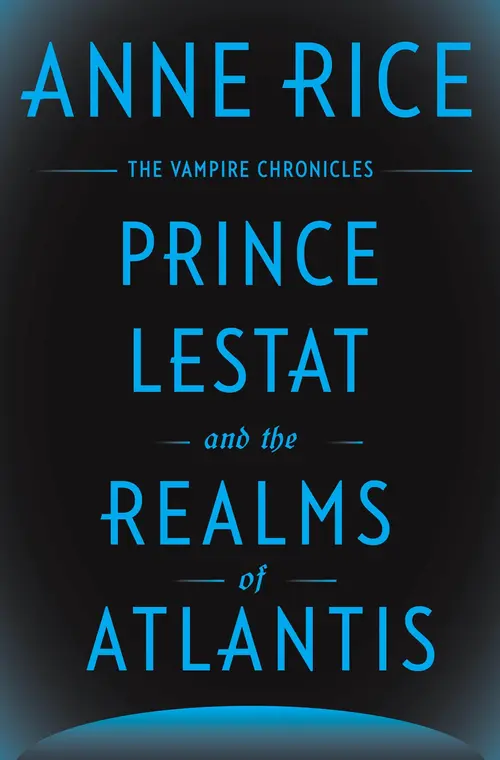
Prince Lestat and the Realms of Atlantis
Cover
ALSO BY ANNE RICE
Prince Lestat
The Wolves of Midwinter
The Wolf Gift
Of Love and Evil
Angel Time
Called Out of Darkness
Christ the Lord: The Road to Cana
Christ the Lord: Out of Egypt
Blood Canticle
Blackwood Farm
Blood and Gold
Merrick
Vittorio, the Vampire
The Vampire Armand
Pandora
Violin
Servant of the Bones
Memnoch the Devil
Taltos
Lasher
The Tale of the Body Thief
The Witching Hour
The Mummy
The Queen of the Damned
The Vampire Lestat
Cry to Heaven
The Feast of All Saints
Interview with the Vampire
UNDER THE NAME ANNE RAMPLING
Exit to Eden
Belinda
UNDER THE NAME A. N. ROQUELAURE
Beauty’s Kingdom
Beauty’s Release
Beauty’s Punishment
The Claiming of Sleeping Beauty
Title Page
Copyright
THIS IS A BORZOI BOOK
PUBLISHED BY ALFRED A. KNOPF
Copyright © 2016 by Anne O’Brien Rice
Published in the United States by Alfred A. Knopf, a division of Random House LLC, New York, and distributed in Canada by Random House of Canada, a division of Penguin Random House Limited, Toronto.
Knopf, Borzoi Books, and the colophon are registered trademarks of Random House LLC.
Library of Congress Cataloging-in-Publication Data
Names: Rice, Anne, [date]—author.
Title: Prince Lestat and the realms of Atlantis / Anne Rice.
Description: First edition. | New York : Alfred A. Knopf, 2016. | Series: Vampire chronicles ; 12
Identifiers: LCCN 2016032866 | ISBN 9780385353793 (hardcover) | ISBN 9780385353809 (ebook)
Subjects: LCSH: Lestat (Vampire), 1760– —Fiction. | Atlantis (Legendary place)—Fiction. | Spirit possession—Fiction. | Vampires—Fiction. | Paranormal fiction. | BISAC: FICTION / Occult & Supernatural. | FICTION / Fantasy / Paranormal. | FICTION / Suspense. | GSAFD: Fantasy fiction. | Horror fiction. | Occult fiction.
Ebook ISBN 9780385353809
This is a work of fiction. Names, characters, places, and incidents either are the product of the author’s imagination or are used fictitiously. Any resemblance to actual persons, living or dead, events, or locales is entirely coincidental.
Cover design by Oliver Munday
v4.1
ep
Dedication
THIS BOOK IS DEDICATED
TO
The undefeated and retired
babyweight champion of the world
and
Mitey Joe,
without whom the book might not have been born,
and
my old friends,
Shirley Stuart and Bill Seely,
and
friends and fellow writers
of my Northern California days:
Cleo, Maria, Carole, Dorothy, Jim, Carolyn, Candy, Lee, and others
and
once again,
to
the People of the Page
who give me so much more than I can ever give them.
Epigraph
Remember him—before the silver cord is severed,
and the golden bowl is broken;
before the pitcher is shattered at the spring,
and the wheel broken at the well,
and the dust returns to the ground it came from,
and the spirit returns to God who gave it.
—ECCLESIASTES
The New International Version
A Brief History of the Vampires
Blood Genesis
In the beginning were the spirits. They were invisible beings, heard and seen only by the most powerful sorcerers or witches. Some were thought to be malevolent; some were praised as good. They could find lost objects, spy upon enemies, and now and then affect the weather.
Two great witches, Mekare and Maharet, lived in a beautiful valley on the side of Mount Carmel, and they communed with the spirits. One of these spirits, the great and powerful Amel, could, in his mischief making, take blood from human beings. Tiny bits of blood entered the alchemical mystery of the spirit, though how no one knew. But Amel loved the witch Mekare and was ever eager to serve her. She saw him as no other witch ever had, and he loved her for it.
One day the troops of an enemy came—soldiers of the powerful Queen Akasha of Egypt. She wanted the witches; she wanted their knowledge, their secrets.
This wicked monarch destroyed the valley and the villages of Mekare and Maharet and brought the sisters by force to her own kingdom.
Amel, the furious familiar spirit of the witch Mekare, sought to punish the Queen.
When she lay dying, stabbed over and over by conspirators of her own court, this spirit Amel entered into her, fusing with her body and her blood and giving her a new and terrifying vitality.
This fusion caused a new entity to be born into the world: the vampire, the blood drinker.
From the blood of this great vampire queen, Akasha, all the other vampires of the whole world were born over the millennia. A blood exchange was the means of procreation.
To punish the twins who stood opposed to her and her new power, Akasha blinded Maharet and tore the tongue from Mekare. But before they could be executed, the steward of the Queen, Khayman, a newly made blood drinker himself, passed on to the twins the powerful Blood.
Khayman and the twins led a rebellion against Akasha, but they could not stop her cult of blood drinker gods. Eventually the twins were captured and separated—sent out as castaways—Maharet into the Red Sea and Mekare into the great ocean to the west.
Maharet soon found familiar shores and thrived, but Mekare, carried across the ocean to lands yet undiscovered and unnamed, vanished from history.
This was six thousand years ago.
The great Queen Akasha and her husband, King Enkil, went mute after two thousand years, maintained like statues in a shrine by elders and priests that believed Akasha contained the Sacred Core—and that if she should be destroyed, all the blood drinkers of the world would die with her.
But by the time of the Common Era, the story of the Blood Genesis was completely forgotten. Only a few elder immortals passed on the tale, though they did not believe it even as they told it. Yet blood gods, vampires dedicated to the old religion, still reigned in shrines throughout the world.
Imprisoned in hollowed-out trees or brick cells, these blood gods starved for blood until the holy feasts at which they were brought offerings: evildoers to judge and condemn and feast upon.
—
At the dawn of the Common Era, an elder, a keeper of the Divine Parents, abandoned Akasha and Enkil in the desert for the sun to destroy them. All over the world young blood drinkers perished, burnt to death in their coffins, their shrines, or in their tracks as the sun shone on the Mother and Father. But the Mother and Father themselves were too strong to perish. And many of the very old ones survived as well, though badly burned and in pain.
A newly made blood drinker, a wise Roman scholar by the name of Marius, went down to Egypt to find the King and Queen and protect them so that no holocaust would ever again ravage the world of the Undead. And thereafter Marius made them his sacred responsibility. The legend of Marius and Those Who Must Be Kept endured for almost two millennia.
In the year 1985, the story of this Blood Genesis was told to all the world’s Undead. That the Queen lived, that she contained the Sacred Core, this was part of the story. It appeared in a book written by the Vampire Lestat, who also told the tale in song and dance in film and from the stage, where he performed as a rock singer—calling the world to know and destroy his own kind.
Lestat’s voice waked the Queen from millennia of silence and slumber. She rose with a dream: that she would dominate the world of human beings through cruelty and slaughter and become for them the Queen of Heaven.
But the ancient twins came forward to stop Akasha. They too had heard Lestat’s songs. Maharet appealed to the Queen to stop her superstitious blood tyranny. And the long-lost Mekare, rising from the earth after untold aeons, decapitated the great Queen and took the Sacred Core into herself as she devoured the dying Queen’s brain. Mekare, under the protection of her sister, became the new Queen of the Damned.
Lestat once again wrote the story. He had been there. He had seen the passing of the power with his own eyes. He gave his testimony to everyone. The mortal world took no notice of his “fictions,” but his tales shocked the Undead.
And so the story of origins and ancient battles, of vampire powers and vampire weaknesses, and wars for control of the Dark Blood became the common knowledge of the Undead tribe the world over. It became the property of old ones who’d been comatose for centuries in caves or graves, of young ones misbegotten in jungles or swamps or urban slums who had never dreamed of their antecedents. It became the property of wise and secretive survivors who had lived in isolation through the ages.
It became the legacy of all blood drinkers the world over to know they shared a common bond, a common history, a common root.
Prince Lestat is the story of how that knowledge changed the tribe and its destiny forever. Brought together by a crisis, the tribe unites, begging Lestat to become its leader.
Prince Lestat and the Realms of Atlantis explores the history of the vampires ever more deeply as the tribe, governed by Lestat, confronts the worst challenges it has ever faced.
Blood Argot
When the Vampire Lestat wrote his books, he used any number of terms taught to him by the vampires he had encountered in his life. And those vampires who added to his work, offering their memoirs and their experiences in written form, added terms of their own, some much more ancient than those ever revealed to Lestat.
This is a list of those terms, which are now common amongst the Undead throughout the world.
The Blood—When the word is capitalized it refers to vampiric blood, passed on from master to fledgling through a deep and often dangerous exchange. “In the Blood” means that one is a vampire. The Vampire Lestat had over two hundred years “in the Blood” when he wrote his books. The great vampire Marius has over two thousand years in the Blood. And so forth and so on.
Blood Drinker—The most ancient term for “vampire.” This was Akasha’s simple term, which she later sought to supplant with the term “blood god” for those who followed her spiritual path and her religion.
Blood Wife or Blood Spouse—One’s vampire mate.
Children of Satan—Term for vampires of Late Antiquity and after who believed they were literally children of the Devil and serving God through serving Satan as they fed upon humankind. Their approach to life was penitential and puritanical. They denied themselves all pleasure except drinking blood and occasional Sabbats (large gatherings) at which they danced, and they lived underground, often in filthy and dismal catacombs and enclosures. The Children of Satan have not been seen or heard from since the eighteenth century, and in all likelihood the cult has died out.
Children of the Millennia—Term for immortals who have lived more than a thousand years and most specifically for those who have survived more than two.
Children of the Night—Common term for all vampires, or all those in the Blood.
The Cloud Gift—This is the ability of older vampires to defy gravity, to rise up and move in the upper atmosphere and to cover long distances easily, traveling the winds unseen by those below. Again, no one can say when a vampire might acquire this power. The will to have it may work wonders. All truly ancient ones possess it whether they know it or not. Some vampires despise the power and never use it unless forced.
The Coven of the Articulate—A modern slang term popular among the Undead for the vampires whose stories appear in the Vampire Chronicles—particularly Louis, Lestat, Pandora, Marius, and Armand.
The Dark Gift—A term for the vampiric power. When a master bestows the Blood on a fledgling, that master is offering the Dark Gift.
The Dark Trick—Refers to the act of actually making the new vampire. To draw out the fledgling’s blood and to replace it with one’s own powerful Blood is to work the Dark Trick.
The Devil’s Road—Medieval term among the vampires for the road each vampire takes through this world; a popular term of the Children of Satan, who saw themselves as serving God through serving the Devil. To ride the Devil’s Road was to live one’s life as an immortal.
The Fire Gift—This is the ability of older vampires to use their telekinetic power to burn matter. They can, through the power of their minds, burn wood, paper, or any flammable substance. And they can burn other vampires as well, igniting the Blood in their bodies and reducing them to cinders. Only older vampires possess this power, but no one can say when and how a vampire acquires it. A very young vampire made by an ancient one may immediately possess the power. A vampire must be able to see that which he or she wants to burn. In sum, no vampire can burn another if he cannot see that vampire, if he is not close enough to direct the power.
The First Brood—These are the vampires descended from Khayman who were in rebellion against Queen Akasha.
Fledgling—A new vampire very young in the Blood. Also, one’s own offspring in the Blood. For example, Louis is the fledgling of Lestat. Armand is the fledgling of Marius. The ancient twin Maharet is the fledgling of her twin, Mekare. Mekare is the fledgling of the ancient Khayman. Khayman is the fledgling of Akasha.
The Little Drink—Stealing blood from a mortal victim without the victim knowing it or feeling it, without the victim having to die.
Maker—Simple term for the vampire who brought one into the Blood. Being slowly replaced by the term “mentor.” Sometimes the maker is also referred to as the “master.” However, this has gone out of use. In many parts of the world it is considered a great sin to rise up against or seek to destroy one’s maker. A maker can never hear the thoughts of a fledgling, and vice versa.
The Mind Gift—This is a loose and imprecise term which refers to the preternatural powers of the vampiric mind on many levels. Through the Mind Gift, a vampire might learn things from the world above even when he is sleeping in the earth below. And consciously using the Mind Gift, he might telepathically listen to the thoughts of mortals and immortals. He might use the Mind Gift to pick up images from others as well as words. He might use the Mind Gift to project images into the minds of others. And finally he might use the Mind Gift to telekinetically open a lock, push open a door, or stop the progress of an engine. Again, vampires develop the Mind Gift slowly over time, and only the most ancient can rape the minds of others for information they do not wish to give, or send a telekinetic blast to rupture the brain and blood cells of a human being or another vampire. A vampire can listen to many the world over, hearing and seeing what others hear. But to destroy telekinetically, he or she must be able to see the intended victim.
The Queen of the Damned—Term given to the Vampire Mekare by her sister Maharet once Mekare had taken the Sacred Core into herself. It was ironic. Akasha, the fallen Queen who had sought to dominate the world, had called herself the Queen of Heaven.
The Queens Blood—These are the vampires made by Queen Akasha to follow her path in the Blood and fight the rebels of the First Brood.
The Sacred Core—This refers to the residing brain or governing life force of the spirit Amel, which is inside the body of the Vampire Lestat. Before Lestat, it was in Mekare. Before it was in Mekare, it was in the Vampire Akasha. It is believed that every vampire on the planet is connected to the Sacred Core by some sort of invisible web or network of tentacles. If the vampire containing the Sacred Core were to be destroyed, all the vampires of the planet would die.
The Savage Garden—A term used by Lestat for the world, fitting with his belief that the only true laws of the universe are aesthetic laws, the laws that govern the natural beauty we see all around us on the planet.
The Spell Gift—This refers to the power of vampires to confuse, beguile, and spellbind mortals and sometimes other vampires. All vampires, even fledglings, have this power to some extent, though many don’t know how to use it. It involves a conscious attempt to “persuade” the victim of the reality the vampire wants the victim to embrace. It doesn’t enslave the victim. But it does confuse and mislead. It depends on eye contact. One can’t spellbind anyone from a distance. In fact, it more often involves words as well as glances, and certainly involves the Mind Gift on some level.
The Undead—Common term for vampires of all ages.
Proem
IN MY DREAMS, I saw a city fall into the sea. I heard the cries of thousands. It was a chorus as mighty as the wind and the waves, all those voices of the dying. I saw flames that outshone the lamps of Heaven. And all the world was shaken.
I woke, in the dark, unable to leave the coffin in the vault in which I slept for fear that the setting sun would burn the young ones.
I held the root now of the great vampire vine on which I was once only another exotic blossom. And if I were cut, or bruised or burned, all the other vampires on the vine would know the pain.
Would the root itself suffer? The root thinks and feels and speaks when he wants to speak. And the root has always suffered. Only gradually had I come to realize it—how profound was the suffering of the root.
Without moving my lips, I asked him: “Amel, what was that city? Where did the dream come from?”
He gave me no answer. But I knew he was there. I could feel the warm pressure on the back of my neck that always meant he was there. He had not gone off along the many branches of the great vine to dream with another.
I saw the dying city again. I could have sworn I heard his voice crying out as the city was broken open.
“Amel, what does this mean? What is this city?”
We would lie together in the dark for an hour like this. Only then would it be safe for me to throw back the coffin lid and walk out of the crypt to see a sky beyond the windows full of safe and tiny stars. I have never taken much comfort from the stars, even though I’ve called us the children of the moon and the stars.
We are the vampires of the world, and I’ve called us many such names.
“Amel, answer me.”
Scent of satin, old wood. I like seasoned and venerable things, coffins padded for the sleep of the dead. And the close warm air around me. Why shouldn’t a vampire love such things? This is my marble vault, my place, my candles. This is the crypt beneath my castle, my home.
I thought I heard him sigh.
“Then you did see it, you did dream it too.”
“I don’t dream when you do!” he answered. He was cross. “I am not confined here while you sleep. I go where I want to go.” Was this true?
But he had seen it, and now I saw the city flashing bright again in the very midst of its destruction. Suddenly it was more terrible than I could bear. It was as if I saw the myriad souls of the dead released from their bodies rising in a vapor.
He was seeing it. I knew he was. And he had seen it when I dreamed of it.
After a while, he gave me the truth. I’d come to know the tone of his secret voice when he admitted the truth.
“I don’t know what it is,” he said. “I don’t know what it means.” His sigh again. “I don’t want to see it.”
The next night and the night after he was to say the same thing.
And when I look back on those dreams I wonder how long we might have gone on without ever knowing any of it.
Would we have been better off if we had never discovered the meaning of what we saw?
Would it have mattered?
Everything has changed for us, and yet nothing has changed at all, and the stars beyond the windows of my castle on the hill confide nothing. But then the stars never do, do they? It’s the doom of beings to read patterns in the stars, to give them names, to cherish their slowly shifting positions and clusters. But the stars never say a word.
He was telling the truth when he said he didn’t know. But the dream had struck a chord of fear in his heart. And the more I dreamed of that city falling into the sea, the more I was certain I heard his weeping.
In dreams and waking hours he and I were bound as no two others. I loved him and he loved me. And I knew then as I know now that love is the only defense we ever have against the cold meaninglessness around us—the Savage Garden with its cries and songs, and the sea, the eternal sea, ready as ever to swallow all the towers ever created by human beings to reach Heaven. Love bears all things, believes all things, hopes for all things, endures all things, says the Apostle. “And the greatest of these is love…”
I believed it and I believe in the old commandment of the poet-saint who wrote hundreds of years after the Apostle: “Love and do what you will.”
Part I
SPIES
IN THE
SAVAGE GARDEN
1
Derek
THEY HAD BEEN talking up there for hours. If Derek lay very still he could hear them perfectly. At this hour, the Andrássy Út was noisy above him, with its cafés and bookstores, but this damp hidden mansion of cellar chambers was quiet. And what else did Derek have to do but listen?
The Story Continues on BooksBarbecue!
Enjoyed this preview? ❤️ Do not stop here!
Read the complete book free online → 🔗
Continue reading now on BooksBarbecue and discover every page!
Love reading? Bookmark BooksBarbecue.com for more amazing books!
Happy Reading!