Poseidon's Arrow
ALSO BY CLIVE CUSSLER
DIRK PITT® ADVENTURES BY CLIVE CUSSLER
Crescent Dawn (with Dirk Cussler)
Arctic Drift (with Dirk Cussler)
Treasure of Khan (with Dirk Cussler)
Black Wind (with Dirk Cussler)
Trojan Odyssey
Valhalla Rising
Atlantis Found
Flood Tide
Shock Wave
Inca Gold
Sahara
Dragon
Treasure
Cyclops
Deep Six
Pacific Vortex!
Night Probe!
Vixen 03
Shock Wave
Raise the Titanic!
Iceberg
The Mediterranean Caper
FARGO ADVENTURES BY CLIVE CUSSLER
WITH THOMAS PERRY
The Tombs
WITH GRANT BLACKWOOD
The Kingdom
Lost Empire
Spartan Gold
ISAAC BELL NOVELS BY CLIVE CUSSLER
The Thief (with Justin Scott)
The Race (with Justin Scott)
The Spy (with Justin Scott)
The Wrecker (with Justin Scott)
The Chase
KURT AUSTIN ADVENTURES BY CLIVE CUSSLER
WITH GRAHAM BROWN
The Storm
Devil’s Gate
WITH PAUL KEMPRECOS
Medusa
White Death
The Navigator
Fire Ice
Polar Shift
Blue Gold
Lost City
Serpent
OREGON FILES ADVENTURES
BY CLIVE CUSSLER
WITH JACK DU BRUL
The Jungle
The Silent Sea
Corsair
Plague Ship
Skeleton Coast
Dark Watch
WITH CRAIG DIRGO
Golden Buddha
Sacred Stone
NONFICTION BY CLIVE CUSSLER
Built for Adventure: The Classic Automobiles of Clive Cussler and Dirk Pitt®
WITH CRAIG DIRGO
The Sea Hunters
The Sea Hunters II
Clive Cussler and Dirk Pitt Revealed
TITLE PAGE
COPYRIGHT

G. P. PUTNAM’S SONS
Publishers Since 1838
Published by the Penguin Group
Penguin Group (USA) Inc., 375 Hudson Street, New York, New York 10014, USA • Penguin Group (Canada), 90 Eglinton Avenue East, Suite 700, Toronto, Ontario M4P 2Y3, Canada (a division of Pearson Penguin Canada Inc.) • Penguin Books Ltd, 80 Strand, London WC2R 0RL, England • Penguin Ireland, 25 St Stephen’s Green, Dublin 2, Ireland (a division of Penguin Books Ltd) • Penguin Group (Australia), 707 Collins Street, Melbourne, Victoria 3008, Australia (a division of Pearson Australia Group Pty Ltd) • Penguin Books India Pvt Ltd, 11 Community Centre, Panchsheel Park, New Delhi–110 017, India • Penguin Group (NZ), 67 Apollo Drive, Rosedale, Auckland 0632, New Zealand (a division of Pearson New Zealand Ltd) • Penguin Books, Rosebank Office Park, 181 Jan Smuts Avenue, Parktown North 2193, South Africa • Penguin China, B7 Jaiming Center, 27 East Third Ring Road North, Chaoyang District, Beijing 100020, China
Penguin Books Ltd, Registered Offices: 80 Strand, London WC2R 0RL, England
Copyright © 2012 by Sandecker, RLLLP
All rights reserved. No part of this book may be reproduced, scanned, or distributed in any printed or electronic form without permission. Please do not participate in or encourage piracy of copyrighted materials in violation of the authors’ rights. Purchase only authorized editions.
Published simultaneously in Canada
ISBN 978-1-101-60700-8
ENDPAPER AND INTERIOR ILLUSTRATIONS BY ROLAND DAHLQUIST
This is a work of fiction. Names, characters, places, and incidents either are the product of the authors’ imaginations or are used fictitiously, and any resemblance to actual persons, living or dead, businesses, companies, events, or locales is entirely coincidental.

CONTENTS
Contents
Also by Clive Cussler
Title Page
Copyright
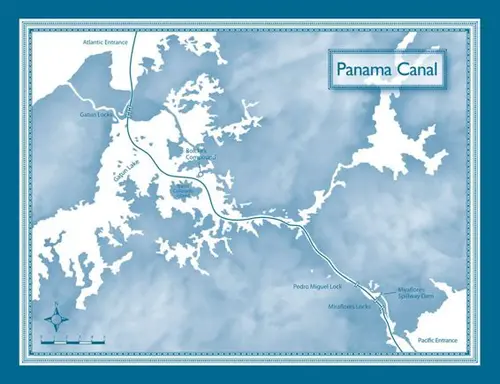
Map
PROLOGUE: BARBARIGO
PART I: POSEIDON’S ARROW
Chapter 1
Chapter 2
Chapter 3
Chapter 4
Chapter 5
Chapter 6
Chapter 7
Chapter 8
Chapter 9
Chapter 10
Chapter 11
Chapter 12
Chapter 13
Chapter 14
Chapter 15
Chapter 16
Chapter 17
Chapter 18
Chapter 19
Chapter 20
Chapter 21
Chapter 22
Chapter 23
Chapter 24
Chapter 25
PART II: RARE EARTH
Chapter 26
Chapter 27
Chapter 28
Chapter 29
Chapter 30
Chapter 31
Chapter 32
Chapter 33
Chapter 34
Chapter 35
Chapter 36
Chapter 37
Chapter 38
Chapter 39
Chapter 40
Chapter 41
Chapter 42
PART III: PANAMA RUN
Chapter 43
Chapter 44
Chapter 45
Chapter 46
Chapter 47
Chapter 48
Chapter 49
Chapter 50
Chapter 51
Chapter 52
Chapter 53
Chapter 54
Chapter 55
Chapter 56
Chapter 57
Chapter 58
Chapter 59
Chapter 60
Chapter 61
Chapter 62
Chapter 63
Chapter 64
Chapter 65
Chapter 66
Chapter 67
Chapter 68
Chapter 69
Chapter 70
Chapter 71
Chapter 72
Chapter 73
Chapter 74
Chapter 75
Chapter 76
Chapter 77
Chapter 78
Chapter 79
Chapter 80
Chapter 81
EPILOGUE: RED DEATH
Chapter 82
Chapter 83
Chapter 84
Chapter 85
MAP
PROLOGUE: BARBARIGO
PROLOGUE
BARBARIGO

OCTOBER 1943
THE INDIAN OCEAN
THE LIGHT OF A HALF-MOON SHIMMERED OFF THE RESTLESS sea like a streak of flaming mercury. To Lieutenant Alberto Conti, the iridescent waves reminded him of a Monet waterscape viewed in a darkened room. The silvery froth reflected the moonlight back to the sky, illuminating a bank of clouds far to the north, the fringe of a storm that was soaking the fertile coast of South Africa some fifty miles away.
Tucking his chin from the moist breeze that buffeted him, Conti turned to face a young seaman standing watch beside him on the conning tower of the Italian submarine Barbarigo.
“A romantic evening, Catalano, is it not?”
The sailor gave him a quizzical look. “The weather is quite pleasant, sir, if that’s what you mean.” Though fatigued like the rest of the crew, the seaman still held a rigid demeanor in the presence of officers. It was a youthful piety, Conti considered, one that would eventually vanish.
“No, the moonlight,” Conti said. “I bet it shines over Naples tonight as well, glistening off the cobblestone streets. It wouldn’t surprise me, in fact, if a handsome officer of the Wehrmacht isn’t escorting your fiancée on a stroll about Piazza del Plebiscito at this very moment.”
The young sailor spat over the side, then faced the officer with burning eyes.
“My Lisetta would sooner jump off the Gaiola Bridge than associate with any German pig. I do not worry, for she carries a sap in her pocketbook while I’m away, and she knows how to use it.”
Conti let out a deep laugh. “Perhaps if we armed all of our women, then neither the Germans nor the Allied Forces would dare set foot in our country.”
Having been at sea for weeks, and away from his homeland for months more, Catalano found little humor in the comment. He scanned the horizon, then nodded toward the dark, exposed bow as their submarine sliced through the waves.
“Sir, why have we been relegated to transport duty for the Germans rather than the merchant raiding, for which the Barbarigo was built?”
“We’re all puppets on the Führer’s string these days, I’m afraid,” Conti replied, shaking his head. Like most of his countrymen, he had no idea that forces were at work in Rome that would, in a matter of days, oust Mussolini from power and announce an armistice with the Allies. “To think that we had a larger submarine fleet than the Germans in 1939, yet we now take our operational orders from the Kriegsmarine,” he added. “The world is not so easily explained at times.”
“It doesn’t seem right.”
Conti gazed across the sub’s large forward deck. “I guess the Barbarigo is too big and slow for the latest armed convoys, so we are now little more than a freighter. At least we can say our Barbarigo attained a proud wartime record before her conversion.”
Launched in 1938, the Barbarigo had sunk a half dozen Allied ships in the Atlantic during the early days of the war. Displacing over a thousand tons, she was much larger than the feared Type VII U-boats of the German wolf pack. But as German surface ship losses began to mount, Admiral Dönitz suggested converting several of the large Italian sommergibili into transport vessels. Stripped of her torpedoes, deck gun, and even one of her heads, the Barbarigo had been sent to Singapore as a cargo vessel, filled with mercury, steel, and 20mm guns for the Japanese.
“Our return cargo is deemed highly critical to the war effort, so somebody has to act as the mule, I suppose,” Conti said. But deep down, he was angered by the transport duty. Like every submariner, he had something of the hunter in him, a longing to stalk the enemy. But now an enemy encounter would mean death for the Barbarigo. Stripped of its weaponry and floundering along at twelve knots, the submarine was more a sitting duck than a feared attacker.
As a white-tipped wave splashed against the bow, Conti glanced at his illuminated wristwatch.
“Less than an hour to sunrise.”
Heeding the unspoken command, Catalano hoisted a pair of binoculars and scanned the horizon for other vessels. The lieutenant followed suit, circling the conning tower with his eyes, taking in the sea and sky. His thoughts drifted to Casoria, a small town north of Naples, where his wife and young son awaited him. A vineyard grew behind their modest farmhouse, and he suddenly longed for the lazy summer afternoons when he would chase his boy through the sprouting vines.
Then he heard it.
Over the drone of the submarine’s twin diesel engines, he detected a different sound, something of a high-pitched buzz. Snapping erect, he didn’t waste time fixing a position.
“Secure the hatch!” he cried.
He immediately dropped down the interior ladder. The emergency dive alarm rang out an instant later, sending the crew scurrying to their stations. In the engine room, a massive clutch was engaged, killing the diesel engines and transferring drive power to a bank of battery-powered electric motors. Seawater began to slosh across the forward deck as Catalano sealed the conning tower hatch, then descended to the control room.
Normally, a well-trained crew could crash-dive a submarine in under a minute. But since it was loaded to the gills in transport mode, there was little the Italian sub could do quickly. With agonizing leisure, it finally sagged under the surface nearly two minutes after Conti had detected the approaching aircraft.
His boots clanking on the steel ladder as he descended into the control room, Catalano turned and scurried forward to his emergency dive station. The clatter of the diesel engines had fallen quiet as the sub converted to battery propulsion, and the crew mirrored the silence by speaking in hushed tones. The Barbarigo’s skipper, a round-faced man named De Julio, stood rubbing sleep from his eyes as he asked Conti if they’d been seen.
“I can’t say. I didn’t actually see the aircraft. But the moon is bright and the seas are relatively calm. I am sure we are visible.”
“We will know soon enough.”
The captain stepped to the helm station, scanning the depth gauge. “Take us to twenty meters, then full right rudder.”
The submarine’s chief steersman nodded as he repeated the command, eyeing the gauges before him as his grip tightened on a large metal steering wheel. The control room fell silent as the men awaited their fate.

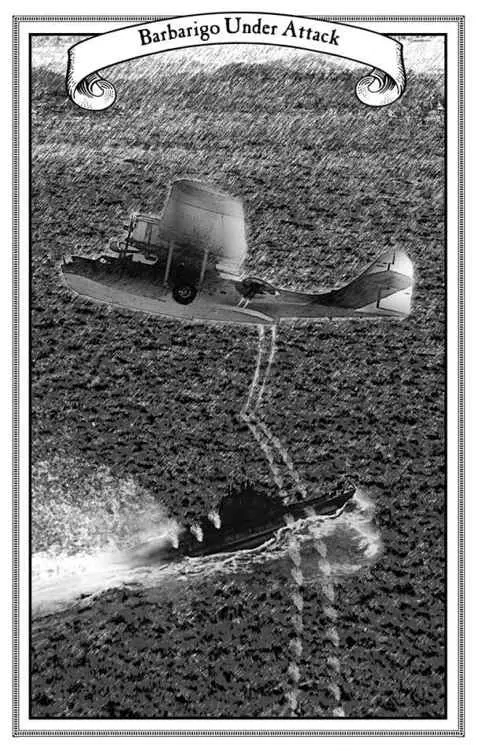
A THOUSAND FEET ABOVE THEM, a lumbering British PBY Catalina flying boat released two depth charges that whirled toward the sea like a pair of spinning tops. The aircraft was not yet equipped with radar; it was the RAF plane’s rear gunner who had spotted the milky wake of the Barbarigo, angling across the rippled surface. Thrilled with his find, he pressed his nose against the acrylic window, wide-eyed, as the twin explosives splashed into the sea. Seconds later, two small geysers of spray shot into the air.
“A bit late, I believe,” the copilot said.
“I suspected as much.” The pilot, a tall Londoner who wore a clipped mustache, banked the Catalina in a tight turn with all the emotion of pouring a cup of tea.
Dropping the charges was something of a guessing game, as the submarine had already disappeared from view, though its surface wake was still visible, and the plane had to strike quickly. The airborne depth charges activated at a preset depth of only twenty-five feet. Given enough time, the sub would easily dive beyond their range.
The pilot lined up for another run, tracking a marker buoy they had released ahead of the initial attack. Eyeing the remnants of the sub’s fading wake, he gauged the vessel’s unseen path, then gunned the pig-bellied Catalina just past the buoy.
“Coming up on her,” he told the bombardier. “Release if you’ve got a target.”
The bombardier for the eight-man crew sighted the sub and flipped a toggle switch, releasing a second pair of depth charges stowed under the Catalina’s wings.
“Depth charges away. Spot-on this time, I’d say, Flight Lieutenant.”
“Let’s try one more for good measure, then see if we can raise a surface ship in the vicinity,” the pilot replied, already banking the plane hard over.
INSIDE THE BARBARIGO, the twin blasts shook the bulkheads with a deep shudder. The overhead lights flickered and the hull groaned, but no rush of water penetrated the interior. For a moment, the explosion’s deafening roar seemed to be the worst consequence, ringing in each crewman’s ears like the bells of St. Peter’s Basilica. But then the ringing was overpowered by a metallic clang that reverberated from the stern, followed by a high-pitched squeal.
The captain felt a slight change in the vessel’s trim. “Fore and aft damage reports,” he yelled. “What’s our depth?”
“Twelve meters, sir,” the pilot said.
No one in the control room spoke. A cacophony of hisses and creaks permeated the compartment as the sub dove deeper. But it was the sound they didn’t hear that prickled their ears—the splash and click of a pair of depth charges detonating alongside the submerged vessel.
The Catalina had dropped wide on its last pass, its pilot guessing north while the Barbarigo veered south. The last muffled explosions barely buffeted the submarine as it plunged beneath the reach of the depth charges. A collective sigh was expelled as, to a man, the crew realized they were safe for the time being. Their only fear now would be if an Allied surface ship could be summoned to renew the attack.
Their relief was cut short by a cry from the steersman.
“Captain, we seem to be losing speed.”
De Julio stepped close and examined a bank of gauges near the pilot’s seat.
“The electrical motors are operational and engaged,” the young sailor said, wrinkling his brow. “But I show no revolutions on the driveshaft.”
“Have Sala report to me at once.”
“Yes, sir.” A sailor near the periscope turned to retrieve the Barbarigo’s chief engineer. He’d taken only two steps when the engineer appeared in the aft passageway.
Chief Engineer Eduardo Sala moved like a bulldozer, his squat frame churning forward in a blunt gait. He approached the captain and stared at him with harsh black eyes.
“Sala, there you are,” the captain said. “What is our operational status?”
“The hull is secure, sir. We do have heavy leakage at the main shaft seal, which we are attempting to stem. I can report one injury, Engineer Parma, who fell and broke his wrist during the attack.”
“Very well, but what about the propulsion? Are the electric motors disabled?”
“No, sir. I disengaged the main drive motors.”
“Are you crazy, Sala? We were under attack and you disengaged the motors?”
Sala looked at the captain with contempt.
“They are irrelevant now,” he said quietly.
“What are you saying?” De Julio asked, wondering why the engineer was evasive.
“It’s the screw,” Sala said. “A blade was bent or warped by the depth charge. It made contact with the hull and sheared off.”
“One of the blades?” De Julio asked.
“No . . . the entire screw.”
The words hung in the air like a death knell. Absent its single screw propeller, the Barbarigo would be tossed about the sea like a cork. Its home port of Bordeaux suddenly seemed as far away as the moon.
“What can we do?” the captain said.
The gruff engineer shook his head.
“Nothing but pray,” he said softly. “Pray for the mercy of the sea.”
PART I: POSEIDON’S ARROW
PART I
POSEIDON’S ARROW
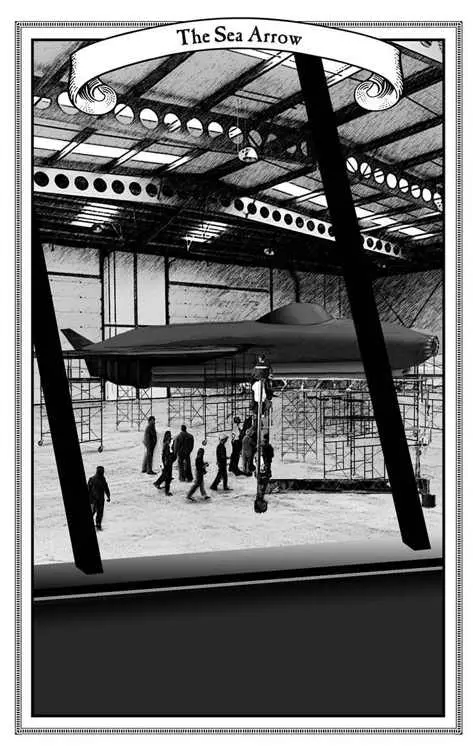
Chapter 1
1
JUNE 2014
MOJAVE DESERT, CALIFORNIA
IT WAS A MYTH, THE MAN DECIDED, AN OLD WIVES’ tale. Often he had heard how the desert’s broiling daytime temperatures gave way to freezing cold at night. But in the high desert of Southern California in July, he could testify, that wasn’t the case. Sweat soaked the underarms of his thin black sweater and pooled in a damp mass around his lower back. The temperature was still at least ninety degrees. He glanced at his luminescent watch, verifying it was indeed two in the morning.
The heat didn’t exactly overwhelm him. He’d been born in Central America and had lived and fought guerrilla campaigns in the region’s jungles his entire life. But the desert was new to him, and he simply hadn’t expected the nighttime heat.
He gazed across the dusty landscape to a conglomeration of glowing streetlamps. They marked the entrance to a large open-pit mining complex spread across the hills before him.
“Eduardo should nearly be in place opposite the guard station,” he said to a bearded man lying prone in a nearby sandy depression.
He was similarly clad in black, from combat boots to the thin stocking cap pulled low over his head. Sweat glistened off his face as he sipped from a water bottle.
“I wish he would hurry. There are rattlesnakes around here.”
His partner grinned in the dark. “Juan, that would be the least of our problems.”
A minute later, the handheld radio on his belt chirped with two static transmissions.
“That’s him. Let’s move.”
They arose and put on light backpacks. Lights from the mine buildings were sprinkled across the hillside in front of them, casting a pale glow over the barren desert. They hiked a short distance to a chain-link fence that encircled the complex. The taller man knelt and rummaged through his pack for a pair of wire cutters.
“Pablo, I think we can get through without cutting,” his partner whispered, then pointed to a dry wash that ran beneath the fence.
The sandy ground was soft in the middle of the creek bed, and he easily pushed some of it aside with his foot. Pablo joined him in scraping away the loose soil until they had excavated a small hole beneath the fence. Pushing their packs under it, they quickly shimmied through.
A low blend of rumbling noises filled the air, the mechanical bedlam of an open-pit mine that operated around the clock. The two men stayed clear of the guard station, to their right, and made their way up a gentle slope toward the mine itself. A ten-minute hike brought them to a cluster of aged buildings crisscrossed with large conveyor belts. A front-end loader at the far end was shoveling piles of ore onto one of the moving belts, which transported it to a hopper on stilts.
The two men were headed to a second cluster of buildings farther up the hill. The mine pit blocked their way, forcing them to cut through the operations area, where ore was crushed and milled. Clinging to the shadows, they darted along the perimeter, then worked their way along the back of a large storage building. Reaching an exposed area between buildings, they moved quickly, striding past a semiburied bunker to their left. Suddenly a door flung open at the center of the building ahead of them. The two men split up, Juan ducking to the side and scrambling behind the bunker while Pablo sprinted ahead toward the side of the building.
He didn’t make it.
A bright yellow beam snapped on, blinding him.
“Hold it right there or you’ll regret taking that next step,” said a low, gravely voice.
Pablo stopped in midstride. But as he made an exaggerated stop, he deftly withdrew a mini automatic pistol from his left hip and concealed it in the palm of his gloved hand.
The overweight security guard walked slowly toward him, keeping his flashlight pointed into Pablo’s eyes. The guard could see the intruder was a large, well-proportioned man, over six feet tall. His coffee-colored skin was smooth and pliant, in contrast to black eyes that burned with malignant intensity. A lighter band of flesh crossed his chin and left jaw, the souvenir from an ancient knife fight.
The guard saw enough to know he wasn’t an accidental trespasser and stopped a healthy distance away, clutching a .357 Magnum.
“How about you put your hands on your head and then you can tell me where your friend went.”
The rumble of a nearby conveyor drowned out Juan’s footsteps as he sprinted from the bunker and plunged a knife into the guard’s kidney. Shock registered on the guard’s face momentarily before his whole body tensed. A wayward shot erupted from his revolver, whistling high over Pablo’s head. Then the guard fell, his body kicking up a swirl of dust as it struck the ground.
Pablo thrust his gun forward, expecting additional guards to rush to the scene, but none came. The gunshot had been lost amid the rumbling of conveyor belts and the pounding of the rockcrusher. A quick radio call to Eduardo confirmed there was no activity at the front gate. No one else in the facility had realized their presence.
Juan wiped his knife clean on the shirt of the dead man. “How did he spot us?”
Pablo glanced toward the bunker. For the first time, he noticed a red-and-white sign on the door proclaiming DANGER: EXPLOSIVE MATERIALS. “That bunker houses explosives. It must be under surveillance.”
Blind luck, he cursed to himself. The explosives bunker wasn’t marked on his map. Now their whole operation was jeopardized.
“Should we blow it?” Juan asked.
They had been ordered to disrupt the facility but to make it look accidental. That had suddenly become a tall order. The bunker explosives could be made useful, but it was too far from their actual target.
“Let it be.”
“Do we leave the guard here?” Juan asked.
Pablo shook his head. He unbuckled the guard’s holster, then pulled off the man’s shoes. He searched the guard’s pockets and retrieved his wallet and half a pack of cigarettes. He stuffed those, along with the .357 Magnum, into his backpack. A growing pool of blood was dampening the ground around his feet. He kicked some loose sand over the blood, then grasped one of the guard’s arms. Juan grabbed the other, and they dragged the body into the darkness.
Thirty yards away, they reached an elevated conveyor on which melon-sized chunks of ore whirled by. With a labored heave, the men swung the guard’s body onto the moving belt. Pablo watched as the guard was carried up the conveyor and deposited into a large metal hopper.
The ore, a mixed fluorocarbonate known as bastnasite, had already passed through an initial crusher and sorter. The guard’s body joined a second round of pulverization that smashed the ore to baseball-sized pieces. A tertiary crushing repeated the process, pounding the rocks into a fine gravel. Had anyone examined the rough brown powder that accumulated off the final conveyor, they would have noticed an odd red tint that marked the guard’s last remains.
The Story Continues on BooksBarbecue!
Enjoyed this preview? ❤️ Do not stop here!
Read the complete book free online → 🔗
Continue reading now on BooksBarbecue and discover every page!
Love reading? Bookmark BooksBarbecue.com for more amazing books!
Happy Reading!