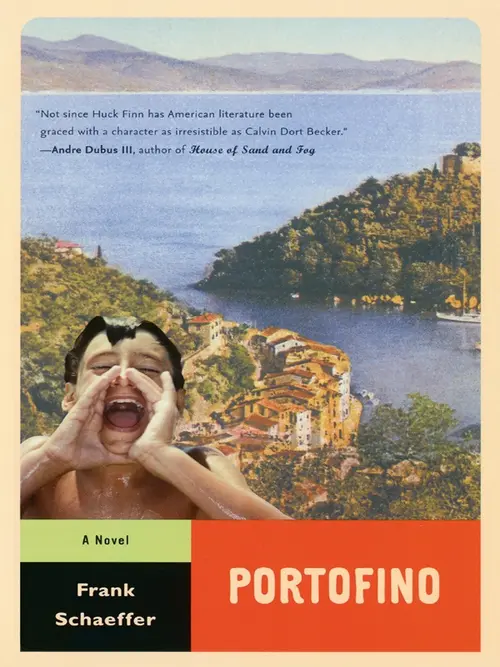
Portofino
Cover Page
PRAISE FOR FRANK SCHAEFFER’S PORTOFINO
“Great insight and unselfconscious humor.” —Publishers Weekly
“Calvin’s observations reveal the ironies of a family that speaks in biblical phrases but faces all-too-human foibles . . . Under Mr. Schaeffer’s graceful rendering, this is a story of sympathetic characters, a deft feat considering some of their narrow views.” —Washington Times
“Delightful . . . a wickedly funny story.” —Chattanooga Times
“Wonderfully lucid and witty . . . Portofino walks a beautifully balanced line between the serious and the humorous, poking gentle fun at the foibles of religious zealotry without disparaging the deep dedication behind it. Hilariously funny at times.” —Anniston Star
“Awry coming-of-age tale . . . splendid laugh-out-loud moments.” —Kirkus Reviews
“Charming.” —Boston Sunday Globe
“Richly ironic and satirical. At times it borders on hilarious . . . wickedly charming.” —Milwaukee Journal
“Schaeffer, by turns, is sentimental, celebratory, evocative and very funny, but we are never far from a sense that harshness and violence are real; we are never entirely sure how things will turn out. . . A rich brew of cross-cultural comedy . . . enlivened by discoveries and misapprehensions, family squabbles and healings and the dizzy sensibility of a boy whose world opens up in all kinds of poignant and hilarious ways . . . Shaeffer makes this utterly unpredictable family—besides the parents, there are Calvin’s two sharply drawn older sisters—both painful and appealing.” —Los Angeles Times Book Review
PRAISE FOR FRANK SCHAEFFER’S SAVING GRANDMA
“Saving Grandma is the sequel to Portofino, which introduced us to young Calvin, his parents and two older sisters. Although Saving Grandma has been carefully designed as a stand-alone story, you might as well buy Portofino while you’re at it, because once you hear the irresistible voice of Calvin, you’ll want to read both . . . Frank Schaeffer has a strange and singular story to tell, and he tells it with happy assurance. It’s impossible not to love it.”
—Rocky Mountain News
“Raucous.”
—Entertainment Weekly
“A triumph! Not since Huck Finn has American literature been graced with a character as irresistible as Calvin Dort Becker . . . Mr. Schaeffer’s gifts as a novelist are more than merely comic: Saving Grandma has a deeper river flowing through it as well, one that is sensual and loving and full of true grace. This is a wonderful book!”
—Andre Dubus III, Pushcart Prize-winning author of Bluesman
“The same humor and warmth that distinguished Portofino. . . great insight . . . Portofino will soon be made into a movie, and one can hope the same will happen to the present work.”
—Library Journal
“[A] sweet-natured, comic tale.”
—Kirkus Reviews
“Funny . . . poignant. . . Shaeffer manages to be both irreverent and sympathetic toward the foibles of this hilarious holier-than-thou family . . . What’s wonderful about this loopy coming-of-age story is Schaeffer’s sensitivity in showing Calvin’s need to break from a family he both despises and loves.”
—St. Paul Pioneer Press
“Clever, humorous, and satisfying.”
—Booklist
“Schaeffer’s greatest feat is transforming Calvin from a rotten little kid into a character so compelling that I felt as if he were pulling me through the pages . . . On a par with Calvin’s metamorphosis is Schaeffer’s near-perfect touch with the details of religion. Somehow he manages to integrate the most serious issues of religious practice, even explaining their relevance to a less-informed reader, without losing the flow of the novel.”
—St. Petersburg Times
“Irreverent, amusing . . . Schaeffer’s slapstick jokes and often tender evocations of youth make for an uneasy but entertaining cross between Portnoys Complaint and TV’s The Wonder Years”
—Publishers Weekly
Also by Frank Schaeffer
THE CALVIN BECKER TRILOGY
Portofino
Zermatt
Saving Grandma
NON-FICTION
Keeping Faith
A Father-Son Story About Love
and the United States Marine Corps
Faith of Our Sons
A Father’s Wartime Diary
Portofino
FRANK SCHAEFFER
CARROLL & GRAF PUBLISHERS
NEW YORK
Copyright Page
PORTOFINO
Carroll & Graf Publishers
An Imprint of Avalon Publishing Group Inc.

Copyright © 1992 by Frank Schaeffer
First Carroll & Graf edition 2004
All rights reserved. No part of this book may be reproduced in whole or in part without written permission from the publisher, except by reviewers who may quote brief excerpts in connection with a review in a newspaper, magazine, or electronic publication; nor may any part of this book be reproduced, stored in a retrieval system, or transmitted in any form or by any means electronic, mechanical, photocopying, recording, or other, without written permission from the publisher.
We have made every effort to trace copyright holders, but if errors or omissions are brought to our attention we shall be pleased to publish corrections in future editions of this book.
All of the characters in this book are fictitious, and any resemblance to actual persons, living or dead, is purely coincidental.
Library of Congress Cataloging-in-Publication Data is available.
ISBN: 978-0-7867-1375-2
eBook ISBN: 9780786740338
Printed in the United States of America
Distributed by Publishers Group West
To my wife Regina
Author’s Note:
Portofino, Zermatt, and Saving Grandma are all about the Becker family and their adventures, as narrated by Calvin Dort Becker. Each novel is a stand-alone work, though taken together they form a trilogy.
Frank Schaeffer, June 4, 2004
Portofino
1962
Chapter 1
THE FIRST GLIMPSE OF THE MEDITERRANEAN was always turquoise. “A turquoise bracelet studded with diamonds,” my sister Janet said. I had two sisters. Janet, my angry fifteen-year-old sister, and Rachael, who was meek and thirteen.
Janet liked to clasp her hands in front of her and say things poetically, like about the Mediterranean being a bracelet. That afternoon the bracelet was framed between the dingy apartment buildings that line the railroad tracks behind the city of Genoa, Italy. Genoa was the place you changed trains in on the way to Santa Margherita.
Santa Margherita was where the summer vacation really began. The smells were right. Gardenia, ferrous oxide from the rusted train tracks, and a hint of urine. Not ammonia-rich, real, stinking, French-style urine, but the subtle Italian variety: a faint apology for the need to relieve oneself in a corner by the ivy-covered wall next to the fountain at the end of the platform.
If we had been rich we would have taken a horse and carriage all the way from the station to the Pensione Biea in Paraggi. We took the blue diesel bus instead.
Mom sat in the one unoccupied seat. The girls and I straddled the luggage. Dad stood staring out the back window. He was still in one of his Moods because Mom had almost made us miss our connection in Milano. She did that every year. She always needed to get something important she had forgotten to pack for the vacation. So she would rush out of the station and cross the road to the shops opposite to get what she needed.
Every year Dad said the same thing. “If the train leaves before you get back we’ll just go without you!”
We children would sit, hearts pounding, praying for Mom. “Dear Jesus, please get Mom back in time. And if she’s late please speak to Dad’s heart so he won’t leave her at the station.”
God answered our prayers. Mom would make it back, but God would not go so far as to make Dad forgive her for making us all nervous wrecks and for risking spoiling “the few precious days of vacation I need so badly!” as Dad said.
Dad knew his rights. He had a highly developed sense of personal grievance. He believed that Mom was in a conspiracy to destroy his life and give him ulcers. He even blamed her for his toothaches. He believed she was in league with bus conductors and train engineers the world over to see how close she could come to making us all miss our travel connections. And how she could prove to Dad that the Lord was more on her side than on his, since the buses and trains were always just late enough so that we made them in spite of her having taken a long bath or gone shopping when he told her there was no time and she had to hurry or we’d miss the train-bus-boat, whatever.
There was no time according to the schedule. But for Mom schedules were irrelevant because angels from heaven always made the buses, trains, or boats late so we could catch them.
We knew this was a miracle and that Mom was more spiritual than Dad because the buses and trains that were late were usually late in Switzerland—that clockwork state run by chronographic fascists—yet when Mom needed a little more time to, for instance, finish shaving her legs, even Swiss trains did not run on time!
So we never doubted the existence of God, and Dad never got to see Mom miss a train and get taught the lesson she so richly deserved to learn. You can’t fight God.
When we got off the bus in Paraggi I ran on ahead to the Pensione Biea. Dad called after me, “You can’t choose your own room. You have to wait until we get there.”
Rachael and I were probably going to get the Outside Room again. You had to leave the main part of the pensione to get to the Outside Room. It was a room that had been added on and had its own staircase and entrance. It also had no water pressure in the shower, and no toilet. The room was higher than the water tank, so when you turned on the shower tap it made a sucking noise, then spit at you. For some reason the bidet worked though, so we had clean bottoms and feet. Also I could run water in the bidet after I peed in it at night. Once I thought of doing the other thing, what we called “Big” rather than “Little.” (“Little” was to pee so you can guess what “Big” was.) But I knew it would not go down the bidet drain and I’d be punished.
Because we were a family of born-again, Bible-believing, fundamentalist Reformed Christians who Stood on the Word, we had euphemistic names for everything embarrassing. My mom would whisper to my sisters that she could not swim that day because she was “Off the Roof.” Mom had a whole parallel universe of phrases that turned almost everything imaginable into either a moral lesson or de-fanged its passion and left it—sex for instance, or ovaries or wombs, whatever—as harmless as a faded Victorian lavender-scented postcard. “Greetings from Montreux!” “I’m Off the Roof today,” “She has a Female Problem,” “Did you go both Big and Little?” “Is your Little Thing sore?” “You should wash under the little protective flap of skin God created to keep your Little Thing clean.”
When my “Little Thing” was “naughty,” it would stand up. It was part of “God’s beautiful gift that you must save to unwrap at Christmas—Marriage,” as Mom would say.
But this was 1962. My “Little Thing” wasn’t connected to my brain yet, and would go up and down for no particular reason. I was ten years old.
When Bible-believing fundamentalist Reformed Protestants go on vacation in Roman Catholic Italy, surrounded by unbelievers, they must witness to the truth.
When everyone else in the Pensione Biea was being served their antipasto at the evening meal, we had our heads bowed while Mother said grace.
When Mother prayed we really “bore witness to the light that was in us.” She would pray as long in the pensione as she did at home. I would stare at three slices of tuna fish, three slices of salami, four olives, and a large round of mortadella while Mom prayed. I tried not to look up to see if Jennifer Bazlinton, the ten-year-old English girl at the next table, was watching us, though I knew she was. I was mortified. I tried not to think of how different we were, even though I knew we had to be since we had been “called out from among the raging heathen to be a light unto the nations.” I counted the pieces of green pistachio nut in my mortadella. There were five. I counted the pieces of the black peppercorn in my three slices of salami; there were two in one, three in another, and only half a piece in the last one.
“Dear Heavenly Father, we just come before Thee to thank Thee for providing the funds for our vacation”—the oil from my olives was draining off them, beginning to puddle—“ . . . and we come into Thy wonderful presence to worship and thank Thee for this day.”
There was a nice Roman Catholic Italian family who were at the corner table. I had seen them say grace and they just crossed themselves with their eyes open. Their dad said something over the food, one sentence. They didn’t seem embarrassed. But our prayers needed to be long so that we might not hide our lamp under a bushel, so that we wouldn’t get to heaven and find that we had been ashamed of the Lord and that because of this He would say we had denied Him before men so He would deny us before the Father.
“We just praise and glorify Thy Holy Name, Lord, and we just ask that You will make our weaknesses perfect in Your strength.”
The dark green oil from the marinated olives was beginning to stain the mortadella slice at the edge. The worst thing that could happen was about to happen. So I began to pray too.
In my heart I said, “Please, oh please, don’t let Lucrezia come to our table to ask if we want wine with dinner while Mom is praying!”
Lucrezia was the owner’s daughter. When she cleaned the rooms with her mother they both wore blue housecoats over their day clothes. At night she was the pensione’s waitress. She wore a white apron over her black pleated skirt. Her starched apron strings hung down to the hemline behind. Lucrezia wore her silver crucifix outside of her white blouse when she served us our dinner. It made her look very Roman Catholic.
Lucrezia was standing at our table. “Vino? Rosso—? Bianco—?she said.
“Please, Lord!” I prayed.
Mom kept right on praying.
“Vino?”
Couldn’t she see we were praying? Would Mom interrupt the prayer and look up?
“We thank Thee for this food and we pray for those who live and work in this pensione that they might come to know Thee as their personal Savior . . .”
“Vino?”
Mom opened her eyes, looked up sorrowfully, blinked as her eyes adjusted to the light, then smiled ruefully at Lucrezia. Poor girl, she didn’t know the Lord. In fact, here we were praying, and she didn’t even wait until we were done. Probably she didn’t even notice. I guess she thought we were staring at our food while Mom talked to herself with her eyes shut. We had pity for Lucrezia and all the unsaved Italians. Roman Catholics thought they knew the Lord, but they worshiped Mary, not Jesus; they did not trust Him as their personal Savior but tried to merit salvation by works. I knew they were lost, but, just the same, I wished we didn’t have to pray in front of them.
“Vino?"Lucrezia was starting to really wonder what was going on. She tried English. “Wine? Red . . . White . . . Yes?” She smiled. Mom smiled too. Mom’s smile was full of compassion.
“No, Lucrezia, no, we wont be having any alcohol to drink.”
“No wine.”
“No, thank you, we’re Christians, just some water please.”
“Acqua minerale?”
“No, just natural water . . . acqua naturale.”
It was Lucrezia’s turn to look sorrowful and to smile wistfully. Mom took her smile to be an expression of longing to know the Truth. I knew Lucrezia just felt sorry for people who drank tepid tap water at dinner when a hundred and fifty lira would buy a bottle of Chianti or Orvieto.
When Lucrezia walked away, we bowed our heads to finish our interrupted prayer. “And, Lord, we pray for dear little Lucrezia. We pray that You will give one of us an opportunity to share Your love with her and an opportunity to witness to her. In Jesus’ precious name we pray. Amen.”
A fly was struggling on its back in the oil on my plate. Its feet kicked, it had smeared the pattern of its wings onto the glaze of the thick white dinner plate.
Jennifer was staring at our table. Then she said something to her mother and giggled.
Chapter 2
I COULD SMELL THE PINE TREE outside our window at the pensione. I checked for mosquito bites. Only one on my elbow. Rachael was still asleep. The white lace curtain hissed against the white wall as it fluttered, curled, then uncurled in the morning breeze. I could hear the grind of a diesel engine as a bus stopped, a Vespa accelerated around it, its flat horn sounded twice. The bus was leaving. I smelled the diesel fumes, then heard the voice of the Banini (beach attendant), who’d just arrived, call out “Buon giorno!” to somebody.
I sat bolt upright. This was the first day of our vacation. I was allowed to go out early by myself! I slept naked in Italy. No pajamas needed. In fact, I slept under just one sheet. Rachael wore a nightgown because she needed to be modest. Her womanhood was flowering, as Mom put it. But nothing was flowering on me, so I could be naked and cool during the night.
I pulled on my swimming trunks and closed the door behind me. I went down the outside stairs. There were two pine nuts lying on the steps from the tree above. I stopped to pick them up. The black powder on their hard thick shell cases, thicker than the white nut inside, dusted off on my fingers. There was a loose brick sitting in the garden. I always used that same brick each year we came on vacation to crush pine nuts. When I was little I used to smash them too hard; the thick shell would get all mashed up with the squashed nut, and you had to sort of suck the nut off every fragment of shell. You never got a big enough piece to really taste the nut. Now I tapped the nut lightly, just hard enough to crack the shell but not pulverize it. I squatted over the path, cracked my pine nut, looked briefly to see if there were any more after I ate it, then ran across the road to the beach.
The Banini swam out to a rowboat tied to a buoy in the bay, then rowed it over to where the other boats were moored. When he had made a “train” of boats, five in all, he would stand facing forward in the first one and row it to shore, pulling the others. Then he would drag the boats up onto the sandy beach and turn them over, so children would not play in them and get sand in them, and he would stick the oars next to them in the sand. On one oar he hung a hand-lettered cardboard sign, “For Renting. 1 Hours—Lire 250. hours—½ Lire 150 ”
As the sun came up over the hill that fell steeply into the little bay at Paraggi, its hot white light turned our bay from dark green to turquoise. I could hear the creak of the oarlocks under the water as I swam out to meet the Banini. He smiled. A missing lower tooth made him look older than he was. “Youa back een a Paraggi? And youa seesters and mama back too?”
I nodded. He motioned with his chin for me to climb into the boat. I struggled to hoist myself over the high prow of the rowboat. The Banini laughed at my effort, then proffered a sinewy brown arm to help me. My hand scrabbled, wet and slippery on his hard, dry forearm. He pretended to let me fall back into the water, I made a grab for the side of the boat; as I slid backward, he caught my wrist and lifted me in one quick swoop into the boat. Dripping, I sat for a couple of seconds in the warm sun. Then I crawled from the front boat he was rowing into the one behind it, then onto the last one in the “train.” There I looked about me at the familiar skyline.
Tall cypresses spiked the top of the hills. Here and there a villa broke the roll of the mountain. Where pine trees stopped, the gray smoke of the olive groves began and ran mistily down in shadows almost to the water. On the point sat the “Castle,” a nineteenth-century villa, magnificent and frescoed, built like a Norman tower with some Renaissance remembrance in its colors, the size of its windows, and its fieldstone foundation made of huge, rough-hewn blocks. It was a fabulous building. People said that J. Paul Getty owned it.
On the beach the Banini’s assistant was putting out the neat rows of red-and-white-striped deck chairs. Each with its own umbrella, ashtray, and side table. The deck chairs’ rental cost was added to the pensione bill at the end of your vacation. We only rented one. This was so Mom could sit comfortably while she read aloud to us. The rest of us would lie on towels. The English family, the Bazlintons, rented a chair for each of them, even Jennifer. But they wasted their chairs. Jennifer was never in hers; her father went and stood talking at the espresso-pizza bar above the beach. Mrs. Bazlinton did not even come out to the beach until about twelve noon and left early each day to go shopping. When she was on the beach, she wore a two-piece bathing suit! Our mom always wore a one-piece bathing suit. It had a little ruffle, like the beginning of a skirt around it, so that no one would get the idea that our mom was immodest, let alone a loose or worldly woman.
The Story Continues on BooksBarbecue!
Enjoyed this preview? ❤️ Do not stop here!
Read the complete book free online → 🔗
Continue reading now on BooksBarbecue and discover every page!
Love reading? Bookmark BooksBarbecue.com for more amazing books!
Happy Reading!