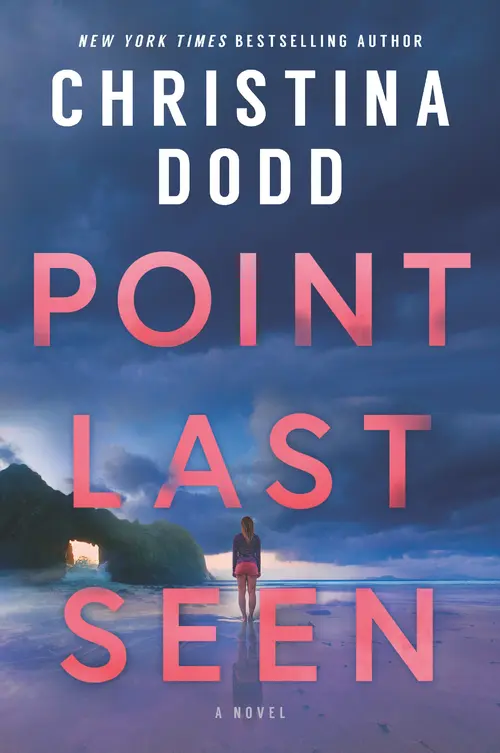
Point Last Seen
Cover
Praise
Praise for New York Times bestselling author Christina Dodd
“If Lisa Jewell, Ruth Ware and Lucy Foley are on your Mount Rushmore of suspense writers, Dodd’s latest release definitely needs a spot on your shelf.”
—E! News on Wrong Alibi
“As with all her fiendishly clever suspense novels, Dodd’s latest should come with a warning label: may cause sleeplessness even after the reader reaches the last page.”
—Booklist (starred review) on Wrong Alibi
“Christina Dodd reinvents the romantic thriller. Her signature style—edgy, intense, twisty, emotional—leaves you breathless from first page to last. Readers who enjoy Nora Roberts will devour Dodd’s electrifying novels.”
—Jayne Ann Krentz, New York Times bestselling author
“Featuring an unforgettable protagonist, who makes Jack Reacher look like a slacker, Dodd’s latest superior suspense novel builds on the well-deserved success of Dead Girl Running.”
—Booklist (starred review) on What Doesn’t Kill Her
“Action-packed, littered with dead bodies, and brimming with heartfelt emotion, this edgy thriller keeps the tension high.”
—Library Journal (starred review) on What Doesn’t Kill Her
“Dodd’s gripping voice will appeal to fans of Sandra Brown, Nora Roberts, Linda Howard and Jayne Ann Krentz.”
—Mystery Tribune on What Doesn’t Kill Her
“Dodd is at her most wildly entertaining, wickedly witty best.”
—Booklist (starred review) on Dead Girl Running
“Complex, intense, and engrossing, this riveting romantic thriller has a chilling gothic touch and just enough red herrings and twists to keep readers on edge.”
—Library Journal (starred review) on Dead Girl Running
Booklist
Also available from Christina Dodd and HQN
Right Motive (ebook novella)
Wrong Alibi
Cape Charade
Hard to Kill (ebook novella)
Dead Girl Running
Families and Other Enemies (ebook novella)
What Doesn’t Kill Her
Hidden Truths (ebook novella)
Strangers She Knows
Dedication
To my mother, Virginia Dodd, who read to me, listened to me, laughed at my corny jokes and believed I could do whatever I set my mind to. I miss our travels together, the sound of your voice, your gentle hands, your raucous humor. Your gritty determination in the face of adversity taught me everything I know about surviving the tough times and coming out on the other side. When I’m cold, I snuggle under the afghan you crocheted for me, and you’re beside me. Thank you for being the best mother I could ever have. I miss you every day, and I love you forever.
1
TWO PRIMAL ELEMENTS DOMINATED this remote area of Big Sur, California: the Santa Lucia Mountains to the east, and the Pacific Ocean to the west. Their legendary battles gave rise to the storms, the sparkling blue days and the interesting legend of Gothic, City of Lost Souls.
The plaque outside the Live Oak Restaurant read:
On stormy nights, Gothic is said to disappear, and on its return it brings lost souls back from the dead.
The myth was nonsense, of course, but local shops encouraged its belief.
A legend or two is always good for business.
Historic buildings lined the seven hairpin turns that formed Gothic’s backbone, a hodgepodge collection of restaurants and art shops that catered to whatever hardy tourists made the trip from the Salinas Valley along the narrow, winding Nacimiento-Fergusson highway on its way west to the coast, or north and south on the Pacific Coast Highway.
Today there was no traffic in Gothic; the Nacimiento-Fergusson highway was open, but the Pacific Coast Highway was washed out again and had been for months, and when it was closed, the village businesses saw bleak times.
Gothic residents were a hearty bunch of loners and eccentrics, artists and fortune-tellers. People who came to Gothic and stayed...stayed for a reason.
Adam Ramsdell’s reasons were his own.
2
A Morning in February
Gothic, California
THE STORM OFF THE Pacific had been brutal, a relentless night of cold rain and shrieking wind. Adam Ramsdell had spent the hours working, welding and polishing a tall, heavy, massive piece of sculpture, not hearing the wailing voices that lamented their own passing, not shuddering when he caught sight of his own face in the polished stainless steel. He sweated as he moved swiftly to capture the image he saw in his mind, a clawed monster rising from the deep: beautiful, deadly, dangerous.
And as always, when dawn broke, the storm moved on and he stepped away, he realized he had failed.
Impatient, he shoved the trolley that held the sculpture toward the wall. One of its claws swiped his bare chest and proved to him he’d done one thing right: razor-sharp, it opened a long, thin gash in his skin. Blood oozed to the surface. He used his toe to lock the wheels on the trolley, securing the sculpture in case of the occasional California earth tremor.
Then with the swift efficiency of someone who had dealt with minor wounds, his own and others’, he found a clean towel and stanched the flow. Going into the tiny bathroom, he washed the site and used superglue to close the gash. The cut wasn’t deep; it would hold.
He tied on his running shoes and stepped outside into the short, bent, wet grass that covered his acreage. The rosemary hedge that grew at the edge of his front porch released its woody scent. The newly washed sunlight had burned away the fog, and Adam started running uphill toward town, determined to get breakfast, then come home to bed. Now that the sculpture was done and the storm had passed, he needed the bliss of oblivion, the moments of peace sleep could give him.
Yet every year as the Ides of March and the anniversary of his failure approached, nightmares tracked through his sleep and followed him into the light. They were never the same but always a variation on a theme: he had failed, and in two separate incidents, people had died...
The route was all uphill; nevertheless, each step was swift and precise. The sodden grasses bent beneath his running shoes. He never slipped; a man could die from a single slip. He’d always known that, but now, five years later, he knew it in ways he could never forget.
As he ran, he shed the weariness of a long night of cutting, grinding, hammering, polishing. He reached the asphalt and he lengthened his stride, increased his pace.
He ran past the cemetery where a woman knelt to take a chalk etching of a crumbling headstone, past the Gothic Museum run by local historian Freya Goodnight.
The Gothic General Store stood on the outside of the lowest curve of the road. Today the parking lot was empty, the rockers were unoccupied and the store’s sixteen-year-old clerk lounged in the open door. “How you doing, Mr. Ramsdell?” she called.
He lifted his hand. “Hi, Tamalyn.”
She giggled.
Somehow, on the basis of him waving and remembering her name, she had fallen in love with him. He reminded himself that the dearth of male teens in the area left him little competition, but he could feel her watching him as he ran past the tiny hair salon where Daphne was cutting a local rancher’s hair in the outdoor barber chair.
His body urged him to slow to a walk, but he deliberately pushed himself.
Every time he took a turn, he looked up at Widow’s Peak, the rocky ridge that overshadowed the town, and the Tower, the edifice built by the Swedish silent-film star who in the early 1930s had bought land and created the town to her specifications.
At last he saw his destination, the Live Oak, a four-star restaurant in a one-star town. The three-story building stood at the corner of the highest hairpin turn and housed the eatery and three exclusive suites available for rent.
When Adam arrived he was gasping, sweating, holding his side. Since his return from the Amazon basin, he had never completely recovered his stamina.
Irksome.
At the corner of the building, he turned to look out at the view.
The vista was magnificent: spring-green slopes, wave-battered sea stacks, the ocean’s endless surges and the horizon that stretched to eternity. During the Gothic jeep tour, Freya always told the tourists that from this point, if a person tripped and fell, that person could tumble all the way to the beach. Which was an exaggeration. Mostly.
Adam used the small towel hooked into his waistband to wipe the sweat off his face. Then disquiet began its slow crawl up his spine.
Someone had him under observation.
He glanced up the grassy hill toward the olive grove and stared. A glint, like someone stood in the trees’ shadows watching with binoculars. Watching him.
No. Not him. A peregrine falcon glided through the shredded clouds, and seagulls cawed and circled. Birders came from all over the word to view the richness of the Big Sur aviary life. As he watched, the glint disappeared. Perhaps the birder had spotted a tufted puffin. Adam felt an uncomfortable amount of relief in that: it showed a level of paranoia to imagine someone was watching him, but...
But. He had learned never to ignore his instincts. The hard way, of course.
He stepped into the restaurant doorway, and from across the restaurant he heard the loud snap of the continental waiter’s fingers and saw the properly suited Ludwig point at a small, isolated table in the back corner. Adam’s usual table.
Before Adam took a second step, he made an inventory of all possible entrances and exits, counted the number of occupants and assessed them as possible threats and evaluated any available weapons. An old habit, it gave him peace of mind.
Three exits: front door, door to kitchen, door to the upper suites.
Mr. Kulshan sat by the windows, as was his wont. He liked the sun, and he lived to people-watch. Why not? He was in his midnineties. What else had he to do?
In the conference room, behind an open door, reserved for a business breakfast, was a long table with places set for twenty people.
A young couple, tourists by the look of them, held hands on the table and smiled into each other’s eyes.
Nice. Really nice to know young love still existed.
There, her back against the opposite wall, was an actress. Obviously an actress. She had possibly arrived for breakfast, or to stay in one of the suites. Celebrities visits happened often enough that most of the town was blasé, although the occasional scuffle with the paparazzi did lend interest to the village’s tranquil days.
She wasn’t pretty. Her face was too angular, her mouth too wide, her chin too determined. She was reading through a stack of papers and using a marker to highlight and a ballpoint to make notes... And she wore glasses. Not casual I need a little visual assistance glasses. These were Coke-bottle bottoms set in lime-green frames.
Interesting: Why had an actress not had laser surgery? Not that it mattered. Behind those glasses her brown eyes sparked with life, interest and humor, although he didn’t understand how someone could convey all that while never looking up. She had shampoo-commercial hair—long, dark, wavy, shining—and when she caught it in her hand and shoved it over one shoulder, he felt his breath catch.
A gravelly voice interrupted a moment that had gone on too long and revealed too clearly how Adam’s isolation had affected him. “Hey, you. Boy! Come here.” Mr. Kulshan beckoned. Mr. Kulshan, who had once been tall, sturdy and handsome. Then the jaws of old age had seized him, gnawed him down to a bent-shouldered, skinny old man.
Adam lifted a finger to Ludwig, indicating breakfast would have to wait.
Ludwig glowered. Maybe his name was suggestive, but the man looked like Ludwig van Beethoven: rough, wild, wavy hair, dark brooding eyes under bushy eyebrows, pouty lips, cleft in the chin. He seldom talked and never smiled. Most people were afraid of him.
Adam was not. He walked to Mr. Kulshan’s table and took a seat opposite the old man. “What can I do for you, sir?”
“Don’t call me sir. I told you, call me K.H.”
Adam didn’t call people by their first names. That encouraged friendliness.
“If you can’t do that, call me Kulshan.” With his fork, the old guy stabbed a lump of breaded something and handed it to Adam. “What do you think this is?”
Adam had traveled the world, learned to eat what was offered, so he took the fork, sniffed the lump and nibbled a corner. “I believe it’s fried sweetbread.”
Mr. Kulshan made a gagging noise. “My grandmother made us eat sweetbread.” He bit it off the end of the fork. “This isn’t as awful as hers.” With loathing, he said, “This is Frenchie food.”
“Señor Alfonso is Spanish.”
Mr. Kulshan ignored Adam for all he was worth. “Next thing you know, this Alfonso will be scraping snails off the sidewalk and calling it escargots.”
“Actually...” Adam caught the twinkle in Mr. Kulshan’s eyes and stood. “Fine. Pull my chain. I’m going to have breakfast.”
Mr. Kulshan caught his wrist. “Have you heard what Caltrans is doing about the washout?” He referred to the California Department of Transportation and their attempts to repair the Pacific Coast Highway and open it to traffic.
“No. What?”
“Nothing!” Mr. Kulshan cackled wildly, then nodded at the actress. “The girl. Isn’t she something? Built like a brick shithouse.”
Interested, Adam settled back into the chair. “Who is she?”
“Don’t you ever read People magazine? That’s Clarice Burbage. She’s set to star in the modern adaptation of Shakespeare’s...um...one of Shakespeare’s plays. Who cares? She’ll play a king. Or something. That’s the script she’s reading.”
Clarice looked up as if she’d heard them—which she had, because Mr. Kulshan wore hearing aids that didn’t work well enough to compensate for his hearing loss—and smiled and nodded genially.
Mr. Kulshan grinned at her. “Hi, Clarice. Loved you in Inferno!”
“Thank you, K.H.” She projected her voice so he could hear her.
Mr. Kulshan shot Adam a triumphant look that clearly said See? Clarice Burbage calls me by my first name.
The actress-distraction was why the two men were surprised when the door opened and a middle-aged, handsome, casually dressed woman with cropped red hair walked in.
Mr. Kulshan made a sound of disgust. “Her.”
3
HER WAS ANGELICA LINDHOLM.
Angelica had inherited the Tower and, by extension, most of the property in Gothic. After a brief career as a model and minor actress, she seized the moment to tell women how to organize their lives. When that proved to be a success, she taught crafts, cooking, gardening, housekeeping and decorating.
Who knew women wanted to be told how to properly arrange a pantry? Certainly not Adam. Yet Angelica —a woman in her sixties, fit, well-dressed, with impeccably cut and styled red hair—had made herself and her operation a brand name.
A harried-looking, twentysomething woman carrying a clipboard, computer tablet and briefcase trailed after Angelica. She took her burdens to the table against the back wall and placed them on one of the two chairs, then went to consult with Ludwig.
Angelica took the occasion to tour the restaurant, speaking to the young couple who looked startled and confused (the man) and thrilled (the woman.)
To Mr. Kulshan Angelica said, “I hope the arthritis in your feet has improved. Did you use the balm I made for you?”
Mr. Kulshan virtually sprouted porcupine’s quills. “Yes, yes, I use it.” He added grudgingly, “Helps. Thank you.”
“Let me know when you need more, and I’ll have Veda deliver it to you.” Angelica smiled in self-congratulation. “Mr. Ramsdell, good to see you out and about.” She moved toward Clarice’s table.
Mr. Kulshan muttered, “Why don’t you ask a little louder so everyone in the place knows I’ve got toes that look like knobby tree roots?” Only, as before, he was louder than he realized.
Angelica stiffened and paused.
She might be able to tell women how to live their lives, but every man in Gothic got his back up when she spoke in tones that insinuated they must be fans...or idiots. That patronizing comment about being out and about... Adam read it as a criticism of his private lifestyle. And who was she to talk? After speaking with Clarice, she made her way to the back table and seated herself, and while Veda carried boxes of flower arrangements to the conference room, Angelica poured coffee, ordered breakfast and scanned her notes.
Adam stood. “Good chatting with you, Mr. Kulshan. Enjoy your sweetbread.” As soon as he returned to his table, Ludwig disappeared into the kitchen, then reappeared with a large pot of strong coffee, a small pot of heated cream and a bowl of cubed brown sugar. He poured the coffee into the waiting mug, added the exact amount of cream Adam required and dropped in one sugar cube. He examined Adam’s face, then added another cube.
“Why did you do that?” Adam asked. “Now it’ll be too sweet.”
Ludwig stirred the brew, lifted the cup, put it in Adam’s hands and again disappeared into the kitchen. He returned with two plates piled with food. “This morning Chef has prepared a Spanish tortilla of potatoes, eggs and onions with a skewer of fruit and fried sweetbread.”
“Sounds good.” Adam sipped the coffee. It was too sweet, yet the coffee and the food were exactly what his exhausted body needed. Simple food, but prepared so well that, if Adam was given to displays of emotion, he would groan with pleasure.
Angelica got the continental breakfast: a basket of rolls, a small orange juice and an assortment of jams. She ate sparingly, although Adam knew the pastries were top-notch. As Veda worked, she glanced wistfully at Angelica’s table. Did she ever get to eat? Angelica could have at least tossed her assistant a mollete.
When two vans pulled up in front of the restaurant, Angelica pushed her breakfast away and marched to the door.
Veda joined her, tablet in hand, and opened the restaurant door while the vans discharged eighteen people of various genders, ages and skin colors...and yet, they were alike: clean, alert and dressed in the Angelica style. Adam appreciated that ethics meant hiring diversely, paying according to skills and not discriminating by gender. But there should be a law against hiring people who all dressed the same.
Angelica welcomed each one with a handshake and a restrained smile. When the last of the line had passed, Angelica consulted her tablet. “Where are Noah and Jill?”
As she spoke, a man and a woman stumbled off a van looking pale and shaky. Motion sickness. The shade and sunshine of the windy road did have that effect.
“Oh, dear.” While the other employees filed into the conference room, Angelica walked two Angelica Lindholm– brand bottles of water out to the unfortunates and shepherded them inside.
Ludwig whipped into the conference room carrying pitchers of orange juice, baskets of pastries, and tea and coffee: the employees would eat like the boss. Except for Noah and Jill, who hastily vacated the room... Sometimes the smell of fresh-baked bread could be fatal to one’s composure. When Ludwig finished placing the food on the table, Veda shut the door behind him. The meeting had begun.
The street door opened, and Adam looked up to see Rune of Madame Rune’s Psychic Readings and Bookshop. Six feet tall with a darkly stubbled chin and flowing gray hair, she wore clothes that proclaimed her profession: long skirts, shirts with asymmetrical hems and coins affixed to the fringe of a tie-dyed scarf. As she made her way across the restaurant she fluttered her fingers at everyone in the place, spoke in her fluting Julia Child voice and took the table next to Clarice Burbage, who welcomed her warmly. They were, apparently, old friends.
How did a fortune-teller from Gothic know a movie star? More ominously, why were they chatting and glancing at Adam?
As soon as Ludwig whisked away Adam’s plates and refreshed his coffee, Clarice wove her way through the tables and indicated the empty chair opposite. “May I?”
Up close, she was striking but not beautiful. Young but not a teenager. Tall but not...well, no. She had legs that rose to the moon. Adam couldn’t imagine that any man ever said no to her. Still, she waited for him to grant permission before seating herself.
Of course, he did grant permission.
Mr. Kulshan said to no one, “Well, he’s a good-looking-enough boy.”
Clarice smiled, gently amused. “Rune told me to wait until you’d eaten. She said you weren’t such a grump when you’d been fed.”
Adam still felt like a grump. “I imagine that’s true of most men. And women.”
“Eating always works for me. Smooths out my temperament.” She seemed so calm, so unassuming, Adam found he couldn’t imagine her showing temperament. “As K.H. told you, I’m here studying for a part. I need privacy. I’ve got one paparazzo who stalks me everywhere I go. Rune says that because of the roads, and because the sheriff and his deputies have a lot of county to cover, it can sometimes take them thirty minutes plus to answer a call in Gothic. Rune indicated to me that you’re the unofficial law enforcement in town.”
“Rune is wrong. I am absolutely not the law enforcement, unofficial or otherwise.”
“I can’t call the sheriff about a paparazzo. Bruno doesn’t do anything criminal. He takes my picture for profit.” Clarice took a quavering breath. “What he really enjoys are photos of me glaring, or sobbing in frustration, or threatening him, so when Bruno finds me, he gets in my face. Pops out and scares me. He’s a stalker who uses a camera as an excuse to terrify. Worse, I’m his special target. He’s told me so.”
At one time Adam had been a target of the press. They were ruthless, but once the scandal had passed, they were on to the next story, indifferent to the pain they left behind. If this guy stalked Clarice specifically...he was dangerous.
“Señor Alfonso promised that Gothic was off the beaten track...and so far, it is. But it’s also known among insiders as a place to stay to study a part.”
Adam remembered the flash of binoculars from the hill above Gothic. Perhaps not binoculars, maybe a long-range lens. “Let’s assume Bruno won’t find you.” Because Adam didn’t want to get involved. Not with her, not with anyone. Even now, a vast weariness weighed him down, and to think that he needed to protect someone when five years ago, he had proved to be so lacking...
The Story Continues on BooksBarbecue!
Enjoyed this preview? ❤️ Do not stop here!
Read the complete book free online → 🔗
Continue reading now on BooksBarbecue and discover every page!
Love reading? Bookmark BooksBarbecue.com for more amazing books!
Happy Reading!