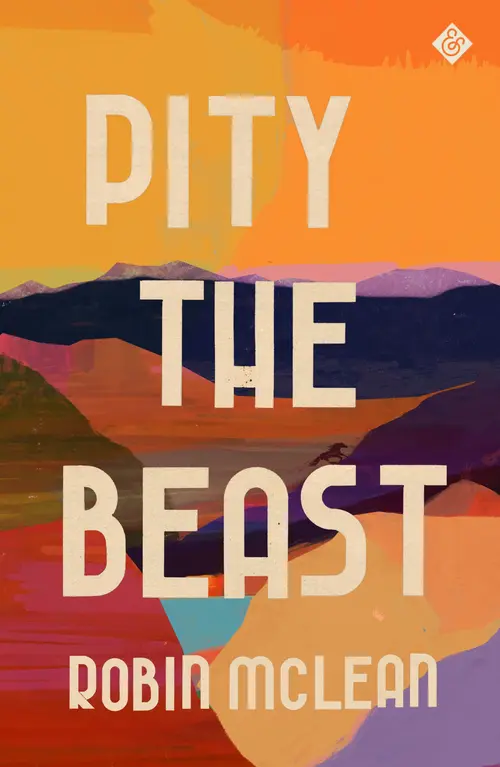
Pity the Beast
Praise for Robin McLean and
Pity the Beast
“Robin McLean sees the world like no one I’ve ever read before. In Pity the Beast, her exacting eye gives us human behavior in all of its beastliness while simultaneously reminding us that it’s not moral judgment that ugliness calls for, it’s even more careful attention. McLean insists that if we face the worst of ourselves, and if we find some way to articulate what we see, we may emerge battered but filled with a compassion we didn’t know we had, and didn’t know we needed.”
Karen Shepard
“Not since I stood in a Washington, D.C. bookstore back in 1992 to read the first few pages of All the Pretty Horses have I known so quickly and surely that I was in the hands of a writer whose skills and sensibilities soared in a direction both thrilling and foreign … But where Cormac McCarthy uses his gifts to solidify the west we have always known—men on the edge, defining and redefining freedom—Robin McLean turns the tables on him (and us) by putting a woman in charge. Though Pity the Beast is, through and through, a feminist novel, there isn’t a sentence in it that preaches, not a word that calls attention to its political undercurrents. Robin McLean may be a literary newcomer, but in years to come we might be calling her a literary master.”
Richard Wiley
“Here is a novel that sets the species down in its proper plain place: talking animal. Late Bloomer to the Big Window. Robin McLean is unafraid of the grand scale, wary of the luxury of mercy. I read Pity the Beast ravenously, stunned by its savage and glorious turns.”
Noy Holland
“Like any Western worth its salt, Pity the Beast abounds in fiction’s elementals: muck and dirt and dust; flies and fire and shit; spirits both mythical and distilled; and, of course, fucking. McLean is a writer of the hardscrabble sacred and well-perfumed profane, and her grotesques cry out from their place there on the page. Behold, the heiress to Cormac McCarthy—her pen to the old man’s throat, her prose blood-speckled and sun-splattered and all her own.”
Hal Hlavinka,
community bookstore, brooklyn
Copyright Page
First published in 2021 by And Other Stories
Sheffield – London – New York
www.andotherstories.org
Copyright © Robin McLean, 2021
ISBN: 9781913505141
eBook ISBN: 9781913505158
Editor: Jeremy M. Davies; Copy-editor: Jane Haxby; Proofreader: Sarah Terry; Typesetting, text design and eBook by Tetragon, London; Cover Design: Anna Morrison
And Other Stories gratefully acknowledge that our work is supported using public funding by Arts Council England.

Contents
- One Percheron
- Two Bear
- Three Pioneers
- Four Dog
- Five Mule
- Six Tree
For Cindy, to keep a promise.
For Marsh, who stayed behind.
For Margaret, always.
Entreat me not to leave you,
Or to turn back from following after you;
For wherever you go, I will go;
And wherever you lodge, I will lodge;
Your people shall be my people,
And your God, my God.
Where you die, I will die,
And there will I be buried.
The Lord do so to me, and more also,
If anything but death parts you and me.
RUTH 1:16–17
One
Percheron
Once, here, on this high plain, there were only Horse, Bear, Rhino. No words to put to things, no call to put them. But today? Ginny and Dan in the barn, and words like this: “You fucked me over. You fuckin’ fucked me over.”
Ginny behind the heaving mare said, “Her water’s broke. I broke it.”
“He was fucking her while you were fucking him and thereby fucking me over,” said Dan. “Now that foal’s too big for her.”
She swatted flies. Her hat was filthy from mucking. Her coveralls were unzipped to her waist. One arm hung free folded to the knee, the other was stuffed inside itself. Her flannel shirt was rolled up her elbow. The dust filled the doorway like the bees and flies.
“That foal will turn her inside out,” Dan said. “That foal will bust her.”
“No one knows how things go.”
“How they go, how they go,” he said. “Look at her belly.” He spit and stirred the dirt with his boot. “Behold the suffering of an innocent creature.”
Ginny spat too. “Behold?” she said. And: “I’ve got things to do.”
Out at dawn, Ginny was in the barn as midwife. Dan saw to the cows. Most of the herd already speckled the south field to the east, burned two weeks back and quickly regreened. The cows ate the grass. Dan was a punctual rancher. He’d slapped them through the gate with his stick, one black, one white, then a tricolor bull calf. The calf turned his head and paused at the ongoing ruckus in the barn: a hoof to a stall and a bucket kicked over. “Easy, easy,” Ginny cooed.
The calf ran on to mingle with the herd in the boulders and grass, grazing, shitting, swinging tails. They would cut off his balls in a week. Dan listened to the barn, which was red and peeling, the shed too, the corners a quarter-century off-plumb. When the hoof kicked the stall again, the gutter shook to the loft that yawned black, empty of hay. The cat slipped out of a raccoon’s hole. Morning is the very best time for reproductive suffering. This is well-known.
Seven horses—a little cavvy—swayed likewise, in their own time, out into the corral. The palomino first, the chestnut last behind the cob, the gang in the middle biting on each other’s necks. They bunched at the fence and sniffed new air. The little mare followed, a pony, small-framed to begin with, bought at the cannery auction and never fully past the effects of starvation. She lumbered between the crossties, stepped out past Ginny after the herd. She was a mixed breed, brown, with her big belly swinging. Any fool could see Shaw’s Percheron had got her. What’s monogamy to a horse, after all? A rare discipline in the animal kingdom. For millions of years, grazing on these same fields, the primal inhabitants of the Great Plains spared it not a thought. Fretting over infidelity about as much as Horse, Rhino, Sabertooth concerned themselves with the continental plates pushing patient below the earth. In millennia since, we’ve learned that both the earth and a good fuck can turn around and get you killed if you’re not keeping a close eye. But what’s the earth to a horse, after all?
“How could you do it?” Dan said to the barn wall. “You fucked me over.” Ten years married. Ten years in love before that. A young man still.
“Settle down now,” Ginny was saying, following the mare out into breaking day. “I can’t help you if you kick me.”
Dan caught a fly in his palm. He would tell Ginny about the fly, a private joke. The yard will fill with flies when the sun gets in, easy easy, soon, a few hours, but the Mormora Mountains still cast their long blue shadow and these flies were young, cold, dumb from smoke. The last calves shouldered through the gate. Another black, another white, then the acorn calves, more heifers, not impatient or impolite. Dan slapped their rumps and they romped and kicked across the field to find their mothers. The haze sat on the ground waiting for a breeze. He should forget about the fly.
“We’ll get that foal out of you,” Ginny was saying. “I promise.”
Now the horses. Pacing and pawing. The little mare after. Dan turned the first seven out to the south field, the cob going first this time, the chestnut last again, always last, the Old Man, and Dan closed the gate after them. The mare hung her head over the top rail. She watched the herd break free into morning, trotting then halting, drifting by boulders, tossing heads, flicking tails. The young ones galloped the sidehill to the creek. He ran his hands across the mare’s belly, withers to stifles, which bulged under her great weight. He listened at the enormous bulge.
“Still two heartbeats,” Ginny said.
“I’ll burn Shaw’s house down if this comes out badly.”
“You’re not some caveman.”
The mare wanted out the south gate. Dan offered the north. She acquiesced, bobbed out of the corral, and he followed. “Maybe I am,” he said. “You should hear them in town. For days, nothing else. You and Shaw.” He nodded toward the oak. “You should’ve closed his gate. You’re smart. Should’ve covered your tracks. Protected us.”
The mare headed up the north field, the last field to be burned, just yesterday. The ground still smelled strong, black-stubble char the quarter mile up to the old oak. Dan followed.
“I’m sorry,” Ginny called after him.
“I’d like to be a caveman,” he called back. “I’d like to try it.”
“I’ve said sorry a hundred times.” His back was lean and dry and split in the middle.
“Say it again anyway.”
“I’m sorry I did it.”
He bent, rubbed his knees that were always sore now. “I don’t feel better.”
“I’m sorry.”
“I’ve loved you right, haven’t I?”
“Yes you have.”
“What’s he got?”
“I don’t know.”
“I’ve been good to you, haven’t I?”
“Don’t know why,” she called. “It felt good. I couldn’t stop it.”
He held his head. “You should hear them talk and talk.”
“Forget them. It’s only us.”
“Only us?” His grin was wrong. He turned back uphill after the mare, who was on a beeline. He walked with long fast strides, three miles an hour uphill. He’d clocked it. He liked a straight line as well as any. If he stayed to the line past the oak, he’d jump Shaw’s fence, which ran the knob above Shaw’s house and barn, and keep going up Hinton’s Hill to Barryman’s Quarry, two more hours along the ridge to the base of the Mormoras where the land was too broken up for grazing.
“She’s headed for shade,” he called back. “Come on. I’ll need you.”
They made a parade of three up the quarter mile. An oak was a rarity in the region, the seed no doubt delivered in the excrement of birds. “Hurry the fuck up,” he said, but calmer now, praise be.
“I’m hurrying the fuck up,” she said in a matching tone, but hung back in body and mind near the outer range of his mutterings.
What’s the earth to a horse? A place to place the hoof, a cradle of grass, a prop to rest his nose while ripping grass out by the roots. And the Herd would have had no interest in eons. Seasons maybe, days maybe, the change of the wind certainly, the daylight hours on their pelts. No interest in geysers. In salt licks, maybe. Horse was a watcher, a minder of his own business, with eyes screwed in on the side of his tin-can skull, peripheral observer, yes, but what of those objects right in front of his nose? Expert in grass and wind, in the locations where rodents bored their holes, since such pits will break a forelock with one misstep. And then Horse would be left by his Herd. And then Wolf would come.
“Can’t fucking trust anyone,” Dan was saying, flaring again. “Least of all, it seems, our fucking wives and mothers.”
“I’m no mother. What do mothers have to do with it?”
“Mothers start it.”
He listed the usual local bad examples since the past is ever useful for lecturing.
Twelve million years back, we’re talking, with Horse grazing in the walnut’s shade with his clan, his wives bossing him, giving in to him or not while offspring and rivals stood off on distant hills watching for changes in the Herd and wind, for any mistake. Bear rumbling farther off, waiting for the same thing, digging a root to chew, ever hungry, ever exiled for his fearsome looks, and ever more fearsome keeping his own company. The Herd swished their tails at Bear’s scent, also to express the desire to mate, also to say hello to the morning sun on their withers, also to deter Fly, though Fly is never deterred for long, will survive all catastrophe, since he thrives on debacle and disaster: internal bleeding, contagion, volcanic eruptions. What creature doesn’t seek blood? What creature doesn’t keep flesh on with flesh? Bear eats Foal. Foal blood soaks the soil where the grass will grow deep green and thick. Mare will feast in that very place, grief forgotten when her hunger is satisfied.
“Though Ella’s fine,” he was saying. “As mothers go. To be fucking fair.”
“Fuck yeah,” Ginny said sweetly. “Be fucking fair to fucking Ella who’s fucking the fuck fine,” since she had limits too and could out-cuss Dan eight days a week and sometimes you have to kill fire with fire.
Sabertooth crouched. Rhino and Camel ripped branches for berries that blackened their tongues. Earth dervished on the business of planets. The eruption was merely due. When it came, Horse chewed on, blinked, as the sky thrilled black and tall for a thousand miles. Buzzard spied the tower-cloud coming, tipped her wings and flew fast south across many rivers and fat bodies of land, but wings fatigue and clouds do not. The air was full of tiny shards, microscopic glass, and these snowed down on all. Chickadee fell first, the most fragile webbing in the lungs, then Crane, who had flown straight through the cloud thinking oh, it is only a cloud, fell with his throat full, legs a tangled mound of ash. Rat keeled over from a bird’s nest he’d been raiding, an egg escaping from his paws when he fell, no mother to meet Chick when he hatched, no heat, no worm or regurgitated grub. In the few hours he lived, Chick thought the world was a gray and silent place and he its only inhabitant, his kingdom, all he would ever know, and he ruled it from high in his branch, good and fair to all. To him his life was long and full of interest, but for the chill on his naked bumpy skin and the unexplained pain in his belly, his eyes scanning the sky, his mouth panting open with vague expectation.
“Saul’s a goddamned lucky man,” Dan was saying.
“Hell, yes. Since Ella’s a fucking peach.”
Badger fell from a limb, Dog from a cliff, floated downriver.
For Horse, the pain was exquisite, long and thirsty. The Herd marched slow to the water hole. Mud was cool on their hooves, the only soothing possible. They nuzzled the foals, a small comfort for lives so short. Breathing was hard, got harder, more shards in each inhalation, more blood. Weeks went by. Bones decayed as the Herd swayed and waited, organs swelled and pressed into organs that pressed and overlapped and crushed each other, no other place to go, one side wins, the other subsides. It was one of those rare conjunctions of scale, when nature, for reasons of its own, takes time out from the routine of hatching life to make good and sure that a few beloved offspring have been well and truly annihilated.
“Ella, Ella,” he was saying, so—
Rhino was last to collapse, the biggest lungs, the grandest capillaries. From a distance his belly was a smooth round boulder.
“Why me?” he was saying.
The sun came up anyway. Tomorrows are blind and ruthless. With them came humans, rabbits, sweet grass. Then new, strange humans in wagons. Wives already with child, walking with sticks beside the wheels; tins of meat riding under the canvas. The new folk drank from creeks. They saw painted faces in the bushes, feathers and spearheads, and kept their powder dry. Men circled the wagons with the women and children safe in the middle. They drove off the natives, ate the rabbits, chased bison through reeds for meat and tanning. Dan knew the story of westward struggle like everyone, and as he trudged up to the oak in failure, he tried now to gather strength from it, from success, from the men before who’d sweated through troubles, dug wells with picks and shovels a few seasons on when there was time for “leisure,” since a creek was fine for running water. They made gates for their oxen with split trees, ate their oxen when starved. Wives died left and right. Oxen died. The men married sisters off trains from Baltimore who thought they’d come out to see the new babies.
“Cheer up,” she said. “You can always get yourself some other wife. Pick of the litter.”
Dan doubled over and she passed him by. He took up the rear.
“Life moves in mysterious fucking ways,” he said, or asked.
“No it doesn’t,” Ginny said without turning. “It’s all happened ten million million times before this, ten billion times fifty.”
“Not this exactly.”
“Nothin’ new under the sun.”
“You’re fucking wrong.”
“No I’m not and you know it.”
The old folk planted eastern corn that sometimes grew, scrawny and mealy. Potatoes were best against western birds but the elk and bison liked them. Sluices turned mills till drought. Plows broke against hidden rocks. Blades were ordered from St. Louis. They came in three months. Blades and sisters arriving by train. The men built barns and doors of rough-sawn. It was always sunshine, terrible sun, Indians in every crack and crevice, scheming. Girls made wildflower crowns and waited for eastern boys. In other times, in other places, cheating wives fed volcanoes. Fornication versus copulation is a delicate point anywhere, something to do with pleasure or sin? But these mountains were sedimentary, or lacked calderas. For somewhere to chuck a faithless wife you’d need to go south, the Yellowstone region or farther. But wait, didn’t volcanoes want virgins? Virginia, I do take Virginia, for ovulation, ejaculation, insemination, fertilization. Who decided those words should rhyme?
“What in hell are you on about?” Ginny said. Then, “Quit this muttering and march on up.”
She was pointing at the poor little mare up at the big old oak that didn’t belong here, that shouldn’t have set down roots here, not by rights or nature, and the sight of the mare’s suffering moved Dan to action. He rose and walked but talked on still.
No volcanoes here, maybe, but plenty of carbon and flame, plenty of fire worship. Dawn-risers, field burners, Dan’s people, his valley. They burned their fields from low to high, whole families in long pants and steel-toed boots, up and across, up and across, rubbing their eyes from neighbors’ smoke. The valley was wide and dry. The Mormora Mountains east, black cliffs without foothills, mile-high curtains for keeping out witnesses. Keeping out the sun, too, till long after daybreak.
“Fucking’s the crux,” he said. “Fucking’s the beginning. Fucking’s the end.”
“Amen.”
“I do love saying it.”
“Say it all you need to.”
From the oak, all the valley spooled out. Fields burned across its rises and falls. The inheritors of the plain—just specks from here, skittering at the ends of plumes—carried hoes, rakes, and gas cans from their barns to their lowest fences. Ginny and Dan didn’t need to see it close. Far off was fine. Their neighbors uncoiled the hose, paid it out across hard pack, turned spigots on full. The water sputtered then flowed before the weed burners were lit. Last year’s grass was dry and matted. Burned fast and hot with the smallest puff of breeze. The first hills, each year, are a quarter burned before the sun tops the Saint’s Head. Neighbors wave shovels and rakes across creeks to neighbors who wave shovels and rakes. For a hundred years now they’ve marched up and across the fields herding fires. Up and across toward the knobs of knobby hills. For a hundred more they will stamp the flames with their boots on top, then walk down again and start another, till the valley smolders black. Kids will always jump the fire lines. Parents will forever scold—such tedious work—and hot as hell even in morning. These people will drink from hoses and creeks as smoke rises between hills, mixing with sticky spring shoots and new buds, dung on skin, gritty teeth gritty. Tongues and lips will spit as a plane flies over. The plane is counting fires all over the region, this flight from Elkins to Romeo. The commissioner’s report is due Monday, saying, “Burning two weeks near St. Cecilia, mostly small livestock operations, sheep, cattle, and a few equestrian. Two hundred to two thousand acres is average. It will soon be too hot, dry, and foolish for burning. Heat lightning will soon decide ignition: spike down after midnight, skimming west to east over hills and hills, farms and ranches, forking down from time to time to touch off neglected fields, a barn roof dried for decades, an unfortunate home, then exit, the innocent culprit, twenty thousand feet above the highest ridges, off across the Reservations.”
“Except that no goddamned commissioner talks like that,” she said.
The Story Continues on BooksBarbecue!
Enjoyed this preview? ❤️ Do not stop here!
Read the complete book free online → 🔗
Continue reading now on BooksBarbecue and discover every page!
Love reading? Bookmark BooksBarbecue.com for more amazing books!
Happy Reading!