Pearly Gates
COVER
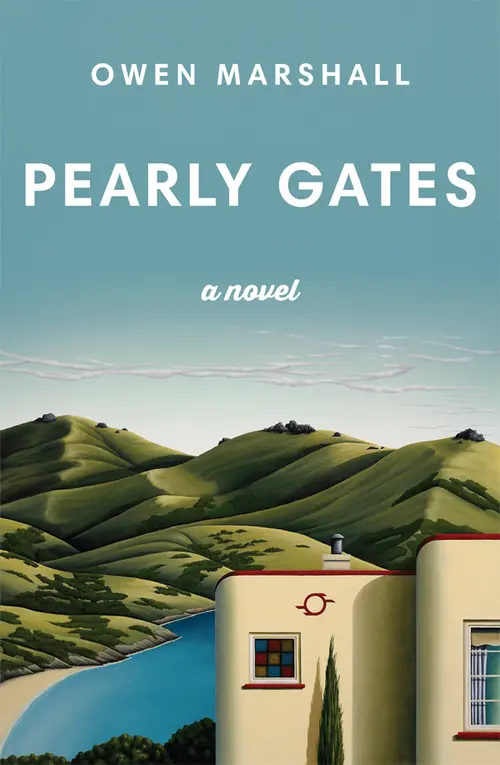
THIS ENTERTAINING AND INSIGHTFUL NOVEL BOTH SKEWERS AND CELEBRATES SMALL-TOWN NEW ZEALAND.
Pat ‘Pearly’ Gates has achieved a lot in his life and evinces considerable satisfaction in his achievements. He has a reputation as a former Otago rugby player and believes he would have been an All Black but for sporting injuries. He runs a successful real-estate agency in a provincial South Island town, of which he is the second-term mayor. Popular, happily married, well established, he cuts an impressive figure, especially in his own eyes.
But will his pride and complacency come before a fall?
‘[Owen Marshall has] the gift of telling stories that take hold of you in a personal way and bring echoes of people, places and events you have known, but not paid enough attention to at the time. It is a magical heightening of the ordinary.’ — Weekend Herald

DEDICATION
For Jackie
ONE
The more the world is tasked with serious obligation, the more insistent it is on entertainment. Pearly was at the annual show, fulfilling the public role expected of the mayor. He had ushered in the parade of floats and given the occasion an official blessing, watched by those people aware of his intention and willing to forsake the alternative amusements. The number who qualified on both counts wasn’t great.
Pearly had been told the sideshows would shut down during his speech, but they had continued: the shrieks from the big wheel and the octopus, the organ-grinder repetition from the merry-go-round, the engine blatter and impact noise from the dodgems, all combining to render his endorsement of regional enterprise and prosperity largely inaudible. The A & P shows of Pearly’s boyhood had morphed into what was essentially a carnival with an arts and crafts entourage. Gone were the tents of pickles, relishes and fruit preserves, the garden blooms, the cattle and sheep led about the ring in strict breed categories seeking garlands of blue and gold, the swelling sponge cakes, apricot slice and pale shortbread artfully arranged before the solemn judges of local repute. Now craft beers and boutique wines, free-range eggs, trays and pinboards of silver, paua and greenstone jewellery, amateur landscape paintings, peripatetic magicians, pale human statues and storytellers, face painting, and the occasional family cluster of huge tractors and harvesters, motionless and vivid among the moving throng like a giant’s gleaming toys.
There were still the wood chopping, candy floss, chocolate wheels and hot dogs, still the discarded wrappers and tickets amid the trampled grass, still the single-sex groups of adolescents in noisy, self-conscious procession, still the colourful bunting and balloons, still the false squeals from the haunted house. Still that empty urgency that accompanies mass entertainment.
Pearly had given his speech from the deck of an articulated Mack truck with the props of the Rotary Club float about him, and he remained standing there for a time as the loudspeaker system was dismantled. Selwyn Ogilvie, the show committee chairman, stood with him. ‘I did tell all the amusements,’ Selwyn said. ‘I did say a twenty-minute shut down at ten-thirty for the official stuff.’
‘I might as well have been talking Japanese,’ said Pearly.
‘Yeah, I’m sorry. They always say that they’re halfway through a paid session and can’t short-change the punters.’
‘Right,’ said Pearly.
‘Thanks anyway. I know you speak up for us on council and we appreciate that. We understand these things don’t just happen. A hell of a lot of work goes in, but of course those who never help don’t realise, or care, about that.’
‘Well, the event brings town and country together,’ said Pearly. It was a platitude that came easily as he gazed over the showgrounds: the colours, the movement, the people still coming in good numbers from cars parked on the racecourse. He would walk among them and be friendly, not just because that was politically advantageous, but because he liked to see any council-supported enterprise succeed, and he came from a farming family himself.
Selwyn put a hand on the truck deck and jumped neatly to the ground. Pearly, twenty years older, followed in a more laboured manner and with a little grunt of exhalation as he landed. ‘Come over to the tent,’ said Selwyn. ‘You’ve earned a drink at least. It’s just such a relief to have a good day, isn’t it? It pissed down last year.’
‘It’s always a bit of a gamble when you’ve got an outside event and there’s no plan B.’
‘Tell me about it,’ said Selwyn.
Already the dry grass showed a track to the committee and volunteers’ refreshment tent. Pearly would have liked a dark ale, but it was barely past eleven, there were women in the tent and always he was under scrutiny as mayor. So he accepted a mug of tea and sat in the marquee on a tubular form looking wistfully at Selwyn’s beer as the chairman sought his support for the building of a large shed on racecourse land to house the sideshows when not in use. ‘It’s expensive and time-wasting,’ Selwyn said, ‘carting the stuff away by truck each year and then back again the next. Most of it isn’t needed anywhere else and it gets dispersed during storage. Sometimes there’s vandalism, the buggers.’ The sunlight filtering through the fabric roof had a subdued, luminous quality, and substance too, drifting like pool water as the tent breathed. Pearly felt for a moment as a goldfish must, immersed, suspended, gazing at a surface from the underside.
In half an hour he was to meet people at 58 Tennyson Street to discuss the sale of their home, but he was reluctant to leave even though he had only tea to drink and Selwyn’s predictable conversation. So many of the people who talked to him wanted something from him.
‘It makes sense,’ he said in reference to Selwyn’s request. ‘Remember, though, it’s always better to come to council with a submission when you already have a healthy commitment from sponsors and a business plan.’ Pearly raised his mug and smiled at the Prendergasts, who passed to find a seat. ‘Anyway,’ he said, ‘you might have a new mayor to deal with by that time.’
‘You’ll bolt in again,’ said Selwyn, his eyes following the Prendergasts. There was a rumour that Rob had been diagnosed with advanced Hodgkin lymphoma.
Would he bolt in again? As he walked through the crowd to his car, Pearly reviewed his private decision to stand for a third term. He enjoyed being mayor, although he was now fully aware of the tedious nature of many of the responsibilities and functions. And his satisfaction in the role wasn’t just an expression of his sense of achievement, of entitlement. Pearly had real affection and concern for his home region, indeed for the country as a whole. He liked to see decent intentions and decent people succeed, as he had himself, and he rarely doubted his own judgement. Pearly was his own role model.
What he didn’t like to see was a scratch on the front left wheelguard of his Ford Falcon. ‘Jesus,’ said Pearly, and he bent with hands on his knees to inspect it, then stood tall and looked about him, as if the perpetrator could be skulking among the uneven ranks of vehicles. ‘There’s always something, Pearly,’ he murmured to himself. He was particular about his car, and even though the minor damage was out of sight as he drove to Tennyson Street, he was aware of it and irritated by that awareness. Maybe he’d made the wrong decision to stand a third time. Who knew what opposition he might face, and he wished to leave office undefeated. All his supporters, though, and the incomplete projects to which he’d given so much time and energy. There was, too, the lure of an honour, which he acknowledged only to himself. A QSM, even perhaps a QSO. He knew that several mayors of provincial towns had received gongs after three terms without scandal. Anyway, the elections weren’t until October. Plenty of time. He’d made no public declaration.
Tennyson Street was in a so-so area of the town. Pearly knew every suburb and the influence on valuations of each. No. 58 wasn’t a jewel. He parked in the street and remained in the car for a time, making a first assessment, as a prospective buyer would. It was his practice when first viewing a house he hoped to sell. Pearly knew the importance of street appeal. A conventional family home in green Summerhill stone with an inappropriate glass addition at the front entrance that Pearly would call a conservatory when advertising the place. On his walk to the door, he noted that the lawn had been recently mowed, leaving a ruff of twitch and oxalis at the border with the neglected garden, above which pairs of white butterflies cavorted and bumblebees droned.
After pressing the bell button on the conservatory door, Pearly stood looking through the glass to the original front entrance, from which the Swifts, true to name, emerged almost immediately, having been watching from a window. Mrs Swift stood in the doorway; her husband advanced the few paces through the fierce heat of the glass addition to greet Pearly. ‘Mr Mayor,’ he said effusively, with just the merest suggestion of underlying sarcasm. He proffered his hand in a comradely way. ‘Eddie Swift,’ he said, and then as they moved through the heat, ‘my wife, Sharon.’
They were such ordinary people that when he wrote up the meeting and decisions that afternoon, Pearly could scarcely remember what they looked like, just Eddie’s laughter used as a form of punctuation, and his wife’s habit of putting her hand to her throat whenever she began to speak. Ordinary, humdrum people preoccupied with their ordinary, humdrum concerns. And in any case Pearly’s attention had been on the house, and it was that professional scrutiny which remained clear to him in retrospect. The larger than expected living-cum-dining room with a glaring fleur-de-lis wallpaper, the one bathroom with a blue toilet seat and humidity stains on the ceiling above the shower, the family photographs lining the narrow passage, the yellowed venetians in the bedrooms, and the new heat pump close to the kitchen door. ‘New heat pump — top of the range,’ Eddie had said as Pearly tried to reduce his client’s hopes of considerable capital gain. ‘Yeah, I intend to have a real go at the section before any open home,’ Eddie said as he farewelled Pearly at the gate.
Pearly had mentioned the garden and the neglected shrubs at the side of the garage. ‘First impressions, you know. A good tidy-up doesn’t need to cost much at all, but it can reap rewards.’ Yet he had no great hopes of Eddie Swift. The place would be given just a lick and a promise.
He said as much to Helen that evening as they sat on the patio beneath a green-and-white umbrella and ate passionfruit cheesecake. ‘At some stage there’s been a wall knocked out to make the living areas open-plan,’ he said. ‘The best feature of the place, actually.’
‘I think someone in Leanne’s netball team lived in Tennyson Street,’ said Helen. ‘I picked someone up there. But that’s years ago.’
From the patio Pearly looked over the drive to the front gate. The surface had been recently resealed, and flanking its dark, smooth surface on the north side were evenly spaced and sized bay trees, and on the other a neat lawn and then Helen’s flower garden. No one could say that they were a lazy couple, and Pearly held that both as mayor and real estate agent he had a certain standard to maintain. The Falcon, though, outside the garage. ‘Oh, yeah,’ he said abruptly, ‘some knucklehead scratched the car this morning at the show. Opened a door on it, I suppose.’
‘How bad?’
‘It won’t need panel beating, just a little paint job.’
‘What a nuisance,’ said Helen. She knew how fastidious he was about his car, about all his belongings. Pearly liked things in order, in place and fit for the purpose. It was a reaction to the rather haphazard husbandry of both his parents, and evidence of his belief life should not be permitted free rein.
‘And the sideshows didn’t stop for my speech this morning either. Same thing last year. At least it’s been a beaut day and people turned up in droves. Selwyn and the committee are really chuffed.’
‘That’s good,’ said Helen. ‘Show days have gone in a lot of towns now, which is a pity.’
They sat in companionable silence for a while with just the occasional shuffle of Pearly’s chair as he leant to wave midges from the food. He could see the small Pratt daughters bouncing on a trampoline next door: they appeared waist-high above the photinia hedge, most often singly, less often together, in effortless levitation. They didn’t shout. They made no sound at all, just rose above the red-tipped foliage and fell again, sometimes languidly pushing wayward hair from their faces, occasionally glancing dispassionately towards the patio.
‘Oh, Esther Hall rang,’ said Helen. ‘I meant to say. I said you’d get back to her this evening.’ Esther was the local MP, with whom Pearly was on good terms. She was careful in public to maintain neutrality in the mayoral contests, but was known to be benign towards Pearly. They worked together for the good of the region and their own advancement with mutual tolerance, and only one or two serious scraps over political territory.
‘I asked her if we could get together to discuss the port development project and the hospital radiography initiative. We need everyone on-side. If we’re not unified, the government will just stall, say we’re not committed.’
‘But who could logically oppose either project?’ said Helen.
‘Everything’s more difficult in election year. People duck-shoving and posturing, and a lot of folk criticise change just for the sake of it. It’s easier to pick holes in other people’s ideas than come up with your own.’
A breeze had begun, and the umbrella filled out with it and then relaxed again. The Pratt girls no longer arose like cut-outs from behind the hedge, and the shadows were assuming the purple shimmer of twilight. As a young man, Pearly had enjoyed going for a run on such evenings. Sometimes with rugby mates, but most often, and most enjoyably, alone. Running through the side streets and up into the park, past the duck pond, through the oaks and macrocarpas, along the reservoir road and back to a home a good deal more modest than the present one. The rhythm of it, the shortened stride on the hills, the quick sweat that comes with fitness, the faded cap, the watch-check on his time afterwards. At his peak, when Pearly was a representative player, he had reached a level of physical capability and confidence that was almost euphoria, though he’d never told anybody that, not even his wife. A feeling he’d also experienced sometimes as he stood within the team waiting for kick-off: a sense of focused energy, body and mind in tune.
It was different now. He wasn’t noticeably fat, but he was no longer as fit. He was sixty-four years old, had niggling back problems and a heightened cholesterol level. Because of a cartilage operation on his left knee and subsequent deterioration he could no longer run for long, although walking was okay. Recently he’d been surprised and dismayed to see in Helen’s dressing table mirror, which had wings to show a rear view, that a bald patch was developing on his crown, despite the vigour of hair growth elsewhere, especially now on his shoulders. He was regressing, Helen had said good-humouredly. The sense of integration of flesh and spirit that is natural to the young had passed. He could no longer trust his body to accomplish everything he wished from it. Full synchronisation was over: sometimes he found himself gripping the car door as an aid to getting out, and when stepping over a fence, or other obstacle, his foot would perhaps catch, unable to quite reach the height he required of it. He thought of seeing Rob Prendergast in the refreshment tent that morning and wished he’d gone over to him and asked about his health. Rob and his wife had given many years of service to the library and the museum. Hours and hours of volunteer work and substantial grants of money as well. Pearly decided that he would bring up the matter at council and see if some form of community recognition was possible.
He mentioned the Prendergasts to Esther Hall when he rang later that evening. She hadn’t been able to attend the show and was interested to hear of its success, confirmed the bad news of Rob’s illness, but her reason for wanting Pearly to get in touch was political. ‘About the regional projects, Pat,’ she said. Esther never called him Pearly. One of the very few not to do so. ‘We need to bring each other up to speed. I haven’t got my head around the full port proposal as yet and there’ll be scrutiny of all kinds, regional and national. Look, I’m going to come to the award of citizenship do on Tuesday the 18th. Why don’t we have a chat after that?’
‘Sounds fine,’ said Pearly.
‘Maybe have David Congreve there?’
‘Good idea,’ said Pearly. David was the council’s CEO.
‘Okay then. Great. I’d better go.’
‘Select committee papers to read?’
‘Nope. Three recorded episodes of Antiques Roadshow. Love it, and I never seem to get the chance.’
Pearly didn’t watch much television either. What with civic duties, his business and section chores, there wasn’t much opportunity. Sometimes he was out for five or six nights on the trot. Rugby, of course: he watched that, and as much other sport as he could. Increasingly he liked to watch golf, although he’d rarely played it. The outdoor setting, the lithe power of the contestants, especially the women, the pressure and the drama. The stewardship of the courses impressed him: immaculate greens and tees, tailored fairways, limpid water hazards, bunker sand as smooth as yoghurt, artfully maintained pines and bluegums. Golf had a sculptured appeal as well as the display of physical accomplishment.
‘Esther’s coming to the citizenship awards on Tuesday and we’ll talk about the harbour and hospital,’ he told Helen when they were preparing for bed. She had gone into the ensuite to put night cream on her face, and said something Pearly didn’t hear clearly. ‘What?’
‘I said that’s fine, but you don’t want her to take all the credit. It’s the council that’s been behind both projects. Okay, the radiography fundraising committee has boosted finance, but the port project has been all council.’ Helen was usually supportive of Pearly’s position and ambitions, although not herself particularly interested in politics. She understood his nature: the drive that was a search for meaning and value in the freefall of life experience. She was accustomed to his assumption of worth, achievement and leadership, but quite capable of pointing out occasions when those assumptions proved false.
The Story Continues on BooksBarbecue!
Enjoyed this preview? ❤️ Do not stop here!
Read the complete book free online → 🔗
Continue reading now on BooksBarbecue and discover every page!
Love reading? Bookmark BooksBarbecue.com for more amazing books!
Happy Reading!