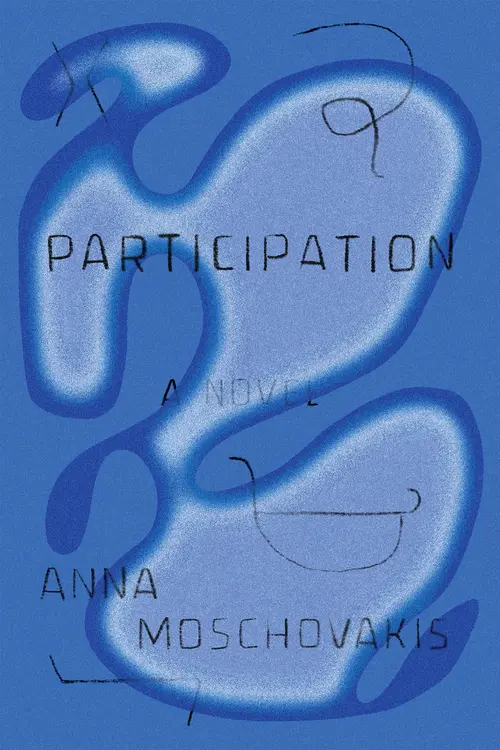
Participation
Cover
PRAISE FOR
Eleanor, or, The Rejection of the Progress of Love
“Philosophically exhaustive yet profoundly human, this book sets itself the task of asking the big questions—What am I? What was I? What will I be?—in a style that evokes Lispector and Camus but with the self-referential and weary globalism of the current milieu. A consummately accomplished novel. A worthy treatise on the now.”
—Kirkus, starred review
“Anna Moschovakis has done something remarkable.”
—Los Angeles Review of Books
“Moschovakis’s novel is braided and experimental, yet it looks for illumination in the plainspoken and the authentic.”
—The Wall Street Journal
“Eleanor is a witty novel, studded with provocative literary and philosophical references.”
—BBC
“A novel about noticing and ruminating rather than assessing and concluding. The daily weather, interchanges with passing acquaintances, views out the window, are accorded the same attentive courtesy as love and pain. Life isn’t seen as a grand arc but as one thing after another, second by second. The book offers each moment, each sentence equitably and leaves us to decide what is important and how.”
—Star Tribune
“Funny, intelligent, and sensual, although also unsettled, Eleanor is engaging from the onset and a welcoming new female voice.”
—Library Journal
“By turns funny, melancholic, and provocative, Anna’s novel undoes and remakes the conventions of realist fiction through repetition and compression of time.… It is ‘luminously ordinary’ in its progression, where profound shifts are as small as a postcard written or a hand touched.”
—BOMB
“Moschovakis is in search of a way of presenting a woman’s life that is not expressed solely through family and bonds with others—that rebuffs inherited conventions while acknowledging that women are still labouring their way through the mare’s nest chaotically erected by patriarchy.”
—Frieze
“Moschovakis has created a novel of great strength and flex. Much as it bends and twists and gyres, it does not break, in fact only accumulates more tensile strength from the motion, just as, one hopes, we all can do.”
—The Brooklyn Rail
“Her prose is marvelously rich with meaning, conceptually dense and precise in phrasing.”
—Commonplace Review
“[A] carefully controlled, intelligent novel of ideas.”
—Literary Hub
“Performance art in print.”
—Publishers Weekly
“A brilliant, visceral, sensual examination of the condition of being a woman, and the inherent struggles related to identity and authority that exist for all of us.”
—Nylon
“[A] searching and poignant work that deftly positions itself between the unspeakable specificity of personal experience and the disturbing surplus of fungible narratives in our online world.”
—Cleaver
“Moschovakis’ book seem[s] to arrange itself as we move, dreamlike, through it, encountering a singular architecture of novel and novelist that challenges us to read and think towards new possibilities, new heights.”
—Arkansas International
“Moschovakis is a poet, and Eleanor is unmistakably a poet’s novel, alert to the textures of experience but relaxed in the pursuit of plot.”
—Lambda Literary
“Moschovakis’s characters are celebrations of the information-collecting prowess of women, of the way in which her characters ‘weigh and consider’ … an overwhelming amount of data throughout each day.”
—Rain Taxi
ALSO BY ANNA MOSCHOVAKIS
FICTION
Eleanor, or, The Rejection of the Progress of Love
POETRY
They and We Will Get Into Trouble for This
You and Three Others Are Approaching a Lake
I Have Not Been Able to Get Through to Everyone
Dedication
for Jo
The only pressing reason for changing a theory is disagreement with facts.
—Paul Feyerabend, Against Method
I can’t position, I can’t assure anyone of their ethical well-being.
Take this engine, the clerk says. You are living your electric life.
—Dionne Brand, The Blue Clerk
ONE
TWO GROUPS
I never made it to Love, and now I hear it’s defunct.
Anti-Love meets regularly, though attendance is spotty. At least I’ve done most of the readings.
Love, by contrast, will be a recuperation project.
Anti-Love is not, to be fair, billed as Anti-Love. It’s billed variously as resistance, revolt, revolution. Sometimes it’s billed (tentatively or defiantly) as Self-Love.
Love bills itself as itself, eponymous and proud.
Without the beginning of the story, it’s enough to know that there is a drafty corner apartment, an all-night bodega out the window, a playground across from the bodega, quiet at night. There is an abundance of emotion—enough years, enough fucks and near-fucks and pseudo-fucks, enough expectations unanswered because unheard or unsaid—and it is that abundance that is known: a partial knowing, as excess is always, paradoxically, partial.
Without the beginning of the story, it is insufficient but still necessary to have a picture of the surround: not only the bodega and the playground, but the news reports filtering up from the apartment below. The news reports appearing at the top right of the screen, a stack of small explosions, almost registering, then, compulsively, swiped away.
There is a stack of books—on a coffee table, for example. An archive of future attention, or else a morgue.
Love isn’t defunct, exactly. It’s been reduced to a virtual form of itself. Flesh into type, an assembly turned list. I enter it, when I enter it, through a screen.
Don’t be fooled by the present tense, the future tense, when they occur, which they will. This is a story about the past. It’s already over.
When I say that the story is over, I mean that a merger has happened, which is not to say an acquisition. (This is a story about two groups.) I am also insisting on the safety of storytelling, to protect myself, and you, from a certain pain.
Story is a safe emergency.

One of the members of Anti-Love is a psychoanalyst, a fact rarely mentioned in our meetings, though the language of this fact—safe emergency—edges in. The psychoanalyst is from Buenos Aires, where an hour of therapy can cost the same as a burger; as a result, a large portion of the population is in treatment.
We absorb such unverifiable facts from conversation, and they become a part of us, they become us.
(Without the beginning, it is also necessary to have a picture of the second surround, some 150 miles away: a table in a room that is open to the public, dirty floor, a radiator that leaks. A village view out the window: gas station, neon lights, small mountain just behind.)
How are we to know who started things? At its peak there were ten of us in Anti-Love; we’d sit around the improvised wooden table, peer at one another over mugs of coffee or of beer. The idea for the group came from me, I’ve been told, though I remember it as always having been there. Not always, in the strict sense. It appeared when I needed it: an acquired taste. Tonight I met a man who was beautiful and tall, who wore capitalism like a well-fitting suit. Anti-Love recognized him, shone a light. For example.
Love was different. You wonder if I have a story to tell. I was invited to Love. The way salt is invited to the early-winter road.
I was invited and I said Yes, I said Send me the syllabus, I said I am only partially fluent in your language. I was told I was welcome nonetheless. Meanwhile, the neighbors were setting each other on fire. California was also burning—actually burning. The neighbors, aflame, sat on their stoops, extracting the burrowed tick of love from one another’s skin.
It’s everywhere in the news reports—swipe, swipe.
You don’t have to believe me, but you can.
FACTS
I can’t know what you believe.
I can offer you parable after parable, tale after tale.
I can tell you the one about Porous and Anemone, who came together over a shared sense of the word expectation. Anemone wanted things from Porous: a lack of friction mostly, but also small noises, an elbow extended into its vulnerability. Porous wanted everything to be decided (elbow in the ribs, far in). One day in the vestibule of one of their apartments, Porous had a change of opinion, which is not the same as a change of heart. The story ends there, with Porous leaking predictable tears, Anemone predictably backing out the door.
There is a theory of the psyche that claims life narratives are necessary to the formation of a coherent subjective self.
This theory has always terrified me. Maybe I’m afraid of stories. Or of selves.
Or maybe I confuse coherence with cohesion. The psychoanalyst once explained the danger of this mistake, of letting the left brain suppress what the right brain knows. The way we rush to make sense of things, invent airtight accounts, stories that follow. We depend on these unprovoked lies.
A cohesive story, the analyst clarified, may well lead to a desired result (we may get wrong why the bird crashed into the window, but the decals we put up save the next bird’s life).
When I was a child, I thought swooping sparrows were hunters, hoping to nest in my unkempt hair.
But coherence doesn’t come so easily, or have such immediate results. At this point in the analyst’s explanation, I began to disappear. My eyes and ears wandered, to a fly buzzing in a spiderweb strung between the radiator and the wall. A session of Anti-Love had just ended; the winter sun had dropped behind the mountain and the gas pumps; the street was empty and I was spent. I struggled to understand the challenge I felt: if cohesion was marked by false order, by a completionism that held chaotic truths at bay, then coherence (its corrective?) consisted of work I didn’t know how to do. What I recall about the distinction between cohesion and coherence is a feeling of desirous terror—or terrified desire—at the prospect of abandoning my attachment to the first before being able even to conceptualize the second.
What can be told, without inciting this terror? What kinds of stories, what narratives, invented or not?
Or are these the questions I’m training myself not to ask?
When dawn lifts itself over the corner apartment, the bodega glows. The playground waits for its portion of light. Late risers don’t know this, but there is always a moment, sometimes fleeting, when the clouds brim pink. In bed, angled toward uncurtained windows, I wait for it. When there are no clouds, the pink separates itself onto puddles, passersby.
I can’t know what has become me, what becomes.
Stack of unverifiable facts, archive of mistakes.
Some strays can attach to anyone, over and over.
WORK
This month, while work has stopped through no fault of my own, while I need to conserve what little funds I have (while I have more time than money), I will try to catch up; I will follow the syllabus of Love. I like to follow, but the syllabus has so many holes. In the beginning, I won’t try to plug them. I can’t make promises for the future—this being one of my failings, both in and out of love.
When I say work has stopped, I mean one-third of my work has stopped. I have three jobs, in two places, connected by a train. (I’m using the word place where before I used surround, though now neither term feels right.)
In one place, I work part-time in a café-bar that serves coffee, pie, and cheap wine in carafes. I like the job because the café-bar is slow and I can read; it’s so slow I wonder how the owner, whom I never see, covers the bills. I wonder if, after paying me and the other part-time worker, he breaks even.
I’ve done the math, and the money I earn at the café-bar just covers the expense of commuting to the other place (surround) to fulfill the obligations of my other two jobs: the expense of the train, some food and drink, and rent for the time-shared room in the corner apartment with the bodega/playground view. The job at the café-bar helps me break even.
I could just call the two places the village and the city, since that’s what they technically are.
My second job is different. My second job is as a mediator-in-training. When I get a call, I travel south to the city to assist my mentor with cases.
I can’t tell you about the cases; they’re covered by a confidentiality agreement I signed when I began my training, and which I sign again in front of each new set of clients. What I can tell you is that, to my mind, the work with my mentor is worth the hours I put in at the café-bar to support my commute. For one thing, the work is interesting; for another, it is the closest I have come to investing in my future: even at the apprentice stage, it pays the most of my three jobs.
But in the place where I am most often—in the village, where my life is manageable and where I work at the café-bar—it’s hard to come by employment as a mediator. Though sometimes working at the café-bar feels like supplemental training.
My third job, the one at which I met the capitalist, is a holdover from my former line of work. It’s a waged job, like the café-bar, but in the information sector rather than the service sector.
I don’t like my third job. I have arguments with its purpose. I would like, once my current obligations to the capitalist are complete, to cut back to just the two jobs. I have only one mouth to feed, after all.
Unfortunately, the work that has stopped through no fault of my own is not the third job, the one I argue with and want to leave behind. My mentor has vanished and isn’t returning my calls.
Now I have two jobs, but they aren’t the two jobs I want. Still, a hole in my schedule has created the opening necessary to catch up with Love.
A SYLLABUS
I’ve fallen twice for philosophers. The first one studied a fascist—still does. The second one studied, still studies, forms of love.
The Stanford Encyclopedia of Philosophy sets out in classic triangulation:
—Love as Union
—Love as Valuing
—Love as Robust Concern
I recognize, from my Western philosophical formation, the triad of eros, agape, philia. I absorbed it as lust, altruism, friendship, often wondering in the intervening years how much damage that taxonomy, trivialized by time and lack of attention, has done.
The first philosopher and I never recovered from a betrayal. I succeeded, with the second, in transforming eros into philia, or finding the philia in eros—prying it out, over time. I sent him the syllabus to Love and he sent it back from his university post, annotated and marked. Love, stained already by Authority, History, Trust.
I messaged the list:
“Loves, I still haven’t met all of you in person, and I regret the demise of the IRL sessions. I did share the syllabus with my love philosopher, as requested. Annotations forthcoming. Yours, E.” This missive earned a single black heart from S, one of the members of Love I’d never met. I jolted when I saw their heart, then I liked it back.
We are not post-gender, but when it comes to names and pronouns—this decision predated my invitation to the group—Love tends toward the least binding. (This was explained to me as an experiment, a gesture.) On the list we are capital letters; we are all they/them.
Picture this against a backdrop of shift, a ground of categorical pause. Picture the clients: a husband and a wife, for instance. Their marriage has ended, something new has taken its place, within (provisionally, at least) the same walls. He walks around the house smiling for the first time in years. She retreats to her corner, begins the process of cleaning up and clearing out. They sleep separately, better than well. They put their arms around each other several times a day. Sometimes, for no reason but because they want to, they fuck.
(Is the story of the husband and the wife mine to tell? Does it preserve confidentiality to replace names with roles, details with abstractions? Does reducing it to gestures honor the contract, or break it?)
I jolted at S’s heart “for no reason.” Does it follow that I jolted because I wanted to?
The style of mediation I’m learning, have been learning, depends on the ability of the mediator to draw out unspoken needs from each party, to go beyond the surface narrative (“the conflict”) to find out what the right brain knows. The phrase used in the Manual is the story beneath the story.
You could say the mediator shares some traits with the therapist. According to the Argentine analyst, therapeutic treatment depends on love being present—if not mutual then at least unidirectional, from therapist to client. This love, the analyst admits, can take effort. And isn’t always possible to achieve.
Learning to draw out the stories beneath the stories told by my mentor’s clients takes effort, especially when a reaction of confusion or defensiveness is sparked within me. When confusion or defensiveness becomes apparent in my body, my task is to reorient toward the client’s story while taking note of the subject or dynamic that provoked me, on which I clearly still have work to do.
It’s only now that I’m not actively being called to the field of mediation that I’m most actively reflecting on that field, viewing it with the peculiar, intimate distance of the cartographer. (And viewing that cartographic distance with the suspicion of the skeptic.)
I don’t know if attention to this task of self-aware reorientation—if the labor it requires—falls under the category of agape. It may be just as important to eros and philia, or it may belong to a category of love still unnamed, or one named somewhere I have yet to encounter.
This category must be represented in Love’s syllabus by its holes.
ANOTHER SYLLABUS
The last time Anti-Love met, we were down to three.
It was brutally cold; the streets were ice. The three of us sat around the big rectangular table, frequently rising to put the kettle back on or to extract a beer from the fridge.
The reading, which was from 1980, was about the politics of consensual sadomasochism in consciously anti-patriarchal love. Around our table, imbalances of experience were revealed, then modulated. I said “according to my friends” and “theoretically.” I said “Don’t you think the expulsion of ‘the natural’ from the erotic is the very definition of freedom?” My face grew warm, an embarrassment due less to an act of disclosure than to the desire to explain.
It occurs to me I could clarify that Anti-Love meets at the café-bar where I work—after hours, which isn’t late, since we close at seven. Sometimes I forget what you know.
I miss my mentor, and I miss the mediation sessions. The style of training I received, am receiving—in principle, if my mentor hasn’t permanently disappeared—is nontraditional, an attempt to redress assumptions that have historically plagued the field: assumptions of neutrality, of objectivity of terms, assumptions that all people have equal access to their ability to tell, fluently in the language of the mediation and without fear of retribution, their story. Let alone the story beneath it.
Sometimes the worst retribution is internal; this is among the hidden threats I’m being trained to see.
It occurs to me that the syllabus for Anti-Love was designed in part to redress assumptions that are analogous to those present in the old style of mediation, which the new style is attempting to correct. Problematic assumptions that may be all too present, that may linger (and this is part of our story, if you can call this a story) in the syllabus of Love.
One aspect of the new mediation technique is that even the attempt to create a shared narrative is intentionally, through the prolonged separation of parties during the interview stage, delayed. Of course, what the parties do on their own time—as with the husband and the wife, for example—is up to them.
It occurs to me that the games of dominance and submission that were at issue around Anti-Love’s makeshift table might be framed in a similar way: as an example of biding—while a conflict is slowly, exhaustively excavated—one’s time.
SUBSTITUTIONS
I’m supposed to be reading about love, but instead I keep reading about drugs.
The kinds of drugs I’m reading about fall into the category psychedelic, a category that—like notions of truth, honesty, and fidelity in thinking about love—is both more dull in its meaning and less clear in its relevance than people think.
Psychedelic (“mind-manifesting”) tells us nothing about the nature of the particular episode of manifestation, or the dynamics of power (for example) that may have led to its occurrence. Just as truth, honesty, etc., tell us nothing about love’s possibilities while telling us everything, though dully, about its corporate lie.
S strikes me—judging by their contributions to the list—as a person who would have a non-dull understanding of both love and drugs. As for the capitalist, I can’t tell.
Did I mention the capitalist has an accent, that uncanny accent I once heard described as English of the Global Elite?
When I said I have three jobs (counting the one that has, perhaps only temporarily, disappeared), that was an oversimplification, a wish. I have tall piles of tasks—paid, unpaid, underpaid—at every moment. Some tasks are stragglers, old obligations, much overdue. I finished one of them yesterday; it involved the accidental rediscovery of another philosopher of love, better known as an anarchist of Science, or anti-Science. This rediscovery led me further off the syllabus.
I considered writing to S to suggest adding the anarchist to the Love readings. Does S know of the anarchist already? Does the capitalist? The capitalist may: he’s an internationalist and an intellectual (and must of course, I remind myself, also be other things: parent, swinger, jock). I recall that among the members of Love is a bitterly anti-academic academic, and while I am not an academic, the anarchist philosopher is, or was.
Though he, too, must of course have been other things as well.
I resist writing to S. I am trying to learn to wait.
The Story Continues on BooksBarbecue!
Enjoyed this preview? ❤️ Do not stop here!
Read the complete book free online → 🔗
Continue reading now on BooksBarbecue and discover every page!
Love reading? Bookmark BooksBarbecue.com for more amazing books!
Happy Reading!