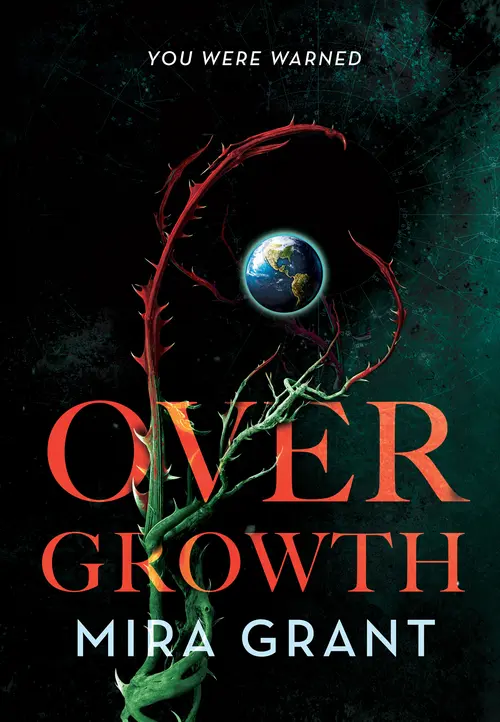
Overgrowth
Copyright Notice
The author and publisher have provided this e-book to you without Digital Rights Management software (DRM) applied so that you can enjoy reading it on your personal devices. This e-book is for your personal use only. You may not print or post this e-book, or make this e-book publicly available in any way. You may not copy, reproduce, or upload this e-book, other than to read it on one of your personal devices.
Copyright infringement is against the law. If you believe the copy of this e-book you are reading infringes on the author’s copyright, please notify the publisher at: us.macmillanusa.com/piracy.
Dedication
For Merav.
I told you so.
Seed
Yet across the gulf of space, minds that are to our minds as ours are to those of the beasts that perish, intellects vast and cool and unsympathetic, regarded this earth with envious eyes …
—H. G. Wells, The War of the Worlds
Sometimes I wonder if pollution isn’t humanity’s way of denying how hard it is to build a wall against the stars.
—Stasia Miller
Fermi’s Paradox, named after the esteemed physicist Enrico Fermi, asks an essential question about the existence of extraterrestrial life: namely, where is it? Given a universe the size of our own—functionally infinite when compared to something as small as a human being—and the number of planets we have already discovered which are potentially capable of supporting life, it seems impossible that we have not yet been visited by our neighbors. Yet conclusive proof of alien civilizations has not been found. Every sighting can be explained; every abduction can be swept away. We are, for all intents and purposes, alone.
Either life is vanishingly rare in the universe, or some other factor is at play. Perhaps intelligence is the rare quality: we may be surrounded by living worlds whose occupants have never risen above the level of common beasts. Or perhaps something, some great and terrible thing, prevents life from developing beyond a certain point. Perhaps we are alone, not because evolution has shown us any great favor, but because we have yet to come to the attention of that which keeps our skies devoid of company.
—from The Fermi Paradox and the Milky Way, by Anthony Vornholt, originally published 2030.
Anastasia has a vivid imagination and does not shy away from sharing her fantasies with the rest of the class. She needs to learn restraint, and when it’s time to put pretend away and focus on the real world. It is slightly concerning how detailed her imaginary scenarios can become. She rarely deviates from the details of her make-believe once she has settled on them, and will argue with other students who attempt to contradict her.
It is not yet a problem for Anastasia to have such a rich fantasy life; at her age, this is fairly common. She should still be monitored in case of future issues telling the truth from fiction, as she will be expected to focus more on her studies as time goes by.
—letter home from Ms. Anne O’Toole, kindergarten teacher. Sent November 2002.
The Story
1.
This is a story. It can’t hurt you anymore.
It’s still important that you listen, because I am going to tell you things you need to know, and it will be easier for you to understand what’s happening if you pay attention to me now. But if you get scared, or if you wonder why I’m making you listen to this, just remember that this is a story. There was a time when it could hurt you, but that time is over and done. You’re safe. I’ll protect you, I promise. I really, really do.
This is a story. You need to know how it starts.
It can’t hurt you anymore.
2.
Like so many things, it begins with a seedpod, large and thick-skinned for protection, irregularly shaped to ease its passage through the air. It isn’t aerodynamic, but where this seedpod floats, there isn’t any atmosphere to pierce. It travels through the depths of space at a speed that no Earthly seedpod has ever approached, trapped in the frozen heart of a comet, followed by a bridal train of stardust and ice. It goes where gravity and orbital forces take it, and it knows nothing of where it is or where it came from. It is not aware.
In the beginning before the beginning that matters to us, this seedpod was one of dozens scattered through the same fertile cloud of icy planetesimals, left by a fruiting body long since passed. Ice and debris swirled around the seedpods, slowly coalescing into comets, which broke loose from their nursery and began their long, uncharted trek through the cosmos. Some of them died before they could finish forming, never quite hardening, their cargos destroyed and undelivered. Others crashed into lifeless moons or were pulled into blazing suns, the ice melting in an instant, the seedpods crisping and dying only a moment later. But some …
Some, like this one, managed to soar on gravitational lines, dancing through the sky on their unknown and unknowable errands. One by one, this seedpod’s fellows have dropped away, even the survivors, leaving it to chart its course alone.
The planet that lies ahead of it is blue green and bright, glowing with points of artificial light. The seedpod has passed it a dozen times before, but this time, ah. This time, there is debris in the air around it, artificial structures and satellites scattered through low orbit. This time, radio signals flutter and flash through the air. Something deep within the seedpod—something less organic than the seedpod itself, something less casually grown than the comet that protects it—sparks and flares to life, recording those signals, picking them quickly to pieces, like a centipede slicing up its prey with the ends of its razored legs.
The signals are good. The signs are good. The comet, which has flown past the planet so many times before, shudders, orbit suddenly adjusting from within rather than from without. It tilts, bending toward the gravitational field. It shakes, spinning wildly, shedding chunks of ice in all directions.
It is not a large comet. Not the sort of thing that attracts admirers or ends epochs. Only a few astronomers on the planet below notice its odd behavior. They take pictures, excited to capture a comet breaking up so close to the atmosphere; they notify their friends that something exciting is going on. They don’t think any more of it. Why should they? Comets die all the time. The sky is a living thing, a void filled with points of slow, deliberate vitality.
The comet spins one last time and plunges below the orbital horizon. Gravity takes over, greedily grabbing for the projectile, like a child snatching the first pieces of candy out of a broken piñata. The last of the ice is ripped away. The surface of the seedpod bulges and contracts, exposed to the elements for the first time since it was nestled in its icy nursery.
The skin, a deep, pitted purple the texture of fruit leather, begins to crack. Gravity continues to pull. The skin splits, a seam running from one end of the seedpod to the other. And then, with no further ceremony or incentive, it falls away entirely, scattering seeds in its wake.
They are surprisingly small, these interstellar wanderers, each about the size of a withered apple or a squirrel’s skull. They are wrinkled like walnuts, labyrinthine in their folds and channels. They fall, surrounded by bright coronas of fire as the friction of their descent ignites the thickening air around them, burning away the top layers of their protective skins.
The wind catches some of them, blows them across oceans and over continents. See how they fall, these travelers, these seeds of something new! They drop out of the sky in fiery halos, and people make wishes on them, call them shooting stars, delight in their presence and their novelty. Astronomers make notes. Some of those astronomers will talk during the weeks to come about the rare and beautiful comet that died in their sky, and none of them will wonder what it carried in its belly.
The seeds fall, in ones and twos and dozens. Some of them drown in the deep oceans. Others land in inhospitable soil, in frozen tundra or burning volcanos. A few even fall on city streets, to be swept up as refuse or collected by curious children who will never recognize them for what they really are. So many opportunities, even now, for discovery, and one by one, they pass by untaken. No one questions the comet. No one slices open a seed found on a sidewalk. No one looks. No one learns.
One by one, they fall, and one of them falls in a green forest on a green continent. It lands in rich and fertile soil, still smoking with the heat of its long journey. No one sees it fall. No one comes to collect or quarantine it. Still, it sits fallow for a full turn of seasons, slowly adjusting to the weather, to the conditions around it.
A year after the comet died above the Earth, the first seeds crack their shells and send down thin, waxen roots, piercing deep into the ground beneath them. They begin to draw water and nutrients from their surroundings. They begin to grow. Inch by inch, cautious to the last, they begin to grow. Some sprout in sun and some in shadow. One grows in the heart of a desert, sending its roots spiraling deep in the quest for water.
Still they are not noticed. Still they are left alone.
At the end of a week, there is a sprout where each of the surviving seeds had been, their green skins underlaid with a thin sheen of blue, like the shimmer of a beetle’s wings. Half the seedlings die before they pass this stage, swallowed by grazing animals which follow them into death a heartbeat later, collapsing into anaphylactic shock.
At the end of a month, each sprout has become a stalk, unfurling delicate, fernlike leaves covered in stinging hairs similar to a jellyfish’s nematocysts. Another quarter of the seedlings die entering this stage, collapsing under their own weight as they fail to properly account for this new world’s gravity.
At the end of a month, buds form atop the strengthening stalks, purple and white and red, streaked and gory. Each bud opens on the third day after its formation, turning a sightless eye toward the heavens, almost as if they can remember coming from those vaunted heights.
Silent, patient, hidden, the flowers wait.
They are very good at waiting.
3.
The seedpod isn’t our only beginning: that doesn’t suit the lifecycle we’re chronicling here, which has many parts and many players. It also begins in a hospital, in a small town in Washington State, where a woman—call her Caroline; say that she is pretty and she is tired and she is trying very hard, even though she is very frightened—has just given birth to her daughter. See her now, sweat matting down her hair, tears on her cheeks, cradling the small, screaming creature she has made with her own body, fueled with her own blood. Is it any wonder she loves and fears it in equal measure, this tiny thing that can cause her so much pain and bring her so much joy at the same time?
The nurses take the baby away. Caroline, exhausted, uncertain, goes to sleep.
When she wakes, her parents—her frustrating, beloved, infuriating parents—are in the room. Her mother is holding the baby. Her father is sitting next to the bed, holding her hand. For the first time, Caroline is struck by how much he looks like she feels, how much parental love transcends generation and gender and even estrangement, even if she can’t quite remember what made her decide she needed to do this on her own.
“Before you get mad, your sister called us,” says her father. “She said that no-good boyfriend of yours ran out as soon as he heard you were in the family way.”
“He didn’t want to be a family with me, and good riddance,” says Caroline. “I don’t need him. I can be a family just fine on my own.”
“Not entirely on your own,” says her father, with a meaningful glance toward the tiny bundle still cradled in her mother’s arms. “What are you going to name her?”
This feels like a test. That was part of what drove her away, she remembers that now: the way her father always seemed to be testing her, the way she could never be sure she had the right answer. It wasn’t comfortable. It wasn’t fair. Caroline takes a breath.
“Anastasia,” she says. “Like Grandma.”
Now her mother looks up, surprised and pleased and smiling. “You’re naming her after my mother?”
“I miss her,” says Caroline, and that’s the reason “away” could never quite be forever, could never come with changing her name or moving to another coast. Family is where you keep the pieces of yourself that need to be shared with someone else if they’re going to have meaning, the memories that must be seen from three or four different angles at the same time before they find their context. She’s been circling her parents since she left, never coming close enough to catch, never stepping far enough away to escape, because these are the people who remember where she comes from, who understand who she is when she’s alone.
“I miss her too,” says her mother, and then, “I miss you. We both do. I’m sorry we aren’t always perfect together. Do you think we could try again, for your sake? For Anastasia?”
Caroline hesitates.
She’s tired. She’s tired of couches, and shitty little apartments with roaches in the walls, and motels that are as happy to rent by the hour as they are by the week. She doesn’t mind the sex workers—they’re sweet ladies, for the most part, and some of them have kids of their own; she’s made her rent more than once by providing babysitting services to glamorous escorts in mended silk skirts and sky-high shoes—but the druggies, they’re a problem. She doesn’t want them around the baby. And how many couches are going to be open to her now that her daughter is out in the open, wailing and puking and messing her diapers, instead of peacefully tucked away inside her belly?
I should have kept you inside forever, where you’d be safe, she thinks, and she’s righter than she will ever have the chance to know.
“It can’t be like it was,” she says. “Not this time. I’m a mother now. I have to be allowed to know what’s best for my little girl.”
“As long as you’ll let me help,” says her mother. Her father, who has no competition in sight for the position of most important man in Anastasia’s life, says nothing. This part of the conversation isn’t for him, and he’s a clever-enough man to know it, to understand that sometimes the right thing to do is stand back and hold his peace.
“I think I could use some help,” says Caroline, and holds out her arms, asking for her mother, asking for her daughter, asking for her family.
Renee Miller, who raised three children of her own, only to lose them all—one to a war, one to the other side of the country, and one, her precious baby girl, to her own stubbornness—walks her granddaughter across the room, and it’s like she’s coming home, and it’s like she never left.
Caroline takes Anastasia in her arms, and everything is perfect. Everything is just the way it’s supposed to be, forever.
4.
The Millers live in a small town in Washington State, surrounded by trees on all sides, with the mountains misty in the distance, playing hide-and-seek with the shadows cast by clouds. It rains less often than people from out of state assume, more often than Caroline, cooped up in a three-bedroom house with an excitable toddler, would prefer.
Whenever the sun is shining—and sometimes when it’s not—Anastasia is outside, tearing around the yard, kicking her little wheeled scooter down the driveway, chasing the squirrels that cluster and chitter in the nearby trees. Their street doesn’t get much traffic, and they know all their neighbors; it’s as safe here as it could be anywhere. That’s enough to make up for the boredom, Caroline thinks. Her daughter is safe.
Anastasia has only three rules for playing outside. Don’t go into the street; don’t go down the sidewalk unless her mommy or one of her grandparents is in the yard to watch her; and don’t go into the trees. The woods are very big and she is very small, and she would be lost very quickly if she strayed too far.
She doesn’t want to go into the street. She saw one of the squirrels after it had gone into the street, and it was flat like a pancake, or like one of the paper dolls her gramma cuts out for her. Only it wasn’t a paper doll, and it wasn’t a pancake, it was D-E-A-D, dead, and it was never going to chitter at her from the trees ever again. She doesn’t want to be flat and quiet forever, so she doesn’t want to go into the street.
She doesn’t want to go down the sidewalk when there’s no one to see her. She has a feeling, vague and unfounded but solid enough to haunt her dreams, that sometimes people go down the sidewalk and they don’t come back. All the other kids she knows have mommies and daddies. They aren’t always in the same combination—Shawna has two mommies, and Mark has two daddies—and they aren’t always around—Alison’s mommy drives a big truck, and she’s gone for weeks sometimes—but they exist. No one ever talks about her daddy, or says where he is, but sometimes her mommy looks at the sidewalk with a great big sadness in her eyes, like everything is wrong. Anastasia’s daddy must have gone out when no one could see, and he couldn’t find his way back to home. She doesn’t want to get lost forever, so she doesn’t want to go down the sidewalk.
But the trees …
The trees are where the squirrels live, and the deer, and the big old owl that goes who-who, who-who at night outside her window. She saw it once, all feathers and silence, flying across the yard like a dream, and she wanted to go with it, with the owl, off into forever. Going into the woods isn’t like going into the street, and it isn’t like going down the sidewalk when there’s no one to see you. Going into the woods is going to see the owl. It’s going to dance with the deer. It’s all good things, and no bad things at all.
Anastasia is three and a half years old, and she wants the woods like her lungs want air. She wants the woods so badly that some nights all she can dream about is what it must be like, out there in the trees, surrounded by rough brown trunks and soft green needles, with the sound of owls all around her.
Her mother knows she wants the woods, and most days, Caroline watches her like a hawk, ready to swoop in and carry her back to safety. But this day is different. This day, her mother is on the phone in the kitchen, distracted, saying things Anastasia doesn’t understand and doesn’t really care about. This day, her mother isn’t watching. Anastasia takes a few steps toward the edge of the wood and pauses to look back, gauging her mother’s distraction. All she can see through the kitchen window is the back of her mother’s head, brown-blonde hair tangled carelessly, like she hasn’t even bothered brushing it yet this morning.
Anastasia turns and runs, not aware that she will never see her mother again. She is consumed by her wanting for the woods, running as fast as her legs will carry her, and she imagines she’s faster than the wind, faster than the owl with its great brown wings, faster than anything has ever been or will ever be. She is a child racing toward the end of her own life. She is the only thing that has ever mattered, or ever will matter. She is a universe unto herself, and up until this moment she has been expanding, stretching toward infinity.
Her legs carry her past the edge of the trees, past the twilight zone of underbrush and fallen branches where she has played before, under the careful supervision of an adult, and into the woods proper. She stops, stunned, looking around herself with open-mouthed wonder.
The Story Continues on BooksBarbecue!
Enjoyed this preview? ❤️ Do not stop here!
Read the complete book free online → 🔗
Continue reading now on BooksBarbecue and discover every page!
Love reading? Bookmark BooksBarbecue.com for more amazing books!
Happy Reading!