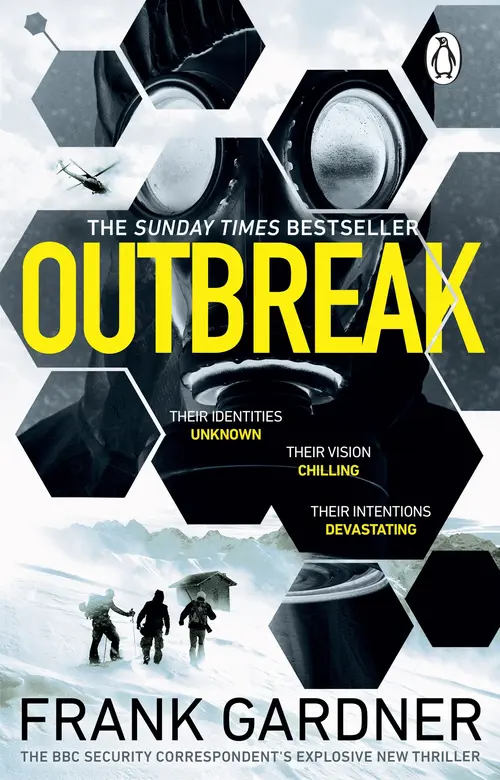
Outbreak
Cover

About the Author
Frank Gardner has been the BBC’s Security Correspondent since 2002. He holds a degree in Arabic and Islamic Studies. In 2004, while filming in Saudi Arabia, he was ambushed by terrorists, shot multiple times and left for dead. He survived and returned to active news reporting within a year. He still travels extensively. Awarded an OBE in 2005 for services to journalism, Frank published his bestselling memoir, Blood and Sand, in 2006. His first novel, Crisis, which introduced readers to SIS operative Luke Carlton, was a No. 1 bestseller. The second Luke Carlton thriller, Ultimatum, was also a Sunday Times top 10 bestseller, as was Outbreak. He lives in London.
You can follow him on Facebook and Twitter @FrankRGardner
Acclaim for Frank Gardner’s Luke Carlton thrillers
‘This is thriller writing of a high order … Gardner steadily ratchets up the tension, peppering the narrative with nuggets of expertise to make an enthralling, intelligent read’
FINANCIAL TIMES
‘Tackles what must now be most governments’ worst nightmare: the deliberate generation of a pandemic by bio-terrorists … packed with authentic detail, Outbreak is both horrifying and entertaining’
LITERARY REVIEW
‘Fast, taut, tense, accurate. A terrific read’
FREDERICK FORSYTH
‘Confirms Frank Gardner’s place among the pantheon of distinguished reporters who have become excellent thriller writers, including Gerald Seymour and Frederick Forsyth … utterly authentic’
DAILY MAIL
‘A terrific page-turner’
SUNDAY TIMES
‘Frank Gardner has written a fast and exciting story rooted in the present horrifying dangers that surround us … brimful of an insider’s insights and reeks of authority’
GERALD SEYMOUR
‘Current international events do not necessarily turn into exciting novels, but Gardner skilfully mixes knowledge garnered as the BBC’s security correspondent with breathless action’
THE TIMES
‘Terrifying and topical … Gardner’s style is addictive … [his] riveting plot really does illuminate both the past and today’s headlines. It would be a spoiler to reveal the shocking climax, but there is a hint of more to come’
ARTS DESK
‘Full of tomorrow’s headlines … a nerve-shredding thriller with an intimate knowledge of the world it portrays. This is intelligent, high-voltage storytelling of the very highest order’
TONY PARSONS
‘A gripping zeitgeisty thriller … an authentic feel … plenty of action … a proper page-turner’
NB magazine
‘Tells the story with a verve and expertise born of long experience of the subject … convincingly authentic. It is the thriller writer’s trick to blur the boundary between current affairs and invention, to make the unthinkable thinkable and exciting … Gardner succeeds triumphantly’
COUNTRY AND TOWN HOUSE
‘Gardner knows his subject – and it shows. A rattling good read’
JOHN HUMPHRYS
‘Combines insider knowledge with heart-in-mouth excitement’
i-NEWSPAPER
‘Compulsively readable’
RADIO TIMES
Also by Frank Gardner
FICTION
Crisis
Ultimatum
NON-FICTION
Blood and Sand
Far Horizons
The views and opinions expressed are those of the author alone and should not be taken to represent those of Her Majesty’s Government, MOD, HM Armed Forces or any government agency.
Dedication
To Lizzie.
Epigraph
Ingen kan tjene to mestere.
Nobody can serve two masters.
NORWEGIAN PROVERB
1
Svalbard, Norwegian Arctic, 78 degrees North
Monday, 7 March, 1520hrs GMT, 1620hrs local
BLINDINGLY WHITE AND bitterly cold, the landscape around them was utterly devoid of life. Bent half double and hunched against the wind, the three muffled figures trudged in single file through the winter afternoon, their snow goggles flecked with tiny crystals of ice. A thin blue nylon cord, tied around their waists, connected the last two to the one in front, their mittened hands steadying their balance as they placed one foot mechanically in front of the other. The blizzard had taken them by surprise. It had come barrelling down the valley, straight from the polar ice cap, eight hundred miles to the north, obliterating the weak yellow disc of the sun within seconds, then tearing and tugging at their thermal protective clothing. Caught out, far from their base camp at Ny-Ålesund, the three environmental scientists from the UK Arctic Research Station had been forced to abandon their field work for the day and make for the nearest shelter.
The hut was tiny, just a distant, solitary blot at the base of a rocky escarpment, its roof obscured beneath a layer of wind-driven snow. No coil of smoke rose from its chimney, no snowmobile lay parked up outside. It seemed no one was home.
‘Better not be locked!’ Chris Coppinger called to the pair behind him, as they tramped up to the door. But the wind stole his words and swept them away down the valley. Coppinger shrugged. Conversation would have to wait until they were inside. He adjusted the sling of the Mauser 30-06 rifle that hung from his shoulder – mandatory protection against the three thousand carnivorous polar bears that roamed the Svalbard archipelago – and pushed open the door.
The smell hit him the moment he stepped inside. At forty-two, with a PhD in atmospheric chemistry, Coppinger was more than familiar with any number of pollutants harmful to humans and plants. This was not a smell he recognized.
‘Bloody hell!’ he exclaimed. ‘This is rank. Something’s gone off in here.’ He moved to one side to make room for the others. They stood in the doorway, stamping the snow off their boots and peeling off their goggles and mittens, their eyes adjusting to the gloomy interior. Coppinger hunted through his pockets until he found a torch. In silence he swept the beam across the room methodically, like the scientist he was, from left to right. A stack of wood, an unlit stove, a metal bucket piled high with coal, a wooden chair, toppled over on to the floor. To its right, a large piece of furniture, an old sofa, covered with a blanket, and there was something on it in the corner, a shapeless amorphous mass. And then it moved.
Dr Sheila Mackenzie, the expedition medic, was the first of the three to react.
‘It’s alive!’ she exclaimed, as she snatched the torch and rushed across the cabin to investigate. She stopped just short of the sofa, nearly dropping the torch, as she clamped her hand over her mouth in horror. Lit by the stark white beam, a human figure lay propped against the back of the couch. The man’s face was hideously disfigured by livid pustules, some oozing yellow matter that trickled down his cheeks. Twin rivulets of dried blood ran from his nostrils past his lips and over his chin, smeared sideways where he had tried to wipe them away. He was wearing a thick woollen chequered shirt beneath a half-open down jacket. The shirt was caked with what looked like black bile, flecked crimson with splashes of half-dried blood. But her attention was focused on something else: the hideously swollen lymph glands just beneath his earlobes. On both sides of his head she could see them clearly in the torch beam and her medical training told her exactly what they were: buboes, a sign of severe infection.
And now this man’s lips were moving – he was trying to say something. Against her better judgement, Dr Mackenzie moved closer to catch his words. His voice was faint and weak, his eyes were closed, but she heard the word clearly. ‘Pamageetye.’ She turned to the others behind her for an explanation. ‘Pamageetye …’ she repeated slowly, for their benefit. ‘What does that mean? Anyone know? It doesn’t sound Norwegian.’
It happened so quickly after that, no one had time to react. As Dr Mackenzie turned back to face the sick man, without warning he arched his body forward off the back of the couch with surprising speed. His whole torso shook with involuntary convulsions. In that same moment, he coughed violently. His mouth wide open in a rictus gape, he emitted a spray of bile, blood and mucus into the air, his face less than two feet from hers, before collapsing, quivering, on to the wooden floor.
2
Herefordshire, England
Monday, 7 March, 1530hrs GMT
LUKE CARLTON HELD the slim cylindrical suppressor in his left hand and screwed it quickly and expertly on to the SIG Sauer P226 Mk25 pistol held in his right. Fifteen rounds in the magazine. That should cover him. His breathing measured and under control, he rose from a crouch and moved forward slowly, testing each footfall before he placed his full weight. Any noise, any sudden movement, could give away his position.
Ahead of him, less than twenty metres away now, he could see the door to the room. Would it be locked? And what if it was? Okay, sure, he could shoot out the lock, but then the element of surprise would be lost completely. Stealthily, he approached the door from the side, dropped once more to a crouch and reached up with his left hand. His gloved fingers closed around the chrome doorknob and he began to turn it. Covert single entries: always a heart-stopper. There was a soft click and he felt the catch slide out of place. He eased open the door, just wide enough to squeeze himself through the gap, then dashed through it, moving quickly to the side, minimizing the time he would be silhouetted in the space. Good. He hadn’t been seen.
Luke found himself at the end of a long corridor, exactly as the floor plan had shown. He knew where he was heading: third door on the left. It was slightly ajar and already he could hear shouts and thuds and screams – the sound of a brutal interrogation under way. He was just in time. Holding the weapon in front of him with both hands, he shouldered open the door, taking in the scene in front of him in a split second. The girl was sitting upright, her hands tied behind her, her arms and legs bound to the chair. Her interrogators were either side of her. Big, well-built men with rolled-up sleeves and black balaclavas. Luke didn’t hesitate. He shot the first in the head, then put two rounds into the chest of the other.
As both went down he dropped low, scanning the room for any other threats. There were none. He uncocked his weapon and holstered it, walking swiftly over to the girl on the chair. But she was already up and shaking off the ropes that had ‘bound’ her.
‘Sergeant Louise Kentish. I’m one of the instructors here,’ she told him. ‘Nice going, but you’ll need to be faster through the door next time. The second one might have dropped you.’ She walked over to a table and switched off the tape player that had been churning out the sounds of a mock interrogation. The lights were coming on now, illuminating the frighteningly realistic three-dimensional fibreglass dummy targets on springs that Luke had put down with the live fragmentation rounds fired from his SIG. They were inside the Bunker, the purpose-built underground SAS ‘Killing House’ at Pontrilas, just half a mile from the Welsh border and a short drive from the Regiment’s base outside Hereford. As one of a very small handful of serving case officers in the Secret Intelligence Service qualified in close-quarter combat and hostage rescue, Luke Carlton had just passed his annual certification test. Since joining the SIS he had been sent on more courses than he could remember, but this was one of the few mandatory tests he found himself actively looking forward to. It kept him on his toes and that was how he liked it.
‘Got time for a brew before you go?’ she asked casually, tidying away the last of the exercise’s rope coils and stuffing them into a burlap sack. The fact that any one of Luke’s shots, if aimed a few degrees to one side, would have ended her life did not seem to faze her in the slightest.
He looked at his watch and winced. ‘Christ, no, I’m out of time! I’m supposed to be at an opera in Covent Garden with the girlfriend this evening. Promised her I wouldn’t be late.’
The instructor shrugged and turned away with a smile. ‘Better not let her down, then, had you?’
3
Svalbard, Norwegian Arctic
Monday, 7 March, 1545hrs GMT, 1645hrs local
THE MOMENT DR Sheila Mackenzie felt the liquid droplets hit her unprotected face she knew she was in trouble. Long before the Covid-19 pandemic erupted around the globe she had known all about viral loads and the risks incurred by exposure to an infected person. Yet she didn’t panic, she didn’t cry out: she did exactly what her years of medical training had taught her. Calmly, and without a word, she bent down and searched inside her day sack until she found what she was looking for: a sealed packet of antibacterial wet wipes. In the grim world of infectious pathogens, she knew this was tantamount to trying to hold off an advancing army with an air rifle, but she had to go through the motions.
The pustules on the man’s face, the black bile, the caked blood down his chest, that and the swollen lymph nodes, told her this was no Coronavirus. It was something very different. She had no idea how long the incubation period would last before the horrendous infection struck. But unless she got medical attention, and fast, just one look at the slumped figure at her feet told her all too graphically exactly what the end state would be like.
She could hear one of the scientists behind her calling her name, but she ignored him. She was too busy painstakingly sweeping every last inch of her face with the antibacterial wipes. Blot and rub, just as she had been trained to do. Then, one by one, she dropped the contaminated tissues into a plastic bag and sealed it. She was so focused on her task she barely noticed that outside the wind had picked up and the storm was intensifying. She could hear her name being called above the rising din. ‘Sheila!’ The voice was ever more insistent. It was Chris Coppinger, still standing just inside the doorway, swirls of wind-driven snow circling around his boots. He was on his phone to the research station back at Ny-Ålesund. ‘Are you okay?’ he shouted inside the hut. ‘They want to talk to you.’ He held out his phone and started to move towards her but she put out a hand to stop him. He should have known better.
‘Social distancing, Chris!’ she rebuked him. ‘I’m infected. And, no, of course I’m not okay. What the hell does it look like? I’m contaminated now. It’s possible we all are. You can’t come near me and I definitely can’t touch your phone.’ He took a half-step inside the hut, just to catch her words, but no further.
‘Right. Of course,’ he said. ‘So what do I tell them?’ Even in the dim light from her torch she could see the fear in his eyes, which she felt just as intensely herself. But she wasn’t going to show it.
‘Tell them …’ she began, struggling to keep her voice even. ‘Tell them we have a suspected case of a dangerous pathogen. Symptoms resemble bubonic plague. One patient possibly in final stages. One, possibly three, presumed infected. We need a team here now in full PPE gear. Tell them that.’
Dr Sheila Mackenzie cast her eyes down at the slumped figure on the floor and swallowed involuntarily. Would this be her in a few days’ time? The hell it would, Sheila. Get a grip on yourself. This is not going to happen to you. You’re going to get the best possible medical intervention. So you need to stay calm and get through this.
She glanced across the darkened room at her colleague, still busy on the line to Ny-Ålesund, cupping his hand over the phone. The door of the hut was still open and flurries of snow were blowing in so she couldn’t catch everything he was saying. But from the way Coppinger was casting sideways glances at her she caught the gist of their conversation. ‘Standing right next to him … heavy dose … full in the face.’
She looked down at her feet and saw that the sick man had shifted his position slightly. He was still alive, but desperately ill. She did not rate his chances in these conditions.
It was only then that she realized someone was missing. The third member of their team, Victor Skeet, had simply disappeared.
‘Chris?’ She interrupted his phone call. ‘Where the hell has Skeet gone?’
4
Longyearbyen Hospital, Svalbard, Norway
Monday, 7 March, 1617hrs GMT, 1717hrs local
DR JAKOB PEDERSEN was on his tea break in the hospital canteen when the call came through from the Arctic Research Station, far away across the ice and snow in the early sub-zero night. Strictly speaking, it wasn’t tea he was drinking from the steaming mug in front of him. It was gløgg, a non-alcoholic version of the mulled wine that warmed him on these endlessly long winter nights here on Svalbard. He took a brief sip from his personal mug, emblazoned with his favourite motto that read: ‘Null stress’ – Norway’s version of ‘No worries’ – and answered the call.
Pedersen was a famously placid man. His craggy, weather-beaten features rarely betrayed any emotion. But ten seconds into the call, that changed. He hurriedly pushed away the mug to reach for a writing pad and pen. In his twenty-seven years as the resident doctor in Svalbard’s main hospital, he had never heard of anything like this before. Broken limbs from a snowmobile accident? Sure. A twisted ankle when someone had slipped on the ice? Frequently. He had even, very occasionally, had to attend to some horrific wounds caused by a marauding polar bear. But this? This was unprecedented. When the world had first gone into lockdown with Coronavirus in the early months of 2020, Svalbard had simply shut its doors to international visitors and not registered a single death. But Dr Jakob Pedersen was far from complacent. He knew immediately that this was more, far more, than anything his remote provincial hospital would be able to cope with.
‘A helicopter? Now? At this time?’ He was already shaking his head, although there was no one in the room to see it. One glance at the window told him the storm outside had not abated. If anything it was getting worse. He could hear the wind howling from halfway across the canteen and could just make out the snow piling up in the corners of the window frame.
‘It’s completely out of the question,’ Pedersen told the voice at the other end. ‘Nobody can fly in this. Not without permission from the Sysselmann – the governor – and I can tell you, he is not going to give it. Besides, there is the obvious risk of infection. Surely you can see that. No, I have to follow protocol here.’
Pedersen frowned as he listened to the response. Then his face softened slightly.
‘Yes, yes, I realize she could die if it turns out to be what you say it is. But moving her here? To my hospital in Longyearbyen? Don’t you see? That could start an epidemic! … Tromsø? On the mainland? … The University Hospital? That’s nearly a thousand kilometres away! … Yes, yes, I hear you, but it carries the same risk – the risk of an outbreak. And I will not be responsible for that!’
He paused as a particularly strong gust of wind shook the windowpane, then resumed the conversation. ‘Listen, my friend. I will tell you exactly what is going to happen now. I am going to alert the Norwegian Department of Health in Oslo immediately and I will ask them to activate an infectious disease protocol …
‘What does that mean?’ Pedersen sighed, repeating the other man’s question back to him. ‘It means help is coming, my friend. They have an EMT – an emergency medical team – on permanent standby for just such an eventuality. But I must insist that until then the patients – yes, because that is what they are now – I must insist that nobody goes near them, do you hear me? No one is to be moved or, God help us, this thing will spread out of control.’
5
Covent Garden, London
Monday, 7 March, 2010hrs GMT
LUKE CARLTON WAS bored to tears. He had nothing against opera per se, but this? No, this Wagner stuff was definitely not for him. He shifted restlessly in his seat and rubbed his eyes with the tips of his fingers. Twelve years in the Royal Marines, the last four spent with Special Forces in the SBS, and now a fully fledged case officer in the Secret Intelligence Service, running covert MI6 agents into dark and dangerous places. And what was he doing this evening? Watching some bearded bloke in a frilly shirt belt out a load of incomprehensible German onstage while the orchestra crashed and thumped in his ears. Just kill me now, he thought.
He sneaked a glance at his watch and slumped inwardly. Christ, they were barely forty minutes into Act One and there were another two to come, plus intervals. What had possessed him to say yes to this evening? He looked over at the girl next to him and there, sitting poised and elegant, was his answer. Elise Mayhew, twenty-nine years old, art dealer in Mayfair and his girlfriend of more than three years.
The Story Continues on BooksBarbecue!
Enjoyed this preview? ❤️ Do not stop here!
Read the complete book free online → 🔗
Continue reading now on BooksBarbecue and discover every page!
Love reading? Bookmark BooksBarbecue.com for more amazing books!
Happy Reading!