Our Castle by the Sea
Cover
A MESSAGE FROM CHICKEN HOUSE
In this thrilling wartime novel, a family lives in a lighthouse on the English coast, surrounded by the threat of invasion. Hidden truths, twists and revelations kept me gripped and guessing all the way through – but eventually our heroes have to face up to what seems like an impossible choice: family or country? (Which would you choose?) But there’s more. Mystical forces are at work, guiding their destinies . . . This is a world of fate, family, myth and adventure – are you brave enough to enter?
BARRY CUNNINGHAM
Publisher
Chicken House
Title Page
For our path in life . . . is stony and
rugged now, and it rests with us to
smooth it. We must fight our way
onward. We must be brave.
Charles Dickens, David Copperfield
For James
and for Freddie – our little miracle
Prologue
I was very small indeed when Pa first told us the legend of the Wyrm and the Stones. It was Hallowe’en and he took us out to the standing stones on the clifftop to play snapdragon and tell ghost stories. This was my big sister Magda’s idea, and we were almost out of our minds with excitement when Pa agreed. I carried the bowl of brandy-soaked raisins very carefully from the cottage, while Pa lit the way ahead with a lantern. Mags galloped giddily behind, drunk on the night air and fizzing with delight at being allowed out after dark. It was probably not long past supper time, but I felt that it must be midnight at least – the witching hour. The darkness danced with spectres.
We wrapped ourselves up in blankets and huddled together on the clifftop, the four standing stones looming around us. Pa lit the brandy in the snapdragon bowl and the flames flickered dangerously, casting shadows on our faces. I had never played the game before. My father and sister started swaying backwards and forwards, grinning and chanting together: ‘Snip! Snap! Dragon!’ They pinched the burning raisins from the flames. I did not recognize these strange, chanting, nightmarish creatures. I was half-afraid of them. I caught the rhythm of their words and joined in the game, pinching at the weird blue flames and gobbling up the burning-hot raisins.
With his blue and lapping tongue
Many of you will be stung!
Snip! Snap! Dragon!
After the game, when the flames had dwindled and our faces were lit only by the lantern, Pa told us the story of the standing stones.
‘Long, long ago,’ he said, his face suddenly serious and skull-like in the lamplight, ‘a thick fog settled on this coast. It was very bad for the fishermen and their families, as they could not fish while the fog lingered, but it was even worse for the families of those aboard the Aurora. The Aurora had set out on the morning before the fog came, and she had still not returned.
‘There were four men aboard the Aurora and each of these men had a daughter. Each evening the girls climbed the path from the harbour hand in hand, making their way up to this very clifftop to light the signal fire, and they kept the fire burning all through the long, cold nights. They hoped that, if the Aurora was still afloat, if she was lost somewhere in the fog, the bright flames would help to lead the little boat home. By the fourth evening, everyone else in the village had given up. They said the Aurora must have been swallowed by the Wyrm – the treacherous sandbank that lurked in the shadow of the towering cliffs. The Wyrm had wrecked many hundreds of ships over the centuries, and it was hungry for another sacrifice.
‘But the girls had one last hope. That night, as usual, they wound their way up the cliff path hand in hand. As usual, they lit the fire, and tended it, and they sat and watched and waited for their fathers to return, but on this night they did not make their way home again.
‘Here in the dark, on this very spot where we are sitting now, the girls sang a special song to the sea. They sang the sweetest, saddest song that has ever been heard. It was a song of love and loyalty and sacrifice, promising the greatest of gifts if only the Aurora were returned safely to the harbour. They sat and sang, and as they sang, they saw the fog begin to disperse. They kept singing and singing.
‘Soon it was dawn and the girls stood up together, holding hands as the darkness dissolved and the new sun started to rise over the sea. Their white dresses billowed like sails in the first breeze that had blessed the shores in four long days and nights. A ghostly little boat seemed to bob up from the grey waves, and the girls knew it was the Aurora. They kept singing – but singing with joy now as they watched the fishing boat sail towards the harbour below.
‘The Wyrm squirmed beneath the surface of the water. It had returned the Aurora, but now it felt angry and cheated and hungry. So it took the great sacrifice the girls had promised: it took their souls. Tentacles of mist reached up from the sea, creeping over the edge of the cliff and into their hearts. As the sun rose over the glittering water, the four daughters turned to stone.’
I shivered horribly. I felt all icy and strange. I looked at Mags and she was frozen, her mouth hanging open. For a moment, I thought perhaps she had been turned to stone too, but then she blinked and swallowed. Pa was still talking, though his voice was very, very soft now – just a whisper.
‘People say that the Daughters of Stone stand here on our clifftop as a warning to those who sail these dangerous waters. If you close your eyes and listen very carefully, you might just be able to hear their sad, sweet, ghostly song . . .’
A sea mist must have risen as Pa was telling the story; tendrils of it seemed to be creeping across the cliff. I was aware of the four stones surrounding us, watching us. I could almost hear them breathing. My heart was thudding in my throat now. I heard a whispered song, as soft as the hiss of sea foam over pebbles, the swish of a sea breeze through a long white dress.
For my father and sister, the legend of the Wyrm and the Stones was just that – a legend, distant through the mists of centuries. But for me it was different. From the moment I first heard the story, I knew it was much, much more. I knew it in the chill of my bone marrow and the crawling of my skin. I knew that the ancient magic of our cliffs was real and that I was destined – somehow – to become part of the legend too.
Part One: Autumn 1939
Chapter 1
1
On the very first day of the war, Mags came home with a split lip. Her eye socket was swollen too and promised to ripen into a large, plum-coloured bruise. Her knuckles were red and grazed.
‘What happened, Mags?’ I gasped. ‘Was it one of the girls at school?’ But my sister ignored me, storming down the footpath and into the cottage through the kitchen door.
Mags is a fiery sort of person. Living with her is a bit like living with a half-tamed tornado, but for all her fierce temper she had never been in a proper fight before. Mutti made her sit down at the kitchen table. She gently bathed my sister’s eye, lip and knuckles with warm water and witch hazel.
I hovered just inside the door, watching.
‘Tell me who did this, please, Magda,’ my mother said.
‘It doesn’t really matter who did it,’ Mags muttered. ‘It could have been any of them. They were all saying the same thing.’
‘What? What were they saying?’
But Mags just drew in a long, shaky breath and would say nothing.
I could see Mutti’s eyes were brimming with tears. She blinked them back, wiped her hands on her apron and then got on with preparing dinner. She pushed her hair from her face with her forearm and quickly chopped an onion. I wondered if she really needed to chop an onion for dinner, or if she just wanted to have something to blame her tears on.
Pa took Mags outside into the darkening garden and I followed a little way behind. I picked up the watering can and made myself look busy tending the vegetables.
Mags and Pa stood near the fence at the bottom of the garden, talking quietly – or rather, Pa was talking quietly and Mags was just staring at the ground with her arms folded across her chest. She kicked at the grass with the toe of one shoe. After a while I heard her say, ‘You didn’t hear them, Pa. You didn’t hear what they said about Mutti.’
There’s something I should mention about my family and, specifically, about Mutti – why we call her Mutti and not Mum or Mother. Mutti was born in Germany and grew up there. German is her first language, and she’s taught it to us too. Mutter is German for ‘mother’. The fact that our Mutti had been born in Germany was never important to us – it was just normal, as normal to us as living in a lighthouse – but now that the war had started, other people seemed to think it was very important indeed.
Mutti called us all in to dinner, and we sat around the kitchen table in silence. Mags touched the corner of her lip and inspected her finger to see if it was still bleeding. It wasn’t like a normal dinner time. There was something else at the table with us – something tense and waiting, like a gun that had been cocked but not yet fired – the fizzing gunpowder trail of the conversation Pa and Mags had started but not finished.
My sister had a library book in her lap – Essential Motor Boat Maintenance – but her eyes didn’t seem to be focusing on the pages as she turned them over.
Pa moved his chair closer to Mags and leant towards her a little. She pretended to be interested in a diagram of a propeller. Mutti and I pretended to be interested in our dinner. Mags frowned down at her book, refusing to look at Pa.
‘You’re too old for playground scraps, Magda,’ he said. ‘You’re nearly sixteen now.’ Then he sighed, and when he spoke again his voice was softer. ‘Try to let it go, Mags,’ he said. ‘Next time they start saying things like that, just try to let it go.’
Mags said nothing.
‘You have a choice,’ he went on. ‘You don’t have to react.’
‘You’re right, Pa,’ Mags said at last, closing her book and turning to look him dead in the eye. ‘I have a choice.’
And the conversation was over.
After dinner, Mags shut herself in our bedroom. She wanted to be by herself, so I took my sketchbook up to the lantern room. Perhaps I’ll draw the sunset, I thought. There were some wonderfully dramatic clouds that evening – dark and jagged against the red sky.
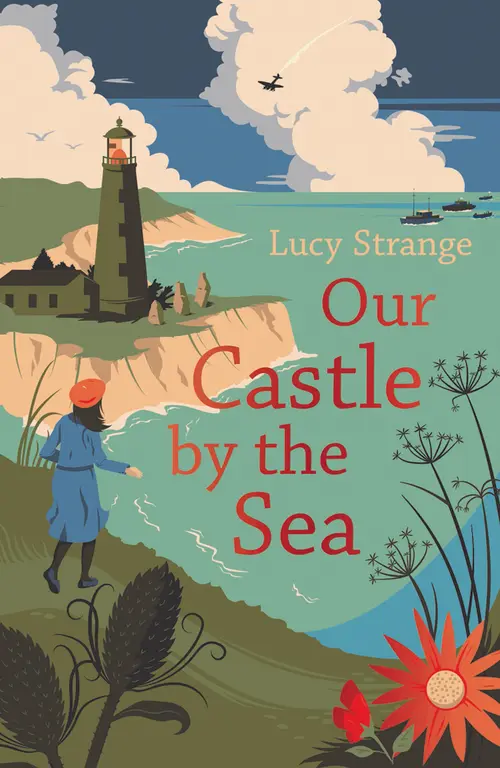
You can see the Daughters of Stone from the top of our lighthouse. In fact, it feels as if you can see the whole world from up here. On a clear day the outline of the French coast is just visible on the other side of the broad, yawning Channel. The harbour is down there to the right, and our village, Stonegate, is tucked away just behind it, in the lee of the cliffs. When the tide is out you can just see Dragon Bay – that long, thin, sandy beach below the chalky south cliff that runs most of the way from here to Dover. If you turn and look the other way, the English farmland stretches out in an enormous patchwork of green and gold – hundreds of oddly-shaped fields all stitched together with hedgerows and dark woodland. Little groups of houses cluster around church spires, clinging to the roads that thread between the fields.
Because there are windows all the way around the lantern room, you can keep turning and turning, and soon the sea and fields, sea and fields, sea and fields become a blue-green blur and you have to sit down.
If you go through the door and out on to the walkway, and if you are brave enough to look down, you will see the standing stones beneath you. The wind out there is nearly always fierce and blustering, even in the summer. The four stones wrap around the seaward side of the lighthouse, like part of an enormous clock face, half-buried in the turf of the clifftop. I think the stones are the main reason that our lighthouse has always been known as the Castle. From a distance, the Daughters of Stone seem to be buttresses or guard towers, or even stony sentinels, facing out towards the sea and the storms, watching for enemies.
I had always liked the fact that there were four standing stones, just like the four of us – Mutti and Pa, Mags and me. The symmetry pleased me – each of us had our own stone. The smallest one was mine – furthest to the left, pointed at the top like a diamond. When we were little, Mags and I would pretend the stones were mountains to climb, or islands in a sea churning with predators – and we would use ropes and rocks and bits of wood to get from one stone to the next without getting our legs bitten off. I remember Mags brandishing a toy sword, using it to slash at the slimy tentacles that had twisted around me and were dragging me down into the inky, blood-black depths of the ocean . . . Pa told us to be careful. He said the stones were megaliths – they were thousands of years old, and if we wanted them to last another thousand years, we probably shouldn’t be scrabbling about all over them.
Pa said people who were experts on megaliths had all sorts of theories about the stones – ideas to do with druids and rituals and the summer solstice. They believed the stones must have come from another part of England altogether, or maybe even France; they aren’t local rock, as our cliffs are chalky and these stones glitter with granite.
I’ve dozed in the long grass between the stones on many a summer’s afternoon. I’ve lain there for hours, listening to the lullaby of the sea and watching the slowly dimming sky. Mags doesn’t believe me, but I’ve heard them singing – on those still, dark dawns when the sun struggles to rise through the fret or the fog. It’s a strange, distant ghost-song, high and resonant, like four different tuning forks buzzing their soft notes from deep within the rock. It feels as if they are singing only to me.
Sometimes I speak to the stones – a sort of whispered, pagan prayer. I remember doing that on the evening of Magda’s fight. As I drew their four, rain-rounded shapes and the dark daggers of cloud that hung above them, I asked the stones to protect my Mutti and my Pa, and my stupid, surly sister.
I have always believed that the Daughters somehow guarded our Castle, and in a way I think they do, but I know now that it is much more complicated than that. This sort of old magic is not loyal to anyone or anything. It has its own laws. It is as cold and unknowable as an ancient god.
Chapter 2
2
It was just a few days after Magda’s fight that Pa received a very strange order from the government. We had to paint the Castle green.
We all painted it together. Pots of green paint shot up and down on pulleys and I was allowed to use the stepladder to paint the downstairs windowsills. It was much better than whitewashing, because if we splashed paint on the grass, it didn’t matter so much – you could hardly see it. Mags painted the very top of the lighthouse – the round roof. She scaled the highest part of the tower with a rope, just like a mountain climber, her paintbrush tucked in a back pocket. It took the four of us three whole days to paint it, and the closer it was to being finished, the more peculiar it looked. I couldn’t get used to the greeny-brown paint at all – it just looked completely the wrong colour for a lighthouse.
‘It’s camouflage,’ Pa said. ‘To make us harder to spot from the air. We don’t want the lighthouse to be bombed, do we?’
No.We didn’t.
There has been a lighthouse above Stonegate for centuries – to warn ships of the dangerous sandbank in the sea beyond the cliffs, and to guide them safely past the Wyrm to the harbour below. Its light has come from all sorts of different things, from oil lamps to braziers and coal fires. It hasn’t always looked the same, of course, but I was pretty sure that it had never been painted green before. The lighthouse has been destroyed many times. It has been hit by hurricanes, struck by lightning and burnt down by fire, but it has always risen again – a phoenix from the storm-blown flames.
I love our lighthouse, and I couldn’t imagine living anywhere else, but I know that other people often find it odd. They might imagine, perhaps, that all the furniture has to be round in order to fit inside, or that we sleep in hammocks hung from the spiral staircase, and spend our days climbing ladders and polishing glass. Actually, there is a fair bit of glass-polishing that has to be done, but we have never slept in hammocks: we sleep in normal beds in the cottage at the foot of the lighthouse. The cottage is just like any other cottage really, like any other home. And we are just like any other family. At least, we were just like any other family, before the war began. Now, if I think back to that sunny autumn day when we finished painting the lighthouse, I can see that the tide had already begun to turn.
It was beautifully warm for September, and Mags and I lay next to each other in the long grass between the standing stones.
‘Looks odd, doesn’t it?’ Mags said. ‘Now that it’s green.’
‘It looks weird,’ I agreed.
I loved our strong, white tower – brilliant and proud against a clear blue sky. It looked so different now that it was the same sort of earthy colour as the fields that surrounded us. It looked as if it had sprouted up from the ground itself.
‘It looks like a goblin castle,’ I said.
Mags laughed. ‘Or an ogre’s folly.’
‘Or a troll’s tower.’
My sister plucked a daisy and threw it at my face. I laughed too and closed my eyes. My muscles were achy from painting, and the grass was warm and dry and pleasantly scratchy beneath me.
‘It makes sense, though, doesn’t it?’ Mags said in a more serious voice. ‘Hitler’s bombers won’t be able to spot us as easily now. Pa said there is a risk that landmarks like lighthouses could be used by German planes for navigation.’
‘Mmmm.’ I started to feel very sleepy. I listened to the gulls calling to each other as they wheeled over the waves. The sea air up on the cliffs was soft, sun-warmed and seaweedy – completely different from the cold-salt smell of the sea in winter. I thought dreamily that the people in Germany were breathing the same gentle air as us, and I wondered if there was a little German girl, lying in the grass somewhere, thinking about me. I stuck my hands up in the air and squinted at them, spreading my fingers out and examining the splashes of green paint on my skin.
Then I heard the engines.
A weird thing happens to me when I am frightened. I freeze. Like a startled rabbit. My whole body stiffens and I can’t move at all. People use the word ‘petrified’ to describe feeling afraid, but it really means much more than that – it means being so terrified that you cannot move a muscle; it means being turned to stone.
I lay there, rigid, breathing very quickly, while the noise of the aeroplane came closer and closer.
‘Pa!’ Mags shouted.
Everything darkened around me.
Chapter 3
3
There were footsteps then, pounding footsteps. Pa was pelting across the garden, and he had picked me up and flung me over his shoulder before I knew what was happening. He ran back to the cottage with Mags at his side, and I went bump, bump, bump, dangling upside down and watching the jolting colours of the sky behind us. ‘All right, Pet?’ Pa called. My family often called me Pet – a silly, shortened version of my name, Petra. ‘Pet’ was affectionate, I knew, but it always made me feel small – like a toy dog on a lead, or a mouse in a cage. I felt pathetic as I hung there, bouncing around like a sack of potatoes on my father’s back.
The engines buzzed louder and louder in the sky above, until it felt as if the whole world were burning with noise. Mutti was waiting for us at the door of the cottage. From upside down, she looked quite normal, but when I was turned the right way up, I could see how scared she was. Pa was calmer; his face was like a slab of stone. ‘It’s the first,’ he said. ‘It’s just the first, and it probably won’t be the last. Reconnaissance, I expect,’ he said. That meant they were enemy planes coming over to gather information.
Pa said we had to go down to the coal cellar. We were to come here whenever we heard low-flying aeroplanes or caught the sound of the air-raid siren drifting up from Stonegate harbour below. Mags said that she thought most of the planes would probably be ours. By ‘ours’ she meant British planes.
The Story Continues on BooksBarbecue!
Enjoyed this preview? ❤️ Do not stop here!
Read the complete book free online → 🔗
Continue reading now on BooksBarbecue and discover every page!
Love reading? Bookmark BooksBarbecue.com for more amazing books!
Happy Reading!