Operation Trojan Horse
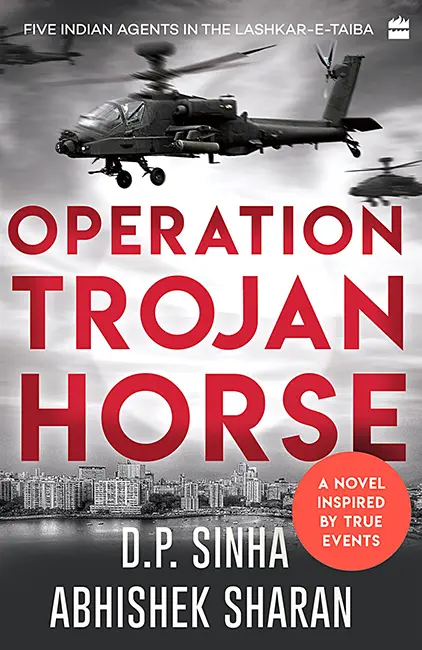
Cover
Title Page
Dedication
To the brave Indian intelligence operatives engaged in battling terror. They remain faceless and nameless despite their priceless sacrifices for the country.
– D.P. Sinha
To India’s ‘Trojan Horses’, who are its silent warriors, and all the families who have lost their loved ones to terror.
– Abhishek Sharan
Authors’ Note
AUTHORS’ NOTE
The Soviet Union ‘Red Army’ withdrew from Afghanistan, the country it had occupied for ten years, by February 1989, stumping the world. The historical retreat did not ensure peace and stability in Afghanistan, however. Instead, the country became embroiled in ceaseless hostilities between the communist government forces of President Mohammad Najibullah Ahmadzai and mujahidee groups in their efforts to control Kabul. It virtually signalled the beginning of a long and enduring national security nightmare for India.
Concluded on 14 April 1988, the Geneva Accords had been signed by the representatives of the Soviet Union, the United States, Pakistan and the Republic of Afghanistan. The agreements were ostensibly meant to provide a framework for the withdrawal of the Red Army and a multilateral understanding among the signatories regarding the future of international engagement in the war-torn country. The Pakistani army and its intelligence agency, the Inter-Services Intelligence Directorate (ISI), meanwhile were left stranded by the sudden departure of the Soviet forces from Afghanistan. The ISI had stockpiles of weapons, explosives and battle-hardened mujahideens of different countries. The training infrastructure for the newly inducted mujahideens was also intact. The ISI decided to divert this against India – for creating mayhem in Jammu and Kashmir and, later, in the soft belly of the country – from 1989 onwards.
In its campaign to bleed India with terror, the ISI began using the Lashkar-e-Taiba (LeT) as its principal battering arm. The LeT was set up in 1987 by Hafiz Saeed and had the blessings of the Pakistani establishment in its terror campaigns against India from the very beginning. The LeT has conducted a spate of terror attacks in India, including the 26/11 Mumbai attacks that killed 166 people. Tackling the LeT’s game plan to seek to pulverize India with mindless suicide attacks and blasts from 1989 onwards has presented a stiff challenge to the Indian security and intelligence agencies. The task of thwarting terror is not an easy one. It’s a 24x7 mission. After its attempt to kill British Prime Minister Margaret Thatcher failed in 1984, the terror group Irish Republican Army had said, ‘You have to be lucky all the time. We only have to be lucky once.’
Pakistan’s hostility is ingrained in its approach towards India and is part of its strategic template. Back in the 1960s and 1970s, Pakistani leader Zulfikar Ali Bhutto had vowed to ‘bleed India with a thousand cuts’. He had earlier also announced a ‘thousand-year war’ against India while addressing the United Nations Security Council in 1965. His dangerous, negative policy was continued by his wily and ruthless successor, General Zia ul Haq. From then on, sub-conventional warfare and the use of terrorism as a strategic tool to achieve its objectives against India became a norm in Pakistan.
During my long innings in the Indian Police Service (IPS), I had the opportunity of serving the country’s premier intelligence agency and getting involved in security and counter-terrorist operations. Terror has no nationality, colour, creed or religion; the human race is its victim. Terror kills and maims the innocent and the unarmed who never expect to be its victims.
I had one mission during my long service career: to do my best to save civilian lives from violent and life-threatening terror attacks. That mission drove me, inspired me.
Operation Trojan Horse is the story of a handful of counter- terrorist operatives engaged in India’s fight against Pakistan-backed terror. I dedicate the book to the brave, faceless and nameless Indian intelligence operatives who are engaged in battling terror. They cannot be identified due to national security and attendant constraints despite their priceless sacrifices for the country.
During my active service career, I hardly had the time to analyse and reflect upon the counter-terrorist operations I was part of. Even during my post-retirement assignment, when I held the statutory position of Central Information Commissioner, it was difficult to spare time and pen down my thoughts. I am really thankful to my co-author, Abhishek Sharan, for putting together my experiences in the form of a nail-biting work of fiction. For obvious reasons, actual incidents cannot be put in the public domain. With his imagination and creativity, Abhishek has been able to create and convey a sense of what could have actually happened on the ground.
Discussions with my wife, Rashmi, son, Dhawal, and daughter-in-law, Sonal, helped me focus on this endeavour and I am thankful for their encouragement. My daughter, Saloni, particularly, was a patient reader of multiple drafts and gave insightful feedback. I am also thankful to my brothers – Ujjwal, Alok and Dr Amit – for their support and enthusiasm. My late parents, Swayam Prakash Sinha and Usha Rani, have been a great influence on my life. Their guidance, teachings and strong value system played a huge part in shaping me. I would not have reached this stage of my life and career without their constant support and faith. My late mother had a photographic memory, a fraction of which I have inherited from her. She taught me to use this attribute at the opportune time and place for maximum impact.
In the end, I want to quote Abraham Lincoln, who said, ‘Without the assistance of that divine being, I cannot succeed. With that assistance I cannot fail.’
D.P. Sinha
New Delhi, July 2021

Who is a terrorist? Is a terrorist alone in his conscious insanity or is he the product of a process? Does a terrorist want a lot of people dead or a lot of people watching? These questions on terrorism, which is a major threat to humanity, have no easy answers.
During his stint as the UN Secretary-General (1997–2006), Kofi Annan had tried in vain to build consensus among countries about what constitutes terrorism to facilitate greater cooperation across issues, including deportation/extradition and the freezing of assets of suspects. In the 1980s, when two American academicians sought responses related to the attributes of terrorism from scholars, the exercise threw up as many as twenty-two key components.
Yet, there exists some unanimity around a broad set of ingredients that define terrorism: the use of unauthorized, deliberate, wanton violence against non-combatants and civilians for political ends. Terrorism’s raison d’etre is to instil fear in the public, and this deadly challenge must be addressed holistically, according to experts. Terrorists want a lot of people watching and a lot of people listening and not a lot of people dead, according to terrorism expert Brian Jenkins.
Academicians also appear to agree upon a set of factors that contribute towards making a terrorist. These include the existence of perceived or alleged grievances that makes one receptive to new ideas or values, a body of ideology to make sense of the discontent and to propel it towards a certain direction, and the idea of being part of a group, according to academician Peter Neumann. According to psychologist-academician Professor Fathali Moghaddam, the final stage in making a terrorist involves the side-stepping of the in-built inhibitory mechanisms against acts such as the killing of another human being.
As a political phenomenon, terrorism emerged in the late eighteenth century. The term ‘Reign of Terror’ came to be associated with Robespierre, one of the key actors of the 1789 French Revolution, when he began targeting ‘counter-revolutionaries’ in the 1790s. Later, the term ‘terrorism’ came to be associated with Europe’s anti-monarchist forces, nihilists, anti-colonial nationalist forces, left-wing radicals, then right-wing vigilantes. The year 1979, when Russia occupied Afghanistan, marked the emergence of a strand of terrorism that was allegedly state-sponsored and made faith-based claims.
The world has suffered two of the most dastardly terror attacks in this century. One is known as the 9/11 attack of 2001 that killed around 3,000 people. It took place in the United States and was orchestrated by the Al-Qaeda.
The other tragedy is the 26/11 Mumbai attacks executed by Pakistani terror outfit Lashkar-e-Taiba, which killed 166 people in 2008. The LeT is accused of carrying out a spate of attacks across India – to wear India down as part of its strategy of attrition. LeT lures gullible youth for ‘just war’ in the name of dubious propaganda and ‘propaganda of the deed’. It was set up in 1987 by Hafiz Saeed with the stated aim of attaining a theocratic, universal state through ‘preaching’ and ‘armed struggle’. Its armed cadre got their first taste of combat in Kunar, Afghanistan, as part of the armed struggle against the Soviet Union. Over the years, it has acquired the reputation of being the alleged irregular special forces unit of Pakistani intelligence.
During my two-decade career as a crime reporter, I have seen – and felt – the ruinous impact of terror attacks. I cannot erase from my memory the sight of mangled body parts lying among charred metal pieces at blast sites. When I learn about a terror attack in any part of the world, the voice of a young mother, whom I met eighteen years ago, still reverberates in my ears. I can hear the desperation and the helplessness in her words. She had lost her husband, a cab driver, in the twin blasts that rocked Mumbai in 2003. But she could not afford the luxury to grieve as she had to make sure her young school-going children survived the trauma of losing their loving father. Her husband had had dreams of making them doctors or lawyers, and paying their school fees demanded her immediate attention.
Operation Trojan Horse is the story of India’s fight against Pakistan-sponsored terror in the country. The Indian response is proactive and precise. The book is a work of fiction inspired by instances of supreme courage and sacrifice exhibited by a few young men who became part of secret projects like ‘Operation Trojan Horse’, choosing national service over lucrative careers to blunt terror. These men must remain nameless in the face of their invaluable sacrifice. The ‘Trojan Horse’ was a hollow wooden horse crafted by the Greeks to conceal themselves in and deceptively enter the city of Troy during the Trojan War.
Mr D.P. Sinha has been an exemplary, upright police officer and has an acclaimed record in counter-terror/intelligence operations. I am grateful to him for having faith in me and collaborating with me to bring out this reality-based fiction based on the world of shadows. Working with two brilliant editors, Siddhesh Inamdar and Shreya Dhawan, has been an absolute pleasure. They have enriched the book with their editing. I thank Siddhesh for believing in the book’s premise from Day 1 and working towards being on the same page thereafter.
This book would not have been possible without the support of my family. I thank my wife, Neha, who is my fellow traveller in life, and our children, for bearing with my long hours at the laptop with a smile. I want to express my gratitude towards my late father, lawyer Tripurari Sharan Tatarvai, and my late grandfather, freedom fighter Krishna Chandra Prasad, who introduced me to the world of words, and my Ma, for their blessings and teachings. I am thankful to my niece, Aditi, for diligently proofreading the first draft and appreciating and criticizing it in equal measure. I thank my siblings, Jaya and Amit, and niece, Akansha, for their suggestions. I am grateful to all my contacts and friends in the police/security services from whom I have learned, and continue to learn, about crime and its ecosystem.
Abhishek Sharan
Mumbai, July 2021
1. ‘IF ANYONE MOVES, FIRE MAARO’
1
‘IF ANYONE MOVES, FIRE MAARO’
A sleek black mobile phone vibrated, a green light flickering in its top left corner. This was the third time the phone had buzzed in less than a minute. It glided a little to the left, then returned to its original position on top of a dark-brown coffee table made of sheesham wood. The table occupied the centre of the living room – a large space with white walls and black doors – in police officer Shekhar Singh’s official residence in New Delhi’s Lutyens’ zone. It was 9.54 p.m. on 26 November 2008.
Shekhar had returned home after a long thirteen-hour workday just a while earlier. He got out of his car, a white Honda City, at the gate, which faced a lush green park. His walk to the front door was slow, one step at a time.
Shekhar rang the bell and was happy to see Anjali, his wife, when she opened the door. She was a professor in the English department at a well-known city college. Shekhar, forty-five, was of a dark complexion and six feet tall with a wiry frame.
‘You seem tired. Was it another stormy day in the office?’ Anjali asked. ‘I have heated up water in the bathroom. You can have a hot shower, which will wash away the exhaustion. I’ll get dinner ready for both of us.’
‘Thanks, Anjali. Yes, it was a really hectic day at work. I had to do a lot of damage control as a project was in nosedive,’ Shekhar said.
‘You, of course, only talk in code, if at all. Only one of us gets that code and that’s not me,’ Anjali laughed.
Shekhar laughed too, patted Anjali on the cheek and headed to the washroom.
Two minutes later, though, he rushed out, a towel wrapped around his waist. Anjali had knocked on the door to inform him that his colleague, Vinay Rathod, an assistant secretary, had been calling continuously to speak to him.
Shekhar and Rathod were both senior officers working in India’s premier domestic spy agency, the Counter-terrorism and Intelligence Cell – CTIC, informally referred to as CTC. The CTC was tasked with internal security, intelligence gathering and counter-terror functions. Shekhar, a joint secretary, was number two in the CTC’s Operations Group hierarchy.
In his twenty years at the CTC, he had supervised the busting of several terrorist cells, most of which were controlled by Pakistan-based terror organizations such as the Lashkar-e-Taiba (LeT), the Jaish-e-Mohammed (JeM), its predecessor Harkat-ul-Mujahideen (HuM), and Pakistan’s external spy agency, the Inter-Services Intelligence (ISI). In the eyes of his peers and seniors, Shekhar had a knack for conducting challenging, audacious ‘operations’. He took good care of his sources, whether human (informants and agents) or technical (gadgets and machinery). He was a no-nonsense boss, a tough task master, but stood up for his team.
Shekhar checked his phone and found that Rathod had called twice earlier as well. Three calls in less than sixty seconds. Why? What calamity had occurred and where? He braced himself for bad news as he dialled Rathod back. He was keen to find out what had transpired so that it could be dealt with effectively.
‘Yes, Rathod, what is it? Is there anything urgent?’ he said calmly, but unable to conceal the weariness in his voice. ‘I was freshening up. I just got home actually.’
Rathod was apologetic but brisk. ‘I’m really sorry, sir. But there are reports of firing happening in different parts of Mumbai, mostly south Mumbai. We don’t know yet who is firing, at whom and why. This has been going on for the last twenty minutes or so. Mumbai Police is scrambling for a response. The police control room is in a state of chaos, busy dealing with the crisis unfolding.’
‘Firing in Mumbai?’ Shekhar said. ‘This sounds like a typical mafia operation, but … there is hardly any underworld there. Who is firing then and at whom? What is the police control room saying about the identities of the gunmen? How many casualties are there?’
‘Sir, shots, suspected to be from AK-47 automatics, were reported to have been fired in high-profile landmark places that attract well-heeled locals and foreigners and at public establishments that attract a huge number of people. So far, shots have been fired at the Leopold Café at Colaba Causeway, the Taj hotel, the Chhatrapati Shivaji Terminus, and the Cama and Albless Hospital near St Xavier’s College in Dhobi Talao.’
‘That’s strange,’ Shekhar said. ‘These aren’t standard mafia attacks. The mafia is driven by money, and no money is to be made by killing random civilians. From the way they are carrying out their attacks and the type of weapons they are using, these gunmen seem to be trained operatives, with skills to act in an urban milieu with substantial police presence, like in the case of Mumbai. They could be terrorists – but who sent them and what outfit do they belong to? Contact Mumbai’s joint commissioner for law and order and the commissioner of police. Find out the latest from them.’
‘Yes, sir.’
Shekhar hung up, finished his tea and picked up an apple from the dining table. He informed Anjali about an ‘emergency at work’ for which he needed to rush to office.
‘Arrey, how can you? Dinner is ready, Shekhar! You can’t do this every time we plan to spend some time together!’ Anjali was furious. But, a second later, she called out to Shekhar, who was at the door, and said, ‘Take care and try to sleep for some time, whatever the emergency may be.’
As he stood on the porch waiting for his driver to bring around his Honda City, Shekhar caught a glint of streetlight reflecting off the dew-soaked shrubbery in the lawn outside. There was a nip in the air. The fragrance of the slender white Alstonia flowers, which bloom in Delhi’s winter, wafted across to him.
Rathod was on the night shift and in charge of CTC’s control room and technical communications wing, which was located in a Raj-era heritage building in a ten-acre complex on the Delhi–Haryana border.
The control room, often referred to as the operations room, was where tracking of targets, domestic and international, including terrorists, the mafia, wanted Maoists and narcotics traffickers, was done. Commands were issued to the Special Action Team to deal with emergencies, especially tasks requiring speed, use of force and stealth. The compound was outfitted with concealed telecommunication and interception equipment and remote-sensing receivers.
The Honda City cut through the late-night traffic, zipping through the streets. An hour later, Shekhar was standing in the operations room, assessing the frenetic activity going on around him.
Rathod briefed him on the latest from Mumbai. The Mumbai police had initially thought that the firing was the result of an all-out street war between rival underworld gangsters having access to sophisticated weapons, including automatics. Later, however, reports of bursts of AK-47 fire at Chhatrapati Shivaji Terminus (CST), targeting commuters, and the use of powerful hand grenades at the terminus and at the Cama Hospital a short distance away indicated the involvement of terrorists.
‘According to eyewitness accounts available with the Mumbai police, both AK-47s and hand grenades were used,’ Rathod said.
‘Have the Mumbai police put up resistance anywhere? Is there a plan in place to deal with the carnage happening there?’ Shekhar asked.
‘A small team of railway policemen returned the fire, with their vintage Second World War .302 Lee Enfield rifles, driving two gunmen out of CST. But many people were killed; there are bodies strewn around in the open, pools of blood everywhere. Thanks to the policemen’s fightback, the gunmen were forced to exit the terminus. The police are putting up a fight at the Taj hotel, the Oberoi Trident hotel and Nariman House, the Jewish outreach centre,’ Rathod said.
‘Are we hearing any chatter connected to these attacks? We have hundreds of numbers belonging to suspects linked with criminal and terror networks that are under surveillance. Is any such phone number active currently that may be relevant for us?’ Shekhar asked.
While Rathod went to check on the phone numbers under surveillance, Shekhar’s eyes wandered to the news coverage of the unfolding events on a large television screen in the operations room.
‘There are reports of two black-and-yellow cabs going up in flames in Wadi Bunder and Vile Parle after blasts tore them up … the two taxi drivers died in the blasts,’ a female news anchor informed her viewers.
Suddenly, Shekhar heard the footsteps of somebody running into the room. It was Rathod, who was visibly excited, a smile on his lips.
‘Sir, one of the numbers under surveillance has just gone active. Conversations are happening on it. It seems a group of men are talking to one of the sets of gunmen active in Mumbai currently. It seems they are the controllers of the gunmen. Both the gunmen and their controllers are speaking in Punjabi laced with chaste Urdu,’ Rathod said.
They both ran towards the terminal where the ‘live’ channel – the tapped phone number – was being monitored.
Shekhar, Rathod and the latter’s deputy, Rakesh Tomar, hunched over terminal number twenty-seven, where at least twenty such phone numbers could be monitored. Rathod passed Shekhar a pair of headphones. Using a set of headphones, Tomar was listening in on the conversation occurring on the number that had been put under watch. He was making notes on a sheet of paper. Several voices could be heard on the same number, against which a tiny bulb glowed red. The number was 91-99107194XX, which was currently active in Mumbai. The Videsh Sanchar Nigam Limited (VSNL) control room had informed CTC that the call was being made to it from the US, using a virtual number, 00120-125318CC.
Rathod told Shekhar that there was one number that was active, sporadically, and several callers were in touch with it.
Tomar was attempting to locate the coordinates of both the target (referred to as Party A in technical intelligence jargon) using the intercepted phone number and the callers (Party B), who seemed like his handlers.
The Story Continues on BooksBarbecue!
Enjoyed this preview? ❤️ Do not stop here!
Read the complete book free online → 🔗
Continue reading now on BooksBarbecue and discover every page!
Love reading? Bookmark BooksBarbecue.com for more amazing books!
Happy Reading!