Open the Door!
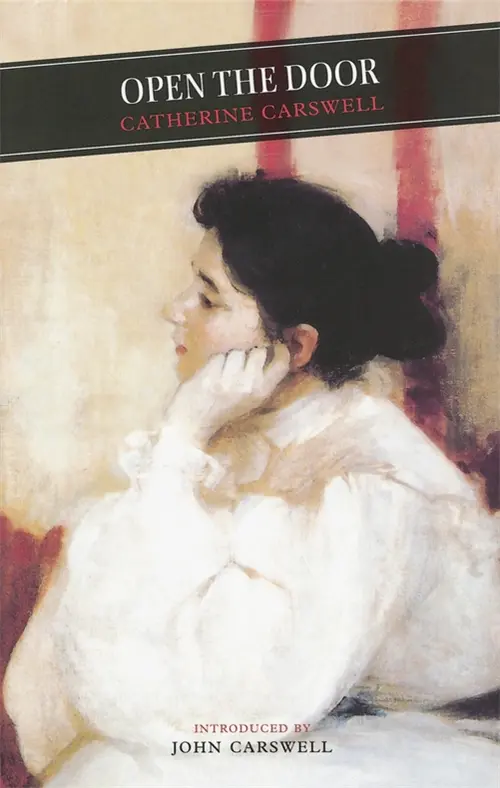
Cover
Catherine Carswell
OPEN THE DOOR!
Introduced by
John Carswell

Introduction
Although the latter part of Open The Door! is mainly set in London, and the clue to the book is an episode in Italy, the roots of the novel are in, and belong to, Glasgow.
One must think of those Victorian terraces and the monumental centre of the city as fairly new, offering a sense of enterprise and confidence in the middle of danger and poverty. It was an energetic city, with its waterways and its shipping, its chemical plants and its neighbouring hills and moors, its dramatic new Gothic university building beside the crevasse of the Kelvin. Gilbert Murray became Professor of Greek there just ten years after Catherine Macfarlane was born in 1879. He was twenty-three. It was one sign among many that Glasgow was on its way to becoming a cultural as well as a commercial metropolis. Soon its School of Art would burgeon under Charles Rennie Mackintosh. All her life Catherine felt herself to be “a citizen of no mean city”.
At one level, no doubt, the title of her novel suggests an escape from the world in which the author grew up – a world of Calvinist religiosity, oppressive conventions and smothering family life. She describes them, and her resistance to them vividly: but lovingly and with sympathy. Much of Victorian Glasgow is repudiated in the book, just as it was in her later life, but never with hatred. The clue to the title has much more to do with entering than with escape, and the “door” is “the little sunken door in the wall” which Joanna, the subject of the novel, sees in Italy and is told admitted a lover to the house of the Renaissance courtesan “La Porziuncola”.
Most novelists, if they decide on an attractive heroine, either describe her attractiveness or arrange that it shall be taken for granted. An unusual thing in Open The Door! is the heroine’s own knowledge of her attractiveness, mingled with senses of power, risk, guilt, misery, fear of failure, pleasure in success, and a measure of mischief: all set against the austere, deeply imprinted consciousness of the family life created by the Free Church of Scotland.
Open The Door! was a first and a mind-clearing book drawn from direct experience. Joanna’s family – especially her elder sister and her lovable but infuriating mother – are taken from life. So is Phemie, the baby-draper’s daughter, whose original, after many adventures, paired off with one of the author’s brothers. Joanna’s lover Louis is modelled on the painter Maurice Greiffenhagen, and Lawrence Urquhart, with whom the book ends, reflects my father Donald Carswell, whom Catherine married in 1915. Even the relative ages of the principal characters are preserved from their originals in real life.
But to what extent was Joanna Catherine? for this one must look at Catherine’s life and the genesis of the novel.
Catherine was the second of the four children of George and Mary Anne Macfarlane, God-fearing Free Church middle-class Glaswegians: both her grandfathers had been ministers who sacrificed their livings in 1843 and “came out” to form the Free Church rather than accept patronage and “intrusion”. Though she was converted to socialism by reading Blatchford at the age of seventeen, and later espoused many left-wing causes, she could never quite abandon the idea that “underneath were the everlasting arms” or bear the depreciation of private charity.
Some of the most lively parts of the novel describe Catherine’s family life with her elder sister and two younger brothers, and in many ways the “hens of gold”, as they loved being called by their mother, were surprisingly free. As the most talented of the four she was the only one to attend a university – Glasgow of course – and she read English and was a star pupil from the first, though in those days she could not be admitted to a degree. Before that she spent two years at the Frankfurt Conservatorium and became a respectable pianist. Her mother’s side of the family had relations in Italy, and there too Catherine spent some time. The Aunt Perdy of the book is not a fiction. But the engineer Rasponi, Joanna’s first husband, is an almost complete invention substituted for Catherine’s first, and disastrous, marriage.
In September 1904, when she was twenty-five, she met a man called Herbert Jackson while she was staying with her Glasgow professor, Walter Raleigh, at Farnham in Surrey. Herbert Jackson was Mrs Raleigh’s brother, and some ten years older than Catherine. He had fought in the South African War and his occupation was now that of an artist. There was a whirlwind courtship, and they were married that October. Whether the Raleighs could have prevented the marriage, one cannot know. Certainly they were placed in an appalling situation, for they knew that for some time past Herbert Jackson had shown clear signs of mental instability. He had causelessly assaulted people, issued challenges to duels and complained of imagined slights and persecutions, though most of the time he seemed normal enough. They kept their counsel. Perhaps they hoped marriage would steady him.
In this they were quite mistaken, for the key to his paranoia was a delusion (and delusion it was) that he was impotent, and the consequent conflict imposed by the need to abandon his delusion produced not an amelioration but a crisis which grew rapidly worse. From claims that he was being watched and spied upon he moved to accusations that Catherine was secretly betraying him. In March 1905, when she was pregnant, he swore the child could not be his and its father was probably the Prince of Wales. A few days later he produced a revolver, which she took from him and threw out of the window. He was taken to a mental hospital, where he remained under a certificate, too dangerous to be discharged, for the rest of his life. He would see neither his wife nor his daughter Diana, who was born in October 1905.
Catherine returned to Glasgow to live with her mother, and was received with a mixture of sympathy and reservation. Her husband was thirty-six, and as the law stood there seemed no way she could avoid being married to him for the rest of his life.
Soon after coming back to Glasgow she started on her writing career as dramatic critic and fiction reviewer for the Glasgow Herald. This renewed her contact with Donald Carswell – the Lawrence Urquhart of the novel – whom she had known when they were studying together at the university, and who was now a sub-editor on the Herald. The Louis of the novel had come to Glasgow about the time of Catherine’s return. This was Maurice Greiffenhagen, who became Professor of the life Class at the Glasgow School of Art – then at the height of its fame – in 1906. Greiffenhagen was already a well-known artist who went on to be an academician and, in his time, a fashionable portrait painter. He had painted what is perhaps the picture by which he is best remembered as long ago as 1891, when he was thirty. This was “An Idyll” which shows a brawny shepherd enthusiastically embracing a reluctant but not wholly unwilling shepherdess in the woodland setting. It hangs today in the Walker Art Galley, and must have been a rather bold purchase at the time. D. H. Lawrence, then teaching at Croydon and still an unknown schoolmaster, saw it in 1908 and was so impressed that he made copies of it and wrote to one of his friends: “As for Greiffenhagen’s ‘Idyll’ it has moved me as much as if I were fallen in love myself.” Later events in Catherine’s life add a strange poignancy to this coincidence.
Greiffenhagen was forty-four when he met Catherine, and she fell lastingly in love with him. He was married, with a family, and seventeen years older.
At that time, deeply committed to Greiffenhagen, Catherine embarked on what most people must have thought was a hopeless attempt to free herself from her own marriage. She could not divorce Jackson, as the law then stood; and he, being certified insane, could not divorce her. Her unprecedented case was that because of his developing mental illness he could not have fully grasped what he was undertaking when they were married, and so the marriage was null and void.
Jackson v Jackson came to court in May 1908 and lasted six days, during which Catherine gave evidence about her extraordinary honeymoon, facing strict cross-examination. Several doctors were called, one of whom, challenged on the point that he had examined Herbert Jackson only after the marriage, compared the forest tree he had seen in the disease with the sapling that must have preceded it. It was powerfully urged on Jackson’s side that a nullity would make the child illegitimate, which no court should allow – least of all on the request of the mother. Jackson himself, his counsel said, was too ill to appear. “The respondent,” said Mr Justice Bargrave Deane, “was not at the time of the marriage a raving lunatic: outwardly to people he was competent. The question is, whether he was really insane.” It was for her to prove it, and he found that she had, so establishing a leading case.
Three years later, in 1911, she received D. H. Lawrence’s first novel, The White Peacock, in her pile for the Herald, and declared that she found in it “a new voice”. Soon afterwards, on the death of her mother, she moved to London (where Greiffenhagen was now living) and established herself in a cottage in Hampstead with Diana. The dramatic criticism for the Herald naturally had to stop, but she continued to review their fiction every other Tuesday, so their columns included favourable notices of The Trespassers and, more enthusiastic still, Sons and Lovers.
It must have been about this time that she began writing the novel that became Open The Door!; her relationship with Greiffenhagen was collapsing under his resolution to follow his own path, and Donald Carswell had also taken the plunge to London with the post on The Times.
Diana, never a well child, died of pneumonia in 1913 after “eight happy years”, as her mother wrote on her grave in Hampstead churchyard. Soon afterwards Catherine and Donald became engaged, and he was to prove an utterly devoted husband – but the name of Greiffenhagen could never be mentioned between them.
One must suppose that some correspondence, now lost, with D. H. Lawrence preceded her first meeting with him in June 1914, since it was clearly prearranged and their friendship ripened very quickly. Lawrence, who had come to England with Frieda to get married, did not reach London till the latter part of June, and by the end of that month he had not only met Catherine but was half-way through her novel. They were to remain close friends for the rest of Lawrence’s life, as some two hundred letters testify: one of the largest bodies of Lawrence’s huge correspondence to survive. Since he never kept letters, her side of the correspondence is lost; but two things are evident. She was never either the recipient or the victim of the wounding fury which Lawrence showered so liberally on and about most of his other friends. She was devoted to him, and perhaps saw more clearly than most his extraordinary originality. But as she records in her own life of him: “From beginning to end I had for Lawrence, as he well knew, a special kind of love and admiration which I never had for any other human being … But I felt also the need to save myself.” Lawrence knew about Greiffenhagen, as several passages in the letters make clear, and that may have entered into and stimulated the development of their early relationship; but they met at a moment when both were on the point of getting married. There was an instinctive puritanism in them both which each was quick to recognize (and sometimes to reproach the other for straying from). Lawrence married Frieda in July 1914, and Catherine married Donald early in 1915.
The novel which Lawrence read in the summer of 1914 was an early version of Open The Door!, not the book we now have. He covered the manuscript with annotations and criticisms, discussed it with her, and called for extensive rewriting. “Nearly all of it is marvellously good. It is only so incoherent … My stars, just you work at it and you’ll have a piece of work you need never feel ashamed of.” Beside this encouragement, his criticism of the style as “indirect and roundabout, stiff-kneed and stupid” merely seemed an invitation to try harder.
Lawrence, at that time, was working on The Rainbow, which came out in 1915 and was promptly prosecuted: but not before Catherine had reviewed it for the Glasgow Herald. She found it “a difficult review to write”, and although it contained a measure of criticism the praise in it caused her to take the precaution of seeing that it went to the printer without passing under the editorial eye. So she promptly lost her job – continuing in journalism, however, as assistant dramatic critic of the Observer.
She was also pressing on with her own novel, and many references in Lawrence’s letters show the interest with which he had followed its progress. By the autumn of 1916 it was finished) and she took it with her to Cornwall where she and Donald stayed some time with the Lawrences, and it was much discussed, Lawrence was by then working on Women in Love, and as a result the name of one of the characters in Open The Door! (Sholto Bannerman) found its way into his novel until she made him alter it, and it became Donald Gilchrist.
This was when the manuscript of Women in Love reached Catherine and Donald a month or so later. Donald read it for libel (he had now qualified as a barrister) and Catherine altered Gudrun’s clothes as well as making a number of stylistic points, all of which Lawrence accepted. But she did not like the novel, and reproached him for writing about “people so far removed from the general run, people so artistic and ‘spoiled’, that it would hardly matter what they said.” Lawrence’s defence, that it was only by the study of upper-class putrescence “that one could discover whither the general run of mankind, the great unconscious mass, was tending”, did not convince her. The difference led to her itemizing his new friends of Garsington and Bloomsbury (friendships the novel in fact destroyed) and telling him he would have to work “for those who could not understand him till long afterwards, and he would have to be alone, all through and in the end alone”.
This difference did not end their friendship, and he continued to encourage her about Open The Door! “Don’t hate Joanna,” he wrote, “She is young. She will grow up. But the hideous wasters who will only rot in the bud, how I hate them. But Joanna is all right. She is a kind of dead-nettle, who looks like a pure weed, and comes out with very quaint and bunchy flowers at the last minute.”
Thus Open The Door! was finished five years after it was first thought of and was submitted to Lawrence’s publisher Duckworth, who refused it on the grounds of length. She then sent it to Melrose, who not only took it but gave it a prize, half of which she offered to Lawrence, who declined it.
The novel was published in 1920, but if, as is usual, one takes the First World War as a Great Divide, it belongs both in conception and flavour to the pre-war world; although oddly enough it owes nothing of its structure or feeling to the conventions of Victorian or Edwardian times. Its characters are not imprisoned by anything but themselves, and the liberation they seek is not social but personal.
Catherine was now committed to a writing career – the more so as Donald’s ambitions at the Bar were quickly disappointed. He was a gentle, scholarly, quite unpractical man, who worked slowly and with infinite care. His two books – one a collection of essays on nineteenth-century Scotsmen, and the other a study of Sir Walter Scott and his circle – broke new ground with their careful research and impeccable writing. They earned respect, but little money. Her small inheritance was soon spent.
Her second novel, The Camomile, which came out in 1922, was much more light-hearted than her first, and more tautly constructed. Two more were planned, one of which was to be shared with Lawrence, who sketched it on lines which later emerged as those of The Plumed Serpent. But what that novel would have been like with the Scottish setting Lawrence projected for it (“The Maclure, who claims to be chief of the clan and has bought the ancestral castle of his native isle … a man of about forty-five, rather small, dark-eyed, full of energy, but has been a good deal knocked about”) has to be left to the imagination. Neither of the collaborators could see how it would end, and it was abandoned.
The difference over who were Lawrence’s friends was the underlying theme of the celebrated dinner party he gave at the Café Royal, at which the world from which he had drawn Women in Love was conspicuous by its absence. Soon afterwards he left England, and Catherine saw him only rarely, though they continued to correspond. Her decision to turn to biography was very much her own, though she was encouraged in her choice of subject by both Donald and Lawrence, and she dedicated the Life of Robert Burns published in 1930, to them jointly.
There had been no life of Scotland’s national poet for many years, and his memory had become institutionalized in a curious mixture of sanctimoniousness and booze. Catherine’s book is in no sense an exercise in iconoclasm but a carefully researched rescue of the real man, and almost every page records her sympathy with what she was discovering about him. It remains today a very sound biography indeed. The book was bitterly denounced by orthodox Burnsites. It was even preached against from the pulpit of Glasgow Cathedral by the Rev. Lauchlan Maclean Watt. Many were shocked that a woman should write the life of Burns. But the book made her name, and brought her many friends, among them John Buchan.
Lawrence died in the year the Burns biography was published, and almost at once she was plunged into the controversies over his memory with a letter to the press denouncing the obituarists who had condemned him as a “dark and sinister failure”. She put her collection of letters at the disposal of Aldous Huxley for his edition of Lawrence’s correspondence, and in 1932 published what is probably her best-known work: the memoir of D. H. Lawrence which she called The Savage Pilgrimage.
It would never have been written but for John Middleton Murry’s strange “destructive hagiography”, Son of Women, against which she felt bound to mount a defence. Of all the early biographies of Lawrence hers is the most clear-headed in that it assesses him as a man, not a prophet. But at the same time she was one of the very few to emphasize the new key that Lawrence had struck and the probability of his lasting literary – and social – influence as a writer.
Catherine was fifty-three when The Savage Pilgrimage was published and a well-known writer with many friends. But of coteries and circles she had an instinctive fear. Her closest friends were Scotswomen with whom she had grown up and who had engaged in professional careers: two doctors, Maud McVail and Isobel Hutton, the sculptress Phyllis Clay, and Maggie Mather (the Phemie of Open The Door!) who became a professional musician. So far as she was concerned they had as much claim on her as the newer friends she made through her work – Vita Sackville-West, Storm Jameson, Athene Seyler and Rose Macaulay.
When one contrasts John Buchan with Hugh MacDiarmid her friendships were indeed wide-ranging. She shared neither the cautious conservatism of one nor the eccentric nationalism of the other, but was a friend of both, as correspondence shows. What is more, both Catherine and Donald were close friends of Edwin and Willa Muir, whom MacDiarmid regarded as his arch-enemies.
During the 1930s Catherine produced three anthologies, much literary journalism, and a third biography: a life of Boccaccio, which she called The Tranquil Hearts chosen, as she said, because Boccaccio was the first author to write avowedly for women. By now she was earning almost all the money that came into the house.
Her closest friend during these years was Daniel George, the critic and publisher’s reader, whom she came to know when he was still Daniel Bunting, the talented, self-educated manager of a firm of geyser manufacturers. He was already an accomplished writer and critic, and in the middle thirties became literary adviser to Jonathan Cape. With him Catherine collaborated on two of her anthologies – A National Gallery and The English in Love. The first was shared with her husband Donald. It is a collection not only of poetry and song (all of course Scottish) but of recipes, legal hints, and everything that might equip, amuse or instruct those pending a brief holiday in Scotland.
The Story Continues on BooksBarbecue!
Enjoyed this preview? ❤️ Do not stop here!
Read the complete book free online → 🔗
Continue reading now on BooksBarbecue and discover every page!
Love reading? Bookmark BooksBarbecue.com for more amazing books!
Happy Reading!