On the Bus with Rosa Parks
Cover
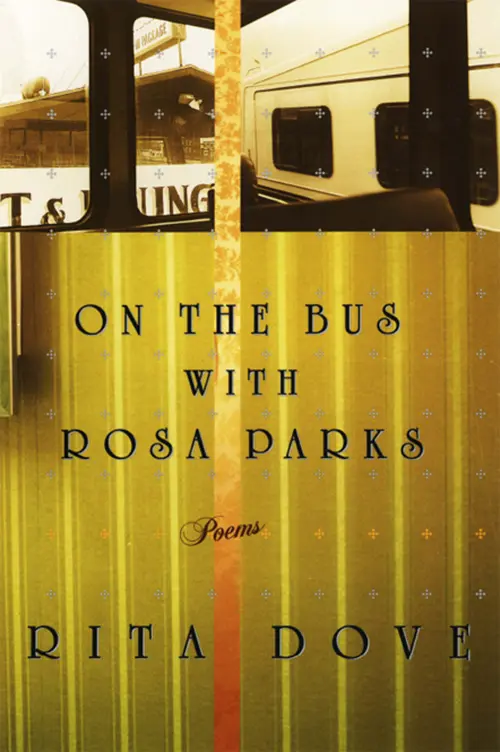
Title
On the Bus with Rosa Parks
Poems
Rita Dove

W. W. Norton & Company
New York • London
Adjusting type size may change line breaks. Landscape mode may help to preserve line breaks.
for
Aviva
for
Fred
Epigraph
NATIONAL BOOK CRITICS CIRCLE AWARD FOR POETRY FINALIST
“[Rita Dove’s] laser glance exposes and cauterizes its subjects in new and disturbing ways.”
—Helen Vendler, The New Yorker
“Dove’s poems read like short fums with the sound turned down. Centre-screen are vivid, often luscious details, while a quiet ironic voice-over points to the menace clouded by innocence or the sadness cramped by social niceties. She is an outstanding poet of the delicate nuances present in social complexity, of the lyric reflection embedded in the epic journey:”
—Sarah Maguire, Times Literary Supplement
“Dove has been extending the boundaries of her art, while also endeavoring to recover the past, be it that of European literary tradition or African-American history and culture.”
—Ben Howard, Poetry
Contents
Contents
Cameos
July, 1925—Night—Birth—Lake Erie Skyline, 1930—Depression Years—Homework—Graduation, Grammar School—Painting the Town—Easter Sunday, 1940— Nightwatch. The Son.
Freedom: Bird’s-Eye View
Singsong
I Cut My Finger Once on Purpose
Parlor
The First Book
Maple Valley Branch Library, 1967
Freedom: Bird’s-Eye View
Testimonial
Dawn Revisited
Black on a Saturday Night
My Mother Enters the Work Force
Black on a Saturday Night
The Musician Talks about “Process”
Sunday
The Camel Comes to Us from the Barbarians
The Venus of Willendorf
Incarnation in Phoenix
Revenant
Best Western Motor Lodge, AAA Approved
Revenant
On Veronica
There Came a Soul
The Peach Orchard
Against Repose
Against Self-Pity
Götterdämmerung
Ghost Walk
Lady Freedom Among Us
For Sophie, Who’ll Be in First Grade in the Year 2000
On the Bus with Rosa Parks
Sit Back, Relax
“The situation is intolerable”
Freedom Ride
Climbing In
Claudette Colvin Goes to Work
The Enactment
Rosa
QE2. Transatlantic Crossing. Third Day.
In the Lobby of the Warner Theatre, Washington, D.C.
The Pond, Porch-View: Six P.M., Early Spring
Notes
Acknowledgments
Cameos
Cameos
Cameos
July, 1925
Lucille among the flamingos
is pregnant; is pained
because she cannot stoop to pluck
the plumpest green tomato
deep on the crusted vine.
Lucille considers
the flamingos, guarding in plastic cheer
the birdbath, parched
and therefore
deserted. In her womb
a dull—no, a husky ache.
If she picks it, Joe will come home
for breakfast tomorrow.
She will slice and dip it
in egg and cornmeal and fry
the tart and poison out.
Sobered by the aroma, he’ll show
for sure, and sit down
without a mumbling word.
Inconsiderate, then,
the vine that languishes
so!, and the bath sighing for water
while the diffident flamingos arrange
their torchsong tutus.
She alone is the blues. Pain drives her blank.
Lucille thinks: I can’t
even see my own feet.
Lucille lies down
between tomatoes
and the pole beans: heavenly shade.
From here everything looks
reptilian. The tomato plops
in her outstretched palm. Now
he’ll come, she thinks,
and it will be a son.
The birdbath hushes
behind a cloud
of canebreak and blossoming flame.
Night
Joe ain’t studying nobody.
He laughs his own sweet bourbon banner,
he makes it to work on time.
Late night, Joe retreats through
the straw-link-and-bauble curtain
and up to bed. Joe sleeps. Snores
gently as a child after a day of marbles.
Joe
knows somewhere
he had a father
who would have told him
how to act. Mama,
stout as a yellow turnip,
loved to bewail her wild good luck:
Blackfoot Injun, tall with
hair like a whip. Now
to do it
without him
is the problem. To walk into a day
and quietly absorb.
Joe takes after Mama.
Joe’s Mr. Magoo.
Joe
thinks, half
dreaming, if he ever finds
a place where he can think,
he’d stop clowning
and drinking and then that wife
of his would quit
sending prayers through the chimney.
Ah,
Lucille.
Those eyes, bright and bitter
as cherry bark, those
coltish shins, those thunderous hips!
No wonder he couldn’t leave
her be, no wonder whenever she began to show
he packed a fifth and split.
Joe
in funk and sorrow. Joe
in parkbench celibacy, in apostolic
factory rote, in guilt (the brief
astonishment of memory), in grief when
guilt turns monotonous.
He always knows when to go on home.
Birth
(So there you are at last—
a pip, a button in the grass.
The world’s begun
without you.
And no reception but
accumulated time.
Your face hidden but your name
shuddering on air!)
Lake Erie Skyline, 1930
He lunges, waits, then strikes again.
I’ll make them sweat, he thinks
and does a spider dance
as the fireflies shamble past.
The sky dims slowly; the sun
prefers to do its setting
on the other side of town.
This deeper blue smells
soft. The patterns in it
rearrange—he cups
another fly. (He likes to
shake them dizzy
in his hands, like dice, then
throw them out for luck.
They blink on helplessly
then stagger from the sidewalk
up and gone.)
Sometimes the night arrives
with liquor on its breath,
twice-rinsed and chemical.
Or hopped up, sparking
a nervous shimmy. Or
dangerously still, like his mother
standing next to the stove,
a Bible verse rousing her pursed lips.
He knows what gin is made from—
berries blue. He knows
that Jesus Saves. (His father
calls it Bitches’ Tea.)
And sisters—so many, their
names fantastic, myriad
as the points of a chandelier:
Corinna, Violet, Mary, Fay,
Suzanna, Kit, and Pearl. Each evening
when they came to check
his bed, he held his breath, and still
he smelled the camphor
and hair pomade. Saw
foreheads sleek, spitcurl
embellishing a cheek, lips
soft and lashes spiked
with vaseline. He waited
to be blessed.
They were
Holy Vessels, Mother said:
each had to wait
her Turn. And he, somehow,
was part of the waiting, he was
the chain. He was, somehow,
his father.
The latest victim won’t
get up—just lies there
in the middle of the walk
illuminating the earth
regular as breath.
He stomps and grinds
his anger in. Pulls
his foot away and yellow
streaks beneath the sole—
eggyolk flame, lurid
smear of sin.
Sisters,
laughing, take his shoes away
and bring them scraped
and ordinary
back. Idiots,
he thinks. No wonder
there’s so many of them.
But he can’t sleep.
All night beneath his bed,
the sun is out.
Depression Years
Pearl
can’t stop eating;
she wants to live!
Those professors
have it all backwards:
after fat came merriment,
simply because she was afraid to
face the world, its lukewarm
nonchalance
that generationwise had set
her people in a stupor of
religion and
gambling debts. (Sure, her
mother was an angel
but her daddy was
her man.)
Pearl laughs
a wet red laugh.
Pearl oozes
everywhere. When she was
young, she licked the walls free of chalk; she
ate dust for the minerals.
Now she just
enjoys, and excess
hardens on her like
a shell.
She sheens.
But oh, what
tiny feet! She tipples
down the stairs. She cracks a chair.
The largest baby shoe
is neat. Pearl laughs
when Papa jokes: Why don’t
you grow yourself some feet?
Her mother calls them
devil’s hooves.
Her brother
doesn’t
care.
He has
A Brain; he doesn’t notice.
She gives him of her own
ham hock, plies him with
sweetened yams. Unravels
ratted sweaters, reworks them
into socks. In the lean years
lines his shoes
with newspaper. (Main
thing is, you don’t
miss school.)
She tells him
it’s the latest style.
He never laughs.
He reads. He
shuts her out.
Pearl thinks
she’ll never marry—
though she’d
like to have
a child.
Homework
| “The Negro and his song are inseparable. If his music is primitive and if it has much that is sensuous, this is simply a part of giving pleasure, a quality appealing strongly to the Negro’s entire being. Indeed, his love of rhythms and melody, his childish faith in dreams . . .” |
|
| Shit, he’ll take Science, most Exacting Art. In school when the teacher makes him lead the class in song, he’ll cough straight through. Better columns of figures, the thing dissected to the bone. Better the clear and incurious drip of fluid from pipet to reassuring beaker. |
|
| “The Negro claps his hands spontaneously; his feet move constantly in joyful anticipation of the drum. . . .” |
|
| Most of all he’d like to study the composition of the stars. |
Graduation, Grammar School
| Joe holds both fists out, palms down. Come on boy, guess. The boy hesitates. He knows there’s nothing in either one. |
| (The game: Who offers the hand first, man or woman? Who first lowers the eyes? If the hand is not received, whose price is reduced? And what if both are men? Or drunk? Or one is white? The possibilities are infinite.) |
| Joe sees his son flicker. Although the air is not a glass, watches as he puts his lips to the brim—then turns away, bored. He is not mine, this son who ripens, quiet poison on a shelf. |
Painting the Town
The mirror
in the hall is red.
Pearl
giggles: Pretty
as a freshly painted
barn. She tugs
a wrinkle down.
Since she’s discovered
men would rather drown
than nibble,
she does just
fine.
She’d like to show
her brother
what it is like to crawl
up the curved walls
of the earth, or
to be that earth—but
he has other plans.
Which is alright. Which is
As It Should Be.
Let the boy reach manhood
anyway he can.
Easter Sunday, 1940
A purity
in sacrifice, a blessedness
in shame. Lucille
in full regalia, clustered
violets and crucifix.
She shoos
a hornet
back to Purgatory,
rounds the corner, finds
her son in shirtsleeves staring
from the porch into the yard
as if it were the sea.
And suddenly
she doesn’t care.
(Joe, after all, came home.)
She feels as if
she’s on her back
again, and all around her
blushing thicket.
Nightwatch. The Son.
(Aggressively adult,
they keep their
lives, to which
I am a witness.
At the other end
I orbit, pinpricked
light. I watch.
I float and grieve.)
Freedom: Bird’s-Eye View
Freedom:
Bird’s-Eye View
Singsong
When I was young, the moon spoke in riddles
and the stars rhymed. I was a new toy
waiting for my owner to pick me up.
When I was young, I ran the day to its knees.
There were trees to swing on, crickets for capture.
I was narrowly sweet, infinitely cruel,
tongued in honey and coddled in milk,
sunburned and silvery and scabbed like a colt.
And the world was already old.
And I was older than I am today.
I Cut My Finger Once on Purpose
I’m no baby. There’s no grizzly man
wheezing in the back of the closet.
When I was the only one,
they asked me if I wanted a night-light
and I said yes—
but then came the shadows.
I know they make the noises at night.
My toy monkey Giselle, I put her
in a red dress they said was mine
once—but if it was mine, why did they yell
when Giselle clambered up the porch maple
and tore it? Why would Mother say
When you grow up, I hope you have
a daughter just like you
if it weren’t true, that I have a daughter
hidden in the closet—someone
they were ashamed of and locked away
when I was too small to cry.
I watch them all the time now:
Mother burned herself at the stove
without wincing. Father
smashed a thumb in the Ford,
then stuck it in his mouth for show.
They bought my brother a just-for-boys
train, so I grabbed the caboose
and crowned him—but he toppled
from his rocker without a bleat;
he didn’t even bleed.
That’s when I knew they were
robots. But I’m no idiot:
I eat everything they give me,
I let them put my monkey away.
When I’m big enough
I’ll go in, past the boa
and the ginger fox biting its tail
to where my girl lies, waiting . . .
and we’ll stay there, quiet,
until daylight finds us.
Parlor
We passed through
on the way to anywhere else.
No one lived there
but silence, a pale china gleam,
and the tired eyes of saints
aglow on velvet.
Mom says things are made
to be used. But Grandma insisted
peace was in what wasn’t there,
strength in what was unsaid.
It would be nice to have a room
you couldn’t enter, except in your mind.
I like to sit on my bed
plugged into my transistor radio,
“Moon River” pouring through my head.
How do you use life?
How do you feel it? Mom says
things harden with age; she says
Grandma is happier now. After the funeral,
I slipped off while they stood around
remembering—away from all
the talking and eating and weeping
to sneak a peek. She wasn’t there.
Then I understood why
she had kept them just so:
so quiet and distant,
the things that she loved.
The First Book
Open it.
Go ahead, it won’t bite.
Well . . . maybe a little.
More a nip, like. A tingle.
It’s pleasurable, really.
You see, it keeps on opening.
You may fall in.
Sure, it’s hard to get started;
remember learning to use
knife and fork? Dig in:
You’ll never reach bottom.
It’s not like it’s the end of the world—
just the world as you think
you know it.
Maple Valley Branch Library, 1967
For a fifteen-year-old there was plenty
to do: Browse the magazines,
slip into the Adult Section to see
what vast tristesse was born of rush-hour traffic,
décolletés, and the plague of too much money.
There was so much to discover—how to
lay out a road, the language of flowers,
and the place of women in the tribe of Moost.
There were equations elegant as a French twist,
fractal geometry’s unwinding maple leaf;
I could follow, step-by-step, the slow disclosure
of a pineapple Jell-O mold—or take
the path of Harold’s purple crayon through
the bedroom window and onto a lavender
spill of stars. Oh, I could walk any aisle
and smell wisdom, put a hand out to touch
the rough curve of bound leather,
the harsh parchment of dreams.
As for the improbable librarian
with her salt and paprika upsweep,
her British accent and sweater clip
(mom of a kid I knew from school)—
I’d go up to her desk and ask for help
on bareback rodeo or binary codes,
phonics, Gestalt theory,
lead poisoning in the Late Roman Empire,
the play of light in Dutch Renaissance painting;
I would claim to be researching
pre-Columbian pottery or Chinese foot-binding,
but all I wanted to know was:
Tell me what you’ve read that keeps
that half smile afloat
above the collar of your impeccable blouse.
So I read Gone with the Wind because
it was big, and haiku because they were small.
I studied history for its rhapsody of dates,
lingered over Cubist art for the way
it showed all sides of a guitar at once.
All the time in the world was there, and sometimes
all the world on a single page.
As much as I could hold
on my plastic card’s imprint I took,
greedily: six books, six volumes of bliss,
the stuff we humans are made of:
words and sighs and silence,
ink and whips, Brahma and cosine,
corsets and poetry and blood sugar levels—
I carried it home, past five blocks of aluminum siding
and the old garage where, on its boarded-up doors,
someone had scrawled:
I CAN EAT AN ELEPHANT
IF I TAKE SMALL BITES.
Yes, I said, to no one in particular: That’s
what I’m gonna do!
Freedom: Bird’s-Eye View
The sun flies over the madrigals,
outsmarting the magisterial
wits, sad ducks
who imagine they matter.
What a parade! Wind tucks
a Dixie cup up its
sleeve, absconds
with a kid’s bright chatter
while above, hawks
wheel as the magistrates circle
below, clutching their hats.
I’m not buying. To watch
the tops of 10,000
heads floating by on sticks
and not care if one of them
sees me (though it
would be a kick!)
—now, that’s
what I’d call
freedom,
and justice,
and ice cream for all.
Testimonial
Back when the earth was new
and heaven just a whisper,
back when the names of things
hadn’t had time to stick;
back when the smallest breezes
melted summer into autumn,
when all the poplars quivered
sweetly in rank and file . . .
the world called, and I answered.
Each glance ignited to a gaze.
I caught my breath and called that life,
swooned between spoonfuls of lemon sorbet.
I was pirouette and flourish,
I was filigree and flame.
How could I count my blessings
when I didn’t know their names?
Back when everything was still to come,
luck leaked out everywhere.
I gave my promise to the world,
and the world followed me here.
Dawn Revisited
Imagine you wake up
with a second chance: The blue jay
hawks his pretty wares
and the oak still stands, spreading
glorious shade. If you don’t look back,
the future never happens.
How good to rise in sunlight,
in the prodigal smell of biscuits—
eggs and sausage on the grill.
The whole sky is yours
to write on, blown open
to a blank page. Come on,
shake a leg! You’ll never know
who’s down there, frying those eggs,
if you don’t get up and see.
Black on a Saturday Night
Black on a Saturday Night
My Mother Enters the Work Force
The path to ABC Business School
was paid for by a lucky sign:
ALTERATIONS, QUALIFIED SEAMSTRESS INQUIRE WITHIN.
Tested on sleeves, hers
never puckered—puffed or sleek,
leg-o’-mutton or raglan—
they barely needed the damp cloth
to steam them perfect.
Those were the afternoons. Evenings
she took in piecework, the treadle machine
with its locomotive whir
traveling the lit path of the needle
through quicksand taffeta
or velvet deep as a forest.
And now and now sang the treadle,
I know, I know. . . .
And then it was day again, all morning
at the office machines, their clack and chatter
another journey—rougher,
that would go on forever
until she could break a hundred words
with no errors—ah, and then
no more postponed groceries,
and that blue pair of shoes!
Black on a Saturday Night
This is no place for lilac
or somebody on a trip
to themselves. Hips
are an asset here, and color
calculated to flash
lemon bronze cerise
in the course of a dip and turn.
Beauty’s been caught lying
and the truth’s rubbed raw:
Here, you get your remorse
as a constitutional right.
It’s always what we don’t
fear that happens, always
not now and why are
you people acting this way
(meaning we put in petunias
instead of hydrangeas and reject
ecru as a fashion statement).
But we can’t do it—naw, because
the wages of living are sin
and the wages of sin are love
and the wages of love are pain
and the wages of pain are philosophy
and that leads definitely to an attitude
and an attitude will get you
nowhere fast so you might as well
keep dancing dancing till
tomorrow gives up with a shout,
’cause there is only
Saturday night, and we are in it—
black as black can,
black as black does,
not a concept
nor a percentage
but a natural law.
The Musician Talks abut “Process”
(after Anthony “Spoons” Pough)
I learned the spoons from
my grandfather, who was blind.
Every day he’d go into the woods
’cause that was his thing.
He met all kinds of creatures,
birds and squirrels,
and while he was feeding them
he’d play the spoons,
and after they finished
they’d stay and listen.
When I go into Philly
on a Saturday night,
I don’t need nothing but
my spoons and the music.
Laid out on my knees
they look so quiet,
but when I pick them up
I can play to anything:
a dripping faucet,
a tambourine,
fish shining in a creek.
A funny thing:
When my grandfather died,
every creature sang.
And when the men went out
to get him, they kept singing.
They sung for two days,
all the birds, all the animals.
That’s when I left the South.
Sunday
Their father was a hunting man.
Each spring the Easter rabbit sprung open
above the bathroom sink, drip slowed
by the split pink pods of its ears
to an intravenous trickle.
There was the occasional deer,
though he had no particular taste
for venison—too stringy, he said,
but made Mother smoke it up just in case,
all four haunches and the ribs.
Summer always ended with a catfish
large as a grown man’s thigh
severed at the hip, thrashing
in a tin washtub: a mean fish, a fish
who knew the world was to be endured
between mud and the shining hook.
He avoided easy quarry: possum
and squirrel, complacent carp.
He wouldn’t be caught dead
bagging coon; coon, he said,
was fickle meat—tasted like
chicken one night, the next like
poor man’s lobster. He’d never admit
being reduced to eating coon,
to be called out of his name
and into that cartoon.
It’s not surprising they could eat the mess
he made of their playground: They watched
the October hog gutted with grim fury,
a kind of love gone wrong, but oh
they adored each whiskery hock, each
ham slice brushed subterranean green.
They were eating his misery
like bad medicine meant to help them
grow. They would have done anything
not to see his hand jerk like that,
his belt hissing through the loops and around
that fist working inside the coils
like an animal gnawing, an animal
who knows freedom’s worth anything
you need to leave behind to get to it—
even your own flesh and blood.
The Camel Comes to Us from the Barbarians
This one is enormous: rough-cut,
the fur like matted felt—
and so much of it,
rising in vulgar mounds upon its back
as if the sand itself had belched
into heaven’s beard. Gods,
what malevolence! The eye a constant
rolling orb, glistening with ill intent,
yellowed, gummed with hair, more hairs
than you or I would care to count,
that eye marks every move its jailer makes
and waits for him to step too near—
one blow would cripple any man.
Another specimen stands bellowing
beneath the farthest palm. Though slighter,
it daunts equally, staked haunches
straining, muscles potent as the reek
that saturates our sun-baked marketplace.
About the larger one some purpose lurks:
Hindquarters splayed, it tugs against its ropes,
snorts, yearns its massive head and slavers
toward that godawful sound. Could
the drabber one be female, and its mate?
More monsters in our midst!
And yet . . . if these vile creatures be
like geese, or dogs, and their offspring
learn to cuddle the one
who coddles them first—why,
our fortune’s pegged for sure.
Let us display our sternest countenance,
then apportion what they most desire
according to the measure of their service.
A rare commodity, these beasts—
who cannot know
what beauty wreaks, what mountains
pity moves.
The Venus of Willendorf
Let your eye be a candle in a chamber,
your gaze a knife;
let me be blind enough
to ignite it.
— PAUL CELAN
She kneels on a workbench
strewn with clipper and trowel
to look out over the valley, red sun
still snagged on the farthest green fringe.
She’s early. Behind her
scratch the arbor’s last leaves
and a few gray birds pecking for crumbs
among the rose husks fallen to the veranda.
Arrived a week ago, one more exotic
in the stream of foreign students
invited to Herr Professor’s summer house
in the Wachau, she was taken
straight from train to tavern
to see the village miracle, unearthed
not five kilometers from this garden shed:
The Story Continues on BooksBarbecue!
Enjoyed this preview? ❤️ Do not stop here!
Read the complete book free online → 🔗
Continue reading now on BooksBarbecue and discover every page!
Love reading? Bookmark BooksBarbecue.com for more amazing books!
Happy Reading!