Off Season
Cover
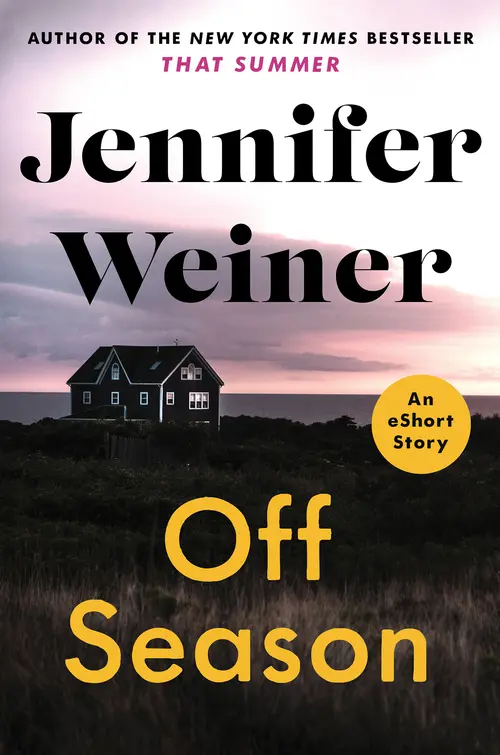
Author of the New York Times Bestseller
That Summer
Jennifer Weiner
An eShort Story
Off Season
Thank you for downloading this Simon & Schuster ebook.
Get a FREE ebook when you join our mailing list. Plus, get updates on new releases, deals, recommended reads, and more from Simon & Schuster. Click below to sign up and see terms and conditions.
CLICK HERE TO SIGN UP
Already a subscriber? Provide your email again so we can register this ebook and send you more of what you like to read. You will continue to receive exclusive offers in your inbox.
Title Page
Off Season
“A writer?”
The agent smirked at the familiar tone—excitement, fascination, a slightly morbid curiosity. The way kids sometimes sounded when they glimpsed some odd-looking animal at the zoo. “She is. One of mine, as it happens.”
“An actual writer. Staying at our house.” Donna Jenkins’s voice had turned dreamy. “How exciting!”
“Very exciting,” the agent agreed, and wondered how much of Donna’s enthusiasm had to do with the idea of an actual, published writer inhabiting their house, and how much could be ascribed to the extra $60,000 she and her husband would be making by renting their place for the off-season, when all the summer people returned to the cities they’d left in June, leaving their big, empty houses behind. “But she’s got some requirements.”
“Oh?”
“She needs absolute privacy to work. She can’t be disturbed or distracted. She can’t have anyone in the house, or around it. No workmen, no lawn service, no cleaning ladies. Nobody shoveling out the drive, or coming to repoint the brickwork. Just her.”
“Hmm.” The agent could hear Donna thinking, weighing the inconvenience of a troublesome houseguest against the paycheck the guest would bring. “We were planning on having some things done in the winter. The living room needs to be repainted, and we were going to replace the carpet in the—”
“I understand,” the agent interrupted. “If it’s too much of a disruption, I can keep looking.”
“No! No. I’m sure we can reschedule everything.” Now the agent could hear a hint of desperation in Donna’s tone. Her husband, Mark, had taken an early pandemic-related retirement package from the bank that had employed him. The money faucet that had gushed reliably all through the 1990s and the aughts and the boom-boom Trump years had slowed its flow to a trickle. If Donna and Mark were going to keep their summer palace, they’d need a new income stream.
“It’s just—a six-bedroom house for one woman.” Donna gave a nervous giggle. “Her books must sell very well.”
“Not yet,” the agent said. But they will, he thought. He’d taken steps to make sure of it.
Sarah Vernon stepped into the foyer of a mansion that overlooked the sea. Weak winter sunshine came slanting through the skylight two stories overhead and through the floor-to-ceiling windows she could see down the hall, illuminating what she was certain had to be called a great room.
The house was very grand. Sarah herself was not. She was big, tall and broad-shouldered, with hands like shovels and feet so large that she had to order her shoes from a website she was pretty sure catered to drag queens. Her hair was mousy and had started turning gray right around the time Sarah turned thirty-five. She had thin lips, and her eyes, pale greenish-gray, protruded slightly, giving her a rabbity aspect. If she were describing herself in a novel, she’d use forgettable if she was feeling generous; unlovely if she wasn’t.
Sarah’s single piece of luggage rested by her feet, her laptop bag hung from her shoulder. A gorgeous fringed rug, in shades of crimson and tangerine and brilliant gold, spread out in front of her. Sarah found herself afraid to set foot on it, afraid to move, or even breathe too deeply. A writer’s retreat, her agent had said. Her new agent. Sarah could barely believe she had an agent at all. She found it even less plausible that the new agent was Will Presser. Will Presser, who represented the award-winning and the bestselling and was a celebrity in his own right. Everything Will Presser touched was a success, and now, Will Presser had touched her.
Unconsciously, Sarah’s lips pressed together, covering her protruding incisors. She shifted her laptop bag, hitching it higher up onto her shoulder, and made herself take her first steps into her temporary home.
Sarah had published three novels by her fortieth birthday, three well-written, tightly plotted thrillers. Elevated thrillers, her previous agent used to say, although Sarah knew that not everyone agreed; that one of the publishers who had passed on her debut said that the book was beautifully written, but a little quiet, a little small. Her publisher said, and Sarah herself knew, that there was an endless appetite for the kind of books she wrote. That might have been true, but, if it was, readers were getting their fill elsewhere, not even bothering to taste what Sarah set out for them. In spite of the glowing reviews in the trade publications—and, once, in the New York Times Book Review’s “On Crime” column—none of Sarah’s books had sold more than five thousand copies, or had earned enough money, either in advances or royalties, for Sarah to make fiction her full-time job. She adjunct-professor’d and freelance edited, she took temporary work proofreading legal documents and wrote speeches and blog posts for executives and newsletters for hospitals and community colleges. With her sales trending steadily in the wrong direction and that first publisher’s assessment forever seared in her brain, Sarah had not been surprised when the publishing house she’d worked with for her first three books had declined to make an offer on her fourth, and when, subsequently, her agent had dropped her. “We all love you,” her former agent, a distressingly young woman, had said, three weeks after Sarah had sent in her pages, weeks that Sarah had spent with her nerves cranked tight, jumping every time her phone buzzed with an incoming email or call and glaring at it when it didn’t. “We think you’re a real talent. We just think someone else might have better luck breaking you out.”
Sarah had listened, the phone tight against her face, feeling like she’d fallen down a dark, dark well; a well with no bottom; like there would be no end to her disappointment and her shame and her sorrow. She thanked the young woman politely, even as she noted the beeps of call-waiting and incoming emails and texts in the background, the sound of other, less-disappointing clients. “I appreciate everything you’ve done for me,” she said. “I know you tried.” She ended the call, set down the phone, then bent forward, slamming her desk with her fists, and screamed, a horrible, guttural sound; the sound of a dying animal, finally admitting defeat.
Except Sarah wasn’t dead or defeated. Not quite yet. She googled until she found Will Presser’s website. For a long moment, she stared at the picture of the agent who’d been nicknamed the Viper. Then, her fingers slamming into the keyboard, she’d bashed out an email. AUTHOR SEEKS AGENT, she’d written in the subject line, followed by a paragraph of introduction, a link to her website, and, in conclusion, a bald, unvarnished request: I know I need a new team to take my sales to the next level—or, really, if I’m going to have any kind of career at all. I’m hoping you’ll be willing to take me on.
As shocked as she’d been to find the guts to write to Will, Sarah was even more surprised when the man called her. “Please hold for Will Presser,” a smooth, female voice had said, and there he was, the man himself. “I’ve read your books,” he said, in a voice that was low and intriguing. Sexy, she thought, but with a rasp. A bite. “And I agree with what you said in your letter. The right people ought to be able to break you out. And I think that I can help.”
He’d invited her to dinner at a fancy sushi place, a restaurant whose ten tables were all booked three months out. Sarah had fretted over her clothes—nothing looked right, and she couldn’t afford anything new. She’d finally settled on black pants and an ivory-colored blouse with pearl buttons, with a deep V of a collar that exposed the skin of her chest, and the dip at the hollow of her throat. Once, a boyfriend had called her collarbones sexy. Sarah suspected that her long-ago beau had been desperate to find something about her that he could praise. She imagined him cataloguing her various parts—hair? eyes? breasts?—and finding each of them wanting until he’d finally arrived at her blameless clavicles. So Sarah had put them on display, and worn her hair in a twist that left her neck exposed. She’d spritzed perfume on her pulse points, fastened her mother’s pearls around her throat, and gone out into the darkness to meet the Viper.
Will Presser had been waiting for her at the bar, wearing a black shirt beneath a blazer made of silky black suede. She could remember his teeth, flashing startling white in the darkness of his neatly trimmed mustache and goatee, when he rose to greet her. He’d kept his hand hovering above the small of her back as they walked to the table, where he’d pulled out her chair with a flourish. The sushi had been decadent, delicious, especially to someone who’d been living on ramen and beans and rice. Sarah remembered the unctuous bits of fish, rich and fatty, slipping down her throat, the bright crunch of seaweed salad, slicked in sesame oil, the burn of warm sake, tracing a fiery path through her chest each time she’d swallowed. They’d talked about publishing first, played Do you know and Have you read. They’d discussed different editors at different publishing houses, the new Reese pick, the most recent scandals. An author who’d cheated on her wife at Yaddo, another, formerly sober, who’d gone on a bender at Bread Loaf that had concluded with him naked on a snowmobile; the pair of young women who wrote a series of mysteries together, only, Will said, lowering his voice, they didn’t actually do any of the writing at all.
“So who writes them?” Sarah could feel the alcohol humming pleasantly in her blood; the taste of raw fish lingered on her tongue. She felt good, relaxed, and happy, at ease in her own skin, for once.
Will lowered his voice, leaning in so close that his knee bumped hers beneath the table. “You know Victoria? Their agent?” Sarah did know Victoria, who was a plump, grandmotherly woman in her seventies. “She does the writing. The girls—” Will made a dismissive, brushing-off gesture with one long-fingered hand. “They’re just there for the author photos.”
Sarah could feel her cheeks flushing as she giggled the laugh of a younger, smaller woman. She wondered how many secrets like that there were in the writing world, and if there was anyone or anything in publishing that Will didn’t know. She was also wondering if this was entirely a professional meeting, or whether it was something more like a date. Oh, sure, said a voice in her head, the one that sounded a lot like her father. Because what Will Presser’s been waiting for his whole life is a forty-one-year-old with buck teeth who’s still practically a virgin. Sarah had, in fact, had sex in her life. Just not much of it, and what she’d had had not been good. She’d been with only two men, and neither one had been an actual boyfriend (one of them, humiliatingly, would only see her between the hours of midnight and 6:00 a.m., sneaking into her dorm, probably after he’d been out with someone else, and sneaking back out before the sun came up). Sarah had never been married, never even lived with a man. As sure of herself as she felt behind the keyboard, moving her invented people through their invented lives, that was how insecure she felt with a real, live man in the actual world.
At some point—a point that coincided with the pair of them finishing a second bottle of sake and Will, without consulting her, ordering a third—the evening started to get soft around the edges. Sarah could remember Will saying Every single one of your books should have hit the list, and cringed as she remembered telling him I’ll do anything. Anything you tell me. Her voice had sounded high and girlish, incongruous, coming from her broad-shouldered frame, as she’d made those vows, as she’d promised to put herself, and her career, entirely in his hands.
She wasn’t surprised when he’d suggested going back to his place for a nightcap. She’d let him steer her out of the restaurant and into the car waiting at the curb. She could feel the heat coming off him, with his shoulder brushing against hers in the backseat; could smell his cologne, a little musky, a little smoky, like something charred. The thought of sophisticated Will Presser smelling like a Weber grill the day after the Fourth of July made her giggle. Will laughed with her, as if he knew what she was thinking and was in on the joke.
Sarah had wiped her eyes “I’ll do anything,” she’d blurted again, and then had felt her face get hot as she realized how that sounded.
Will’s hand was a warm weight on her forearm; his raspy-sexy voice comforting and certain. “I know,” he’d said, very softly. “I know you will.”
Then everything had gone blank until the morning, when Sarah had found herself sitting upright and fully dressed in Will’s living room. Will, too, was dressed, except for his shoes, and he was talking on the phone. His feet looked like small pink animals as he walked over the dark-lacquered floorboards. Sarah filed the phrase away—small pink animals—thinking that she’d use it in her work. Thinking about Will’s feet meant that she wasn’t thinking about what had happened during the hours she couldn’t remember.
Her ivory blouse was spattered with soy sauce, her pants were stiff with something she didn’t want to think about, her head ached terribly, with a pain so sharp that her eyes watered. Had they gone to bed? Should she ask? Or would he be insulted if they had, and she couldn’t remember? She looked at him, trying to decide. In the unforgiving morning light, she could see the lines around Will’s eyes, the discoloration of his skin, which made him look his age, whatever that was (fifty? sixty? sixty-five?).
He ended his call, pocketed the slim, silvery phone that she was sure was the very, very latest, and smiled at her. “I think what you need is a writer’s retreat. I’ve made the arrangements,” he’d said. “There’s a car waiting downstairs. You’ll be on the one o’clock ferry to Elder Island. Have you ever been?” He must have guessed, from her shocked face, that no, Sarah had never been to the ultraexclusive enclave, between Martha’s Vineyard and the Cape. “I’ve got a home there, and I’ve rented you a place.” He turned away, giving her his profile as he looked out his window, down at the city. “It’s a wild place.”
“Wild, like parties?” Sarah’s mouth felt very dry, and her thoughts, and her body, felt sluggish, like her heart was taking an extra-long time with each beat.
“Well, in the summertime, sure. But that’s not what I meant. Wild, like unspoiled. You’ll like it there.”
“But—my job—” She’d gotten a part-time position teaching English at a prep school where tuition for a semester cost more than she’d made in the last eighteen months.
“Art demands sacrifice,” said Will, with a wink. “And I can give Perry a call.” Perry was Perry King, the headmaster of the school and, it turned out, a friend of Will’s. While Sarah was trying to remember if she’d told Will where she’d been teaching, he was talking about the arrangements. “It’s a fully winterized house. You’ll be comfortable. It’ll be quiet. I’ll make sure you aren’t disturbed, and I’ll advance you money for food and incidentals.” He cocked an eyebrow. “Do you have Venmo?”
Sarah’s mind was whirling madly from one thing—her job! her apartment! Elder Island!—to another, pinballing among all of the reasons why she couldn’t leave right now. Not the least of which was: she had fewer than three thousand dollars in her checking account.
“Don’t think this is charity.” Will smiled. “I’ll be taking the cost of the rental out of the advance I’m going to get you.”
“But…”
“Yes,” he’d said, and put his hands on her shoulders, his gaze boring into hers. “I’m sure.”
And that, it seemed, had been that. Will had escorted her downstairs and she’d climbed into the car—the same one from the previous night. At her apartment, she’d thrown clothes and books and chargers into a bag. She’d left a note for her roommates, along with a check for her portion of the next month’s rent, and the car had waited for her, and had driven her to the ferry, which had taken her to Elder Island, which, Google informed her, was a thirty-five-square-mile island with a year-round population of just under three thousand (99 percent of them were white), a population that increased by a factor of ten in the summer. The average price of a single-family home was $3.3 million. There’d been Native Americans there, once. Most of whom had died of smallpox in the 1740s and 1750s, after white settlers deliberately infected them. Some residents believe that the island is cursed, Sarah read. They say that Chief Wanahinpah’s dying proclamation was that the spirits of wild animals would inhabit the settlers’ souls, that they would tear at one another with tooth and claw until the tides ran red with blood.
Nice.
Sarah gathered herself and went to the kitchen. The pantry was stocked with everything she liked, right down to her preferred brand of almond milk and the flavors of oatmeal. She wondered how Will had done it, how he’d chosen what she would have picked for herself and gotten it all here. Money, she thought. If you’ve got enough money you can do anything. The refrigerator, too, was full; the options a little heavy on the red meat, but that was men for you. Steaks and chops and burgers. After her mother died, that had been all her father would eat, with a baked potato as the only vegetable. How would you like that cooked? a waitress would ask. Bloody, her dad would say, or Still mooin’, making what passed, in the Vernon household, for a joke as he bared his teeth in what passed, in the Vernon household, for a smile.
The Story Continues on BooksBarbecue!
Enjoyed this preview? ❤️ Do not stop here!
Read the complete book free online → 🔗
Continue reading now on BooksBarbecue and discover every page!
Love reading? Bookmark BooksBarbecue.com for more amazing books!
Happy Reading!