Of Ants and Dinosaurs
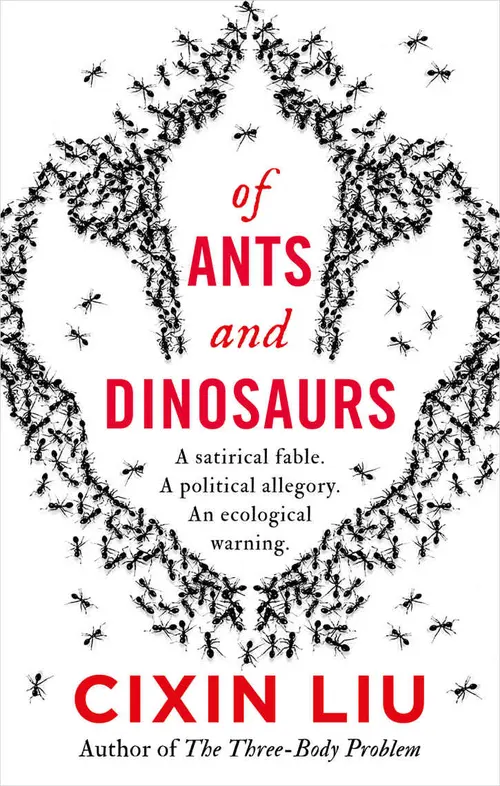
of
ANTS
and
DINOSAURS
BY CIXIN LIU
The Three-Body Problem
The Dark Forest
Death’s End
*
Ball Lightning
The Supernova Era
SHORT STORY COLLECTIONS
The Wandering Earth
Hold up the Sky
Title Page
of
ANTS
and
DINOSAURS
CIXIN LIU
TRANSLATED BY ELIZABETH HANLON
Copyright
First published in the UK in 2020 by Head of Zeus Ltd
Copyright © 2010 刘慈欣 (Liu Cixin)
English translation copyright © 2019 FT Culture (Beijing) Co., Ltd.
Co-published by Chongqing Media & Publishing Co., Ltd.
Translation by Elizabeth Hanlon
The moral right of 刘慈欣 (Liu Cixin) to be identified as the author of this work has been asserted in accordance with the Copyright, Designs and Patents Act of 1988.
All rights reserved. No part of this publication may be reproduced, stored in a retrieval system, or transmitted in any form or by any means, electronic, mechanical, photocopying, recording, or otherwise, without the prior permission of both the copyright owner and the above publisher of this book.
This is a work of fiction. All characters, organizations, and events portrayed in this novel are either products of the author’s imagination or are used fictitiously.
A catalogue record for this book is available from the British Library.
ISBN (HB): 9781789546118
ISBN (XTPB): 9781838935191
ISBN (E): 9781789546095
Design: David Wardle
Images: © Shutterstock
Author Photo: Li Yibo
Head of Zeus Ltd
First Floor East
5–8 Hardwick Street
London EC1R 4RG
Contents
By Cixin Liu
Title Page
Copyright
Prologue: Bright Sparks
1. The First Encounter
2. The Age of Exploration of the Dinosaur Body
3. The Dawn of Civilisation
4. Tablets
5. The Steam-Engine Age
6. The Ants’ Arsenal
7. The First Dinosaur–Ant War
8. The Information Age
9. The Dinosaur–Ant Summit
10. The Strike
11. The Second Dinosaur–Ant War
12. The Medical Team
13. The Final War
14. Mine-Grains
15. Luna and Leviathan
16. Defection
17. The Ultimate Deterrent
18. The Battle of the Signal Stations
Epilogue: The Long Night
About the Author
An Invitation from the Publisher
of
ANTS
and
DINOSAURS
PROLOGUE
Bright Sparks
If the entire history of the Earth were condensed into a single day, one hour would equate to 200 million years, one minute to 3.3 million years and one second to 55,000 years. Life would appear as early as eight or nine o’clock in the morning, but human civilisation would not emerge until the last tenth of the last second of the day. From the morning that philosophers held the first ever debate on the steps of a temple in Ancient Greece… from the day slaves laid the first foundation stone of the Great Pyramid… from the minute that Confucius welcomed his first disciple into the candlelit gloom of his thatched hut… right up until the moment you turned the first page of this book, only one-tenth of a tick of the clock would have elapsed.
But in the hours before this tenth of a second, what was life on Earth doing? Was every single living being doing nothing but swimming, roaming around, breeding and sleeping for… well… billions of years? Was every other organism universally and unremittingly stupid – for aeon after aeon? Of the countless branches on the tree of life, was our small twig really the only one to have been graced with the light of intelligence? It seems unlikely.
Nevertheless, for a germ of intelligence to grow into a great civilisation is no easy feat. It requires that many conditions be met simultaneously, a one-in-a-million coincidence. Nascent intelligence is as precarious as a tiny flame in an open field. It’s liable to be snuffed out in the slightest breeze, and even if it does catch and manages to set the surrounding weeds alight, the little fire will likely find its path blocked by a stream or an empty clearing, causing it to die out without so much as a whimper. Should it somehow muster sufficient energy and spread like wildfire, a heavy rainstorm will probably extinguish it. All in all, the chances of a tiny flame becoming a raging conflagration are exceedingly slim. And so we can assume that, through the endless night of antiquity, budding intelligences flickered on and then off again like the brief, brilliant twinkles of fireflies.
At approximately twenty minutes to midnight – that is, approximately twenty minutes before our arrival – two flames of intelligence appeared on Earth. We might call them bright sparks. This twenty-minute period was no mere flash in the pan, for it equates to more than 60 million years. It’s an era unimaginably distant from ours. Humanity’s ancestors would not emerge for another few tens of millions of years. There were no humans back then, and even the continents were shaped very differently than they are today. On the geologic timescale, it was the Late Cretaceous period.
At that time, gigantic animals called dinosaurs inhabited Earth. There were many different types of dinosaurs, and most of them were ludicrously large. The heaviest weighed 80 tonnes, or as much as 800 people, and the tallest grew to thirty metres, the height of a four-storey building. They had already lived on Earth for 70 million years, which is to say that they appeared on Earth more than a billion years ago from now.
Compared with humanity’s several hundred thousand years on Earth, 70 million years is a very long time indeed. Time enough for the patter of raindrops drip-dripping steadily onto the same spot to carve great chasms out of the Earth; time enough for the gentlest of air currents blowing continuously against a mountain to level it. A species undergoing continual evolution over the same timespan, no matter how stupid to begin with, will become intelligent. And that’s what happened to the dinosaurs.
Over those millions of years, the dinosaurs discovered how to uproot the biggest trees, strip away the branches and leaves, and tie massive boulders to their ends with rattan. If the boulder was round or square, the tree became a hammer so humongous that it could have flattened one of our cars with a single blow. If the stone was flat, the dinosaurs used it as a megalithic axe. If the stone was pointed, they left intact some of the tree’s upper branches and crafted the trunk into a spear tens of metres long. The branches stabilised the spear during flight, and it flew like a dud missile.
The dinosaurs formed primitive tribes and dwelt in enormous caves they excavated themselves. They learnt to use fire, preserving the embers left by lightning strikes to illuminate their cavernous abodes and to cook food. For candles they co-opted entire pine trees several arm-spans around. They even wrote on the walls of their caves with the charred tree-trunks, recording in simple strokes how many eggs were laid yesterday and how many baby dinosaurs hatched today. More importantly, the dinosaurs already possessed a rudimentary language. To our ears, their conversations would have sounded like the whistling of trains.
At the same time, another species on Earth was showing signs of budding intelligence. Ants. They too had undergone a long process of evolution; in fact, by this point, the scale of ant society far outstripped that of dinosaur society. Ants had raised cities on every continent – some of these took the form of towering ant-hills, others were subterranean labyrinths – and many of their kingdoms had populations exceeding 100 million. These vast societies developed ingenious, tightly organised structures and hummed along to an efficient, systematic rhythm. The ants communicated with each other using pheromones – extremely sophisticated odour molecules that could convey the most detailed information – and this endowed them with a more advanced language than that of the dinosaurs.
However, although the first glimmers of intelligence had appeared in two species on Earth – one great and one small – both species were beset with fatal flaws, and their respective paths to civilisation were strewn with insurmountable obstacles.
The dinosaurs’ biggest disadvantage was that they lacked dexterous hands. Their huge, clumsy claws were matchless in a fight (one type of dinosaur, Deinonychus, had claws as sharp as sabres, which it used to disembowel its rivals) and could fashion crude tools, but they were incapable of performing fiddly tasks, manufacturing sophisticated implements or writing anything complicated. This was problematic because manual dexterity is a prerequisite for the development of civilisation. Only when a species has versatile hands can a virtuous circle form between brain evolution and survival activities.
The ants, conversely, could execute extraordinarily fiddly tasks, and they constructed the most intricate architecture both above ground and beneath it. But they lacked flair and a certain richness of thought. When a gathering of ants reached critical mass they exhibited a collective intelligence that was literal and unerring, much like a computer program. Guided by these programs, which developed over extended periods of time, ant colonies built city after labyrinthine city. Their society operated like a vast, precisely engineered piece of machinery, but separate an ant cog from that machine and you’d find that the individual’s thought processes were disappointingly shallow and pedestrian. This was the ants’ downfall, for the sort of creative thinking required to progress civilisation is the province of individuals – individuals like our Newton and Einstein, for example. The very nature of collective intelligence, its intrinsic principle of redundancy, is antithetical to the production of advanced thought; 100 million of us humans, though we might rack our brains as hard as we can, would still not come up with the three laws of motion or the theory of relativity.
In the ordinary run of things, therefore, neither ant society nor dinosaur society could have continued to evolve. As with countless such examples before and since, the flames of intelligence that had flared into life within these two species should have fizzled out in the waters of time, a couple of ephemeral bright sparks in the long night of Earth’s history.
But then a curious thing happened.
1
The First Encounter
It was an ordinary day in the Late Cretaceous. It is impossible to determine the exact date, but it was truly an ordinary day, and Earth was at peace.
Let us examine the shape of the world that day. At that time, the profiles and positions of the continents differed radically from their current forms. Antarctica and Australia made up a single landmass greater in size than either continent today, India was a large island in the Tethys Sea, and Europe and Asia were two separate landmasses. Dinosaurs were found predominantly on two supercontinents. The first, Gondwana, had been Earth’s only continuous landmass several billion years earlier. It had since broken up, and its area was greatly reduced, but it was still as big as present-day Africa and South America combined. The second, Laurasia, had split from Gondwana and would later come to form what we now know as North America.
That day, every creature on every continent was occupied with the business of survival. In that uncivilised world, they knew not where they’d come from and cared not where they were headed. When the Cretaceous sun was directly overhead and the shadows cast by the leaves of the cycads were at their smallest, their sole concern was where they were going to get lunch.
In a sunlit clearing amid a stand of tall sago palms in central Gondwana, one as yet quite unexceptional Tyrannosaurus rex had just lynched a plump, good-sized lizard for its midday meal. With its fearsome claws it ripped the still wriggling lizard in two and tossed the tail end into its gaping jaws. As it munched away with relish, the dinosaur felt entirely happy with the world and its own place within it.
Things below ground were far from calm, however. The Tyrannosaurus’s pursuit of the lizard had caused a powerful earthquake in the subterranean ant town located a mere metre from the dinosaur’s left foot. Fortunately, the town had just avoided being trampled, but now hordes of its thousand or so residents scuttled to the surface to see what had happened.
The Tyrannosaurus had blocked out more than half their sky; it was like a towering peak piercing the clouds. For the ants massed in the mountain’s shadow, it was as if the day had suddenly become overcast. They squinted up, up, high into the sky, watching as the lizard’s tail arced through the air and into the fathomless mouth of the Tyrannosaurus. They listened to the sound of the dinosaur chewing, to the cracking and rumbling that was like thunder from the heavens. On previous occasions, this thunder had often been accompanied by a heavy downpour of splintered bones and chunks of flesh. Even a light drizzle of the dinosaur’s leftovers would provide lunch for the entire town. But this Tyrannosaurus kept its mouth tightly closed, and nothing rained down from the sky. After a few moments, it tossed the other half of the lizard into its mouth. Thunder boomed overhead again, but still the shower of bones and flesh held off.
When the Tyrannosaurus had finished, it took a couple of steps back and lay down contentedly for a nap in the shade. The ground shuddered, the peak collapsed into a distant mountain range, and brilliant sunshine flooded the clearing once more. The ants shook their heads and sighed. The dry season was long this year, and life was getting harder by the day. They had already gone hungry for two days.
Just as the crestfallen critters were turning back towards the entrance to their town, another earthquake rocked the clearing. The mountain range was rolling agitatedly back and forth across the ground! The ants watched intently as the Tyrannosaurus stuck one of its monstrous claws into its mouth and began to dig furiously between its teeth. Immediately, they understood why the dinosaur could not sleep: lizard flesh had got stuck in its teeth and was getting on its nerves.
The mayor of the ant town had a sudden idea. It climbed onto a blade of grass and released a pheromone towards the colony below. As the pheromone spread, the ants understood the mayor’s meaning and passed the message on. Antennae waved as a tide of excitement swept through the crowd.
Led by the mayor, the ants marched towards the Tyrannosaurus, streaming across the ground in orderly black rivulets. At first the mountain range seemed impossibly far away, visible on the horizon but unreachable. But then the restless Tyrannosaurus rolled towards them again, closing the gap between itself and the procession of ants in an instant. As it shifted, one of its huge claws fell from the sky and landed with an earth-shaking thump right in front of the mayor. The impact bounced the entire procession clear off the ground, and the dust it raised mushroomed before the ants like an atomic cloud.
Without waiting for the dust to settle, the ants followed their mayor onto the dinosaur’s claw. The dinosaur’s palm had come to rest perpendicular to the ground, forming a craggy, precipitous cliff. But to the ants, who excelled at climbing, this was no obstacle. They quickly darted up the cliff-face and onto the dinosaur’s forearm. Still in formation, they navigated the rough skin of the forearm, winding their way across its plateau-like surface, down and up the steep sides of its countless gullies and on towards the upper arm and the Tyrannosaurus’s maw.
Just then, the Tyrannosaurus raised its massive claw to pick at its teeth again. The ants advancing across its forearm felt the ground beneath them tilting, followed by an alarming increase in G-force. They clung on for dear life. Half their view of the sky was now taken up by the dinosaur’s colossal head. Its slow breathing was like wind gusting through the heavens and its oceanic eyes peering down at them made them tremble with fear.
Spotting the ants on its forearm, the Tyrannosaurus raised its other arm to brush them off. Its palm blotted out the midday sun like a vast stormcloud, casting a threatening shadow over the ant army. They stared up at it in horror, twitching their antennae frantically. The mayor quickly raised one of its front legs and the rest of the troop immediately did the same, the entire colony now one long, quivering black arrow pointing at the dinosaur’s mouth.
The Tyrannosaurus was stunned for a few seconds but eventually grasped the ants’ intention and lowered its arm. The stormcloud dispersed and sunlight returned. Then the dinosaur opened its mouth wide and placed a single clawed finger against its titanic teeth, forming a bridge between arm and jaw. There was a fraction of hesitation, but the mayor took the lead once again and the rest of the colony marched on without demur.
The first group of ants swiftly reached the end of the finger. Standing on the smooth, conical claw-tip, they gazed into the dinosaur’s mouth in awe. Before them was a night-time world where a storm was brewing. A fierce, damp wind reeking of gore blasted their faces, and rumblings rose up from the dark, chasmic depths. When the ants’ eyes adjusted to the gloom, they could just make out a patch of even denser darkness in the distance, the borders of which kept changing shape. It took them a long time to realise that this was the dinosaur’s throat. It was also the source of the rumbling, which was coming from the Tyrannosaurus’s stomach. The ants instinctively recoiled in fright. Then, one by one, they climbed onto the dinosaur’s huge teeth and crawled down the smooth white enamel cliffs.
With their powerful mandibles, the ants tore at the pink lizard flesh that was lodged in the ravines between the teeth. As they chewed, they stared up at the enormous white columns rising skywards to either side of them. High above them, on the dinosaur’s palate, another row of gnashers gleamed menacingly in the sunlight, looking for all the world as if they might come chomping down at any moment. But the Tyrannosaurus had already moved its finger to its upper jaw, and an unbroken stream of ants was now scaling those teeth and devouring the meat stuck between them, creating a mirror-image of the scene on its lower jaw.
More than a thousand ants bustled about the dozen or so crevices and soon the scraps of meat had been picked clean. The dinosaur’s dental discomfort had been dealt with! The Tyrannosaurus was not yet evolved enough to say thank you, so it merely let out a long sigh of satisfaction. This sudden hurricane blasted every last ant out of the dinosaur’s mouth and into the air in a cloud of black dust, but because their bodies were incredibly light, they landed unscathed about a metre from the Tyrannosaurus’s head. With their stomachs now full, the ants pattered back to the entrance of their town, thoroughly sated. The Tyrannosaurus, meanwhile, rolled over into the cool shade and fell into an easy sleep.
And that was that.
As the Earth quietly turned, the sun slid silently towards the west, the cycad shadows lengthened, and butterflies and bugs flitted through the trees. In the distance, the waves of the primeval ocean lapped against the shores of Gondwana.
Unbeknown to all, in this most tranquil of moments the history of the Earth had taken a sharp turn in a new direction.
2
The Age of Exploration of the Dinosaur Body
Two days after the encounter between the ants and the dinosaur, on an equally sweltering afternoon, the inhabitants of the ant town were shaken by another quake. They scampered up to the surface and were met by the towering figure of a Tyrannosaurus, which they straightaway recognised as the same one from before. It had hunkered down and was scouring the ground for something. When it saw the colony, it lifted a claw and jabbed at its teeth. The ants understood immediately, and in a single uniform gesture all 1,000 of them waved their antennae excitedly. The Tyrannosaurus placed one of its forearms flat on the ground and allowed the ants to climb on. And just like that, the scene from two days earlier was replayed: the colony made a meal of the scraps of meat stuck between the dinosaur’s teeth, and the dinosaur was relieved of a minor dental discomfort.
For some time after that, the Tyrannosaurus routinely sought out the town of ants so they could pick its teeth. The ants could feel its footfalls from a kilometre away and were able to accurately distinguish them from those of other dinosaurs. They could even tell from the vibrations in what direction the Tyrannosaurus was moving. If it was heading towards the town, the ants rushed eagerly to the surface, knowing that their food supply for the day was assured. Even though one party in this cooperative endeavour was very large and the members of the other party were undeniably very little, it didn’t take long for the interactions between the two to become well honed.
One day the vibrations coming through the ants’ earthen ceiling sounded different, unfamiliar. When they streamed up into the clearing to investigate, they saw that their partner had brought along three other Tyrannosaurus rex and a Tarbosaurus bataar! All five dinosaurs gestured at their teeth, requesting the ants’ help. The mayor, recognising that its colony couldn’t possibly undertake such a massive task on its own, sent several drones post-haste to contact other ant towns in the area. Soon, three mighty rivers of ants came pouring in from between the trees, and an army of more than 6,000 ants converged on the clearing. Each dinosaur required the services of 1,000 ants, or, rather, the meat between the teeth of one dinosaur could satisfy 1,000 ants.
The next day, eight dinosaurs came to have their teeth cleaned, and a few days later that number increased to ten. Most of them were exceedingly big carnivores and they had a correspondingly big impact on their surroundings. They trampled the nearby cycads, enlarging the clearing significantly, and at the same time they solved the food problems of a dozen ant towns in the vicinity.
The Story Continues on BooksBarbecue!
Enjoyed this preview? ❤️ Do not stop here!
Read the complete book free online → 🔗
Continue reading now on BooksBarbecue and discover every page!
Love reading? Bookmark BooksBarbecue.com for more amazing books!
Happy Reading!