Nosferatu
Chapters (14)
Cover Page
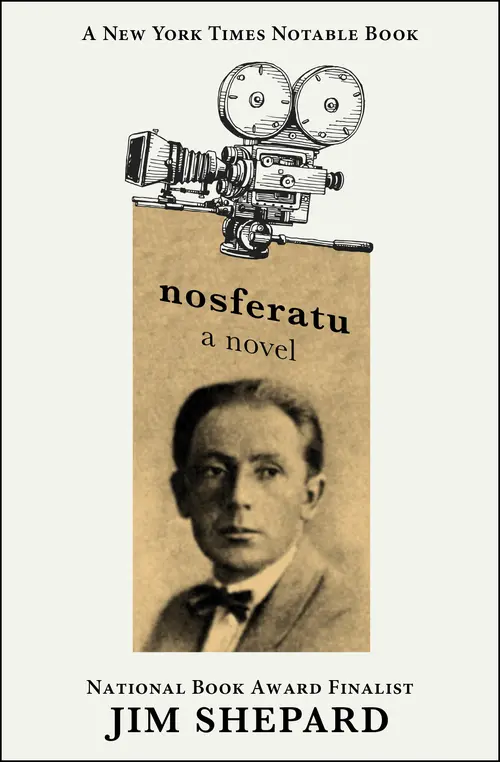


Title Page
Nosferatu
A Novel
Jim Shepard
Introduction by Ron Hansen

Dedication
For Karen
Introduction
INTRODUCTION
Friedrich Wilhelm Plumpe was born to a family in the textile trade on December 28, 1888, in the Westphalian city of Bielefeld, in the farmlands of northwest Germany. At the age of eighteen, after receiving his Abitur, the “angular and gawky” Wilhelm went east to study philology at the University of Berlin, and at the Charlottenburg railway station met a finely freckled, barrel-chested classmate who yearned to become a poet. “For Wilhelm,” Jim Shepard writes, “it was as if he’d caught his first glimpse of life’s splendor, which in its fullness always surrounded him, veiled from view and far off.” With Hans Ehrenbaum-Degele, the son of a wealthy Jewish banker, Wilhelm fell in love.
The soulmates went on to the University of Heidelberg where they studied art history and literature until the great director Max Reinhardt offered Wilhelm a place in his newly founded theater school in Berlin. There the young man established himself as a rather good actor and fledgling stage director, and fell into friendships with the lunatic poet, Else Lasker-Schüler, and with Walter Spiess, a painter who “seemed to be committed to nothing in particular, to stand in an attitude of general hospitality to opportunities.”
Shepard here suggests that Wilhelm jettisoned his family name—plump in German meaning just what it does in English and also carrying the added indignity of “clumsy”—after a Christmas idyll with Hans in a ski lodge at the Upper Bavarian spa of Murnau, where he assumed the village’s name as his own. They’d gone there “in the hope of rededicating themselves to each other,” but just a few years later while Murnau placidly submitted to a homosexual tryst with Spiess, afterward watching “Hans’s contentment transformed into the damaged wariness of a child’s understanding that his loved ones weren’t motivated only by selflessness.”
Soon after their country recklessly plunged into the Great War, Hans joined the infantry, and Murnau was called into the First Regiment of the Foot Guards at Potsdam, transferring into the Flying Corps after hearing that Hans was killed in the infantry trenches of the Russian front, identified only by his torso. Assigned to an observation squadron that flew flimsy, fabric-covered biplanes, Murnau crashed to earth several times before a final crash landing in Switzerland took him out of the war. Shepard suspects it was an act of desertion that was inspired almost wholly by his deep mourning for Hans. As Shepard movingly puts it, “Hans was the anguish that pulled its plow through his sleep.”