Northwind
Cover
Dedication
This book is dedicated to Jennifer Flannery,
my agent of thirty years. She has been, more than once,
the what, where, when, and how of my work.

The Saga of Sea Child
AND IT CAME TO PASS HE WAS BORNE OF
A WOMAN OF THE SEA,
BORNE OF A SEA WOMAN, WITH A BLOOD
CLOT HELD TIGHTLY
IN HIS TINY FIST.
Å SIGN.
A SIGN TO TELL, TO TELL OF HARDSHIP AND
DANGER IN THE LIFE TO COME,
TO COME, FROM THE TINY FIST AND CLOT.
AND THE MOTHER, OF NO REMEMBERED
NAME, DID DIE BIRTHING THE BOY
AND THE FATHER, ALSO OF NO
REMEMBERED NAME,
HAD PASSED TO VALHALLA FIGHTING A
WHALE.
AND AS THERE WAS NO OTHER NAMED FAMILY
THE BOY WAS BORN AN ORPHAN.
ALONE.
TO LIVE ALONE ON THE DOCKS, A DOCK
BOY, A WHARF BOY, NURSED BY SUCKING
RAGS DIPPED IN SOUR GOAT’S MILK AND
FISH OIL,
FED ON SCRAPS OTHERS WOULD CHEW TO
SOFTEN,
DRESSED IN YET MORE RAGS WITH
CRUDELY CARVED WOODEN SHOES,
ALWAYS HALF NAKED.
HE WAS THAT BOY.
THAT BOY.
AND THEY CALLED HIM THE WHARF RAT AND
NAMED HIM LEIF
FOR NO OTHER PERSON ON THOSE DOCKS
HAD THAT NAME.
AND WHEN HE WAS OLD ENOUGH TO WALK
THEY TOOK HIM ON THE BOATS.
FOR ALL HIS YOUNG LIFE HE WAS PASSED
FROM ONE BOAT TO THE NEXT, TO THE NEXT,
TO THE NEXT.
NO LONGER THE WHARF RAT NAMED LEIF BUT
A BOAT RAT NAMED LEIF.
AND WHEN HE COULD USE HIS HANDS THEY
SET HIM TO REPAIRING NETS,
SEWING RIPPED NETS, TORN CLOTHING, AND
SHARPENING THE SEAL-KILLING HARPOONS,
BEATING HIM WITH WOODEN RODS IF HE
DID THEM WRONG.
AND THEY MADE HIM COOK GREASY EEL MEAT
THAT THE SAILORS WOULD EAT,
CLAIMING IT WAS SOFT AND WOULD BE
EASY TO PUKE WHEN THEY BECAME SEASICK.
ACROSS ONE OCEAN, INTO ANOTHER OCEAN,
THEN NORTH LOOKING NOT FOR WHALES –
WHICH WERE TOO HARD TO KILL – BUT FOR
SEALS, FOR THEIR GREASE-MEAT AND FURS.
ALWAYS AFTER FURS.
FOR SEAL FURS SHINED LIKE GOLD PIECES.
ALWAYS NORTH, WHERE THE SEAL FUR WAS
THICKEST AND MADE FOR BETTER WARMTH.
AND THE BOY GREW AND WAS FIVE SUMMERS,
THEN SIX, THEN EIGHT, AND TEN,
AND TWELVE SUMMERS, TAKEN ON ONE
BOAT, THEN ANOTHER AND ANOTHER,
UNTIL WHEN HE SLEPT IN HIS DREAM
STORY IT SEEMED LIKE ALL ONE OCEAN,
AND WHEN HE CAME AWAKE IT STILL
SEEMED LIKE ONE OCEAN JUST AS ALL
BOATS SEEMED LIKE ONE BOAT AND ALL
EEL MEAT – WHICH HE LEARNED TO PUKE –
SEEMED LIKE ONE MEA TAND ALL PUKE
SEEMED LIKE ONE PUKE
AND ALL BEATINGS SEEMED LIKE ONE
BEATING.
AND WINTERS.
THE BOY HAD WINTERS WHERE THE FREEZING
SEA BOILED IN BLOWN RAGE AND WAS
SOMETIMES SO COLD,
MEN’S FINGERS WOULD FREEZE BLACK AND
HAVE TO BE CUT OFF,
AND THE BOY WOULD RUB OIL ON THEM
TO TOUGHEN THE STUBS,
AMAZED THAT MEN COULD STILL WORK
WITH ALMOST NO FINGERS.
NORTH.
FOR THE BETTER FURS THAT SHINED LIKE
GOLD.
UNTIL THEY WERE NORTH, HAD COME IN THIS
BOAT NORTH TO TURN EAST
IN THE GIANT STRAITS AND UP INTO THE
FORESTED WILDNESS
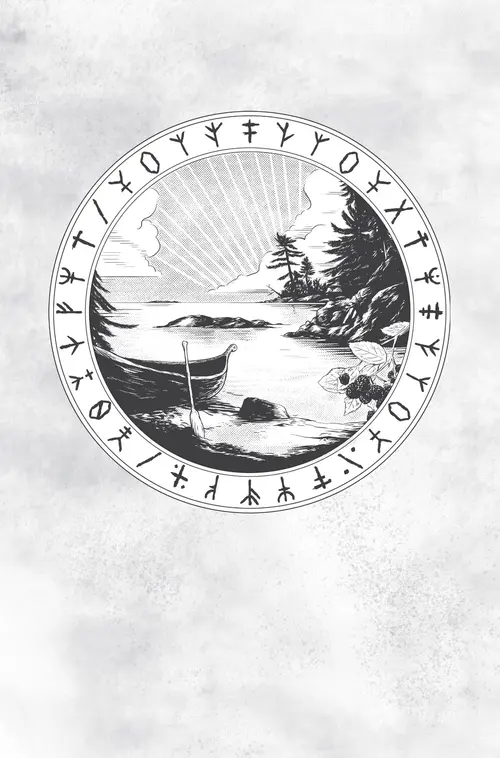
AND AN ISOLATED FISH CAMP WAS SET UP
WHERE A SMALL RIVER CAME IN TO THE
SEA.
WHERE THE SHIP LEFT LEIF.
AND FOUR USED-UP AND PART-CRIPPLED OLD
MEN – ONE NAMED OLD CAR L – AND A
SMALL THRALL BOY BOUGHT OFF A
WHALING SHIP ON WHICH A TRAVELLING
WHARF WOMAN HAD BORNE THE CHILD AND
PASSED AND AFTER SHE WAS BURIED AT
SEA THE CREWFED THE SMALL BOY ON
FISH SAUCE AND SEAL MILK CUT FROM
DEAD SEALS THAT HAD BEEN NURSING
UNTIL HE LEARNED TO WALK. BUT WITH
THE WOMAN GONE, THEY WANTED NO
CHILDREN AND SO SOLD HIM FOR A
FOLDED BOLT OF HEAVY SAILCLOTH.
AND HE WAS NAMED LITTLE CARL FOR HE HAD
NO OTHER NAME.
AND IN THIS FISH CAMP THEY WERE TO TAKE
SALMON FROM THE MOUTH OF THE RIVER AND
SMOKE THE MEAT WHILE THE SHIP WAS
GONE UP NORTH OUTSIDE THE GIANT
ISLAND LOOKING FOR SEALS.
FOR THE SEALS WERE LIKE GOLD IN THE SUN.
AND THIS THEY DID, TAKING AND CUTTING
HUNDREDS OF SILVER SALMON AND
SMOKING THEIR MEAT IN HAND-FASHIONED
RACKS FOR DAYS UPON DAYS UNTIL THEY
HAD ENOUGH SMOKED AND DRIED FISH TO
LAST A WHOLE CREW OF A SHIP FOR AT
LEAST SIX MOONS.
AND THEY WAITED FOR DAYS UP ON DAYS
AND THE SHIP DID NOT RETURN FOR THEM.
WOULD NEVER RETURN FOR THEM.
FOR THIS WAS A BAD COAST WITH TERRIBLE
RIPPING TIDES AND UNPREDICTABLE WINDS AND
ROCKY POINTS WHERE DEATH WAS ALWAYS
WAITING, AND THIS THEY KNEW AND SO
CAME TO KNOW THERE WOULD BE NO SHIP
COMING BACK FOR THEM AND THAT THE
SHIP AND CREW WERE GONE TO VALHALLA.
AND THEY WERE ALONE.
AND THEY WOULD HAVE TO LEAVE THIS PLACE
BY WAY OF THE SEA. THEY HAD A SMALL
CANOE, WHICH THEY HAD USED AXES TO
CARVE FROM A CEDAR LOG, FOR WORKING
IN THE STREAM SPEARING SALMON, BUT
THEY WERE TOO MANY FOR SO SMALL A
CRAFT AND IT WAS DECIDED THEY SHOULD
MAKE A LARGE DUGOUT CANOE TO TAKE
THEM ALL AND HAD CUT DOWN A GIANT
TREE TO ROLL-DRAG INTO CAMP.
AND THEY WOULD HAVE DONE THIS.
COULD HAVE DONE THIS.
EXCEPT DEATH FOUND THEM.
Men Who Have Lost Their Shadows

Nobody knew exactly when the dark ship came and to be sure at first they could not see it at all but only understood it was there in the thick fog by the smell.
There was a drifting stink of death.
A green-dark stench of burned and rotting greasy death came out of the fog, up the rocky bank, over the cedar canoe, into the small bark shelter huts they had made, past and around and through everything, slithering into every nook until all the men who had been deep in safe sleep came awake with the smell clawing into their every breath.
Death smell.
Death smell from a large wooden ship that rode heavy with the wind on dirty sails, hanging now in sloppy, stained loop-folds, coming from and with and in the fog so the dark and ugly ship seemed almost an extension of the fog itself.
There was no wind. Not a breath of it. And yet the boat moved, had moved along and down channels from the open sea, coming in silence – dead silence – on the moon-currents as the wild tides changed and pulled and pushed the silent drifting wooden ship until at last it came into the cove in front of the camp, seemingly of its own volition.
And stopped. Meant but not meant, not planned to be there but there, sending its death stink, the stink from blood-soaked decks and rotted gore and rendered fat, boiled off small whales, seals, dolphins – anything alive that had fat on it and could be made dead and the fat cooked out – ahead of the ship like a silent, dirty scream of filth.
But something else, too: the smell of dying, rotting men.
For a time there was a silence. Non-sound. A complete cessation of sound. Not even a croak from the crows and ravens circling above the drying racks. Night moved away and light came and the fog dissipated slowly, streaking around and away in grey swirls until the source of the stink could be seen, sitting in the cove, squat, thick-heavy in the water, its bow nudging against the rocky pebbles of the shore. A silent horror.
Then came the men.
They were not clean.
As crude and dirty and stinking as the ship, four men lowered a small workboat from the side of the ship and climbed down into it. One man used two oars to push the boat to the pebble beach, and three climbed out with great effort while the fourth held the small boat against the shore.
Some in the camp later said of the men that they seemed to be made from scraps of parts of the ship. Indescribably dirty, as worn as old wood, with their skin hanging from their bones, eyes red and deep in their sockets, and when they opened their mouths to smile a greeting, it could be seen that many teeth were gone.
They were in some strange way not unkind – though their appearance was in itself offensive – but so weak they could hardly stand. It was not even clear what they wanted, as their language made no sense. One of the elders said later it was as if their tongues tripped in some manner on their sparse teeth so the words rattled and could not be understood.
‘Nyet,’ one said, shaking his head while he stuttered more unknown words, waving generally in the direction of the sea.
‘Da,’ another added, nodding, pointing away from the sea and towards the shore, towards some thing up on the shore near the forest, the sailor waving and pointing, so that men in the camp out of politeness all looked up in the same direction as intently as they could, but saw nothing.
No part of the encounter was any better, made any sense. The weak men stood, weaving slightly, and the men in camp stood watching them and all was in silence, all in the tendrils of fog that still rolled back and forth. Real but not real, there but not there, men but not men.
Then the moon-currents came once more into the cove and captured the ship and it started to drift out of the cove and the boatmen hurried as best they could, staggering and nearly falling, and went back onto the vanishing ship.
Into the fog, into nothing. As if it had never been there, never been seen or heard or even smelled.
Gone.
Never seen again.
‘They were spirit men,’ said one man from the camp, and who was to argue with him?
‘Fog spirits – ghost men from the dark world . . .’
And those who said such things looked away in quiet fear at where the ship had been, and they shivered as if a dark-cold wind had come upon them.
A dead wind.
Death wind.
‘They are men who have lost their shadows,’ said Old Carl, the eldest of the crew. ‘They are men who have done some great wrong and have lost their shadows.’ He waved his hand to the sky places. ‘They must search for their shadows to become men again. Whole men. They must drift forever in the death ship. And because they will never find their shadows again . . .’
He did not finish as he did not need to finish.
But the boy Leif wanted, needed, to know more and did not know how not to be rude, so he asked: ‘What happens because they cannot find their shadows?’
‘They will bring misery,’ Old Carl said. ‘Misery. They will kill all joy and only bring misery with their foulness.’
And because Old Carl was thought to be wise, everyone believed he was right. Even though they would never see the death ship again and the fish smoke fires drove away the smell of the ship and the man-dead stink, even then they knew something bad had to come. Had to come.
Something from the dark places would come in like the fog.
Something bad.
And eight days after the dark ship and men without shadows had gone the first men grew sick.
Two men first.
They became uncomfortably warm and then hot with a burning fever and so weak they could not stand and finally crawled into their huts to lie, still and sweating. Until vomit took them and they could not hold food or hot fish soup, the other men tried to feed them, and then not even water, and the vomit turned to blood and the second day even with what care they could be given the ghosts left the bodies of the two men almost at the same moment and they died.
Died.
Then the man who cared for them was hunted and found by the fever and went down and lost his ghost and likewise died.
Three of them.
But it did not end.
Instead the sickness became like a fire roaring through the camp and soon Old Carl started to burn.
Before he vomited blood, the old man took Leif and Little Carl and put them in the cedar canoe with some food and supplies, and sent them away.
‘Go north,’ he said, pushing them as hard as he could from the shore. ‘The men without shadows made the air here sick with their poison. Head north where the air is not sick and where the water channels are so small they will not let the death ships pass. Keep going north and never come back. Never come back to this place. Never.’
Yet Leif, who did not understand about not being rude, said: ‘But what of you? Can you not come?’ For he liked, loved Old Carl in his fashion and if he found truth in himself he admitted that he felt fear, deep fear, in going off from the camp, into what wildness he did not know.
‘All who are here will pass over the bridge. I am already sick. The fever has not taken you and Little Carl and you must leave. Now. Go away from this bad air, this bad dead place and do not look back, do not come back, do not even think back. Go.’
And Old Carl turned away from the shore and walked back into the camp and the boy would always remember that he walked straight and tall though he was walking to his end, to his journey over the bridge of life into the other. The Other. Valhalla.
Then the canoe caught the moon-currents, which had turned and were heading out, and moved by itself around a point of forest that stuck out and Leif could not see the cove nor the camp any longer.
Since the current was heading north in the channel that passed the cove, Leif took up a paddle and dug it deep into the water next to the side of the cedar canoe and it slid forwards. He neither cried nor choked a sound at his fear and sadness because Little Carl was watching him and one should not cry nor show fear in the face of small children.
It was early in the day when Old Carl pushed them off and the sun came up to warm their bare backs and Leif kept paddling hard, as if the mere act of hard work would ease the misery and pain and homesickness that worked at him.
Little Carl was very young and when it became obvious that he could not work at using the second paddle, he ate a small strip of smoked fish and curled up against the bundle of supplies and went to sleep.
Leif kept stroking with his paddle and the canoe seemed to almost fly along with the moon-currents, but he kept digging the paddle deep even after his shoulders started to ache and his arms felt like they belonged to some other person.
All that day. They stopped once at a tiny stream that came falling out of the rocky edge of the forest, sitting in the canoe, and drank the water that they dipped with their hands, sweet and cold, and then Leif went back to paddling.
Heading north. Always north up through the wide channel all the afternoon and when the sun had moved over to shine on their shoulders Leif pulled into a narrow cove and used the braided rope to tie off the canoe to a small tree. He decided they would sleep in the canoe. What night came was exceedingly short this time of the year, and he was so tired he didn’t feel like trying to start a fire.
Still sleep did not come easily. Little Carl was restless and though he didn’t speak he kept coming to the edge of crying and would turn away without speaking. Leif touched the small boy’s forehead and thought it seemed warm and then felt his own to compare as those who became ill said first their foreheads grew hot. But it proved nothing because his forehead felt the same temperature as his hand, so he used the paddle across the thwarts of the canoe as a rest, leaned back against it, and doze-slept through the partial darkness that was night.
The forest was strangely silent through his sleep. No sound of birds nor squirrels until just at dawn when he awakened to hear some ravens gurgle-talking their morning chat-speak and he sat up and stretched. He had slept hard and dreamed but could not remember what the dream was about except that it was in some way dark, and he shook his head to shake the feeling away.
There was still a good amount of smoked fish so he tore off and chewed a big-enough hunk to cut hunger and then turned to Little Carl.
The child was awake but did not speak, even to answer. He stared at Leif as if seeing through him. He would not eat and his forehead felt definitely warmer now, and Leif knew he was sick but didn’t know what he could do about it. He splashed some cold seawater on the little boy’s forehead to make it feel cooler, and he tried to fight down the horror from the death days in the camp that now seemed to be following the canoe. Seemed to be hunting them. A dark beast that he could not see but had come in his dream was now coming with them. At them. To take them.
Go north, Old Carl had told them. Go to where the air was not poisoned, and Leif untied the braided cord from the trees and pushed off and took the paddle in his hands and dug deep into the water. Dug down like he was digging into the earth. Dug down as he was digging for his life. Or dug deep, he thought, as if digging a grave.
Out of the inlet and into the bigger channel the moon-currents were flooding north and he rode them.
Rode them.
Praying for the cleaner air that wasn’t poisoned that Old Carl said lay somewhere to the north.
Pushed, ripped, dragged the paddle through the water so that the beautiful cedar canoe had a life of its own, a life without poison air, a life to live, to be.
North.
Without a break. His arms and shoulders and back screaming in agony, but still digging deep and long. Until it came to be later in the day, almost evening, and he found himself weak, weaker, and knew he was getting hot, burning with the death fever.
Leif stopped paddling. He let the moon-currents have them while he leaned to the side and vomited fish and bile and traces of blood into the water – as Little Carl had been doing all day. He could not fight anymore and collapsed and let the fever take him as the moon-currents took them.
Swirling into his mind, his thoughts, his dreams, fevered currents and mind pictures and finally, at last finally, the great and almost joyous release of nothing. Away into no place, no time, no being, no thing.
Away.
And away.
Nothing.
Mother Waters and Brother Whales
He did not know . . . anything.
For the longest time he only knew, or thought he knew, he was dead. He had gone to that place in the dark world where all was without knowledge or understanding and what he believed was true did not really exist and when that was gone there was nothing to replace what he had been. Replace his life.
He simply did not exist. No dreams, no memories, no anything of what life had been.
He lay in the bottom of the canoe unconscious, unknowing, for a time he could not even fathom. A day into night and then another day into night and floating, floating back and forth and around, caught in the moon-currents, the canoe a deathbed, where he would die, knew he would die, covered in his own filth, vomiting, finally, just where he lay. Too weak, too soft and weak even to raise up and vomit over the side.
Once his eyes opened briefly and the sun shone down on Little Carl, and Leif could see his greyness, see that the little boy’s ghost had gone over the bridge but he could do nothing. Could not move. His body racked with bone aches and deep pain, pushing his mind back down into the pit.
And no movement.
A blankness.
And in that, into his unconsciousness, there came the large sound of breathing. It came – though Leif did not know it – from next to the canoe as a pod of the black-and-white whales came near the boat and nudged it, played with it, pushed it back and forth. One and then another of the young ones rose up above the canoe and looked down on Leif and the body of Little Carl in open curiosity but did not find them very interesting, and when one of the mothers made the sound that called to them, they sank back down in the water and moved off.
Young whales, above all, love to play and the young ones did not see danger in the perfect toy – so light and quick to the nose-touch that it slid like a wooden feather on the water – and they were soon back at it, pushing the canoe back and forth across the surface. It was a game they loved, a kind of catch. They played it with a large fish or a small piece of wood, sometimes a small seal, which they’d throw and tail-slap back and forth to one another.
They nudge-pushed the canoe between them across open water, slipping it to and fro on the smooth surface until they came to a small inlet – there were, literally, thousands of such places – surrounded by trees. Here one of the mothers, fed up with their play, came among them, pushed the canoe onto the rocky little beach with a hard shove, and chased the young whales away before any of them could get hung up on the rocky shoreline. Getting stranded on a rock-strewn shore was a great danger for young ones who did not always understand their limitations. It could, and sometimes did, lead to a slow death and this time they caught the urgency in the mother’s command and listened and moved out of the inlet.
And the canoe sat.
The Story Continues on BooksBarbecue!
Enjoyed this preview? ❤️ Do not stop here!
Read the complete book free online → 🔗
Continue reading now on BooksBarbecue and discover every page!
Love reading? Bookmark BooksBarbecue.com for more amazing books!
Happy Reading!