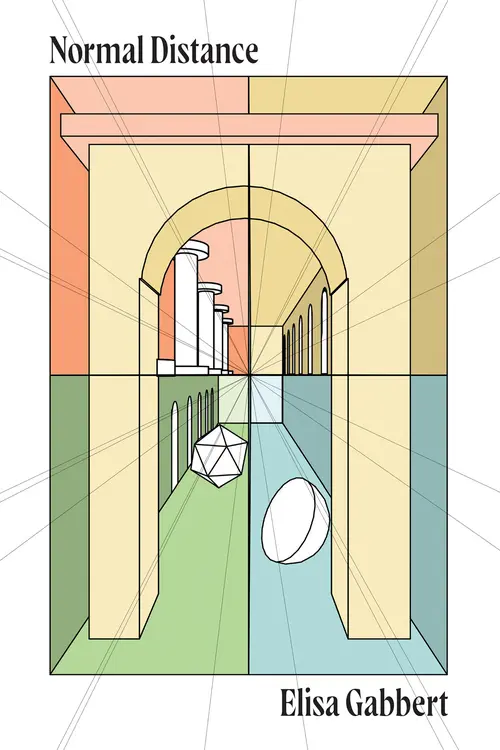
Normal Distance
Cover
Advance Praise for Normal Distance
“What I love about the poems in Normal Distance is how each uncannily assembles within the reader a scale model of Gabbert’s own booming wonder—a New Mexico moon rises ‘absurd on its face. // All ha ha ha.’ Sleep is where ‘Time comes out of time’; then, it’s ‘a performance for God.’ It’s all just so delight-full, delight in the Horatian sense of dulce et util, delight that pierces the reader’s mind so wisdom can get in. Gabbert achieves that highest lyric aim: she restores to living a bit of its baffle.”
—Kaveh Akbar, author of Pilgrim Bell
“Reading Elisa Gabbert’s Normal Distance is like seeing through ‘a mirror at strange angles,’ where contradiction and paradox fascinate and stymie the human drive to know. I loved wandering with Gabbert through extended, long-lined meditations and drilling down with her into short intense lyrics on the eternal subjects—suffering, boredom, madness, the moon—like I’d been taken in hand by a mad hatter epistemologist, wondering why we think we know what we know. You can use Normal Distance for bibliomancy, opening its pages at random to find just the right words for what ails you, and what might lift your mind and spirit too. It’s friendly and surprising, thinking with Gabbert: her wit is sly, her apprehension of the ordinary so strange and true: ‘We are born not remembering why we walked into the room.’”
—Dana Levin, author of Now Do You Know Where You Are
“‘I feel,’ says Kierkegaard’s aesthete ‘A,’ ‘as if I were a piece in a game of chess, when my opponent says of it: That piece cannot be moved!’ But in this playfully despairing book, our speaker—call her the melancholy American—feels to me like she’s on third base with (a) the bases loaded and (b) the distinct feeling that the batter’s going to get walked. He does, she saunters, and, refreshingly free of ballyhoo, she scores. The poems in Normal Distance find Elisa Gabbert taking her trademark even-keeled clairvoyance and matter-of-fact sass to new extremes of quotidiana, new cul-de-sacs in the abyss. Say them and they’ll eat at you all day.”
—Graham Foust, author of Embarrassments
“A magnificent book of poems, unafraid to interrogate our maddening existence, vengefully honest, and pierced with a blazing conversation towards philosophy. Gabbert has a gift for exposing human longing, with poker-faced lyricism, for the fantasy it often is. Suffering pervades this book: our addiction to it, our denial of it, and the absolute inevitability of it. What Gabbert shows us is that suffering comes in many forms, and one of the most prevalent is boredom: ‘The secret to immortality is boredom. If you’re bored enough you’ll never die,’ she writes. Always there is a solidarity in the poems. We are all together in this; we are the poet. And humor—which Freud knew held as much rich unconscious content as dreams—makes these elegant, genius poems anything but boring. ‘Can you not pay attention to your desires?,’ she asks. She replies with all her pitch-perfect characteristic sagacity: ‘I don’t care. I want to change my mind.’ Same.”
—Bianca Stone, author of What Is Otherwise Infinite
“Elisa Gabbert’s newest book of poems, Normal Distance, is a must-read. It is a work of full force and cannot be forgotten long after you close its pages. Its intricate language mazes and areas of language play create a landscape of full sensations, thoughts, and pure emotion. In the book, you enter places where the starkness of our time is met with the tenderness of what it means to be a human. Places where the ‘lindens’ both ‘bloom’ and ‘didn’t bloom,’ where ‘suffering was less absurd,’ places where the ‘inflection of a spell’ ‘turns off your power,’ where ‘everything is a monolith,’ places with ‘frightening’ ‘empty space,’ and where ‘youth is a kind of genius.’ These poems are places where anything can be anything and where what the poet feels intimately can still be everything. As Gabbert writes, ‘We are born not remembering why we walked into the room,’ and I believe her. This is a book that you will remember for a long time, after birth and death, and into the eternal space where poetry still lives.”
—Dorothea Lasky, author of Milk
“‘There’s a hole in your nightmare / You could fall down,’ writes Elisa Gabbert from America of the 2020s, where ‘normal’ has never been ‘normal’ and now distance is up in your face. ‘Every year, when the lindens bloom, I think of the year / when the lindens didn’t bloom,’ begins this journey wherein distraction helps thinking and precision allows perspective, and indecision, which by now is a character trait of a large group, touches on metaphysical: ‘Everything reminds me of it, but I don’t know what “it” is.’ But Gabbert knows answers, and isn’t afraid to share them: ‘We are born not remembering why we walked into the room.’ She knows, too, that ‘What it wants is desire. / A barrier to crossing / The chasm of the day.’ The metaphysics in this book is felt, and lived, and searching. The questions are playful, the answers are wise, and the language is always precise, beautiful. Normal Distance is a joy to read and reread.”
—Ilya Kaminsky, author of Deaf Republic and Dancing in Odessa
“If you were to start Elisa Gabbert’s sharp and companionable new book by reading the Notes, you’d find the tracks of a restless thinker whose trip through the past—what has been written, thought, said, felt—is lined with the present-tense vertigo(s) of self-doubt, forgetfulness, anxiety, pain, joy. But don’t start at the end: read this sequence from the start, open to its unfolding entanglement of quick revelations, ‘The way you fail to see, or recognize yourself, in a mirror at strange angles.’ Like its unresolvable title, Normal Distance vibrates between assertiveness and mystery, poking at philosophy’s rules and continually returning us to questions of a less containable sort: how and what the body knows, and how and what the body of the poem might tell.”
—Anna Moschovakis, author of Eleanor, or, The Rejection of the Progress of Love
Select Praise for The Unreality of Memory
A New York Times Editors’ Choice
A Colorado Book Award Finalist
“Gabbert draws masterly portraits of the precise, uncanny affects that govern our psychological relationship to calamity—from survivor’s guilt to survivor’s elation, to the awe and disbelief evoked by spectacles of destruction, to the way we manage anxiety over impending dangers. Even more impressive is her skill at bending crisp, clear language into shapes that illustrate the shifting logic of the disastrous, keeping the reader oriented amid continual upheaval.”
—Alexandra Kleeman, The New York Times
“Gabbert moves fluidly from disaster to dislocation to political upheaval, offering a kind of literary road map to our tumultuous era . . . Her questing, restless intelligence is what holds the essays together . . . A fine collection from a poet who seems equally comfortable in prose.”
—Kirkus Reviews (starred review)
“Whatever the chosen topic, Gabbert’s essays manage to be by turns poetic, philosophical, and exhaustively researched. This is a superb collection.”
—Publishers Weekly
“Gabbert’s voice is calm, playfully engaging and clear—a voice for our anxious, wired times, if ever there was one . . . Each diligently researched essay seems to evolve organically and if she doomscrolls her way down a rabbit hole, you know it will lead somewhere not just pertinent, but poetic and philosophical too.”
—The Guardian
“As a philosopher of disaster—imminent, recurring, and far-flung—Gabbert knows there’s no time to waste . . . This work lays bare the intractable chasm between what we fear and what we understand.”
—Rachel Vorona Cote, The Nation
“How did she so clearly see what was coming for us? One answer is that she has read and thought a lot about disaster and human perception, the themes that tie her essays together. Another is that she’s good at finding angles readers might not otherwise see. Like a restless photographer, she’ll stretch herself to find another and then another shot. She’ll zoom way in and way out.”
—The Washington Post
Select Praise for The Word Pretty
A New York Times Editors’ Choice
“Like any good magpie, Gabbert keeps the delightful facts coming, and often leads into them the way she might at a dinner party . . . In just three or four paragraphs, she brilliantly parses something you might have felt about dozens of memoirs without ever putting it quite this way.”
—John Williams, The New York Times Book Review
“An assemblage of layers, Gabbert’s book acquires density and heft through its strategy of accumulation, creating a rich work of literary reflection that invites the reader to explore the works under consideration, as well as the wider world, from multiple, perpetually fresh perspectives.”
—Melynda Fuller, Los Angeles Review of Books
“All the individual essays feel meaningfully connected, like the balls on the pool table. Although the pattern they form may appear to be random, the leave has been cleverly chosen, and the shot goes in.”
—Michalle Gould, Chicago Review of Books
ALSO BY ELISA GABBERT
The Unreality of Memory and Other Essays
The Word Pretty
L’Heure Bleue, or the Judy Poems
The Self Unstable
The French Exit
Title Page
I lived in the present, which was
that part of the future you could see.
LOUISE GLÜCK,
from “Landscape”
Prelude
Every year, when the lindens bloom, I think of the year when the lindens didn’t bloom.
This year, so far, the lindens haven’t bloomed.
I think of the year when the lindens didn’t bloom.
An idea almost comes, or it comes in disguise—it’s the same old thought, but today it is startling.
The way you fail to see, or recognize yourself, in a mirror at strange angles.
Thoughts almost arrive.
The way an owl swoops between two black trees, only at dusk, the dusk of evening—
Morning, of course, has its own foreshortened, clandestine dusk.
Dusk of morning. The light unblue.
Original thought was the mere idea, idea with no shadow.
The thought everafter is only shadow, and shadows are startling.
About Suffering
Part of suffering is the useless urge to announce you’re suffering.
There is no other way to say it: I’m suffering. Just to say “I suffer” helps.
I read somewhere, “we become lyrical when we suffer.”
Happiness is suffering for the right reasons.
First-order suffering is second-order happiness.
You have to suffer for beauty? Because you have to suffer.
We pride ourselves on a high quality of suffering.
Turgenev was born in 1818 in the province of Orel, and suffered during his childhood from a tyrannical mother.
In the past their suffering was less absurd.
The problem is, everything’s worse. Paper or plastic? We’re all still going to die suffering.
I value being alone with my thoughts, but it’s weird to say, “This thing that makes us suffer less, we have to stop doing it.”
Isn’t it kind of the point of culture to assuage our feeling needless and alone?
How does one suffer “gladly,” exactly?
At least the rich get to suffer in comfort.
It makes the life feel longer. Live to suffer another day.
One’s past suffering can be a great source of comfort. A torturous luxury. Velvet upholstery.
Suffering is happiness, after forty minutes of desolate shuffling. The point is, life is suffering.
About suffering, no one is ever wrong.
The Idea of Beginning
My brother knows how to make a chair from the little wire cage on a bottle of champagne.
I find it hard to throw away the wire when I know there’s a chair inside.
A chair my brother would have made, which would make it worth saving.
I find it hard to throw out flowers, which were dead on arrival.
Some philosophers think that your phone has a conscious “mind.”
Same for anything sufficiently connected—like Pando, a tree that manifests as hundreds of trees and is “currently thought to be dying.”
I haven’t seen a crow in a long time—do crows have a season?
I got a book about symbols in the mail and it opened to the “crow” page—I’m not lying.
It said, Because of its black colour, the crow is associated with the idea of beginning.
Once, driving south through New Mexico at sunset, the sunset was endless.
I am not sure why, geographically or astronomically speaking, it just kept glowing.
I associate the idea of beginning with the idea of death: to exist at all is to enter eternity.
I associate the word thing with false humility—who am I to name a thing?
Who am I with this long blond hair?
Who am I when I sleep so deeply I wake up thinking of my childhood bed?
In New Mexico the moon rising over the mountain was absurd on its face.
All ha ha ha.
When It’s Hot It Snows
There’s a hole in your nightmare
You could fall down, a trapdoor, an old well.
Don’t go there.
Say any word
With the inflection of a spell.
This turns off your power.
You have no more wishes.
You’re in the just past, a figure of history.
It makes you significant.
You know how you die.
Can you smoke cigarettes?
Can you make choices.
You’re a beautiful woman
In a black-and-white photo, forever,
Answering a rotary phone.
New Theories on Boredom
Once as a kid, I was so bored at my parents’ office that I made a deck of cards.
My brother had a really boring snake who only moved when you dumped a bag of live crickets into its cage.
I wonder what would bore a tortoise.
How bored are dogs? Pretty bored, I think.
I’m kind of interested in people using two stars to mean “I got bored and didn’t finish it.”
I don’t trust books that aren’t a little boring.
It’s almost like there should be different words for “boring because simple” and “boring because complex.”
“Boring because complex” isn’t actually boring, it can just be mistaken for boring, the way a hangover can be mistaken for guilt.
You can call this banality versus tedium, or “good boring” versus “bad boring.” Kubrick movies are often great while also boring.
Whether something is boring or not has nothing to do with how good it is.
You could also call “boring because complex” interesting-boring (boring in an interesting way) or slow-interesting (interesting, but at a pace that sometimes resembles boredom).
All good poetry is slow-interesting.
I often wonder why having a beverage makes something boring more interesting. To put it another way, I love drinking while I’m bored.
I wonder why we don’t get bored in the shower.
Michel Siffre lived alone in a cave in Texas for six months and got so bored he contemplated suicide, making it look like an accident.
I heard on the radio that lazy people have higher IQs—because their minds are more active, they don’t get bored doing nothing.
I don’t think this is true.
Some people outside are having a boring conversation about dogs in general.
When it rains it’s boring.
When it rains it bores holes into your body. Turns out it was acid rain!
Being so bored you actually start crying must be a really transformative experience.
To me, sex is not art. Once it’s over it’s boring again.
We’re in the bargaining stage of civilization, and it’s boring.
Civilization got bored with itself.
Pretty cool how we’ve evolved to find peace boring!
You can only be bored almost to death.
“This is boring.” “No, it interrogates boringness!” “This is doggerel.” “No, it interrogates talent!”
What, poets can’t be bored by eclipses?
How boring not to have a crush on anyone.
Did you ever have a kiss so bad you felt like you were the bad kisser?
I think this is related to how boring people make me feel boring.
Did you know that you can trick people into being more interesting by being more interesting yourself?
I used to be bored around my parents, which made them boring. In my thirties I was shocked to learn I didn’t know everything about them.
So if you have to spend time with boring people, try being DAZZLING.
My most common thought while lucid dreaming is God, what a boring dream.
I’m glad Andre Gregory knows the Andre character is a “raging narcissist” bore.
My TED Talk topic would be “Jiro Dreams of Sushi Is Not an Enjoyable Movie.”
I would just make people watch it and stop it every now and then to say, “See? This is boring and oppressive.”
A totally fascist approach to sushi.
I sometimes think After Hours is the worst movie that’s anyone’s favorite movie.
I associate it strongly with Joe Versus the Volcano, since I think of both as somehow “angry boring.”
It takes a special kind of mediocrity to be offensive and boring at the same time.
If the language is boring, there should at least be some emotions or ideas or something.
Boring through, or thoroughly boring?
I was very boring today.
Sometimes the dystopia was boring.
At least everyone was boring at the same time about something inherently interesting.
Sometimes it feels like if I’m not fascinated, I’m bored.
Wild Animals (Normal Distance)
Watching silent films in a backyard at night, I’m distracted by a bat fluttering overhead, its flight path so erratic.
A moth made bright in the projector light.
The day before in the park, there were so many midges in “the middle distance” we couldn’t estimate their number.
Thousands? Hundreds of thousands?
A raccoon in the vines on a telephone pole . . .
Baby bunny in the grass . . .
However cute, I like to imagine it might be rabid.
I think a little threat is necessary for happiness.
I think sometimes we want to be threatened, sometimes we want to be the threat.
Sometimes when I’m standing what feels like a normal distance from a person, they keep seeming to edge away.
I must keep edging closer too, or the effect would stop happening, but it continues.
Like when you go into the ocean, you never come out where you went in.
I’m trying to decide if Wittgenstein was sexy. It’s not obvious.
I think the answer is “yes” or “unanswerable.”
I think delicate people are frightening.
But I also think fear is erotic.
Wittgenstein believed his Tractatus was the last work of philosophy that would ever “need” to be written—that he had answered all the important questions.
He quit philosophy for a while and became an architect . . .
He built a house for his sister she wouldn’t live in . . .
Einstein believed that publishing his theory of relativity would end all thinking about time.
Now scientists believe we have a mirror universe, a “reflection” of our universe where time flows backward from the future to the past.
The “arrow of time” either points in one direction or in two directions, forward and back.
Why not in all directions, like a minute hand? Or in all directions, like everything?
I want to experience my past again, but as I was then, doing what I did then—nothing changed.
In what sense, then, am I not living through it, again and again?
Isn’t the past always happening?
The Vagueness of the Moment
I saw a dead bunny in the grass, all bloody and ravaged—
First by a dog or a hawk and now covered in ants.
I stopped to look at it but did not photograph it.
There’s no time for mourning; the deaths fall
Into the void of unceremony
And become one death.
It’s not some monolith, they say about everything,
But everything is a monolith,
A wave that never collapses.
I play an eight-hour track of rain sounds on windows
All day on a loop. The sky is too high
And I want to feel crushed.
The vagueness of the moment
Has a crispness in memory,
Like mountains from a distance.
I’m Not Mourning (There Is Voids)
I had it again, the dream that I lose my bags in the airport and miss my flight to Paris.
Every time, it’s devastating.
I’ve never been to Paris, in real life or in a dream.
Awake, I sometimes feel that it’s too late (in history) to go to Paris.
Paris syndrome is a state of “extreme shock” experienced by travelers forced to reconcile Paris-in-reality with their expectations—it can cause acute anxiety, despair, hallucinations, delusions, and “depersonalization,” the impression of observing yourself from the outside.
The sense that your self has left your body—you have depersoned.
Unlike Stendhal syndrome, a condition that occurs when one is overcome by the beauty and profundity of great art, Paris syndrome is the result of “immense disappointment” in the face of the banality of Paris.
Even in Kyoto, I long for Kyoto.
In the mourning journal he wrote in the months following his mother’s death in 1977, Roland Barthes quotes Donald Winnicott: “The catastrophe you fear will happen has already happened.”
Less than three years after his mother, Barthes died from injuries sustained when he was hit by a laundry van while walking through the streets of Paris.
Pierre Curie was also killed in the streets of Paris, in 1906. He fell in the rain, and a horse-drawn cart wheeled over his head.
He was already weakened by massive exposure to radiation.
From Marie Curie’s mourning journal: “My Pierre, the life is atrocious without you, it is an anguish without name.”
There is almost something romantic about dying from “complications.”
Romanticism makes of all death a romance.
The Story Continues on BooksBarbecue!
Enjoyed this preview? ❤️ Do not stop here!
Read the complete book free online → 🔗
Continue reading now on BooksBarbecue and discover every page!
Love reading? Bookmark BooksBarbecue.com for more amazing books!
Happy Reading!