Night Music
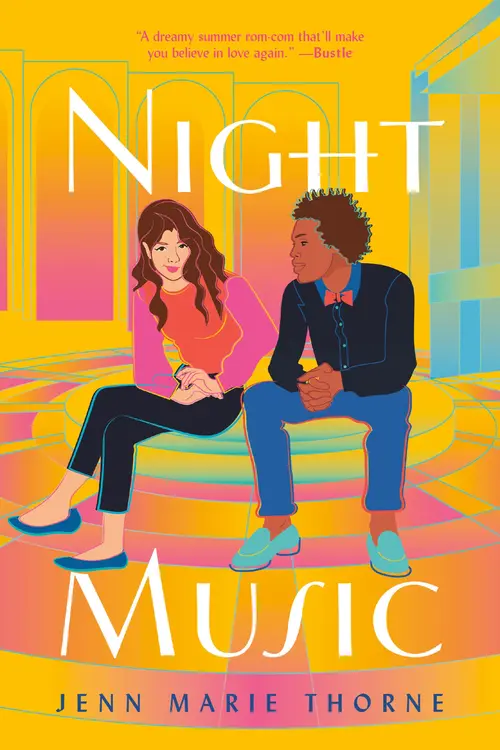
Cover
Dedication
In memory of Edward Kraeder
1.
a stranger was playing my piano. My piano, untouched for months, purring under his fingers like a stray cat. More than purring . . . singing, leaping, laughing, dying, all in the time it took me to stumble-run downstairs.
I stared into the dusty living room from the bottom step, not trusting my eyes—my ears even less. But there he was, half standing while he played, one knee on the bench, like this was a quick errand he’d needed to run.
A boy. Tall, lean, angular, skin rich brown, hair a supernova of spirals backlit by afternoon sun.
I couldn’t see his fingers, but I could feel them skipping over the keys, tiny pings in my chest, arms, spine. So many notes. It was contrapuntal, insanely complex, cogs and gears—which piece? I couldn’t pick out the key, let alone the composer, but here he was, commanding my piano, smiling at some private joke. He wasn’t even looking at the keyboard as he played.
He was staring at me.
“Do you like it?” he called.
Was this a hallucination? A musical one?
“You play really well,” I got out.
Nobody was supposed to touch my piano. Not me, not anybody. Not anymore.
Not a stranger in my house.
He was still going—softly now, relentless, the key shifting. “But the piece?”
My eyes darted to our tall many-paned windows, the big oak doors—open to the stoop. How had he gotten in? “I—I’m trying to figure out what it is. I know it’s Bach, but . . .”
He hopped with delight, not missing a single note. “Not Bach. But oh my God, that you thought so . . .”
He grinned, so relaxed and weirdly familiar that everything seemed to readjust like it does in a dream, making me wonder if he lived here and I was visiting. He had a single dimple, an easy smile—what was happening?
Chatter from West Seventy-first Street filtered into the living room and away. I took a step closer. A better look.
My age—seventeen, eighteen?—dressed like an August issue of GQ. Short-sleeved striped button-down, royal-blue bow tie, neatly pressed chinos, a canvas belt. He was definitely real. Hyperreal.
This couldn’t be an intervention. Nobody could have been tone-deaf enough to send a brilliant pianist here to tempt me to change my mind. Could he be some stalker fan of Dad’s or Mom’s, or Win’s or—was it pure coincidence? Had I just . . . left the door open behind me and he’d seen the piano? Or, or, or . . .
My staring must finally have gotten to him, because he bobbled the first note in twelve thousand. He took his hands off the keyboard, a magician before the reveal.
“Want another try?” His bright eyes locked on mine.
I didn’t. I didn’t want to talk about music at all. But I didn’t want to lose whatever game this was either.
“Frescobaldi.”
His eyebrows rose. “Damn, going for the deep cuts.” Then he rubbed his cheek, relaxing his shoulders, falling marginally mortal. “It’s Bell.”
“Bell?” I eyed him warily. “Elizabeth? Or . . . it really doesn’t sound like Iain Be—”
“Oscar Bell.” He closed the distance, extending his hand. “Nice to—”
I edged away. “You composed that.”
He shrugged. Cocky.
“That’s your fugue.” A snort burst out of me. “Okay.”
“I could sketch it out for you.” He glanced around, miming scribbling. “I should start writing this shit down anyway.”
Before he even finished saying it, his knee was back on the bench, fingers back on the keys, repeating the first movement, adding another voice, another and another as if it were as simple as breathing.
I didn’t realize I’d been backing up until I hit Mom’s Steinway across the room. I flinched away like her piano was a hot pipe. “You couldn’t have improvised that. There’s no—”
“Course not.” His eyes danced up to meet mine, teasing. “I came up with it on the ride over.”
Now that I looked out through the front bay windows, I saw an SUV taxi idling at the curb, back hatch open.
“Sorry if I surprised you.” The boy’s voice dropped into a different register. “Mr.—uh, Marty just said to come say hi to Ruby.”
I closed my eyes, letting out a slow breath. He knew Dad. Of course.
“I’m hoping you’re Ruby? But right now I’m thinking you’re not.”
“What? I’m her. Me,” I said as Dad’s voice bellowed from the street, “Carry it down there and put it by the door, that’s good!”
This guy—“it’s Bell”—was still staring at me.
I shrugged, flustered. “Why wouldn’t I be Ruby?”
“I don’t know. You seem older, so I thought maybe you were another of his students. And . . .”
Another of his students? Since when did Dad have his own students?
“The way he talked about you—I thought you’d be short?”
I let out a startled laugh, then glanced down. All five foot eight of me was draped in black—black ballet flats, black yoga pants, black sleep top, black cardigan, its black sleeves covering my hands to the fingertips. With my pasty face and long dark hair frizzing loose, I must have looked like something out of a micro-budget horror movie.
But Oscar extended his hand again. “Sorry. Let’s . . . I mean—I’m Oscar Bell. Nice to meet you.”
“Ruby. Chertok,” I said, sliding my palm into his. “Pleasure to . . . um . . .”
He smiled, lips parted as if he wanted to finish my sentence for me. His hand was sturdier than most pianists’—warm and smooth, except for his rough fingertips.
“You’ve met! Fantastic!” Dad filled the doorway, six foot two, wild white hair, pink forehead, nose, cheeks, gray beard, arms and legs and trunk like an oak. He strode forward with his hands out and I thought for a second he wanted a hug before he zigged left and clapped Oscar on the shoulders. “This is our prodigy.”
“Ah, I don’t know about that.” Oscar looked at the floor—smiling.
He knew about that. He knew all about that.
“Found him on YouTube,” Dad said, leaning against Mom’s piano like it didn’t burn his skin at all. “Can you believe it? I love the Internet, love it.”
Outside, the scrawniest kids I’d ever seen were lugging furniture into our basement apartment from the trunks of what now looked to be a line of taxis. A desk, twin bed, chair, low bookshelf, all of it the same dorm-room pine.
Dad laughed. “What are the odds of somebody like you going to the same school as Nora Visser’s niece?”
Oscar’s body wavered like a struck string.
Dad whapped him. “A once in a lifetime musical prodigy with a family connection to our board chair! Uncanny.”
“Yes! I mean, thank you.” Oscar beamed back, height restored. “But yeah, pretty wild.”
I tapped the window. “Dad, are those Amberley kids? Why are they—what’s with the bed?”
Dad glanced over his shoulder. “They’re moving Oscar in. I found them lazing around the common room and they volunteered to help.”
Of course they did. They’d go dumpster diving if the great Martin Chertok asked them to.
Then I turned. “Wait—what? Moving Oscar . . . ?”
“He’ll stay in the basement apartment this summer. The dorms were full and we’re between tenants—it’s kismet!”
We’d been “between tenants” for eight years, since my brother Leo got his spot with the Boston Symphony. We stored our luggage down there now. And here it was, coming back up the stone steps, one empty roller bag at a time being hauled by a bespectacled teenager wearing a T-shirt that said: Oboe You Di’int.
“Thank you again for this, sir.” Oscar’s voice was suddenly neutral, the light drawl I’d noticed gone. “I’m so honored to have the chance to study with you. The New City Symphony completely changed my—”
“The honor’s mine.” Dad waved away the compliment, turning so that all I could see was his wall of a back. “I love new talent, it’s what keeps me going.” He pointed to the piano. “What was it I heard you playing a second ago?”
“What we were talking about in the car,” Oscar said, scratching his hair so it bent like a crown and sprang back up. “The baroqueness of the bridge, you know? I wanted to try it out.”
The baroqueness. Of the bridge.
Oscar traced the keys and then started the melody again, lightly, carelessly. Perfectly.
Even without seeing Dad’s face, I could sense the reverence on it. He tapped the piano lid. “This is going to be a good summer.”
This summer. In my house. The summer I was supposed to find solace, clarity, a series of days that had nothing to do with music.
Mr. Prodigy—Oscar—was still playing, oblivious to all damage. His song surrounded me, a trap, one strand slipping around the other—
I was in motion. To the coat-tree. The porcelain key bowl. Bag, keys, ponytail holder into hair, me into the sweltering street. The music trailed me out, Oscar Bell’s voice following after.
“Oh. Hey, sorry if . . . It was nice to meet you, Ruby!”
Never missing a note.
2.
behind me, I heard Amberley students arguing over which way to tilt the bed through our basement door—the city din, the slam of the back of a delivery truck, a distant jackhammer, none of it enough to drown out the sound of my piano—until I reached the stoop two buildings down, where a blond girl in running gear was tying her sneaker, screaming into her cell phone.
“That’s how you want to do this? Really? I don’t know, you could be supportive?”
For the first time, I glanced back. Not because Julie Russo was yelling. Because she was wearing running gear.
Her eyes drifted to mine. She blinked slowly, a challenge, just as Dad stepped back onto the street behind me, shaking hands with the Amberley kids—all those brilliant musicians hauling dorm furniture, what a travesty—and I had to walk faster.
I could go to the courtyard. God knew it was quiet. But I didn’t want to pollute it with how I felt right now.
Central Park swayed across the street, a border to cross. I sprinted through the crosswalk as the light stopped flashing, then past a watercolorist’s easel, a pretzel stand, a busker playing the flute, “Danse de la Chèvre,” so clear, I could practically feel ice crunching on grass, wind surging down—
I kept going until I couldn’t hear the flute anymore. Just bikes ticking along the path behind me. Ducks squabbling on the lake. My wool cardigan, hot. Itchy.
I found a bench and sat, watching the world spin on.
Was this the plan? No, it was not.
Dad was supposed to be doing his “in residence” thing, presiding over the Amberley School of Music’s prestigious teen summer program, preparing the upcoming Met season, being the human mascot for Lincoln Center. I was supposed to cover the pianos in our living room with tasteful dust sheets, enjoy the silence, smother every mope, hide from prying questions, take the opportunity to . . .
To . . .
No idea.
When I reached the shadow-dappled edge of the park again, the honk-clamor-shriek of Central Park West splashed me like a puddle. I checked my phone for the time.
4:07. Still a few hours left in the day to accomplish . . . something?
A taxi stopped a few feet ahead and a petite forty-something stepped out, sunglasses sliding low as if to avoid detection. The sun reflected off a high-rise window like an arrow onto her copper bob.
“Nora?” My step slowed. She didn’t hear me.
Nora Visser, Amberley’s board chair. Family friend since before forever. My godmother. Not a musical genius—she just had this weird gift for living. She could trip over a curb and make it look like the happiest thing that had ever happened. And here she was, stumbling onto the same stretch of concrete as me while the taxi she was in sped away with someone else still sitting in the back.
I felt like a sailor spotting land. “Nora!”
She turned—and the look on her face made me wish she hadn’t. Her first reaction was close to horror, such an alien expression that I thought for a second I’d confused her for someone else. But I stepped back, and there she was again, the real Nora, tickled to confetti bits to see me.
“Ruby!” Nora extended her arms like a net and I walked in, noticing as I did how flushed her cheeks were. “You have just made my day, I can’t even tell you!”
“What are you doing here?” By here, I really meant the taxi. Nora never took cabs.
“Oh, lord . . .” She shook her cell phone like she was trying to strangle it. “One appointment to the next. You know how I am, I overbook. I just can’t seem to say no! How are you, sweetheart?”
She adjusted a frizz of my hair, and something about the small touch made my eyes go tingly.
I smiled to cover. “Good. Great! What’s next, then?”
“Oh!” She slumped daintily. “A reception for the Central Park Conservancy. A tea . . . sort of . . . thing?”
“Tea sounds nice,” I said, mostly to unfrazzle her.
“Would you like to come?” The instant she said it, I knew that it was a formality, the done thing, but—
“I’d love to!” My skin went from hot to scalding. Taking someone up on an empty invitation was the opposite of the done thing. Even so, I wanted it. Tea. Park. Distraction. “Would you mind?”
“Oh my goodness, please do!” Nora squeezed both my hands and bounced on her low heels. “You would be saving me.”
I laughed. “From what?”
“Boredom!” Her eyes flitted to my all-black outfit, smile unwavering.
“Oh. When does it start? Do I have time to—?”
“Absolutely!” She swiveled toward my block. “We’re close, and it’s a pop-in kind of thing . . .”
We linked arms and hurried to the crosswalk.
“Don’t you dare spruce too much. A light dress is fine, especially in this heat. How is it July already? You don’t even need any makeup. You’re just”—Nora framed my face with her hands, eyes proud, like she’d painted me—“charmed!”
Charmed. That wasn’t a word I heard much, especially from someone as sparkly as Nora. I was stupidly pleased by the compliment.
We got to the stoop and I found to my relief that all the Amberley students had disappeared back through their prodigy portals. The front room was silent, but I could hear Dad pacing the floor up in his study.
“I won’t be long,” I called over my shoulder.
“No rush!” Nora was already absorbed in her cell phone, pushing buttons with the tip of one finger like she wasn’t sure how to work it.
I took the stairs to my fourth-floor bedroom two at a time, passing dusty-framed black-and-white photos—a recent pic of Alice playing the viola, Win at the podium, Leo with his oboe, me at ten holding that ridiculous piccolo.
Then I confronted my closet, every hanging garment blurring into a smear.
Dress. A light dress.
I pictured Nora’s outfit—knee-length pink and orange, heels—and picked the most similar dress I could find—pale blue, starchy. I hadn’t worn it for a few years. It was tight against my armpits, shorter than I remembered, but whatever, it would work.
I kicked on some lace flats and scooted down to the third-floor bath for a quick splash of water to help with the death-pallor thing, and—
I turned the handle and the door slammed back in my face. “Oh.”
“Just a sec!” Oscar’s voice rang out. Then the sound of the toilet flushing. And a zipper.
“Oh. No. Take your . . .” I paced away, heart pounding. Then I fled to my room, staring out my window at the white-washed walls of the apartment building across the street until I was sure I could hear the bathroom door open and his steps moving down the creaking stairs.
Why was I embarrassed? This was my home. Mine.
I threw open my door to prove it, and thundered down two narrow flights, only to come to a halt at the sight of Nora, Dad, Oscar all standing around the dining area—Nora perched on her tiptoes, trying to touch Oscar’s hair, murmuring, “You are so lucky, mine just sits there!”
What in the no.
Oscar’s laughing eyes darted to mine, one blink flashing mayday.
“There’s a lock,” I blurted. First thing to pop into my head.
Nora pulled her hand back to gawk at me, and Oscar shifted out of reach.
“On the bathroom door.”
Oscar imitated sheepishness. “I noticed a second too late. Sorry.”
I shrugged, so very breezy. “I didn’t see anything. So.”
Thus descended the heaviest silence in the history of Manhattan Island.
Dad clapped a hand on Oscar’s shoulder. “Shall we get to work?”
And the tableau churned back into motion.
“I’m abducting your daughter for a fundraiser tea,” Nora shouted. “Hope that’s all right!”
“As long as all she drinks is tea.” Dad shot me a wink over his shoulder.
I forced a smile back, deflated by his non-reaction. This was a thing, after all, wasn’t it? After months of stasis—me, switching lanes. But I knew better than to take it personally. Martin Chertok, Greatest Living American Composer, presided over the realm of music, not park teas. If it didn’t involve instruments, it didn’t warrant more than a passing wink.
Nora squeezed Oscar’s wrist as he followed Dad’s slow trudge upstairs. “So glad we nabbed you, Oscar. Can’t wait to see what you dazzle us with next!”
“Great to finally meet you, Ms. Visser,” he called back, his brown eyes meeting mine for the briefest second before he disappeared up the stairs.
I followed Nora out, turning the name “Ms. Visser” over in my head. She’d only been a “Visser” for six years. I’d gone to the wedding, but couldn’t remember what her last name was before that.
“Our newest recruit,” Nora said as a Bentley glided to the curb. “He’s young!”
“Is that a surprise?”
She waved to her driver and hopped in the back, patting the open seat for me to join her.
“Not at all.” She pulled out a lighted compact as we pulled away. “He just seems older in the video, don’t you think? Maybe because he’s got the baton. That does something to conductors. Gives them a little . . . what’s the word . . . ?”
“What video?”
“You haven’t seen it. Stop. Tell me you’ve seen it!”
I winced an apology.
“Ha! So there are limits to Nancy’s magic.” She dropped the compact into her purse and pulled out her phone.
“Nancy?”
“Wait, I’ve got to find this for you . . .” She started feverishly typing, then beamed up at me. “Gravitas!”
“Gravi—?”
“The word I was thinking of.” Her face was buried in her phone again. “Let me see if I can . . .”
We pulled onto the Seventy-ninth Street crossing. Traffic was at a standstill.
“Thank you so much for bringing me,” I put in, strangely jittery. “I haven’t gone to anything like this in forever.”
Nora squinted up. “Not the Cloisters. It can’t have been that long.”
“Two years, I think?”
“Anna kept twirling you, do you remember? Calling you her ‘miniature.’ God, she was so proud of you.”
I didn’t remember it—not like that. I remembered Mom fuming at Dad for not wanting to go out. Her too-sharp smile as she dropped a dress in my lap and told me to forget homework and Hanon, she needed a date. I’d been out of place, gawky and confused all evening, and it had still been a starlit blur of happiness. Our last hurrah.
“I’ve missed you, you know,” Nora said. “Your whole family.”
My throat went tight. “You see Dad, like, every day.”
“I know, and I adore Marty beyond words, but . . . I haven’t heard from your mom in almost a year, can you believe it? How is she doing?”
“She’s . . .” I smoothed my hem. Over and over. “Really good! Busy. Her tour is going well.” All facts that could be easily googled.
“Well, that’s great. She deserves it. Such a talent.”
Nora watched me with taut eyes, like she wanted to go on . . .
But then she shifted, bless her, into a playful wink. “People have been asking about you.”
Oh God. “Me.”
“They want godmother gossip. Whether you’re going to follow in your family’s footsteps, carve your own path.”
Your own path. My body loosened into those words. To do that, to have the option . . .
“Whether you’re seeing anyone.” She nudged me.
I coughed on my laugh. “I’m not. At all.”
“Hmmm.” Nora swiped her phone screen. “Who do I know? Charlie Weatherby’s starting at Yale in the fall. Might be too short for you.”
“It’s really okay—”
“I’ll keep thinking. Oh—voilà.” She handed me her phone, a video already playing on its glossy screen. “Now, come on, you must have seen this. It was trending on Twitter last month!”
I don’t Twitter, I thought, watching as what looked like a school orchestra performance began on screen, shot on a shaky cell phone camera.
“He’s really got something.” Nora leaned against me to watch.
“Who—?” I started to ask, and then I saw him, tossing his head back to grin at the audience, the video finally focusing on his face.
Of course. Oscar Bell.
3.
the camera was moving closer. What were they playing? It sounded like Vivaldi, but . . .
The key shifted, the violins did a funny leap that made my breath hitch, and—it was the same theme, but now it sounded like Haydn . . . or Mozart? Elegant, silvery, impossibly clever.
“What is this?” I asked, but Nora was leaning into the front seat, saying something to her driver, so I pulled my focus back to the screen.
A teensy diminuendo and the arrangement shifted again fearlessly, swelled into a twentieth-century Romantic. Shostakovich? Stravinsky? My brain couldn’t catch up with my ears. It sounded like a storm on the ocean.
“Do you recognize it?” Nora smiled over her shoulder. “This is more your generation.”
“A . . . medley? Different periods of classical music . . .”
“It’s Kudzu Giants!” She bounced back into her seat as the traffic started moving again. “I don’t follow hip-hop either, but it’s a song called ‘Sparkler’ that’s very of the moment. And he’s done it in the style of—”
“Everyone.” I stared.
Nora took the phone and tapped the screen so the title of the video appeared: Variations on a Kudzu Giants Theme. By Oscar Bell.
One point eight million views.
The Story Continues on BooksBarbecue!
Enjoyed this preview? ❤️ Do not stop here!
Read the complete book free online → 🔗
Continue reading now on BooksBarbecue and discover every page!
Love reading? Bookmark BooksBarbecue.com for more amazing books!
Happy Reading!