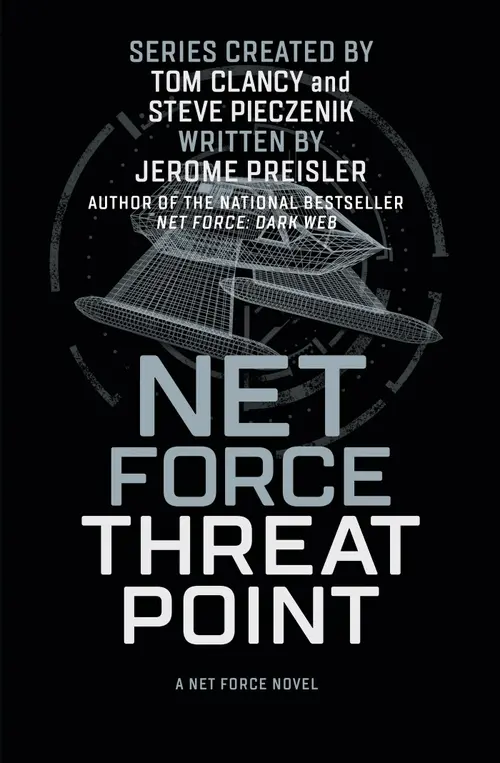
Net Force
Cover
Booklist
Also in the Net Force series
created by Tom Clancy and Steve Pieczenik,
and written by Jerome Preisler
Net Force: Dark Web
Net Force: Eye of the Drone
Net Force: Attack Protocol
Net Force: Kill Chain
Dedication
FOR SUZANNE
Quote
Bears, dragons, tempestuous on mountain and river,
Startle the forest and make the heights tremble.
Clouds darken beneath the darkness of rain,
streams pale with a pallor of mist.
The gods of Thunder and Lightning
Shatter the whole range.
—Li Bai, 701–762 AD
PART ONE
ASSASSIN’S MACE
1
The South China Sea
April 10, 2024
“You’re at two-zero-zero meters on the button,” said Murph.
Murph was John Murphy, the dive supervisor topside aboard the cable-laying ship CS Stalwart.
“Roger,” replied Zak through the pipe.
Zak was Isaac Tinian of Warwick, Rhode Island. He had been on the job five years, longer than most guys. Before that he was a police scuba diver, a solid line on a saturation-dive applicant’s résumé. But even with that unique level of experience, he’d needed multiple referrals to qualify for the training.
There had been twenty-five men and women in his class. Zak was the last still with the company. That was a ninety-six percent attrition rate.
Now he was nearly in the dark, with a whole lot of water on top of him. It meant a whole lot of depth pay on top of his salary. With good reason. He knew all the risks. But he also knew the thrill of it. That, and the big bucks, kept luring him back to sea.
Two-zero-zero.
For the average person, two hundred meters translated to about six hundred fifty feet underwater. At that depth, the pressure bearing on Zak was over twenty times what it would be on the surface. At half that depth only one percent of the light made it down. It was like being in outer space but with poorer visibility. Space was sterile and empty. The ocean was an organic soup swirling with particulate drift. Decaying aquatic plants and animals, an endless blizzard of fish poop. With all that gunk floating around, even high-intensity lights couldn’t reach very far. It played tricks with your mind. You felt lost in all that darkness.
But Zak had no room in his head for fear, uncertainty and doubt—FUD in sat-diverspeak. His ability to push all that aside was largely what made him one of the tiny percentage of people who could do what he did over the long haul.
“Systems look good from here,” said a second voice in his ear. “How you feeling?”
“Nice and steady.”
“Let’s keep it that way.”
“Check, Rawl.”
Rawl. Everybody on a dive crew was called something for short. Zak liked to joke that they all might as well be baseball players. Andrew Rawlings was his partner and the man in the diving bell. After a month in storage breathing heliox instead of normal air, they both sounded like ducks in some old cartoon. In Rawl’s case, a duck with a noticeable Southern twang. His hometown was Bartlett, Tennessee, and he still lived there between gigs.
Zak continued to descend on his umbilicals. The bell—known as Beebe after the famed inventor of the bathyscaphe—hung from a cable about three hundred feet closer to the surface. As it had neared its working depth minutes ago, he’d exited the floor hatch, taken a short ride on the guide weight beneath it, then jumped clear and dropped toward the seabed.
Now he could no longer see its egg-shaped contours. He was descending through a pitch-black void, with only the faint, smeary glow of Beebe’s exterior lights above and the blue ghosts flitting around him. Bursts of luminescence emitted by various deep-sea creatures, they were like living fireworks, sparking and curling and braiding out in every direction. They had no pattern, no predictability. Without visual landmarks for reference, it was impossible to even guess their distance from him. The blue ghosts could be ten feet away or a hundred. A hundred or a thousand. They were hypnotic, beautiful and very dangerous if he let them become distractions.
He shot a quick glance down at the bottom. He had two head mounts: a high-intensity LED underwater lamp on one side of his hat, and a digital video camera on the other. Both were powered by his umbilical lines and would run without interruption throughout the dive. The digicam feed was streaming up to Rawl and the support crew on the Stalwart’s deck, so they could inspect the site in real time.
Below Zak, clear in the light beaming from his helmet, was the thirty-foot-wide trench Stalwart’s sea tractor had recently plowed into the sea bottom. The trench had yet to be backfilled by the tide, leaving its excavated center—where the cable was buried—lower than its margins.
“I’m right above the cable trench,” he said. “Eyes wide open.”
He wasn’t expecting any problems. The site had been chosen for its geological stability. There were no underwater canyons, no slopes, no reefs or fault lines. Just mud and gravel, the terrain a flat, level expanse running off toward the Spratly Islands... China’s Dangerous Ground. So named because that was where the aquatic terrain got rough.
Zak descended a little further. His augmented reality HUD said he was at exactly two hundred seventy-three meters—almost nine hundred feet. Which put him just west of the exposed cable connection and about a mile upstream from the landing station at Palawan.
After a few moments his boots touched down beside the trench. He hopped across the bottom, following its southern edge. His helmet’s A/R was a more sophisticated version of the dashcam system in his car, but not much. Basically, it served the same purpose, overlaying his video input with arrows, colored lines and data readouts. It would guide him to the juncture he wanted to inspect and sound an alert once he reached it.
Zak was about ten yards along when he heard the beep. He hadn’t really needed it. The Stalwart had installed a multiplexer here two weeks back, ahead of laying several branching lines of cable, the first of which was already buried in its own trench. He could see where it forked eastward from the splice, stringing out to its own endpoint.
He looked down at the shallow furrow defining the original cable’s path toward shore.
“Odd,” he said over his radio. “Everyone getting the vidstream?”
“Roger.” That came from Murph. “Hang on a second. I’m going over your coordinates.”
“You must be in the right place,” Rawl said. “You see the cable sticking up out of the bottom.”
Zak did not reply. His dive partner was right on both counts. This was the only cable nexus for miles around. And the Positioning System for Deep Ocean Navigation—POSYDON—was as dependable as terrestrial GPS. There was no doubt in his mind he was on point. But what confused him was that he didn’t see anything all. At least, nothing unusual.
He waited. Maybe there was a mistake. But he didn’t see how it was possible.
“Zak?” Murph again.
“I hear you.”
“Your location positively checks out.”
Which came as no surprise. And which also confused the hell out of him.
“I can scoop out the sediment,” he said. “Inspect the cables and SDM to see if anything’s funny.”
“Sounds like an idea,” Murph said. “Give me a minute. Fried’s on his way to Control.”
Fried was Bill Friedlander, the dive team’s project manager on the Stalwart. Calling him in was SOP. Everything had to be logged and subject to approvals. They would need his green light before digging up a segment of line.
Zak waited. Blue ghosts spun and danced around him like fireflies. No one really knew why so many organisms down here emitted a glow. He’d heard they used it to confuse their prey. Or stun them. But he’d also heard that some of them used it defensively, sneezing out light trails to send stalkers off in the wrong direction. Whatever their purpose, they put on a stunning show. It was like they were all scribbling on a huge three-dimensional blackboard at the same time. With phosphorescent chalk.
Zak was watching one such manic display to his right when he noticed a separate and distinct radiance some distance off. Exactly how far off he couldn’t tell. At first it looked like a small sphere of light. Not blue but white, with a diffuse halo around it.
Zak stared for a long five seconds, puzzled. The light grew in size, its corona and inner circle quickly resolving into a single disk of brightness. It appeared to be coming closer and was moving at a rapid clip.
“Does everyone see what I see?” he said.
There was no answer from above.
“Murph? Rawl? Do you two copy?”
He waited. Then waited some more, frowning behind his mask.
There was still no answer.
The dive-control van was a modular unit in the center of the four-hundred-fifty-foot Stalwart’s main deck. Situated near the moon pool—the well through which the diving bell was lowered into the water—it was nothing fancy on the outside. Not too big, not too small, a single door, a couple of windows. The sort of corrugated aluminum trailer where the foreman might slug down his morning joe at an ordinary construction site.
The interior of the DCV was another thing. There were two side-by-side stations, one with specialized video-monitoring and communications panels, the other with the gauges, dials and switches used to regulate the life-sustaining gas mixture inhaled by the underwater team. A third console, on a separate wall, controlled the scrubbing and filtering of gases exhaled by the divers, removing carbon dioxide, moisture and biological contaminants, then mixing the leftover oxygen with helium for recycling to the bell. The Gasmizer made for an efficient, closed system that ensured the supply of heliox would be without interruption.
All three technicians in the van were dead. Grigor Malkira had shot the men at the side-by-side stations as he entered, using a single subsonic bullet for each. They never knew what hit them. The third tech, seated with her back to the door at the Gasmizer console, lived long enough to register his presence, swiveling toward the door. Grigor put one round in her heart and one in the middle of her forehead. She had sprawled backward over the console, her blond hair spilling over its controls and readouts in a bloody fan.
Now Grigor stood behind the dead man at the dive-control station, holding his sound-suppressed FN Five-seveN against his thigh. Eight seconds ago, he had cut all communications between the surface and the bell and between the bell and diver. His next matter of business was at the saturation-control station beside it.
It proved fortunate that the window was between them. Grigor was sidling past it when he glimpsed a man outside on deck, approaching the DCV in the shadow of the crane. He immediately recognized him as Friedman, the project manager.
The van was close quarters, but Grigor moved with fluid, unconstrained ease. He was unusually tall and thin, his limbs disproportionately long, giving him an odd, stretched-out appearance—like he was made of soft putty or taffy instead of meat and bones. As a boy at the Russian detdom, the other orphans had joked that if he stood sideways, he disappeared.
He returned to the door, two quick steps, flattening his back against the wall alongside it.
A moment later Friedman reached the van. Grigor waited for him to swipe his finger under the biolock scanner, listened for the click of the dead bolt and brought the Five-seveN up in his clenched fingers.
He was stronger than his rubbery appearance suggested. As the door swung open and the project manager stepped inside, he grabbed the man’s arm above the elbow and flung him toward the Gasmizer station. Friedman stumbled toward the dead woman but managed to catch his balance before crashing into her body.
He spun around toward Grigor.
“Gelfland?” he blurted. His expression was quizzical.
Grigor used up two more bullets, and the project manager crumpled lifelessly to the floor, his forehead a red smear. Then he kicked the door shut behind him and mouthed a simple order in Southwestern Mandarin. The mild Sha County inflection was a brushstroke that would have delighted his Pinnacle instructors. Old Anna in particular.
“Ji. Kin leh.”
“Si.”
He slid over to the sat-control station, shoved the man slumped over the console to the floor and took his seat, holstering the pistol under his windbreaker. He’d familiarized himself with its gas distribution panel over the past few months and was able to reset its critical life-support values in seconds.
Grigor was looking over the gauges when he heard the rat-a-tat of automatic gunfire outside the van. There were multiple bursts, then a pause. Then more short bursts.
He glanced at his watch. Ten minutes to go.
He rose from the chair, stepped over and around the bodies on the floor and went out onto the deck, turning quickly toward the helm of the massive ship.
Zak knew he was in serious trouble.
There should have been an alert. It was supposed to be automatic. A series of urgent beeps in his earpiece, simultaneous warning messages on the HUD. But it didn’t happen. The cascade of system failures was so rapid it felt like everything shut down at once. He was suddenly cut off from his life support, the bell and the dive-control crew.
Zak opened the valve for the bailout tank on his back. The cylinder’s emergency supply of heliox would buy him four minutes, maybe a couple more if he regulated his breaths. That wasn’t enough to get him to the surface. He would need a slow ascent to prevent his internal body tissues from exploding. Hours, not minutes, of decompression. But if they were aware of the situation topside—and they had to be—they would be working like hell to restore the connections to him. The same for Rawls. And there were built-in fail-safes in case of critical system malfunction.
Zak urged himself not to panic. They weren’t going to let him die down here. Not if they could help it.
He breathed. Almost sipping from the bailout tank. Wanting to conserve the precious gas mixture.
Then the light shone in his eyes. That circle of light in the darkness. It was coming on fast, about ten feet above the seabed, slightly above him.
The light fanned out. The detritus in the water refracting and dispersing and attenuating it. Zak stood there, baffled. Then saw the craft take shape underneath it.
He realized it was some kind of deep submersible. A bubble capsule in front under the light, a large arm on either side of the capsule. There was something vaguely crab-like about it.
It slowed, drew closer still, then stopped. Hanging there above him, its lamp shining through the black.
Zak’s mind raced along three parallel tracks. He was acutely aware his bailout canister was emptying with each breath. Aware he’d heard nothing from Rawl or the control van. And he was aware of a human form looking out through the bubble.
Blurred. Barely visible. But there.
Watching him.
He was mystified and afraid. Those were alien feelings on a dive.
“Rawls? Murph? Do you copy?”
Silence. The submersible hovered motionless for another long second. Then a sudden burst from its thrusters sent it flying forward.
At first Zak thought it would shoot past him. But it didn’t. It stopped again. This time directly overhead, its metal grapplers snatching at his umbilicals. He felt a hard tug as they clamped shut over the lines, sinking into them, clipping them like giant wire cutters.
The second tug was even harder. It lifted him with a jerk, hoisted him upward. And then his feet were no longer anchored on the seabed. The submersible was carrying him away, dragging him through the pitch-black water like it was a hungry predator and he was its helpless prey.
He hung below it. He couldn’t see anything. He was cold. Terribly cold.
Zak was swept through the water for what felt longer than it must have been. Dangling from the severed lines, he struggled desperately to breathe as the submersible carried him along. His heliox was running out. There was a pressure gaining behind his eyes, in his head, his chest. Like they were all bursting from within.
He felt his consciousness departing in a muddled rush and tried to hold on to it. But he couldn’t. It was slipping away from him. He was no longer able to think, no longer struggling to fill his lungs, no longer feeling much of anything. There was only the cold and an increasingly vague sense of movement.
Soon Zak’s awareness let go of them too, and he belonged entirely to the darkness.
Grigor strode from the elevator onto the bridge and almost tripped over a dead body. He paused and lowered his eyes to it. The crewman was sprawled in his own blood, his white uniform shirt stained the color of the red puddle around him.
“Women yijing guding hao jiash shi, Zhe chuan shi women de.”
Grigor glanced up at the man who’d spoken to him. Tall, bearded and muscular with thick Mongolian features, Jochi stood on the opposite side of the leaking corpse, wearing the tan shirt and reflective yellow vest of a ship’s engineer. In his hand was a compact Brügger and Thomet TP9 submachine pistol, suppressed with a thirty-round magazine.
“Nin shifou yi yu chedui qude lianxi?” Grigor answered in the same coastal Mandarin he’d finessed earlier.
Jochi motioned toward the wide curve of windows around them. Outside, the ocean rippled blue and reflective in the midday sun.
“Shi,” he said. “Tamen zai lushang.”
Grigor nodded his satisfaction. The fleet was on its way.
He looked about the room. There were nine others in it besides himself, Jochi, and the dead man lying faceup between them on the floor. Four belonged to the bridge crew, and they were lifeless and bloody in their rotating chairs. Another dead man was slumped against the wall under a window, his shirt dotted with bullet holes. A fifth, the Stalwart’s captain, was at the command station. His throat had been cut. The gash looked like a grotesque lipstick smile.
The rest, four men in total, were alive. It was no fluke that they were members of Jochi’s strike team. All carried weapons identical to his TP9. One had taken the helm.
Grigor immediately strode up behind him. The dimensions of the bridge were expansive, and the U-shaped operations console occupied most of it. He saw rows of radar, sonar and navigational touch screens, joystick controls and panels with clusters of lighted indicators and industrial buttons.
He studied the navigation displays over his helmsman’s shoulder. The main screen showed the Stalwart in stationary position off Palawan. But that was a fake. A chimera. A second nav screen gave a different picture—and the real one. The ship had already left the vicinity of the Philippine archipelago and was bearing toward the Spratly Islands at its top speed of fifteen knots.
Grigor trusted the Wolf’s location-spoofing software would be masked from the most sophisticated counteranalysis. What he’d seen of his work in New York had easily cemented his reputation as dark prince of the technologie vampiri.
But he would have felt confident regardless. The average car had over a hundred fifty million lines of software code. How many powered the ship? Trillions? A few malignant lines slithering into its system would be hell to detect.
The digital conning binoculars on the console were Wi-Fi-tethered to the ship’s nav system. Grigor lifted them to his eyes. As the fleet appeared in the lenses, they noted its exact coordinates and measured the distance. It was less than ten miles to the southwest.
He counted ten unmarked boats...eighty-foot trawlers with high bows and stern wheelhouses. The sort of aging rust buckets that were mother ships for poachers of sea cucumbers and reef clams.
Grigor nodded to himself, lowered the binoculars. He saw that Jochi had come up to the console and handed them over to him.
The bearded man peered through them across the miles of glittering sea. “Tamen you henduo caihu,” he said. “They have many talents.”
Grigor gave a thin smile.
“Zongguo nan ti,” he said.
Jochi nodded his understanding. It was truly and literally a Chinese puzzle.
The submersible returned to the trawler’s launch bay with the diver still dangling from his umbilicals. His body was a gruesome sight.
When a person died and circulation ceased, the gases in the cells and blood vessels became static and formed thousands of tiny bubbles. When a person who died during a saturation dive surfaced too fast—without proper decompression time—the pressurized bubbles grew in size until they became very large.
The result was like shaking a can of carbonated beverage and then popping the tab. But with a human body instead of a can, and blood and fluid instead of soda.
The three deckhands who removed it from the grappler’s clasp wore their biohazard suits gladly.
As they removed the diver’s suit on a plastic tarpaulin, they would have unanimously agreed the most disturbing sight wasn’t the blood foaming from his pores and orifices, it was the eyes. They had ruptured in their sockets and then liquefied to the consistency of custard, which caused one of the men to vomit on the spot, inside his hood.
Undressed and wrapped in the tarp, the body would be carried off for cremation. But the trio would still need to sanitize his helmet and wet suit before passing them along for analysis.
The technicians had it easy, they grumbled. In all accomplishments they took full credit, leaving it for others to clean up their ugly messes.
2
New Hampshire/Maine
April 15, 2024
Mother Nature was responsible for the weather. The theatrics were Carol Morse’s.
The Story Continues on BooksBarbecue!
Enjoyed this preview? ❤️ Do not stop here!
Read the complete book free online → 🔗
Continue reading now on BooksBarbecue and discover every page!
Love reading? Bookmark BooksBarbecue.com for more amazing books!
Happy Reading!