Neom
Praise for Neom
“A stunning return to his world of Central Station, twinning the fates of humans and robots alike at a futuristic city on the edge of the Red Sea.”
—Green Man Review
“This is Tidhar at his best: the crazily proliferating imagination, the textures, the ideas, the dazzling storytelling. A brilliant portrait of community and its possibilities.”
—Adam Roberts, author of Purgatory Mount
“This was superb and I’m in awe of Tidhar’s vision. He’s conjured up a futuristic city that feels simultaneously ultramodern and also run down. The rich histories of the region and its cultures are seamlessly interwoven into the fabric of this fully-realized world. Tidhar writes beautifully.”
—The Speculative Shelf
“A deliciously inventive wild ride through a future Middle East full of unexpected wonders: dutiful jackals, traumatized robots, terrifying terrorartists, caravans of elephants and great slinkying robotic khans, preserves for wild mechas and monasteries that are also singularities. But more than that, the world of Neom is deeply, richly lived in: the past and the present and the future are not just unevenly distributed, they are marbled together—tiny slithering tadpole robots adapted to the fused-glass desert around an ancient crash site, okra and tomatoes frying in a pan, rogue sandworms and grandmothers doing Tai Chi in an urban park, the Oort cloud and milkshakes, Martian soap opera Bedouin actors, a Bazaar of Rare and Exotic Machines equally excited by Atari Pac-Man cartridges and city-obliterating superweapons. It is this eye for detail, this deft touch intermingling now and someday, that makes Neom’s future so vividly real: not just human or gritty or lived-in, but full to bursting with the variety and complexity that characterize life. It is a world anchored by its characters: the bright ambition and yearning of the orphan Saleh, the sensible pragmatism and inexhaustible humanity of the capable housecleaner/flower vendor/receptionist/tamagotchi shelter volunteer Miriam de la Cruz . . . and the robot, who is obsolete and dangerous, full of grief and mystery and philosophy, and whose obstinate mission beckons us ever forward through Neom's pages. . . .”
—Benjamin Rosenbaum, author of The Unraveling
“Yet again, Lavie Tidhar's future world of Neom is exciting and distinctive, his characters complex and fascinating, and his themes powerful and thought-provoking. Tidhar is the best sort of science fiction.”
—Kij Johnson, author of The River Bank
“Vivid and techno-mythological, Neom infects you with something special that transcends all the incidents and terrors—a shimmering current of guarded optimism.”
—David Brin, author of Existence, Earth and The Postman
“Neom is a treasure, and Tidhar says that there are so many more stories from this complicated world. Every new one is a compelling chapter in this future history that reflects so much about who we are and the basic things we yearn for.”
—SciFi Mind
“Always expect the unexpected with Lavie Tidhar, and this welcome return to the sprawling space-operatic world of Central Station delivers oodles of poetry, action, memorable characters, wonderfully bizarre landscapes and wild imagination. No two books by Tidhar are ever the same, but each is a revelation.”
—Maxim Jakubowski, author of The Piper’s Dance
Praise for Central Station
John W. Campbell Award Winner
Neukom Literary Arts Award Winner
Arthur C. Clarke Award Finalist
NPR Best Books
Barnes and Noble Best Science Fiction and Fantasy
Locus Recommended Reading List
“Beautiful, original, a shimmering tapestry of connections and images.”
—Alastair Reynolds, author of the Revelation Space series
“A dazzling tale of complicated politics and even more complicated souls. Beautiful.”
—Ken Liu, author of The Paper Menagerie and The Grace of Kings
★ “Readers of all persuasions will be entranced.”
—Publishers Weekly
★ “A fascinating future glimpsed through the lens of a tight-knit community.”
—Library Journal
“If Nalo Hopkinson and William Gibson held a séance to channel the spirit of Ray Bradbury, they might be inspired to produce a work as grimy, as gorgeous, and as downright sensual as Central Station.”
—Peter Watts, author of Blindsight and The Freeze-Frame Revolution
“It is just this side of a masterpiece—short, restrained, lush—and the truest joy of it is in the way Tidhar scatters brilliant ideas like pennies on the sidewalk.”
—NPR Books
“A mosaic of mind-blowing ideas and a dazzling look at a richly-imagined, textured future.”
—Aliette de Bodard, author of The House of Shattered Wings
“Tidhar weaves strands of faith and science fiction into a breath-taking and lush family history of the far future.”
—Max Gladstone, author of Three Parts Dead
Selected Books by Lavie Tidhar
Novels
The Bookman (2010)
Osama (2011)
The Violent Century (2013)
A Man Lies Dreaming (2014)
Central Station (2016)
Candy (2018)
Unholy Land (2018)
Adler (2020, graphic novel series with Paul McCaffery)
By Force Alone (2020)
The Escapement (2021)
The Hood (2021)
Maror (forthcoming, 2022)
Anthology Series
The Apex Book of World SF, Volumes 1–3 (2009–14)
Neom
Lavie Tidhar
Map
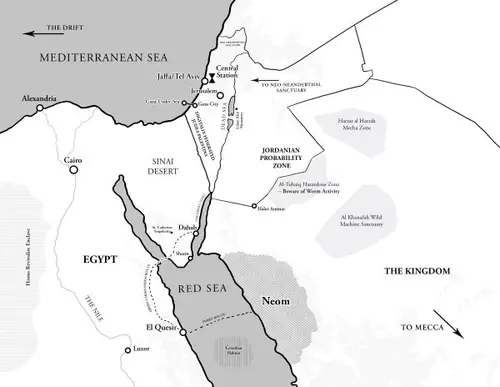

The city of Neom in these pages is old.
The city of Neom today remains mostly the dream of a Saudi prince, a futuristic wonderland backed by a marketing video.
You can go visit it, though. Neom Bay Airport (IATA: NUM, ICAO: OENN) is real and there’s even a weekly flight from Riyadh.
There’s not much else there right now, but then again, who knows? In time there might be flowers and, if so, a robot might come to the souq one day to buy a rose.
1. The City
Beyond Central Station, that vast spaceport that links Earth with the teeming worlds of the solar system, there is a city. The city lies past the Gulf of Aqaba and the Straits of Tiran, in the old Saudi desert province that was once called Tabuk. The founders of the city called it Neom.
In sandstorm season the hot air is cooled down by gusts of wind blown into the wide boulevards of the city. The solar fields and wind farms that stretch from beyond the city proper deep into the inland desert capture all the energy Al Imtidad needs, feeding it back to serve all the city’s needs.
On the shores of the Red Sea the sunbathers gather. The bars are open late. The kuffar sit smoking sheesha as children run laughing on the beach. Suntanned youths kite-surf in the wind. It is said it’s always spring in Neo-Mostaqbal, in Neom. It is said the future always belongs to the young.
Mariam de la Cruz, who came trudging down Al Mansoura Avenue, was no longer so young, though she did not consider herself in the least bit old. It was more of that in-between time, when life finds a way to remind you of both what you’d lost and what lay still ahead.
Of course she was perfectly fine. But she was minutely aware of the ticking clock of senescence on the cellular level. Or in other words, ageing. Which was a problem in a city like Neom, which had been built and then sold—floated on the stock exchanges of Nairobi Prime and Gaza-Under-Sea and Old Beijing—on the premise that anything can be fixed, made good, made better, that things do not have to remain the way they’d been.
In Neom, everything was meant to be beautiful, ever since the young prince Mohammad of the Al Saud dynasty first dreamed up the idea of building a city of the future in the desert of the Arabian Peninsula and along the Red Sea. Now it was a mammoth metropolitan area.
Al Imtidad, the locals called it. The urban sprawl.
Mariam had grown up there, had never known another place. Her mother came to Neom from the Philippines in search of work, had met Mariam’s father, a truck driver from Cairo who knew the desert roads from Luxor to Riyadh, from Alexandria to Mecca.
He was dead now, her father, had died in a collision on the border of Oman, delivering Chinese goods to the markets of Nizwa. She still missed him.
Her mother had lived on, remarried once, was now in a care facility on the edge of town, in the Nineveh Quarter. Much of what Mariam made went on paying the fees. It was a good place, her mother was well cared for. In the old days families would live together, would look after each other. But now there was only Mariam.
Now she walked, slowly in the heat, cars zooming past her in all directions. Latest model Bohrs, a Faraday roadster, a Gauss II black cab. No one ever named cars after poets, she thought. Her own taste in poetry ran to the neo-classical: Ng Yi-Sheng, Lior Tirosh. They weren’t the most famous, they just . . . were.
The cars swarmed around her, ferrying people every which way. They resembled the movement of fish flocks, the way they flowed independently yet in unison. It was illegal to drive a car in Al Imtidad. They were all run by an inference engine. It was usually the way of things, Mariam had found. People didn’t trust other people for things like driving them, or for making investment decisions, or for medical care.
Unless, of course, it was a matter of status.
Al Mansoura Avenue, on the outskirts of midtown, was a pleasant road with many equally spaced palm trees providing shade along the pavements on either side. The buildings were only a few stories tall, shops on the ground floor and nice spacious apartments above. Dog-walkers walked other people’s dogs and nannies pushed other people’s babies along the pavements. Cafés were open, blasting out cool air, and the patrons who sat sipping cappuccinos were busy interacting with each other in a meaningful manner, signalling to any passerby that they were not merely relaxing but engaging in important face-to-face connectivity.
The shuttle plane to Central Station flew low overhead. Mariam passed the cafés, the shops selling cultivated pearls and imported perfumes, anti-drone privacy kits, an artisanal bakery wafting out the smell of fresh sourdough loaves and sticky baklawah. A florist stall sold bouquets of fat red roses. The people who lived on Al Mansoura were the upwardly-mobile, and they lived on hope. Hope was a powerful drug.
Another shop, this one renting out luxury watches. She never understood that desire to wear these overpriced, tiny mechanical machines that measured time. Her own watch was a plastic knock-off from the roadside markets in Nineveh, mass-produced in Yiwu, shipped across the world on the Silk Road that China built. The sort of junk her father would have ferried in his truck. But people wore watches to tell the world they were rich, successful, that they were going places. That they took time seriously.
Mariam did too. She was paid by the hour. Now she made her way to the address and punched in the code and rode up in the elevator to the Smirnov-Li apartment. It was a nice spacious apartment, with floor-to-ceiling windows overlooking the city and the sea far in the distance. The sort of place that was always rented because it was too expensive to own.
Hardly anyone owned their own place on Al Imtidad. Everything in Neom was rented—living spaces, luxury watches, people.
Smirnov and Li weren’t in. Mariam filled a bucket with warm soapy water in their gleaming bathroom. They were a nice, handsome couple, men in their early thirties, their wedding photos hanging in the living room from some beachside ceremony in Fiji or Bali, anyway one of those places people always went to get married in. While Neom’s land belonged still to the Saudis, the Committee for the Promotion of Virtue and the Prevention of Vice—the Mutaween—had no power beyond the border, and Mutaween agents had no power of enforcement within the sprawl. Neom’s freedom had been part and parcel of the pitch package long before it ever had stocks for sale, when it was still just a corporate promo on a video-sharing site, some wealthy prince’s unlikely, faintly ridiculous dream.
As Mariam cleaned the windows she stared out at the city. She liked having the apartment to herself, imagined herself living there, in all that minimalist simplicity. Sometimes Smirnov or Li would be there, but mostly they left her alone to do her job. It was a Neom thing. She knew from the last time she’d seen them that they had been talking about having children, which caused an argument since Smirnov (she never learned their first names, which was another Neom thing) was pushing and Li was resisting, worrying about the costs of an exowomb and arguing over the baby’s eye colour.
She cleaned and vacuumed, fed the fish, dusted the shelves, took out the trash and dumped it into the automatic recycling chute.
If people were any poorer they just used some general-purpose household robot. If they were much poorer, they cleaned by themselves. If they were much richer, they had live-in staff. Li and Smirnov were at just the right income level to employ a human cleaner on a part-time basis. Just enough to drop casually in conversation, “Oh, yes, we just had the cleaner in yesterday,” and so on. “Lives down in Nineveh, the poor thing.” They were nice people and they paid her well enough, and on time, which meant something. They always told her she could have whatever was in the fridge but, whenever she opened the gleaming chrome door, all she found inside were probiotic yoghurts. People in Neom took care of their gut bacteria the way people in other places looked after their children. Which is to say, personally.
When she left the apartment that afternoon she was hot and she was hungry, and she grabbed a falafel at a roadside stall. Oil ran down her chin and she wiped it with a paper napkin, not caring for the moment about the heat or anything else. Everybody loved falafel. A street was not a street if it didn’t have at least one vendor on it.
She passed a branch of the old Banque Nationale de Djibouti, looking for her friend, Hameed. He could usually be found on the corner there.
Then she saw him, sitting as usual with his back to the wall of the bank. Looking up at the sun.
But something was wrong. Something about his posture, his stillness. She took a step forward and another. Then the wrongness intensified and she began to run.
When she reached him, for just a moment, she couldn’t take it in. His face, usually so animated, was slack, the smooth skin scorched and torn, the head itself pummelled senselessly until it hung crooked from his neck. His left eye had been gouged from its socket and hung loose over his face. One of his arms was broken and his knees had been smashed, the whole motionless body crudely destroyed and left for dead.
“My God,” Mariam said. “My God.”
Her fingers stroked his cheek, tracing the soft flesh rubber. The biometric skin had been torn in chunks from the face, revealing the crude mechanical skull and brain behind it. It too had been bashed and broken, and the automaton sat lifeless against the wall.
“Hameed?” Mariam said. “Hameed?”
But there was no response. The one remaining eye stared into nothing. Mariam was shaken, for this was a kind of violence she had seldom experienced, and Hameed was her friend.
He had been a general purpose caregiver-automaton, the sort they used to have installed in old people’s homes. He was old, had been made obsolete years before. Usually they’d dump the mannequins afterwards into recycling but Hameed escaped that fate and lived out on the street. He was always very chatty and he smiled a lot and people seemed to like him.
She wiped her eyes. Stood up, looked at the damage. It must have been kids, teenagers who did this. With crowbars or anything crude, some sort of bat. Mariam shook with anger. She called the shurta.
Other passersby went round, ignoring the sight of the broken automaton. On a balcony on the other side of the road, two women were having tea. A fruit-juice seller went past with his cart. A group of Djibouti bankers went past in faded suits.
Djibouti, situated on the Horn of Africa and the Gate of Tears, was the central hub of underwater cables linking Asia, Africa and Europe. They had gradually gained in political and economic importance as the digital overlaid the physical.
But they paid no attention to Hameed, either.
It wasn’t long before a shurta cruiser pulled up, and an officer stepped out. The car was a sporty Marconi, striped green and white, with a curved sword on the side, and the officer was slightly less sporty, but with neatly trimmed black hair and polished shoes and an easy smile.
“Hey, Mariam,” he said.
“Nasir,” she said, relieved. She had known him since kindergarten, his mother had been friends with Mariam’s. “I didn’t know you worked midtown.”
“I’m a sergeant now,” he said, smiling a little self-consciously. “What seems to be the problem, Mariam?”
“It’s Hameed,” she said. “He’s been murdered.”
Nasir dropped the smile and approached the prone body of the automaton. He knelt down to look at the damage.
“I’m sorry,” he said.
“You knew him?”
“Everyone knew Hameed. He was practically a fixture of the neighbourhood.”
“So? Can you do something? Can you catch whoever did this?”
Nasir straightened. Looked at her closely.
“Would you like some tea?” he said. “There is a place around the corner from here.”
“Can you catch them!” she said.
“Mariam, it’s not a person,” Nasir said. “It’s just a chatbot with a face. It was designed to be appealing to people, but there was no consciousness, nothing but a set of pre-scripted responses in a neural network. It’s not like one of the real robots, the old humanoid ones they made for the old wars.”
“But you can’t—!” she said. “You can’t just not—”
“I could get them for property damage,” he said, “only Hameed wasn’t anyone’s property, he was, well, discarded. I suppose someone would have to clean it up, so maybe you could get them on littering. Yes—” He brightened. “Littering is a serious crime. We’re always on the lookout for—”
But she was no longer listening to him. She nodded, politely, when he spoke, and when he offered her tea again she shook her head, No, thank you, and Yes, I’m quite all right, and then he called it in to the street maintenance crew to come and clean up, and then he was gone again.
But before he’d left he said, “Look, it was really nice running into you again.” He shifted from foot to foot.
“Would you like to, I don’t know, go out for dinner one night? Catch up on old times, you know . . .” He trailed off.
“Sure,” she said. “Sure. I’d like that.”
“All right, then.” And he smiled that beaming smile again. “Then I guess I’ll see you.”
“I’ll see you, Nasir.”
Then he was gone, and she was left alone with the robot.
Mariam took the bus. Like the other vehicles it was fully automated and air-conditioned, and it took her away from midtown and to the edges. As she approached Nineveh Quarter the streets became a little dirtier (but not too dirty) and the wind carried more sand. When she stepped out of the bus the sun was setting and over the desert she could hear the rumble of thunder. She slipped on her sunglasses and walked the rest of the way, dogs barking, children running barefoot, market stalls spilling out their wares. This was where the very many human workers of the city lived: the cooks and cleaners and the waiting staff, the manicurists and the hair stylists, housekeepers, nurses and security guards, the ushers and attendants.
People like her. People who thought even an old robot might be a friend, not just a thing to throw away when you were done with it. She went to visit her mother at the home. Her mother looked good today, more vibrant, talking animatedly when Mariam came in.
“Your father will be back tonight,” her mother said. “And we’ll go out for dinner, and then to that halo-halo place you like. Wouldn’t that be nice?”
“Yes, Mama. It will be very nice,” Mariam said. Her father was long dead, and the halo-halo place closed down years earlier. She said, “I saw Hameed today.”
“The robot? You always liked him,” her mother said. “Ever since you were a little girl. They’re good with kids.”
Her mother had worked in just such a home as she’d ended up in. That was where Mariam had met Hameed. Her mother could remember the past with startling clarity. It was the present that forever evaded her grasp.
“Yes,” Mariam said. “Are you well, Mama?”
Her mother’s hand rested on hers. Mariam looked at her mother’s hand and marvelled at its spots and wrinkles, remembering again being a child, her mother’s strong hands, how gently she’d wash her in the bath. The hands unlined then, and still unmarked by years and the ravages of time.
“I’m well, Mariam. You worry too much.” Her mother sat back and sighed. “Your father will be back soon . . . then we’ll go out for dinner. We can stop at that halo-halo place you like so much. What do you think, love?”
“I’d like that, Mama,” Mariam said.
Mariam took her shopping through the thronged streets to her apartment block. It had started to rain and the mud overflowed through the broken slab stones of the street. Kids rode around on electric scooters and shopkeepers put out hurricane lamps to hang from their awnings, as the power to this part of the city was often cut unexpectedly if it were needed elsewhere. When she got to her building at last the elevator wasn’t working again. She climbed the stairs, at last reaching the apartment. She unlocked the door. In the small kitchen, she chopped garlic, set a pot of okra in tomato sauce to cook. She went to the balcony, lit a rare, illicit tobacco cigarette. One of her neighbours sold them and, on a night like this, no one was going to report her.
She stood on the balcony, looking out to the desert beyond the city. Lightning flashed out in the direction of Mecca, and the wind howled up here, driving with it rain-sodden sand.
The Story Continues on BooksBarbecue!
Enjoyed this preview? ❤️ Do not stop here!
Read the complete book free online → 🔗
Continue reading now on BooksBarbecue and discover every page!
Love reading? Bookmark BooksBarbecue.com for more amazing books!
Happy Reading!