Natural History
Chapters (13)
Cover
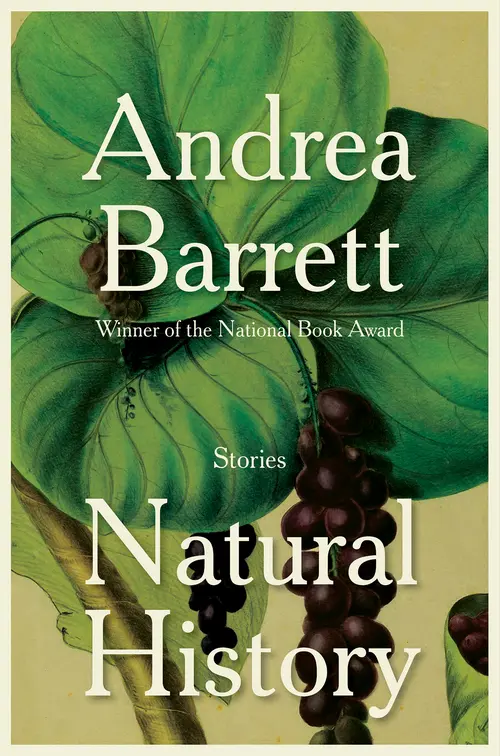
Title
NATURAL
HISTORY
stories
ANDREA BARRETT

W.W. NORTON & COMPANY
Independent Publishers Since 1923
for Emily Forland,
stalwart companion
There were some advantages about being a writer of histories.
The desk was a shelter one could hide behind, it was a hole one could creep into.
—WILLA CATHER, The Professor’s House
I
I

Wonders of the Shore
WONDERS OF THE SHORE
I.
The sea-shore, with its stretches of sandy beach and rocks, seems, at first sight, nothing but a barren waste, merely the natural barrier of the ocean. But to the observant eye these apparently desolate reaches are not only teeming with life, they are also replete with suggestions of the past. They are the pages of a history full of fascination for one who has learned to read them.
The cover is a faded olive, not flashy; not the first thing you’d pull from a bookshelf. Wonders of the Shore. Black type, black decorations: a small silhouette of a fiddler crab; a pair of stylized starfish bracketing the author’s name. Coiled snails frame the “Wonder” while sea anemones frame the “Shore.” Actually it is attractive, in a sober, subtle way. Someone labored over that design. And over the photographs, too, reprinted from many sources but freshly labeled and crowded on thick, glossy paper, which makes the book heavy.
The writing is old-fashioned, more detailed than we’re used to now; it was published in 1889. The author, Daphne Bannister, thanks a long list of people at the end of her preface. Some are professors at places like Harvard and Barnard, others curators or—the women—assistants at the Smithsonian. Especially thanked are Celia Thaxter, “whose kind invitations to Thaxter Cottage made my working visits to the Hotel such a pleasure,” and “my dear friend and stalwart companion, Miss Henrietta Atkins.”
One of Henrietta’s relatives, Rose Marburg, inherited the book, but for a long time Rose didn’t look at it.
II.
It is hoped that this book will suggest a new interest and pleasure to many, and that it will serve as a practical guide to this branch of natural history, without necessitating serious study. Marine organisms are interesting acquaintances when once introduced, and the real purpose of the author is to present, to the latent naturalist, friends whom he will enjoy.
Celia Thaxter is easy to trace; she wrote a book of poems, a collection of pieces about the beloved island where she was raised, a book about her garden. There are letters, too, and portraits and photographs, and a couple of biographies. Among her well-known friends were Whittier, Sarah Orne Jewett, and the painters William Morris Hunt and Childe Hassam. Nathaniel Hawthorne visited her island cottage. Major Greely claimed her poems comforted him during his disastrous Arctic voyage. She met Dickens and Robert Browning.