Mystery at Witchend
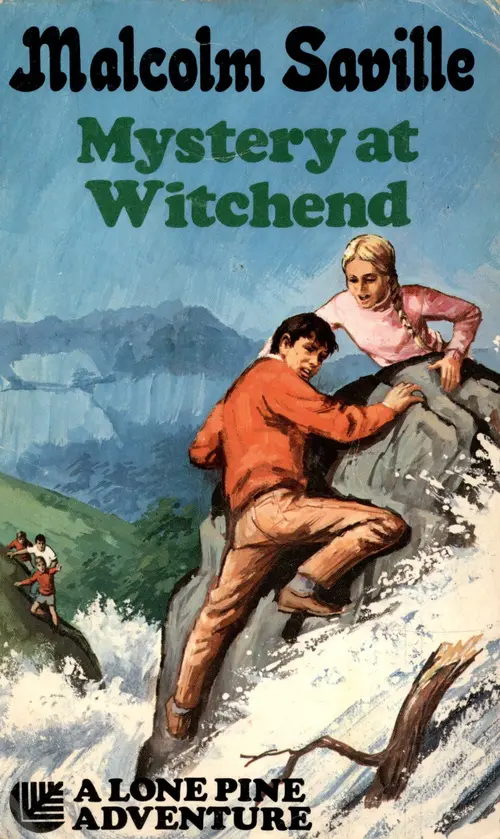
Mystery at Witchend
Malcolm Saville
First revised edition published in 1969 by Wm. Collins Sons and Co. Ltd., London and Glasgow. This edition first published 1971 by Wm. Collins Sons and Co. Ltd., 14 St. James's Place, London S.W.1.
© Malcolm Saville
Printed by Love & Malcomson Ltd., Brighton Road, Redhill, Surrey.
CONDITIONS OF SALE
This book is sold subject to the condition that it shall not, by way of trade or otherwise be lent, re-sold, hired out or otherwise circulated without the publisher's prior consent in any form of binding or cover other than that in which it is published and without a similar condition including this condition being imposed on the subsequent purchaser.
Foreword
Much of what Bill Ward told the children is true. There is actually a mountain called the Long Mynd in the high-lands of Shropshire - a wild, rolling hill, with steep and lonely valleys or "gutters" as they are called locally, on the eastern side.
Caer Caradoc, like a crouching lion, does guard the vale between the Stretton hills, and over towards the borders of Wales another lonely range called the Stiperstones is crowned with black rocks which are hidden by the mists as "he" takes his seat on his throne.
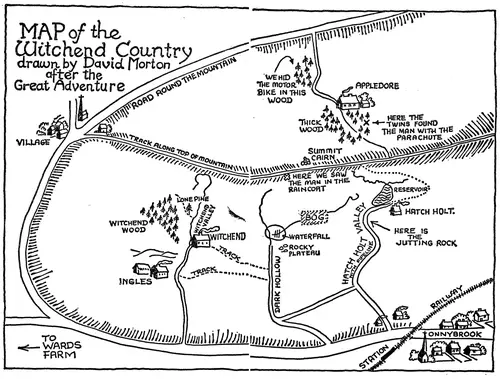
The country in which this story is set is real, but if you are ever lucky enough to explore it for yourself you will not find Witchend or Appledore or Hatchholt and its reservoir. There is no village called Onnybrook and all the people you will read about in these pages are imaginary and have no reference to any living person.
M.S.
1. Witchend
They changed trains at Shrewsbury. "Promise me, twins," said Mrs. Morton, "that you'll stay here with the luggage and look after Macbeth. Don't move till we come back. David is going to find a porter and I'll see if I can get something to eat."
"All right, Mummy," said Richard. "Trust us."
"We swear," said Mary solemnly, as she sat herself firmly on a trunk and hoisted an agitated little black dog up beside her. Macbeth was grateful for this attention and licked her face. He hated trains and crowds. People trod on him.
David didn't feel particularly grown-up as he went up the long platform. He knew he ought to be. He remembered what his father had said. "Take care of Mother for me, old chap, and look after those awful twins as well. I know you'll all love Witchend, and I want you to have a good time while I'm away... But be sensible and remember that I trust you not to do silly things."
The crowds were thinning out now. The guard waved his flag, and the long chocolate and cream train slid out on its way to Chester and Birkenhead. David watched the last coach disappear round the bend, and when he turned an old porter was standing just behind him.
"And where be you going, young man?"
"Onnybrook," said David. "Will you come and help us with the luggage, please?"
On the other side of the station their new train was waiting. The guard got up leisurely from the van step as they came up.
"Push 'er in, Albert," he said with a wink to David. "Don't stand loiterin' about, man, and keep us all waiting."
He looked at the labels.
"Onnybrook, eh? Where are you staying, lad?"
And here the twins chimed in.
"We're going on a great adventure," said Mary.
"Our father is in the R.A.F.," said Richard, "and we're going to Witchend to live. We had bombs in London."
"Witchend?" smiled the guard. "Maybe you'll have your adventures up there all right by that old rascal mountain."
The compartment chosen by Mary had a sailor in it - a brown-faced, blue-eyed sailor with very white teeth. With apprehension David saw the twins exchange a meaning glance. Strangers were apt to be fascinated by their strange likeness, and it was an old game for them to select a victim and proceed to play with him. More often than not they had the same idea at the same time, and had no need to put their thoughts into words, and this habit could be very disconcerting.
But this sailor proved a willing victim. He helped Mrs. Morton in with the bags, laughed at Richard and Mary, patted Macbeth, and slapped David on the back. Long before the train started they were all friends, and the children had told him who they were and where they were going.
"If you like adventures you'll find plenty at Witchend," he told them. "I've lived in Shropshire all my life and it's the grandest county in England. We've got everything - mountains, moors, streams and rivers and waterfalls, and on the Long Mynd where you are going, there are hidden valleys with wild ponies in the bracken and heather and little dark brooks which you can follow up to their source."
"Tell us some more about the Long Mynd," said David.
"You'll have to find out its secrets for yourself," he winked, "but take care when you're up there and watch the weather. Many a man has been lost in the snow and fog up on the Mynd. You'll see it soon looking bare and innocent in the sunshine, but there are bogs and pools at the top, so remember what I tell you."
He looked over to Mrs. Morton.
"See they take care," he went on, "for the Mynd is a mountain of moods - not black and cruel like the Stiperstones..."
"Tell us about them. Talk about the Stiperstones."
"Well, they're different. The Long Mynd is smooth and rolling. It's wild and lonesome, as I say, but the Stiperstones, way over the other side, are rugged and cruel, and those who live near 'em know they're evil, too."
"Gosh!" said Richard. "Go on. Tell us more."
"At the top of the Stiperstones is the Devil's Chair - a big outcrop of shining black rock. My father told me once that these rocks are the oldest in England and that long ago, when all this part of the country under sixteen hundred feet was buried under a sheet of ice, the Devil's Chair stood up like a black island. But that's as may be. What we do know is that one day Satan came with giant strides out of the west, and you can still see the imprint of his foot on a stone in the brook which he crossed in the valley below. He was on his way to the Long Mynd to fill one of the valleys - we call 'em Gutters - with stones which he was carrying in his apron. We reckon the old devil was a bad walker, for they say he picked up a stone in his shoe and sat down in his chair to rest. He undid his shoe and flicked out the pebble which landed nine miles away in a field near Bishop's Castle. Some say this great stone turns round when the church clock there strikes thirteen."
"Go on," said Mary. "Tell us more."
"Well, he rested on his chair a bit, but when at last he got up to step across the Mynd his apron string broke and all the stones dropped out, and you can see 'em there to-day."
Mrs. Morton was smiling at him.
"Sometimes we smile, too," he said. "But there are many as still hold that he comes back to his throne. Only when his chair is vacant can it be seen by mortal eyes. When it's clear and can be seen a long way off we know the weather will be fine, but sometimes while we watch a mist comes up from the west and hides it, and he comes back to his throne and the cottagers below go indoors and put up the shutters. And that's why I tell you, young man," he went on, turning to David, "not to trust too much to the weather on these mountains. Always watch the west, where the bad weather comes racing over from Wales, and if you're doubtful turn back and always keep to the tracks."
Their new friend was still yarning when the train started. He told them that his name was Bill Ward, that his father had a big farm away down in the plain some seven miles from Witchend and he invited them all to come down and see him.
"Do you like castles, Mary?" he went on. "You do? There's one at Ludlow. You can go and see it for yourself. If you do, climb a twisting turret stair and from the watchtower look out across a broad river to the Marches of Wales."
Mary clasped a protesting Macbeth to her.
"I just can't wait to begin," she said.
"Come this side," said Bill after a little, "and you'll see Caradoc. He looks like a crouching lion. Look! There he is."
They crowded over. Alight in the westering sun, grim and crowned with rocks, he seemed to guard the way into a new country. But the children's first view of the Long Mynd - the mountain which was to mean so much to them - was not so exciting. It was, as Bill had said, a long, smooth, rolling mountain without a peak like Caradoc. The slopes were bare of trees, and so suddenly did the mountain seem to grow out of the plain that it seemed as if they might lean from the windows and touch it. As they watched, the sun slipped down behind it, and a great shadow was flung across the country to the train. The slopes that had looked so smooth and inviting were now dark and mysterious as black clouds came rolling up from the south-west.
"Better get your things ready," said Bill. "Onnybrook is the next stop, and you'll be running into a storm, I'm thinking... Look at the mountain now, David, and you can see the valleys I told you about. You'll want to explore them all."
The train stopped and the guard opened the door.
"Come and count your baggage, young man, and then get under cover quick, else you'll be wet through before you start."
Bill helped them out and shook hands with them all.
Then an aged porter came along with a barrow just as the first heavy drops fell. Mrs. Morton ran for the shelter of the booking office.
"See to the luggage David," she called, "then come in here with us. We'll see if the car has come. Come on, twins! Good-bye, Mr. Ward, and good luck and thank you..."
The last bundle was on the barrow and David was checking everything methodically when there was a commotion down by the level-crossing gates.
"Stop! Stop!" a man was shouting excitedly. "Wait for me," and as he ran up the platform he banged David and sent him falling back against the loaded truck. Then he began to turn their luggage over and look at the labels.
"My parcel," he shouted. "My parcel! What have you done with it? Addressed to Thurston. Where is it?"
The porter told him there was no parcel for Thurston and the guard checked his van. But still the stranger wasn't satisfied. They must telephone to Shrewsbury, he said, and find out whether the parcel was there. While he was shouting he started to turn over the Morton's luggage again.
"Please leave our luggage alone," David said stoutly. "We haven't got your parcel."
The guard waved his flag and Bill leaned from the window and saluted as the train pulled out. The rain threshed down fiercely and the old porter trundled his barrow over to the shelter of the booking office.
At David's denial, the stranger seemed to notice him for the first time, and was now staring intensely at him with bright, piercing eyes. David observed that the man was short and thick-set, with remarkably long arms.
Suddenly David shivered. He felt angry and oddly afraid, and wanted to be with the others. He turned his back and ran through the rain alone.
"The car's here, David," said Mrs. Morton, "but we can't get the luggage on for a minute. It's too wet. What did the funny old man want?"
From under the barrow, Macbeth began to growl, and they looked up to see the stranger in the doorway. Mary grabbed the dog's lead and held on with all her strength as the man called out to the porter:
"Hi, you! Have you telephoned about my parcel? I must have it. When is the next train?"
"No more trains tonight, mister," said the old porter with a grin. "Better ask station-master if you want to telephone."
Scowling and muttering to himself, the man rudely looked the Mortons up and down before striding out into the rain. A few minutes later they heard the noise of a motor-cycle.
Somehow they got the luggage stowed away - some on the roof, some on the back and some on the front seat with John.
At last they started on the last stage of their journey.
The climbing road twisted and turned for another mile before the trees thinned out, and they rushed out to the crest of a long hill. Ahead was rolling country with their road threading its way like a ribbon into the distance. But before David had time to exclaim old John braked and turned sharp right into a lane flanked again by trees.
"Are we nearly there?" he asked.
"Just through the wood, son, and you'll see Witchend."
The rain had stopped now and the clouds were breaking in the west above the rolling grandeur of the Long Mynd. To their left the mountain sloped abruptly away to its southern extremity. To their right it stretched hard across a skyline aflame with the scarlet and gold of the setting sun.
"Please stop for a minute," said Mrs. Morton. "Where's Witchend? Show us..."
Old John pointed ahead.
"There's her smoke. See the larch wood down the side of the hill like a black wedge? Look again at the corner of the wood and you'll see a patch of grey - that's the side of the house, and I see her smoke against the trees. But we'll be moving, and I'll have you home in five minutes."
They rushed down the hill and pulled up as some cows straggled across the lane into a farmyard. A man in khaki raised his hand in a cheery salute to them as they crawled past.
"That's your near neighbour - Alf Ingles. He's a great one for this Home Guard... always crawling about the country on his stomach. I tells him he'd be better lookin' after his cows, for that old Hitler's not goin' to bother about us up here... not that we wouldn't give him something to remember if he did!"
They were now almost at the foot of the Mynd, and in its shadow. Above them a dense wood of swaying larches clung to the side of a steep valley. Their lane came to an end and the car stopped on a level of close, springy turf alongside a white gate in a wall of loose stones.
Beyond the gate they could see the gleam of water and the shadow of a long barn and, on the right, the house. In the dusk Witchend looked bigger than they had imagined. In front under the roof two gabled windows jutted, while at the back the hill came so close that it looked as if the house was leaning against it.
A stream came tumbling under the wall and ran chattering round the edge of the turf on which they were standing and finally disappeared under the hedge at the bend of the lane.
Old John opened the car door for Mrs. Morton. "Witchend, mum - and a welcome to you all to your new home."
By the time the car was through the gate the front door had opened, and a tall, thin, forbidding-looking woman came out onto the step.
"You'll be Mrs. Morton, I'm thinking. Ye're late. I've been expecting you this half-hour gone."
David didn't hear what his mother replied, but he did hear Dickie muttering "She's a witch. She must be, Mary. Just look at her."
The next hour was a desperate muddle. Old John carried the trunks up the narrow stairs, but they all helped to bring in the other bundles. Macbeth got trodden on and yelped.
Mrs. Braid did not seem a friendly sort of person, and once snapped at Richard for getting in the way. Mary answered back indignantly for her twin - they often did this for each other - and so surprised was the housekeeper that she dropped a heavy suitcase.
"It wasn't his fault," said Mary. "Can't you see he was only trying to help. We always help. We're jolly useful at helping, and maybe you'll be sorry for speaking to us like that..."
"Mary," said Mother, in her special, quiet voice, "go into the other room with Dickie and Macbeth and stay there until you are called. You can be thinking of how you will apologize to Mrs. Braid."
Mutinously they went into a long, low room lit by the flickering flames of a wood fire.
"Did you see her legs?" whispered Dickie. "Witch's legs, they were. All thin and scraggy. Sparrow's legs! That's what we'll call her, Mary - Sparrow's Legs. When I say S.L. you'll know what I mean... Gosh! I'm hungry."
At last old John said "Good night" and the car rattled away in the dusk. Mrs. Morton was shutting the front door as David came clattering down the stairs.
"I say, you kids, this is a grand place. All sorts of secret hiding-places and mysterious rooms. Come and see."
"I'm sorry, David," said Mary, "but we can't come now... We've been rude... We're to sit here quietly till I 'pologize. We're thinking of what to say."
But Richard was not so circumspect.
"What's she like really? The old witch, I mean. We've got a name for her..."
Then Mother came in with Mrs. Braid and the twins got up together.
"I'm sorry I was rude," began Mary; and "We didn't really mean to get in the way," finished her twin.
Quite unexpectedly Mrs. Braid smiled. And when she smiled she looked quite different. Not a bit "witchy" and almost nice.
"Ah well," she said. "Maybe I was a bit hasty and worried. We'll say no more, my dears, except I'm sorry, too, and hope you'll soon find old Agnes's bark is worse than her bite... And now it's time for us all to bite, I'm thinking, before yon pigeon pair is packed off to bed."
And rather awkwardly she put a hand on each twin's shoulder and gave them a gentle push towards the door.
The kitchen was a big room with a low, beamed ceiling from which hung a large oil lamp. The floor was of stone and along one wall was a big kitchen range in which burned a cheerful fire. On the table was a plate piled with slices of brown bread, a jar of golden syrup, and each place was set with a boiled egg.
"It's that difficult to get a square meal with all this ray-shunning," Mrs. Braid was saying, "but Mrs. Ingles down the lane gets us milk and eggs, and I'm thinking you'll soon be wanting some pullets yourselves... and there's cocoa for those that likes it and tea for them as can't abide the stuff like me..."
"Thank you, Agnes," said Mrs. Morton. "It's a lovely meal and not a bit like wartime. Let's sit down and start."
After tea they were given a quarter of an hour to explore Witchend before the twins were packed off to bed.
It was a fascinating house - friendly downstairs and really "lived in".
An uncarpeted staircase led from the kitchen, and another door opened into the scullery which had not only a sink but a copper and a bath.
In another corner was a genial grandfather clock with a loud and friendly tick and a jolly face.
When they had explored downstairs, Mrs. Morton insisted that they could only prospect upstairs first and then the twins must go to bed. She gave them all a solemn warning about the dangers of oil lamps and candles, and put David in charge of the expedition.
They were all so tired afterwards, and for once David went to bed with the others. He was a little ashamed, but suddenly found that he could barely keep his eyes open.
He had meant to put lots of his things away and make some changes in the little room he shared with Richard, but suddenly nothing seemed to matter except bed.
Then he was dreaming. He dreamt that he was in the garden at home in the days when his father went to the office every day. He was playing with his father and Macbeth. It was a favourite game.
They chased Macbeth down the garden until they got him into the corner by the potting shed. He might, and often did escape them five or six times, but finally they always forced him into this corner. It was a sort of ritual and Macbeth loved it. He would tear madly round the lawn snarling and dodging, but not until he was pinned in his corner did he start to bark.
It was not the bark he used when ratting or rabbiting, nor was it his watchdog bark, but rather a special kind of yelp. And now he was yelping loudly. Really loudly... louder and louder... David turned to ask his father why Mac was making so much noise this time, and found he was alone.
He woke up. Macbeth was still barking.
David reached for his torch and looked at the watch his father had given him the week before. Twenty to three. He did not much like the idea, but he knew he had got to go down and stop Macbeth making such a din.
The growls died in Mac's throat as he saw David.
"What's wrong, you silly little dog?" With a rush Macbeth came at him and jumped up. David did not know where the dog was supposed to be sleeping, but every time he tried to leave him on the coloured hearthrug he jumped up again and followed him to the door.
"All right, Mackie," he said at last. "I don't know what Mother will say, but you'd better come up with me. I think you're lonely."
Mac knew. His tail wagged so violently that the whole of his little black body swayed and he fairly galloped up the stairs.
The Story Continues on BooksBarbecue!
Enjoyed this preview? ❤️ Do not stop here!
Read the complete book free online → 🔗
Continue reading now on BooksBarbecue and discover every page!
Love reading? Bookmark BooksBarbecue.com for more amazing books!
Happy Reading!