My People
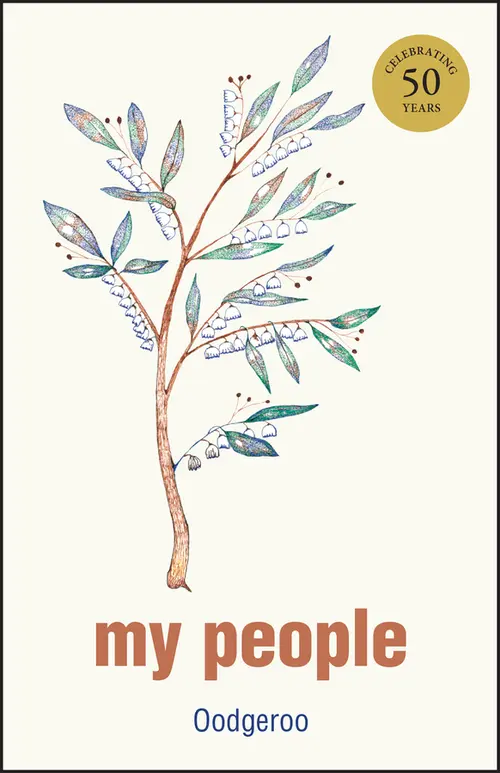
Cover
Dedicated to my son Kabul
of the tribe Noonuccal
Custodian of the land Minjerribah
(Vivian Charles Walker)
All One Race
Black tribe, yellow tribe, red, white or brown,
From where the sun jumps up to where it goes down,
Herrs and pukka-sahibs, demoiselles and squaws,
All one family, so why make wars?
They're not interested in brumby runs,
We don't hanker after Midnight suns;
I'm for all humankind, not colour gibes;
I'm international, and never mind tribes.
Black, white or brown race, yellow race or red,
From the torrid equator to the ice-fields spread,
Monsieurs and senors, lubras and fraus,
All one family, so why family rows?
We're not interested in their igloos,
They're not mad about kangaroos;
I'm international, never mind place;
I'm for humanity, all one race.
Let Us Not Be Bitter
Away with bitterness, my own dark people
Come stand with me, look forward, not back,
For a new time has come for us.
Now we must change, my people. For so long
Time for us stood still; now we know
Life is change, life is progress,
Life is learning things, life is onward.
White men had to learn civilised ways,
Now it is our turn.
Away with bitterness and the bitter past;
Let us try to understand the white man's ways
And accept them as they accept us;
Let us judge white people by the best of their race.
The prejudiced ones are less than we,
We want them no more than they want us.
Let us not be bitter, that is an empty thing,
A maggot in the mind.
The past is gone like our childhood days of old,
The future comes like dawn after the dark,
Bringing fulfilment.
An Appeal
Statesmen, who make the nation's laws,
With power to force unfriendly doors,
Give leadership in this our cause
- That leaders owe.
Writers, who have the nation's ear,
Your pen a sword opponents fear,
Speak of our evils loud and clear
- That all may know.
Unions, who serve democracy,
Guardians of social liberty,
Warm to the justice of our plea,
- And strike your blow.
Churches, who preach the Nazarene,
Be on our side and intervene,
Show us what Christian love can mean
- Who need it so.
The Press, most powerful of all,
On you the underprivileged call:
Right us a wrong and break the thrall
- That keeps us low.
All white well-wishers, in the end
On you our chiefest hopes depend;
Public opinion's our best friend
- To beat the foe.
The Curlew Cried
Three nights they heard the curlew cry.
It is the warning known of old
That tells them one tonight shall die.
Brother and friend, he comes and goes
Out of the Shadow Land to them,
The loneliest voice that earth knows.
He guards the welfare of his own,
He comes to lead each soul away –
To what dim world, what strange unknown?
Who is it that tonight must go:
The old blind one? The cripple child?
Tomorrow all the camp will know.
The poor dead will be less afraid,
Their tribe brother will be with him
When the dread journey must be made.
‘Have courage, death is not the end,’
He seems to say. ‘Though you must weep,
Death is kindly and is your friend.’
Three nights the curlew cried. Once more
He comes to take the timorous dead –
To what grim change, what ghostly shore?
Note: The curlew was brother of the Aboriginal peoples. He came to warn them of a coming death by crying near a camp three nights in succession. They believed that the curlew came to lead the shade of the dead one away to the unknown world.
Sounds Assail Me
Something obscene
In man-made sounds affronts the sweet and clean,
But Nature's never.
Shout of the stormy winds, ever
Toneless and rude, tossing the trees,
The harsh scream of seabirds – these
Somehow belong
As much as the wren's airy song.
Man only, the books tell, knows evil and wrong;
Even as art now the yelp and yell
Like music of hell,
Music made evil, the squawk and squall
When the disc jockeys loose the blare and bawl.
Give me the sounds God made so –
I love them all
Whether loud or low,
From the small, thin
Note of the bee's violin
To the rough sea's uproar,
In wild tumult tumbling upon the shore.
Tree Grave
When our lost one left us
For the Shadow Land,
In bark we bound him,
A weeping band,
And we bore him, wailing
Our wild death croon
To his lonely tree-grave
By the Long Lagoon.
Our wandering fires
Are now far away,
But our thoughts are turning
By night and day
Where he lies for ever
Under the white moon,
By the lit waters
Of the still lagoon.
His hunts are over
And the songs he made;
Poor lonely fellow,
He will be afraid
When the night winds whisper
Their ghostly tune
In the haunted swamp-oaks
By the Long Lagoon.
Dawn Wail for the Dead
Dim light of daybreak now
Faintly over the sleeping camp.
Old lubra first to wake remembers:
First thing every dawn
Remember the dead, cry for them.
Softly at first her wail begins,
One by one as they wake and hear
Join in the cry, and the whole camp
Wails for the dead, the poor dead
Gone from here to the Dark Place:
They are remembered.
Then it is over, life now,
Fires lit, laughter now,
And a new day calling.
Dark Unmarried Mothers
All about the country,
From earliest teens,
Dark unmarried mothers,
Fair game for lechers –
Bosses and station hands,
And in town and city
Low-grade animals
Prowl for safe prey.
Nothing done about it,
No one to protect them –
But hush, you mustn't say so,
Bad taste or something
To challenge the accepted,
Disturbing the established.
Turn the blind eye,
Wash the hands like Pilate.
Consent? Even with consent
It is still seduction.
Is it a white girl?
Then court case and headline
Stern talk of maintenance.
Is it a dark girl?
Then safe immunity;
He takes what he wants
And walks off like a dog.
Was ever even one,
One of all the thousands
Ever made responsible?
For dark unmarried mothers
The law does not run.
No blame for the guilty
But blame uttered only
For anyone made angry
Who dares even mention it,
Challenging old usage,
Established, accepted
And therefore condoned.
Shrug away the problem,
The shame, the injustice;
Turn the blind eye,
Wash the hands like Pilate.
Not My Style
Not my style?
Man! the world will end
And you complain.
I want to do
The things I have not done.
Not just taste the nectar of Gods
But drown in it too.
Shed my grass-root skin.
Emerge!
As woman!
-
poet!
-
writer!
- musician!
-
Eat herbs;
Chew grass;
Commit suicide;
Live.
Stuff myself
Of the bitter and the sweet,
Before,
-
that thing,
-
that thing,
- outside
-
Comes.
Last of His Tribe
Change is the law. The new must oust the old.
I look at you and am back in the long ago,
Old pinnaroo lonely and lost here,
Last of your clan.
Left only with your memories, you sit
And think of the gay throng, the happy people,
The voices and the laughter
All gone, all gone,
And you remain alone.
I asked and you let me hear
The soft vowelly tongue to be heard now
No more for ever. For me
You enact old scenes, old ways, you who have used
Boomerang and spear.
You singer of ancient tribal songs,
You leader once in the corroboree,
You twice in fierce tribal fights
With wild enemy blacks from over the river,
All gone, all gone. And I feel
The sudden sting of tears, Willie Mackenzie
In the Salvation Army Home.
Displaced person in your own country,
Lonely in teeming city crowds,
Last of your tribe.
Note: Willie Mackenzie was the last surviving member of the Darwarbada tribe of the Caboolture district. He died in 1968, age unknown, but probably in the eighties. His tribal name was Geerbo, his totem the native bee. The ‘Mackenzie’ came from his family's first white boss, a selector of that name.
The Child Wife
They gave me to an old man,
Joyless and old,
Life's smile of promise
So soon to frown.
Inside his gunya
My childhood over,
I must sit for ever,
And the tears fall down.
It was love I longed for,
Young love like mine,
It was Dunwa wanted me,
The gay and brown.
Oh, old laws that tether me!
Oh, long years awaiting me!
And the grief comes over me,
And the tears fall down.
Happy the small birds
Mating and nesting,
Shrilling their gladness
No grief may drown.
But an old man's gunya
Is my life for ever,
And I think of Dunwa,
And the tears fall down.
The Young Girl Wanda
Crooning her own girl thoughts and dreams
The young girl Wanda,
Grinding nardoo with the women
Softly chanted her simple song
Of all she hated.
‘I hate death and the going away,
All sad endings.
I hate things that have no joy,’
Said the young girl Wanda.
‘I hate sunset bringing the dark
That is full of secrets,
I hate silence of desolate places,
Swamp-oaks sighing by lonely waters,
And tree graves,’
Said the young girl Wanda.
‘I hate old men's rules and laws,
Old wrinkled faces,
The elders who no longer know
What the young know,’
Said the young girl Wanda.
‘All time too much hate, you.’
Said the old gin Onah.
‘Tell us what you love.’
‘I love joy of life,
I love arms around me,
I love life and love,’
Said the young girl Wanda.
‘I love all young things,
The young dawn, not the grey day dying,
The white of daybreak on awakening waters.
I love happy things,’
Said the girl Wanda.
‘High eagles, the light in eyes we love,
The camp crying for joy when one returns.
I love colour, berries yellow and red,
The grass when it is green,
The blue that is on the kingfisher,
And a bright flower for my black hair,’
Said the young girl Wanda,
‘But most of all my strong lover I love,
And his arms around me.’
Whynot Street
Officiously they hawked about
‘Petition’ to keep abos out,
And slavishly, without a peep,
The feeble yes-men signed like sheep.
And are we still the ousted, then,
And dare you speak for decent men?
This site was ours, you may recall,
Ages before you came at all.
‘No abos here!’ Why not, Whynot?
And if black-balling and boycott,
First black-ball pride and arrogance,
Boycott this vile intolerance.
White Australia
Since God's good world began,
Not God but godless man
Made barrier and ban,
- And reared each frontier wall.
Brothers, when shall we see
Selfless democracy?
Life is for liberty,
- And earth was made for all.
Let little kiplings rant,
Narrow and arrogant,
Their chauvinistic cant
- That white is nobler birth.
The best of every race
Should here find welcome place;
The colour of his face
- Is no man's test of worth.
Acacia Ridge
White men, turn quickly the earth of Acacia Ridge,
Hide the evidence lying there
Of the black race evicted as of old their fathers were;
Cover up the crime committed this day,
Call it progress, the white man's way.
Take no heed of the pregnant black woman in despair
As with her children she has to go;
Ignore her bitter tears that unheeded flow;
While her children cling to her terrified
Bulldozers huddle the crime aside.
White men, turn quickly the earth of Acacia Ridge,
Plough the guilt in, cover and hide the shame;
These are black and so without right to blame
As bulldozers brutally drive, ruthless and sure
Through and over the poor homes of the evicted poor.
Homeless now they stand and watch as the rain pours down;
This is the injustice brought to the black man there,
Injustice which to whites you would never dare,
You whites with all the power and privilege
Who committed the crime of Acacia Ridge.
The Unhappy Race
The Myall speaks
White fellow, you are the unhappy race.
You alone have left nature and made civilised laws.
You have enslaved yourselves as you enslaved the horse and other wild things.
Why, white man?
Your police lock up your tribe in houses with bars,
We see poor women scrubbing floors of richer women.
Why, white man, why?
You laugh at ‘poor blackfellow’, you say we must be like you.
You say we must leave the old freedom and leisure,
We must be civilised and work for you.
Why, white fellow?
Leave us alone, we don't want your collars and ties,
We don't need your routines and compulsions.
We want the old freedom and joy that all things have but you,
Poor white man of the unhappy race.
Corroboree
Hot day dies, cook time comes.
Now between the sunset and the sleep-time
Time of playabout.
The hunters paint black bodies by firelight with designs of meaning
To dance corroboree.
Now didgeridoo compels with haunting drone eager feet to stamp,
Click-sticks click in rhythm to swaying bodies
Dancing corroboree.
Like spirit things in from the great surrounding dark
Ghost-gums dimly seen stand at the edge of light
Watching corroboree.
Eerie the scene in leaping firelight,
Eerie the sounds in that wild setting,
As naked dancers weave stories of the tribe
Into corroboree.
Stone Age
White man, only time is between us.
Once in the time long gone you lived in caves,
You used stone axe, you clothed yourself in skins,
You too feared the dark, fled the unknown.
Go back, remember your own Alcheringa
When lightning still was magic and you hid
From terrible thunder rolling in the sky.
White superior race, only time is between us –
As some are grown up and others yet children.
We are the last of the Stone Age tribes,
Waiting for time to help us
As time helped you.
Assimilation – No!
Pour your pitcher of wine into the wide river
And where is your wine? There is only the river.
Must the genius of an old race die
That the race might live?
We who would be one with you, one people,
We must surrender now much that we love,
The old freedoms for new musts,
Your world for ours,
But a core is left that we must keep always.
Change and compel, slash us into shape,
But not our roots deep in the soil of old.
We are different hearts and minds
In a different body. Do not ask of us
To be deserters, to disown our mother,
To change the unchangeable.
The gum cannot be trained into an oak.
Something is gone, something surrendered, still
We will go forward and learn.
Not swamped and lost, watered away, but keeping
Our own identity, our price of race.
Pour your pitcher of wine into the wide river
And where is your wine? There is only the river.
Integration – Yes!
Gratefully we learn from you,
The advanced race,
You with long centuries of lore behind you.
We who were Australians long before
You who came yesterday,
Eagerly we must learn to change,
Learn new needs we never wanted,
New compulsions never needed,
The price of survival.
Much that we loved is gone and had to go,
But not the deep indigenous things.
The past is still so much a part of us,
Still about us, still within us.
We are happiest
Among our own people. We would like to see
Our own customs kept, our old
Dances and songs, crafts and corroborees.
Why change our sacred myths for your sacred myths?
No, not assimilation but integration,
Not submergence but our uplifting,
So black and white may go forward together
In harmony and brotherhood.
The Teachers
For Mother, who was never
taught to read or write
Holy men, you came to preach:
‘Poor black heathen, we will teach
Sense of sin and fear of hell,
Fear of God and boss as well;
We will teach you work for play,
We will teach you to obey
Laws of God and laws of Mammon …’
And we answered, ‘No more gammon,
If you have to teach the light,
Teach us first to read and write.’
Ballad of Totems
My father was Noonuccal man and kept old tribal way,
His totem was the Carpet Snake, whom none must every slay;
But mother was of Peewee clan, and loudly she expressed
The daring view that carpet snakes were nothing but a pest.
Now one lived right inside with us in full immunity,
For no one dared to interfere with father's stern decree:
A mighty fellow ten feet long, and as we lay in bed
We kids could watch him round a beam not far above our head.
Only the dog was scared of him, we'd hear its whines and growls,
But mother fiercely hated him because he took her fowls.
You should have heard her diatribes that flowed in angry torrents
With words you never see in print, except in D. H. Lawrence.
‘I kill that robber,’ she would scream, fierce as a spotted cat;
‘You see that bulge inside him? My speckly hen made that!’
But father's loud and strict command made even mother quake;
I think he'd sooner kill a man than a carpet snake.
That reptile was a greedy-guts, and as each bulge digested
He'd come down on the hunt at night as appetite suggested.
We heard his stealthy slithering sound across the earthen floor,
While the dog gave a startled yelp and bolted out the door.
Then over in the chicken-yard hysterical fowls gave tongue,
Loud frantic squawks accompanied by the barking of the mung,
Until at last the racket passed, and then to solve the riddle,
Next morning he was back up there with a new bulge in his middle.
When father died and we wailed and cried, our grief was deep and sore;
And strange to say from that sad day the snake was seen no more.
The wise old men explained to us: ‘It was his tribal brother,
And that is why it done a guy’ – but some looked hard at mother.
She seemed to have a secret smile, her eyes were smug and wary,
She looked as innocent as the cat that ate the pet canary.
We never knew, but anyhow (to end this tragic rhyme)
I think we all had snake for tea one day about that time.
White Man, Dark Man
- WHITE MAN
Abo man, we
To you have brought
Our social science,
And you we have taught
Our white democracy.
- DARK MAN
White man, who
Would teach us and tame,
We had socialism
Long before you came,
And democracy too.
- WHITE MAN
Poor blackfellow,
All you ever had
Was ancestor Biami,
Except the big bad
Bunyip and his bellow!
- DARK MAN
White fellow, true
You had more for pride:
You had Jesus Christ,
But Him you crucified,
And still do.
The Protectors
While many despise and would exploit us
There are good white men will help us,
But not the appointed and paid officials,
Not the feudal police Protectors,
The protectors who do not protect.
The police of the little far inland towns,
The Protectors of Aborigines
Who move us about at will like cattle
At the request of graziers and their wives:
We feel like owned animals of the Sergeant,
The protector who does not protect.
Is there rape of dark girl by white man or men?
There is no question even of inquiry;
There is no remedy, there is no appeal.
Whom can we appeal to but the Protector
Who feels only contempt for the blacks?
The feeling is mutual, Sergeant!
He sees dark children left without schooling,
Women working from dawn to dark, trapped and unhappy;
He jokes with the rest about storekeepers robbing the blacks,
He is content with all this,
The little local overlord with all power over us,
The protector who does not protect.
Intolerance
White the white glug contemptuously
Says ‘nigger’, it is plain to me
He is of lower grade than we.
When the dark stockman, used to hate,
Is note accepted as a mate,
Democracy is empty prate.
When we hear from the white élite
‘We won't have abos in our street,’
Their Christianity's a cheat.
When blacks are banned, as we know well,
From city café and hotel,
The stink of Little Rock we smell.
Dark children coming home in tears,
Hurt and bewildered by their jeers –
I think Christ weeps with you, my dears.
People who say, by bias driven,
That colour must not be forgiven,
Would snub the Carpenter in heaven.
Bwalla the Hunter
In the hard famine time, in the long drought
Bwalla the hunter on walkabout,
Lubra and children following slow,
All proper hungry long time now.
No more kangaroo out on the plain,
Gone to other country where there was rain.
Couldn't find emu, couldn't find seed,
And the children all time cry for feed.
They saw great eagle come through the sky
To his big stick gunya in a gum near by,
Fine young wallaby carried in his feet:
He bring tucker for his kids to eat.
Big fella eagle circled slow,
Little fella eagles fed below.
‘Gwa!’ said Bwalla the hunter, ‘he
Best fella hunter, better than me.’
He dropped his boomerang. ‘Now I climb,
All share tucker in the hungry time.
We got younks too, we got need –
You make fire and we all have feed.’
Then up went Bwalla like a native cat,
All the blackfellows climb like that.
And when he look over big nest rim
Those young ones all sing out at him.
They flapped and spat, they snapped and clawed,
They plenty wild with him, my word,
They shrilled at tucker-thief big and brown,
But Bwalla took wallaby and then climbed done.
No More Boomerang
No more boomerang
No more spear;
Now all civilised –
Colour bar and beer.
No more corroboree,
Gay dance and din.
Now we got movies,
And pay to go in.
No more sharing
What the hunter brings.
Now we work for money,
Then pay it back for things.
Now we track bosses
To catch a few bob,
Now we go walkabout
On bus to the job.
One time naked,
Who never knew shame;
Now we put clothes on
To hide whatsaname.
No more gunya,
Now bungalow,
Paid by hire purchase
In twenty year or so.
Lay down the stone axe,
Take up the steel,
And work like a nigger
For a white man meal.
No more firesticks
That made the whites scoff.
Now all electric
And no better off.
Bunyip he finish,
Now got instead
White fell Bunyip,
Call him Red.
Abstract picture now –
What they coming at?
Cripes, in our caves we
Did better than that.
Black hunted wallaby,
White hunt dollar;
White fella witch-doctor
Wear dog-collar.
No more message-stick;
Lubras and lads
Got television now,
Mostly ads.
Lay down the woomera,
Lay down the waddy.
Now we got atom-bomb,
End everybody.
Bora
Stone Age youth
Impatient for the testing
Waits command of elders
To face Bora ordeal.
Boyhood is over,
No more now
Playing with the children,
Keeping with the women;
Today at the Bora
Terrified but eager
Boy becomes man.
He will not dare
To cry when the stone knife
Shapes bleeding Bora marks
Of manhood and honour.
Deep scorn and anger
Should he fail the man test.
He will be given now
Woomera and firesticks,
Given balanced boomerang,
War shield and spear.
He will be tracker now
A tribesman, a fighter,
Sitting with the men now,
Dancing in corroboree;
Going with the hunters
To prove himself a man.
Proudly he'll return now
From his first stalking,
Flinging down his weapons,
Flinging down the kill.
The children he played with
The Story Continues on BooksBarbecue!
Enjoyed this preview? ❤️ Do not stop here!
Read the complete book free online → 🔗
Continue reading now on BooksBarbecue and discover every page!
Love reading? Bookmark BooksBarbecue.com for more amazing books!
Happy Reading!