My Italians
Cover
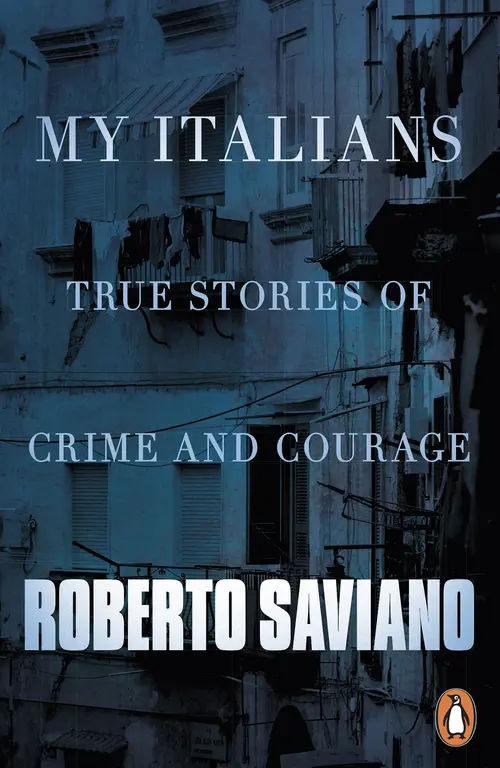

Roberto Saviano
MY ITALIANS
True Stories of Crime and Courage
Translated by Anne Milano Appel

Roberto Saviano
MY ITALIANS
True Stories of Crime and Courage
Translated by Anne Milano Appel
PENGUIN BOOKS
MY ITALIANS
Roberto Saviano was born in Naples in 1979. He is the author of the international bestseller Gomorrah, the film adaptation of which won the Grand Prix of the 2008 Cannes Film Festival, and Zero Zero Zero. He has been living under police protection since October 2006, following threats received from the criminal organizations that he denounced. In November 2008 Saviano was invited by the Nobel Committee in Stockholm to give a lecture on ‘Freedom of Speech and Lawless Violence’.
Preface
For a writer there is something unreal about working on a television show and putting it together from start to finish. On the page, everything you write leaves room for imagination; everything you recount can be experienced, pondered and elaborated upon in the reader’s mind and soul. With television that’s not the case: with television the words are not written down – you have to visualize the words. A narrative is most effective when you don’t try to faithfully reproduce life, but instead transform it truthfully into a story. In essence if you’re a writer you feel out of place everywhere but on the page, and yet when I was invited to tell stories about Italy on television, my answer was instinctively ‘yes’. I was excited about it, but I could only nod my head briefly, as if it were my body saying ‘yes’ rather than my brain.
And so an adventure began, made up of tension, sorrow and intense passion, an adventure that made me giddy and afforded me a chance to glimpse a way out of the dark night. The night of my country. I was dreaming of an ambitious, quality programme, with prominent guests: a show intended for a wide audience, that would portray an Italy rarely shown on TV. I wanted to talk about the mudslinging machine, the systematic process of discrediting people who speak out, about the mafia and politics, about how vote-buying works, about the lies surrounding the earthquake of L’Aquila, about the waste-disposal business. My dream (or ambition) was to speak to that segment of the country that is actually the largest, the part that wants to redesign the nation and rebuild it, that wants to declare that all Italians are not the same and that our diversity lies in being able to make mistakes without being corrupt, in having weaknesses that do not involve blackmail and extortion. I wanted to speak to that portion of the population that dreams, unashamedly, of being able to call this land of ours, which today is so forlorn, their country, patria, once again.
The resulting programme was aired in 2010 in four episodes and was called Vieni via con me (Come Away With Me). My TV monologues form the basis for the chapters in this book. The series was a sort of TV revolution: aired on Raitre (the third national channel) against the will of and with no support from the network’s highest executives. Despised by the government, it became a huge public success, the most viewed programme in the history of Raitre.
‘To see what is in front of one’s nose,’ George Orwell wrote, ‘needs a constant struggle.’ More than five years have passed since the series was aired, and after three successive governments there remains a certainty: nothing has really changed. Or better, what remains is a sense of impotence: now that Silvio Berlusconi is not presiding over Italy any more, now that we have a new, young and left-wing government, we are silenced by hope and disappointed by reality.
Even if some parts of the mudslinging machine appear to have been dismantled, it continues to operate, silently, ready to spring into action whenever it is needed. Worse still, there has been absolutely no progress in terms of the fundamental legislation that would strengthen Italy’s democracy. A natural disaster can still offer a good opportunity to those who want to siphon off public money, and key civil rights, like the recognition of same-sex unions and laws regarding the end of life, are still not guaranteed. As such, this book is as representative of Italy today as it was five years ago. The Lega Nord continues to exert considerable political pressure, and the government lacks the unity and strength to implement the reforms that the country really needs. Italy remains a two-speed country: the North attracts most of the investment and the South, lacking in infrastructure, is left to the most dangerous of enterprises: criminal organizations.
That’s the reason why I considered (and consider) it essential to commemorate the epic of national unification, which was motivated by ideals, not just economic interests, based on a federalism of solidarity rather than a self-seeking federalism like the one the Lega Nord appeals to today. A movement which started in the South, an area torn by criminal organizations, a mirror of our entire country: a hush-up which seems more and more difficult to come to terms with. It’s been very difficult to talk about the North as a terrain invaded by the South’s mafia, because it is not easy to accept the idea that a large part of the Italian economy is determined in unfamiliar, backward southern villages rather than in the big, modern northern metropolises. The bandit Salvatore Giuliano used to say: ‘In città scivolo,’ in the city I can slip, meaning that your footing is steady on soil, whereas on pavement, in the cities, where everyone is unfamiliar, you can become disoriented and you’re likely to make mistakes. Platì, Casal di Principe, Africo, Corleone, Casapesenna, Natile Careri: these are the places from which most of Italy’s capital is controlled. It is here, in the villages, that rules are written and administered. Though they are economic rules, they are first and foremost cultural, and they reach as far as the cities, even in the North or all the way to Germany, as demonstrated by the Duisburg massacre in the summer of 2007. The same affiliation rites that are believed to pertain only to backward regions are replicated even in the North; identical rituals are performed in response to the same immutable code. It’s not just militant dynamics, but primarily cultural dynamics that are nurtured by practices that are atavistic, perennial, fixed, eternal. Rules adopted as a way of life, as a mechanism for being in the world. Rules that are the force behind Italy’s most powerful entrepreneurial factions: the ’Ndrangheta, the Camorra and the Cosa Nostra. It would be too simple to believe that all this is the result of medieval backwardness, profound ignorance and the absence of the State. Because there is no backwardness in a place where millions and millions of Euros flow in through drug trafficking. That’s precisely the crux of the matter: the highest degree of traditional archaic rule, combined with the highest degree of economic development. The Web, the market, finance, drugs, yet all governed by the rules of property, of downcast eyes, of arranged marriages, of virginity and blood.
I didn’t want to tell stories about a backward village in the South in the hands of Mafia families. Many of the millions of viewers who watched us would have perceived them as remote, unrelated to them: stories that would not have had the power to engage the whole country. So I decided to talk about what was happening in the North, in Lombardy, in cement, in the drug trade, in the distribution of food and gas, in contract management, in the influences on local governments. I wanted to report what happens in the healthcare sector in Monza, in Novara, in the towns of Giussano, Seregno, Verano Brianza, Mariano Comense, Desio. These are not marginal stories, as they would have you believe. They are stories that concern everyone, the result of a system that is obeyed by those who at this time control much of my beautiful, ill-fated country. Yet my reconstruction of the Mafia’s infiltration in Lombardy, territory of the Lega Nord, was described as ‘infamous’. ‘For Saviano, the North is trash,’ they wrote in the papers, ‘For Saviano, the North is Mafia-run,’ simplifying to the utmost what I had presented in the broadcast, beginning with investigations into the infiltration of criminal organizations in the North and with the Legambiente’s reports on the ecomafia. As often happens, it’s as if the one telling the facts were at fault, the one exposing the mechanisms, the one who recalls the past asking the nation to face the findings as a unified front. The word that generated such an uproar in those days is ‘interloquire’, to have a say in. I had stated that the Mafia organizations have a say in discussions with political powers and that in the North, where political power is in the hands of the Lega Nord, the ’Ndrangheta chimes in with the League. I had based this on investigations which report continuous attempts by the ’Ndrangheta to influence the lists of candidates, and which describe intercepted communications among ’Ndrangheta members who speak of the League to one another as a party that they can influence, approach, control. ‘Interloquire’: a very broad term which does not by any means establish direct collusion or corruption, but which is a premise for suggesting that no one can feel safe and that no areas are immune from criminal money and the mafia-entrepreneurial alliance. Many politicians have even exploited the love story between Piergiorgio and Mina Welby (the first being affected by amyotrophic lateral sclerosis, they both fought to grant Piergiorgio a dignified death without the assistance of a breathing machine) and the testimony of Beppino Englaro (father of Eluana Englaro, a woman who, after a car crash, has lived for seventeen years in a vegetative state) in the debate about the right to die. They tried to build consensus by discrediting people who gave strength and meaning to Italian institutions. ‘The good man will act only on maxims which he can at the same time will to be universal laws’: in the affairs of Beppino, Piergiorgio and Mina this Kantian principle was informed with blood, sweat and tears. And a defence of rights. Refusing to take a quicker way out, Beppino, Piergiorgio and Mina asked the institutions of our country for civility, understanding and the respect of a judgment from the Court of Cassation. They could have left Italy but they didn’t do so, turning their bodies into the battleground for a crusade in defence of fundamental human rights, in order to confirm the inalienable right of every individual to be able to freely decide on the type of care they undergo: treatment which is considered a cure and that involves keeping a patient alive at all costs.
Maybe it’s only when faced with such evidence that we are able to explain the story of Socrates, to understand, after having heard it thousands of times, why he drank the hemlock rather than running away. A way out that is not taken, that is actually abhorrent, is much more than a campaign in favour of a single dignified death: it is a battle in defence of every individual’s life. The daily struggle of Beppino, Mina and Piergiorgio was a struggle in defence of rights, because it is clear that the essence of the law is the right to live. By acting as they did, they led the way to a new approach, showing that a person can and should remain in Italy, using the tools that democracy provides. For once, conscience and the law did not emigrate from our country. For once, people did not leave in order to obtain or even just ask for something, no attempt was made to be heard elsewhere. No Italian citizen, whatever he may think, can refuse to respect Beppino Englaro, who requested that a judgment of the Court of Cassation be applied, and Mina Welby, who fought for her Piero to have a Catholic funeral: two citizens whose actions restored to our country the dignity that often we ourselves take away.
In the days following the broadcast they called us the ‘death party’, in contrast to the ‘life party’. They simplified religion and politics, making them into a battleground without considering the fact that we portrayed a church which, in Italy, out of the spotlight, is the only one operating in the most difficult areas, in the most desperate situations, the only one that affords human dignity to migrants, to those the institutions overlook, to those who can’t stay afloat in the crisis. It would be nice if the ending of this story could be that in Italy, tomorrow, thanks to the non-violent battle of Beppino, Piergiorgio and Mina, each of us would be free to choose: to be kept alive by machines in a vegetative state for decades or elect our own end without having to emigrate. Just as patients in a permanent comatose state choosing to continue the support should be afforded decent, ongoing assistance without having to be a burden on the families, as often happens. This is an Italy that would embrace rights and compassion, that would allow choices different from one’s own to be respected and understood, an Italy with which it would be wonderful to be able to identify. Wanting to see yourself in a country that’s different, starting from where you feel the story pertains to you, where that idea of life pertains to you. Getting angry about the filth to which power often forces you: the shamefulness of it.
Like the many Neapolitans who have had enough of being constantly described as overflowing with trash, hurt by seeing their city covered with garbage. ‘Because we believed Berlusconi, and now how do we get out of it?’ ‘I knew the garbage would come back and that Berlusconi hadn’t solved anything. That’s politics.’ Those are the first two comments (their simplicity makes me smile) made by a listener who calls in to a local radio station which gives Neapolitans a chance to vent their outrage after an avalanche of refuse has once again, for the umpteenth time, inundated the streets of the city. Everything, periodically, goes back to the way it was before. But in Naples, almost as if to ward off bad luck, you can no longer talk about the waste crisis and you should not even mention the so-called ‘land of fires’ of which I wrote in my first book, Gomorrah – that triangle of land poisoned by decades of illegal and dangerous waste traffic and never reclaimed. Every now and then the city centre goes back to stinking like a garbage dump, the streets are lined with trash again, the population continues to protest against the opening of new landfills, alarmed that they might attract not only lawful refuse but also illegal waste, as Campania’s landfills have always done. Sometimes they’re lucky enough, when nothing happens in the world to monopolize attention, and the news is heard; at other times there’s a hurricane, a plane crash, a flood, or a sex scandal, and the protests are passed over in silence. They try to say that the soil is safe, that only a small amount of it is polluted, but waste continues to burn, the air in these areas is almost unbreathable, people die of cancer and no answer seems to be due. Governments change, but they keep on telling us: ‘You see? Everything is fine, the citizens’ committees that were protesting earlier have realized that the landfills are harmless and necessary.’ False. But after years of sticking-plaster solutions that have done nothing to solve the problem, this enormous sham is sometimes exposed, sometimes not, and it’s the region and the people’s health that pay the price. Landfills are overflowing because they’ve been filled, in recent decades, with all types of waste from outside the region. But if you report this you get an immediate, violent reaction from the mayors of the municipalities you mention: those from which the toxic wastes came and those in which the wastes were spilled, entombed, buried or hidden. All threatening lawsuits simply because you stated that those areas are toxic-waste trafficking zones. The Camorra continues to profit in all of this, while the lack of solidarity on the part of some regions of the North – which refused to accept Campania’s waste when needed so that the cycle might be normalized – has proved to be once again a short-sighted, perhaps unwitting, gift to the clans.
Telling the story does not change what happened, but it can alter what is to come. That’s the power of the narrative: when a story is heard, it becomes part of those who feel it’s their own and then act on what hasn’t yet happened. Every story has this margin of uncertainty, which resides in the perception of the listener. Hearing a story and feeling that it relates to you is like acquiring a formula to fix the world. I often think of a story the way a virologist does a virus, because a story can also become a contagious form which, by transforming people, transforms the world itself.
The Italy that listened to those monologues moved me. Each day I received thousands of letters and messages from people attesting to their receptiveness, their solidarity. Men and women who wanted to share their approval, as if a fresh breeze had begun to blow. What suffused every part of me during that time was actually the feeling that through that medium, television, which often seems useless, a device for obscuring people’s minds, a desire was building up: a longing to transform, to change, to speak out politically, to show that the country is different from the way it is portrayed, different from its political class, different from the crisis that it is going through.
The initial challenge was to portray this different Italy through ‘lists’ that would be the programme’s framework and grammar. A simple idea, because lists are containers for everything, every experience, every story. Here, too, audience participation was at a high: everyone thought of his or her own list, and during the broadcast, via Facebook and the website, thousands of them came in. Beautiful, funny, dramatic. I was reminded of the scene in the film Manhattan, when Woody Allen, lying on the couch, reflects on ‘An idea for a short story about, um, people in Manhattan who are constantly creating these real, unnecessary, neurotic problems for themselves ’cos it keeps them from dealing with more unsolvable, terrifying problems about … the universe.’ As an antidote, Allen thinks of something optimistic: a list of things that make life worthwhile. Of course it’s an expedient, the chronically ill person is him, and the optimistic list is useful to him and him alone, to free him from the pointless, neurotic issues which hold him captive. Woody Allen lists Groucho Marx, Willie Mays, the second movement of Mozart’s Jupiter Symphony, Louis Armstrong, Flaubert’s Sentimental Education, Swedish films, Marlon Brando, Frank Sinatra, those incredible apples and pears painted by Cézanne, the crabs at Sam Wo’s and Tracy’s face. A light-hearted list that is worth more than a moral compass for those at a loss.
I’ve always been attracted to lists. Someday I’d like to write books of lists. And I’m confident that a list of things that make life worth living is a fundamental exercise for remembering what we’re made of. A map of ourselves. I would like to spend my time seeing what people write, the ten things that give meaning to their lives. I would have liked to read them all on the air. But on television words must always be used sparingly. Here, however, I have paper in front of me, it never limits me. Unfortunately and fortunately. This is my list. These are the ten things which, for me, make life worthwhile:
1) Mozzarella di bufala from Aversa.
2) Bill Evans playing the ‘Love Theme from Spartacus’.
3) Going to the tomb of Raffaello Sanzio with the person you love most and reading the Latin inscription which many are unaware of.
4) Maradona’s 2-0 goal against England at the 1986 World Cup in Mexico (my apologies!).
5) The Iliad.
6) Listening to Bob Marley singing ‘Redemption Song’ in your earbuds while walking along, free.
7) Diving, but out in the deep, where the sea is the sea.
8) Dreaming of returning home after you’ve been forced to stay away a long, long time.
9) Making love on a summer afternoon. In the South of Italy.
10) Turning on the computer after a day when they’ve collected signatures against you and finding an email from your brother that says: ‘I’m proud of you.’

1.
I Swear
The Story Continues on BooksBarbecue!
Enjoyed this preview? ❤️ Do not stop here!
Read the complete book free online → 🔗
Continue reading now on BooksBarbecue and discover every page!
Love reading? Bookmark BooksBarbecue.com for more amazing books!
Happy Reading!