During the day, we make our way through the desert; at night he photographs the sky. Along the way, we both take pictures of the earth that catch our attention. Recording the sky is like hunting, like night fishing—he arranges his cameras and then we sit and wait for their lenses to catch a set number of pictures. That takes hours. (You’re a hunter, that’s now becoming quite obvious to me. Images of melting lead and making shotgun pellets in your early childhood, in northern Bosnia, filling the cartridges with tiny balls of lead, hunters’ tales round the fire, that’s what you remembered as essential, as your first memories to which you return . . .) Awake the whole night, we sit in the car, or stretch our arms outside, gazing at the stars, talking. When we run out of topics of conversation, we sit and each do our own thing. I draw. And last night, in the motel, I drew until almost daybreak. A photograph documents existence, although in fact it always shows something that no longer exists. A drawing is something else. It doesn’t have the strength of a document, a drawing is unreliable when compared to the reality seen with one’s own eyes, and so it fictionalizes my notes from our journey. And that unreliability is a good description of my journey with Harun, because over these last days my past has been dangerously mixed up with reality.
A red scarf. You belonged to the last generation of Tito’s “Pioneers.” Do you remember, when you started school, as part of your ceremonial uniform, you received a Partisan cap with a five-pointed star and a red scarf to be worn round the neck?
Little Pioneer! For five days now I’ve been watching you negotiate the roads and the desert. Tito would be proud of you!
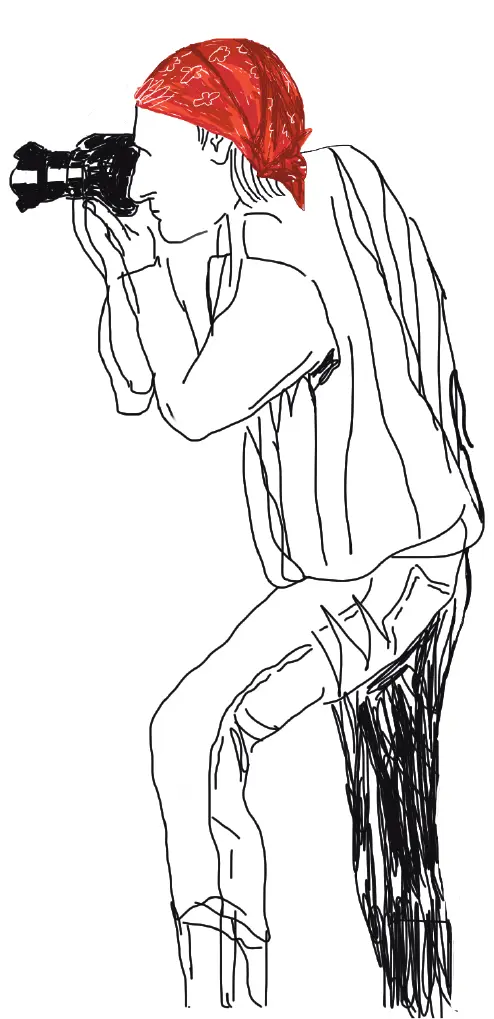

I thought that your red bandana was your photographer’s uniform. Did we use the word bandana in Bosnia? Or were all the various kinds of scarves all called by the same common name? I don’t remember. I’ve begun to forget my own language. Did we use the word fedora, or was all headwear of that kind just called a hat?
It’s interesting, this spring a brown fedora appeared on our coat stand, bought many years ago, but I had never stepped outside the house wearing it. I should also say that I had not written anything for months and was fairly despondent as a result. And two Saturdays ago, as soon as I woke up, in my pajamas, on my way to my desk I picked up the hat and put it on, just to see what it looked like on my head. I can say that this little change pleased me. Every day now I go to my desk in my pajamas with the hat on my head, that’s now my working uniform, because I started writing again when I was wearing it. It’s a purely theatrical effect: once I had put the hat on my head, I entered into a role. Like a character, like someone else, I began to write unimpeded, perhaps because it’s easier to express one’s opinions in someone else’s name; in other words, with the fedora on my head, I freed myself of the responsibility of being “me.” That “I” is the source of my despondency, it’s my daily terrorist.