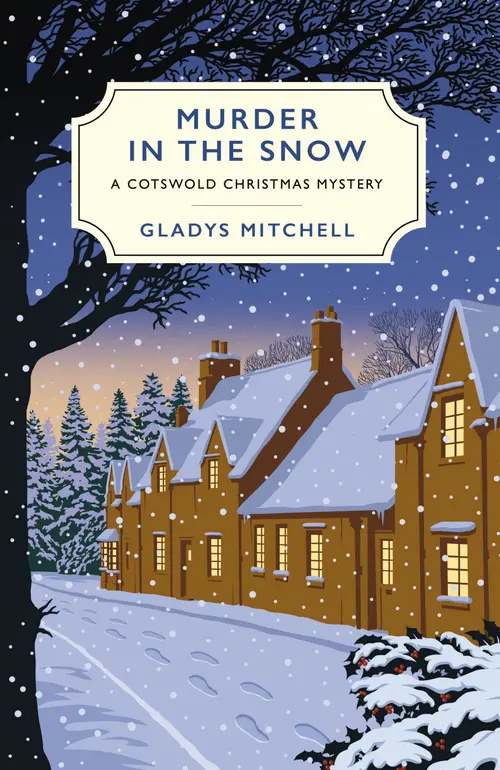
Murder in the Snow
Cover

ABOUT THE BOOK
Mrs Bradley, sharp-eyed detective and celebrated psychiatrist, has decided to spend Christmas with her nephew at his beautiful house in the Cotswolds.
It isn’t long before a mystery unfolds. There are strange events occurring in the nearby wood and local villagers are receiving anonymous threatening letters. Then the snow begins to fall – and a body is discovered.
Mrs Bradley is on the case, but she’ll have to hatch an ingenious plan to reveal the truth and find the culprit …
ABOUT THE AUTHOR
Gladys Maude Winifred Mitchell – or ‘The Great Gladys’ as Philip Larkin described her – was born in 1901, in Cowley in Oxfordshire. She graduated in history from University College London and in 1921 began her long career as a teacher. She studied the works of Sigmund Freud and attributed her interest in witchcraft to the influence of her friend, the detective novelist Helen Simpson.
Her first novel, Speedy Death, was published in 1929 and introduced readers to Beatrice Adela Lestrange Bradley, the heroine of a further sixty-six crime novels. She wrote at least one novel a year throughout her career and was an early member of the Detection Club along with G. K. Chesterton, Agatha Christie and Dorothy Sayers. In 1961 she retired from teaching and, from her home in Dorset, continued to write, receiving the Crime Writers’ Association Silver Dagger Award in 1976. Gladys Mitchell died in 1983.
ALSO BY GLADYS MITCHELL
Speedy Death
The Mystery of a Butcher’s Shop
The Longer Bodies
The Saltmarsh Murders
Death at the Opera
The Devil at Saxon Wall
Dead Men’s Morris
Come Away, Death
St Peter’s Finger
Printer’s Error
Brazen Tongue
Hangman’s Curfew
When Last I Died
Laurels Are Poison
The Worsted Viper
Sunset Over Soho
My Father Sleeps
The Rising of the Moon
Here Comes a Chopper
Death and the Maiden
Tom Brown’s Body
The Devil’s Elbow
The Echoing Strangers
Merlin’s Furlong
Watson’s Choice
Faintley Speaking
Twelve Horses and the Hangman’s Noose
The Twenty-Third Man
Spotted Hemlock
The Man Who Grew Tomatoes
Say It With Flowers
The Nodding Canaries
My Bones Will Keep
Adders on the Heath
Death of a Delft Blue
Pageant of Murder
The Croaking Raven
Skeleton Island
Three Quick and Five Dead
Dance to Your Daddy
Gory Dew
Lament for Leto
A Hearse on May-Day
The Murder of Busy Lizzie
Winking at the Brim
A Javelin for Jonah
Convent on Styx
Late, Late in the Evening
Noonday and Night
Fault in the Structure
Wraiths and Changelings
Mingled With Venom
The Mudflats of the Dead
Nest of Vipers
Uncoffin’d Clay
The Whispering Knights
Lovers, Make Moan
The Death-Cap Dancers
The Death of a Burrowing Mole
Here Lies Gloria Mundy
Cold, Lone and Still
The Greenstone Griffins
The Crozier Pharaohs
No Winding-Sheet

VINTAGE MURDER MYSTERIES
With the sign of a human skull upon its back and a melancholy shriek emitted when disturbed, the Death’s Head Hawkmoth has for centuries been a bringer of doom and an omen of death – which is why we chose it as the emblem for our Vintage Murder Mysteries.
Some say that its appearance in King George III’s bedchamber pushed him into madness. Others believe that should its wings extinguish a candle by night, those nearby will be cursed with blindness. Indeed its very name, Acherontia atropos, delves into the most sinister realms of Greek mythology: Acheron, the River of Pain in the underworld, and Atropos, the Fate charged with severing the thread of life.
The perfect companion, then, for our Vintage Murder Mysteries sleuths, for whom sinister occurrences are never far away and murder is always just around the corner …
CHAPTER 1
Mrs Bradley Takes a Christmas Vacation
‘Go, stop the swift-winged moments in their flight
To their yet unknown coast, go hinder night
From its approach on day.’
William Habington
Mrs Beatrice Adela Lestrange Bradley tapped with the corner of a stiff envelope on the edge of her writing desk. It was very seldom that she found difficulty in coming to a decision, but on this occasion she was conscious of doubt and hesitation.
She put the envelope down, took up a foolscap envelope instead, re-opened it, and re-read the letter it contained – an invitation to a conference of educational psychiatrists in Stockholm. The letter was warmly expressed, Mrs Bradley had spent an autumn and early winter in special and most fascinating research, and she badly wanted to attend the conference, whose views, generally speaking, would not accord with her own, but whose members would be interested in, if argumentative on, what she would have to say.
On the other hand, there was the invitation from the Cotswolds. Mrs Bradley’s three marriages had provided her with a vast and varied tribe of spirited and gifted in-laws, some of whom she liked. The stiff envelope contained a letter from her favourite nephew who had obliged her by marrying the young woman of her choice. Mrs Bradley had greatly desired to find place in the family circle for the lovely Deborah Cloud, and her nephew Jonathan had been the vehicle for this inclusion. That he had chosen Deborah for his own and not for his aunt’s reasons delighted that powerful but scrupulous mediator almost more than the actual fulfilment of her wishes.
‘Now we’ve somewhere to live, won’t you please come and spend Christmas? We are combining a Christmas party with a general house-warming, and are particularly anxious to have you,’ Jonathan had written. ‘Good company, Deb looking her best, and, what’s more, I’ve achieved a bottle of Scotch, and if you stay until New Year’s Day I swear you shall have a haggis.
‘P.S. We don’t care how many of your pet cases are going to collect delirium tremens at the festive season, or how many conferences you want to attend in January. Blood is thicker than water, and you always said you would visit us as soon as we were settled. You also promised to stay a good long time. So what about it? If coming, don’t bother to reply.’
Mrs Bradley rarely acted on impulse and was averse to solving her difficulties by indulging in superstitious practices, but on this occasion her mind was so divided that she suddenly picked up two long spills from a jar near the fireplace and tossed them into the air. One landed on the rug and the other fluttered on to the writing desk. The tiny kitten on the hearth immediately pounced, and began to play with the spill on the rug.
‘If you’ve got the longer one I’ll go to Sweden, if the shorter, I’ll go to the Cotswolds,’ pronounced Mrs Bradley, solemnly. She picked up the kitten and took away the spill. She measured it against the one which had landed on the writing desk. The spill which the kitten had captured was the shorter by almost an inch. Mrs Bradley took up a telegraph form, scribbled rapidly on it, and rang the bell. She handed the form to her secretary with instructions to send the telegram at once. Then she seated herself, picked up the kitten and the two spills, looked thoughtful for a moment, and then, putting down the tiny animal, she looked closely at the two spills, which were home-made from strips of newspaper. Then she untwisted the ends.
‘Oh, dear!’ she said aloud. ‘Now what have I done?’
The end of the shorter spill had been doubled over. As she straightened it out she discovered that the actual length came to several inches more than the length of that which she had decided at first was the longer spill.
‘It ought to have been Sweden, after all!’ she thought, with some amusement, crumpling the spills and throwing them into the basket.
‘Well, the telegram’s gone,’ said her secretary, when Mrs Bradley told her what had happened. ‘And I’m very glad. You need a holiday. You can go to Sweden next year!’
Jonathan Bradley and his wife Deborah had been lucky. A great estate in the Cotswolds had been offered for sale in two lots. Two-thirds of the property and the huge modern house had been sold to the Ministry of Education, but the remaining third of the land and the original manor house had been purchased by Mrs Bradley’s nephew. It lay in typical Cotswold country, hilly yet gloriously open. It was partly wooded, had a dashing stream, and offered some shooting and the chance of going out with the local Hunt.
Jonathan and his wife had bought their share of the estate in January, had moved in in April, and had purposely refrained from inviting guests until they felt that they were settled and at home.
The month was now December, and Mrs Bradley arrived two days before Christmas Eve. She travelled by train, for her chauffeur had been given Christmas leave, and she had deliberately made no mention to her nephew of the time of her train, for his house was miles from Cheltenham, (her terminus), and she disliked to cause inconvenience.
Jonathan Bradley, however, was at the station to meet her.
‘Deb wanted to come,’ he observed, ‘but I didn’t know whether I’d picked the right train. You didn’t say, and I thought it was a bit too cold for her to hang about draughty stations. I wish I’d brought her now.’
He took Mrs Bradley out to his car, and saw her luggage put on. A few minutes later the car was slipping like a homing cat across the Oxford–Gloucester turning, past a fifteenth-century barn, past a country bus-shelter, and so along the Cirencester Road.
Great slopes brooded dreamily upon their lost summer treasure of wheat, clover and barley; little by-roads sloped quietly up or down to Coberley, Elkstone, Brimpsfield and Compton Abdale. After half an hour’s driving, some deep woods, a lodge with its drive, a full stream at the bottom of steep banks, a straggle of black pine trees, a desolate farm, a narrower road, a sandy turning, and the entrance to a long and uphill lane, brought the car on to Jonathan’s land.
The car crept onward up the steep, uneven lane. Mrs Bradley, seated beside her tall and black-haired nephew, looked out of the window with interest. To her left ran another small wood. On the right the treeless ground curved almost voluptuously downward to another noisy little stream.
‘That turns the mill,’ said Jonathan, jerking his head towards the sound. ‘We’ve got a mill, a smithy, the pub and the post-office. Quite a model village, all told.’
As the rise mounted and the wood was left behind, the wet green slopes of the country filled the landscape. At the top of the rise was a grey and snow-filled sky, and, as the car climbed and the hills changed their contours, Mrs Bradley saw two small houses, one on either side of the way.
‘What do you think of it?’ asked Jonathan, touching his horn as the car approached the houses, and then changing gear as the slope became more gentle and a drive took the place of the lane.
‘Desolate, enchanted, apt and supernormal,’ replied his relative, gazing raptly at the charged and lowering sky.
‘Apt for what?’
‘For treason, magic, stratagems and snow. Who lives at the lodges now?’
‘Will North, the gamekeeper, lives in the left-hand one. He’s a grand chap. I’ve been out with him several times already and always had good sport. The other one belongs to the Woottons, Abel and Harry. They garden for us and for the College. Deb likes gardening, fortunately, so for us they don’t do very much. They chop stuff down and burn it, and they tackle most of the digging. They work at the College mostly, but I was asked to let them stay on here at their cottage. They’re most steady, respectable chaps. Abel is a widower with one kid, a boy of twelve. Harry is a bachelor. They’ve a sister who keeps the lodge at the College gates, and they go up there for their dinner more times than not. The sister’s a dragon, but she has a keen sense of duty, sees that her brothers toe the line and don’t spend their money at the pub, and she mends the kid’s clothes and makes him go to church and get to school early and that sort of thing, you know. I really hardly see what they’d do without her.’
‘Who looks after Will North?’ Mrs Bradley enquired.
‘Oh, Will? He’s self-sufficient. Cooks and cleans, and is all kinds of a handyman. He gets food from our cook when he wants it, but he’s remarkably independent, and a wonder with a gun or with snares. The last owner used to rear pheasants, but I don’t know what happens now. Will finds me one or two to pop at, but the woods are no longer preserved. You can’t get the food for the birds.’
‘I think I shall like Will North.’
‘I’m sure you will. He’s a bachelor, sensible bloke! – and cares for nothing much except his dog and his ferrets. He’s got what he calls his Dogs’ Cemetery behind those bushes you saw by the drive. Properly dug, deep graves, headboards, last messages and all. If he takes a fancy to you you’ll be shown it, I shouldn’t be surprised.’
The drive curved in almost a semi-circle, and Mrs Bradley had her first sight of the house which her nephew had purchased.
It was of stone, and had the high gables and beautiful greyness of all early Cotswold manors. It had been built in 1560, but was simply designed and had the bareness and austerity of even earlier days.
Its tiles were of stone, too, and had weathered to a mellowness which was absent from the stark walls and the Tudor drip-stones above the windows. A broad archway led to the stables, and there was a large dovecot, almost the size of a cottage, at the side of the house. There was a row of plain stone shields cut just above the square-headed Tudor doorway, and beneath them was the lovely Deborah Bradley, waiting to welcome home the travellers.
‘This is grand!’ said Deborah, greeting Mrs Bradley. ‘I betted Jon you wouldn’t come! I said you’d be off on a toot to some conference or other. Do tell me what worked the charm!’
Mrs Bradley told the tale of the kitten and the two spills.
‘Good for the kitten!’ said Jonathan. ‘Look here, Deb, it’s barely three o’clock, and Aunt Adela says she had lunch on the train. We’ve time to go out and see a bit of the park.’
‘Indeed you have not!’ protested his wife at once. ‘Aunt Adela is going up to her room, and then, when she’s ready for it, I’m going to ring for tea, and by the time we’ve had tea it will be dark, and in any case you’ve got to go into Cirencester for those parcels. You had better go now and we’ll have tea as soon as you get back. It won’t take you long. I thought you were in a desperate hurry to put the car away!’
‘Don’t nag,’ said Jonathan, kissing her.
‘Do you like the house?’ asked Deborah, when tea was over and Mrs Bradley had been taken upon a conducted tour of the oak-beamed, gloomy, friendly, surprising old place.
‘Immensely,’ Mrs Bradley replied with the utmost sincerity.
‘Yes, so do I. I’m glad I’m going to have the baby here. He’s twins and I’m going to call him Mary Crispin.’
‘Indeed?’ said Mrs Bradley, studying her niece-by-marriage with interest. ‘This is glad news.’
‘You’ll be godmother, won’t you? I do so much want you to be.’
‘I shall be delighted. When do we first greet your heirs?’
‘Not until May, I’m afraid. Can you bear to wait until then? I don’t honestly think I can.’
‘I shall count the days, and mark them off on my calendar.’
‘You’re nice,’ said Deborah contentedly. ‘I’m very, very glad you could come. Please will you come at the time? I shall feel safe with you in the house.’
Mrs Bradley lay that night in an oak-beamed, mullion-windowed room with a view to the west and an ash-tree outside the window. She thought of Provost M. R. James’ story, but slept none the worse for that, and after breakfast she, her nephew and his wife went out for the promised expedition.
The weather was cold but not bitter, and the sky was still lowering and grey. They took a short cut from the house by way of a door in a wall, a path between centuries-old yew hedges, black, close-leaved and cleanly silent, and an iron fence over which Jonathan climbed and then lifted Deborah, and over which Mrs Bradley hopped like a robin.
This fence divided what might be called the garden proper from a paddock which climbed rapidly and (said Deborah, hanging on to Jonathan’s arm) unnecessarily uphill to the woods.
Here a broad walk among beeches dropped downwards to the two lodges. Skirting these, the party continued through the woods, came out for a bit on to rough pasture from which a magnificent view across the valley showed the huge, rather ugly modern house (which was now a college) backed by a grove of trees, and then, keeping the little church and some of the stone-built houses of the village to his left, Jonathan led the way towards a narrow spinney, a mere straggle of trees where the woods petered out on top of the windy rise.
At the end of the spinney was a gate. Jonathan stood still and pointed.
‘That’s where our ghost hangs out,’ he said. ‘I think it must be genuine. Anyhow, everybody round here believes in it. It’s supposed to be the local parson of about eighteen-fifty. He’s to be seen hanging over the gate, a most realistic-looking corpse, on moonlight nights at between twelve and one, although some people claim to have seen him during the afternoon.’
‘What is the story?’ Mrs Bradley enquired, going forward to inspect the gate, which was of the ordinary country pattern, and which opened on to some rough ground pitted with rabbit holes.
‘Nobody seems to know exactly. One story is that he was set on by robbers when he was coming back from visiting a dying parishioner, and another is that he had been celebrating rather too enthusiastically and just collapsed and died on the way home. He was found hanging over the gate and has haunted the place ever since. One can understand it if he was set upon, robbed and murdered, but if the other story is correct it’s not very easy to see why he can’t leave us alone. Dash it, he can’t want the village to know that their parson was tight!’
‘I expect he wanted to tell somebody something,’ suggested Deborah. ‘Which way are we going from here?’
‘Oh, across old Daventry’s fields, out on to the road, and as far as Tiny’s and Bill’s place. I rather want to see Tiny, and Aunt Adela may as well make his acquaintance, and Bill’s, too. They’ll be with us on Boxing Day, so she may as well meet them straight away.’
‘Tiny’s the agent,’ explained Deborah. ‘He agents for us and for the College. He’s a most useful person, because he knows all the people round here and has introduced us to most of them. But Bill, his cousin, is nicer.’
‘Yes, Bill’s a good chap,’ said Jonathan, ‘but I think you’ll like them both. Tiny’s right up your street, as a matter of fact. He used to be in the Indian police. You ought to have plenty to talk about. He’s got some amazing yarns.’
Tiny’s and Bill’s house proved to be a modern bungalow with a wonderful outlook over a deep valley. Tiny and Bill both were out when the party arrived, but the housekeeper was certain that they would soon return. She put out whisky and sherry, turned a red setter, two Manx cats and a bull-terrier out of the armchairs, repeated that Mr Fullalove and his cousin would be back at any moment, added that old Mrs Yates’ roof did not really leak and never had, but that the Irish were like that, and left the company to themselves.
‘Yes, Tiny and Bill are bachelors, lucky chaps,’ said Jonathan, smiling at Deborah who was looking adorably beautiful that day. ‘They’ve got a treasure in Mrs Dalby Whittier, their housekeeper. Oh, yes, she has to be given her full name. It’s her only idiosyncrasy. She’s a real find, though. Tiny says he doesn’t know what they did before she came. She popped up out of nowhere and asked for the job. Just came up to the door two years ago and said she’d heard in the village that they had a vacancy for a cook-housekeeper. They’ve kept her ever since. It’s a lonely spot up here, but she never minds being by herself. Bill is a bit of a naturalist, so he says, and is often out at night badger-watching and all that sort of thing, and Tiny sometimes goes up to Town, but she never turns a hair. Queer, in a way, because she’d lived all her life in London until she came here, or so she told them.’
‘What made her leave London, I wonder?’ Mrs Bradley remarked. Her nephew had no time to answer, for at that moment both dogs began to bark, one cat jumped on to the window sill and the other on to the table. Jonathan went to the window and opened it, and an alert man of about fifty with a face almost as dark as an Indian’s and small light-green eyes, climbed over the sill, shut the window, glanced down at his leggings, and then, with a cat on each shoulder and a dog’s muzzle glued firmly to each knee, advanced to greet the guests.
‘Get off, Mick. Get off, Deemster,’ said he to the cats. ‘Chuck it, Lassie. Go away, Cripes,’ he added to the dogs. ‘Hullo, Bradley. Good morning, Mrs Bradley.’
‘This is Tiny Fullalove, Aunt Adela,’ said Deborah. ‘Tiny, this is Jon’s aunt, Mrs Lestrange Bradley.’
‘I am always taken aback when it is recalled that Deborah is also Mrs Bradley,’ observed the reptilian, favouring Mr Fullalove with a leer. He responded with a gallantly meaningless remark, and began to dispense sherry.
The Story Continues on BooksBarbecue!
Enjoyed this preview? ❤️ Do not stop here!
Read the complete book free online → 🔗
Continue reading now on BooksBarbecue and discover every page!
Love reading? Bookmark BooksBarbecue.com for more amazing books!
Happy Reading!