Murder in the Museum
Chapters (29)
- Murder in the Museum
- Copyright
- Contents
- Introduction
- Chapter I
- Chapter II
- Chapter III
- Chapter IV
- Chapter V
- Chapter VI
- Chapter VII
- Chapter VIII
- Chapter IX
- Chapter X
- Chapter XI
- Chapter XII
- Chapter XIII
- Chapter XIV
- Chapter XV
- Chapter XVI
- Chapter XVII
- Chapter XVIII
- Chapter XIX
- Chapter XX
- Chapter XXI
- Chapter XXII
- Chapter XXIII
- More from this Author
- Contact Us
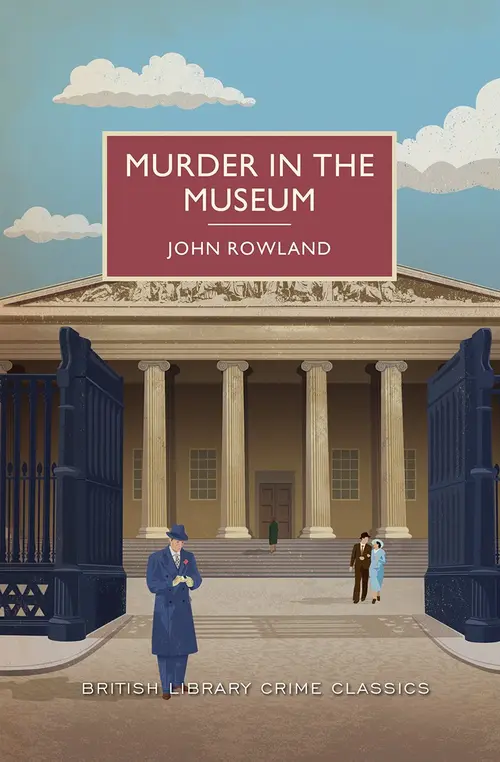
Murder in the Museum
Murder in the Museum
John Rowland
With an Introduction
by Martin Edwards
Poisoned Pen Press
Copyright
Copyright
Originally published in London in 1938 by Herbert Jenkins
Copyright © 2016 Estate of John Rowland
Introduction Copyright © 2016 Martin Edwards
Published by Poisoned Pen Press in association with the British Library
First E-book Edition 2016
ISBN: 9781464205804 ebook
All rights reserved. No part of this publication may be reproduced, stored in, or introduced into a retrieval system, or transmitted in any form, or by any means (electronic, mechanical, photocopying, recording, or otherwise) without the prior written permission of both the copyright owner and the publisher of this book.
The historical characters and events portrayed in this book are inventions of the author or used fictitiously.
Poisoned Pen Press
6962 E. First Ave., Ste. 103
Scottsdale, AZ 85251
Contents
Contents
Murder in the Museum
Copyright
Contents
Introduction
Chapter I
Chapter II
Chapter III
Chapter IV
Chapter V
Chapter VI
Chapter VII
Chapter VIII
Chapter IX
Chapter X
Chapter XI
Chapter XII
Chapter XIII
Chapter XIV
Chapter XV
Chapter XVI
Chapter XVII
Chapter XVIII
Chapter XIX
Chapter XX
Chapter XXI
Chapter XXII
Chapter XXIII
More from this Author
Contact Us
Introduction
Introduction
It is perhaps appropriate that the British Library should republish John Rowland’s Murder in the Museum, which made its first appearance in 1938. At the time that Rowland’s book came out, the United Kingdom’s national library formed part of the British Museum, which in this book supplies a memorable crime scene.
Meek, mild-mannered Henry Fairhurst is undertaking research in the domed reading room at the Museum. “An assiduous reader of detective stories”, he indulges in idle speculation about his fellow occupants of the reading room. One red-haired individual who catches his eye appears to be asleep, but when Henry approaches him, he discovers that the man is dead. He has been poisoned with cyanide.
Inspector Shelley, who featured in most of Rowland’s detective novels, takes charge of the inquiry, but Henry finds himself fascinated by the case, and strives to remain involved. Shelley is an affable fellow, and—as in several other John Rowland books—he proves willing to allow an amateur to assist with the investigation, generosity that may be surprising but tends to justify itself with results.
This combination of professional and amateur detectives, whether working side-by-side or as rivals, was not unusual in crime fiction of the 1930s. Henry Fairhurst is reminiscent of Ambrose Chitterwick, who featured in three excellent novels written by Anthony Berkeley, one of the most influential crime novelists of the era. Chitterwick, like Henry, is hen-pecked, and is subservient to a domineering aunt, much as Henry is bossed around by his formidable sister. The similarities are particularly apparent when one compares this book to Berkeley’s The Piccadilly Murder, a cleverly contrived mystery which opens with Chitterwick witnessing a murder by cyanide whilst taking tea in a London hotel.