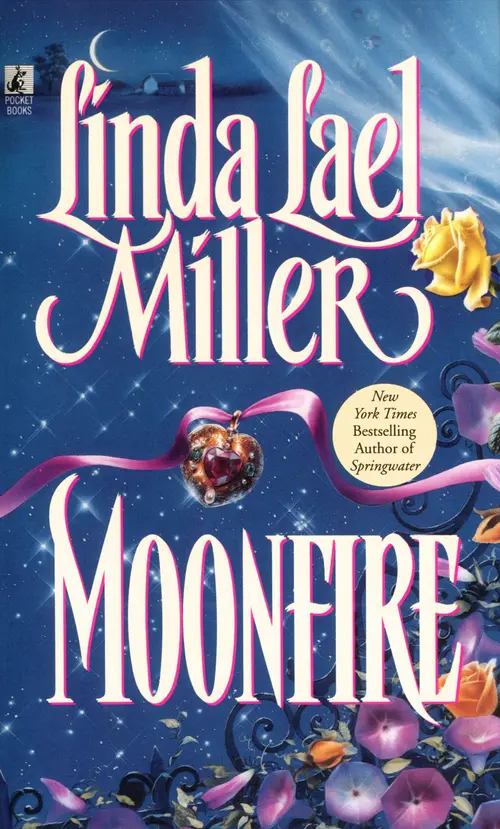
Moonfire
Cover

LOOK FOR
LINDA LAEL MILLER’S
STUNNING FRONTIER NOVEL
Springwater
AND HER DELIGHTFUL NEW SERIES FROM
POCKET BOOKS
SPRINGWATER SEASONS
Four dazzling tales in four months!
Rachel Savannah Miranda Jessica
AND DON’T MISS HER OTHER MARVELOUS ROMANCES
BANNER O’BRIEN
CORBIN’S FANCY
MEMORY’S EMBRACE
MY DARLING MELISSA
ANGELFIRE
DESIRE AND DESTINY
FLETCHER’S WOMAN
LAURALEE
MOONFIRE
WANTON ANGEL
WILLOW
PRINCESS ANNIE
THE LEGACY
TAMING CHARLOTTE
YANKEE WIFE
DANIEL’S BRIDE
LILY AND THE MAJOR
EMMA AND THE OUTLAW
CAROLINE AND THE RAIDER
PIRATES
KNIGHTS
MY OUTLAW
THE VOW
TWO BROTHERS:
THE LAWMAN & THE GUNSLINGER
She Stood Fast as Reeve Untied Her Camisole, and Then Peeled It Away from Her Flesh …
“Maggie,” he said, in a low and ragged voice, and then she felt Reeve’s breath on her face and instinctively she tilted her head back to greet his mouth with her own. His forceful but infinitely gentle hands entangled themselves in her hair and he kissed her …
As the soul-shattering kiss continued, Maggie felt the straining power of him and trembled for the want of it, even as she recoiled inwardly in fear.
Maggie was powerless to protest, much less flee, and when she felt herself being lowered to a soft bed, she offered no resistance. Reeve’s voice was thick, hoarse with needs Maggie couldn’t even begin to comprehend. “You’re a virgin, then, aren’t you, lass?”
Books by Linda Lad Miller
| Banner O’Brien | Lily and the Major |
| Corbin’s Fancy | Emma and the Outlaw |
| Memory’s Embrace | Caroline and the Raider |
| My Darling Melissa | Pirates |
| Angelfire | Knights |
| Desire and Destiny | My Outlaw |
| Fletcher’s Woman | The Vow |
| Lauralee | Two Brothers |
| Moonfire | Springwater |
| Wanton Angel | Springwater Seasons series: |
| Willow | Rachel |
| Princess Annie | Savannah |
| The Legacy | Miranda |
| Taming Charlotte | Jessica |
| Yankee Wife | A Springwater Christmas |
| Daniel’s Bride |
Title Page

Copyright Page
This book is a work of historical fiction. Names, characters, places and incidents relating to non-historical figures are either the product of the author’s imagination or are used fictitiously. Any resemblance of such non-historical incidents, places or figures to actual events or locales or persons, living or dead, is entirely coincidental.
An Original Publication of POCKET BOOKS
 POCKET BOOKS, a division of Simon & Schuster Inc.
1230 Avenue of the Americas, New York, NY 10020
www.SimonandSchuster.com
Copyright © 1988 by Linda Lael Miller
All rights reserved, including the right to reproduce this book or portions thereof in any form whatsoever. For information address Pocket Books, 1230 Avenue of the Americas, New York, NY 10020
ISBN: 0-671-73770-8
First Pocket Books printing May 1988
10 9 8 7
POCKET and colophon are registered trademarks of Simon & Schuster Inc.
Cover illustration by Morgan Kane
Border design by Marlene Moore
Printed in the U.S.A.
Dedication
For Crystal Harworth,
who taught me to hear
the sweet, mystical music that words make
Prologue 
Dublin—September 1867
A DEFT FLIP OF JAMIE’S WRIST CAUSED THE GOLDEN WATCH to spin at the end of its chain. With a glint of triumph in his ice-blue eyes, he caught the gentleman’s time-piece in one grubby palm and grinned.
Reeve, two years older than his brother at fourteen, lacked Jamie’s taste for petty larceny. For the sake of the woman and the priest over near the fire—they were about the business of death—he kept his voice low. “Do you want to be transported, you idiot? It’s one thing to pinch an onion or a turnip, but a dandy’s watch?”
Jamie swallowed hard and glanced toward their mother’s cot, which had been set as close as possible to the pitifully inadequate coal fire in the grate. “Herself is wantin’ medicine,” he said with lame defiance.
“She’s past that,” Reeve retorted. “There’ll be no need of medicine, and we both know it.”
The priest was giving last rites by then, and both Jamie and Reeve watched and listened in silence, hating their helplessness and their hunger. Through it all Callie McKenna lay motionless, her eyes closed.
At last Father McDougal turned weary-eyed from Callie’s cot, his face gaunt and deeply lined. He seemed to carry the troubles of all Ireland on his thin shoulders. As he approached, he reached one slightly tremulous hand into the pocket of his frayed coat.
From his perch on the edge of the table Jamie skittered to his feet. “Is she—”
Father McDougal shook his balding head. “Not yet, lad, but I don’t look for Callie to last the night, bless her soul.” He paused to cross himself, and then sighed. “She’s in God’s hands now.”
Reeve scowled and folded his arms across his chest; he’d hear no talk of God or his mother’s coming happiness in heaven. Where had God been when Callie McKenna was left to scour the scummy floors of taverns and mend the gowns of fancy ladies who didn’t think her fit to spit upon?
“Any work to be had on the docks these days, then?” the priest asked pointlessly. He already knew the dismal answer, for there was no work anywhere in Ireland, not in the cities and not on the farms.
Reeve lowered his dark head. He was a sturdy lad, broad in the shoulders and strong despite the hunger that had gnawed at his belly for as long as he could remember. “No work,” he muttered. It didn’t seem right to mention his plans for the future, not now, with his mother dying.
The elderly priest cleared his throat; Reeve glanced up and saw that Jamie still clutched the watch in one filthy hand. “Stealin’ again, are you, boyo?” he demanded more in despair than in anger. “Shameful thing, that. Wrong in the eyes of God.”
Jamie’s answer was quick and flippant, as Jamie’s answers tended to be. “God ain’t lookin’, now, is He? Not toward me and not toward me poor mum and not toward the whole of Ireland!”
The old man sighed and then, after a moment’s hesitation, drew his hand from his pocket and opened his palm to reveal two bits of tarnished brass shaped like coins and punched through at the top. When neither lad responded, he pressed one into Reeve’s hand and one into Jamie’s and hastily left the cottage.
In the gloom Reeve examined the coin. Thanks to the nuns of St. Patrick’s parish, he could read a little, and he made out the words: Blessed is he that considereth the poor.
Shame scalded the back of his throat and throbbed behind his blue-green eyes. “It’s a bloody beggar’s badge!” he hissed.
Jamie was quiet; both brothers listened to the labored breathing of their mother. She was cold and sick and she was going to die hungry—just as she’d lived.
In a burst of fury and helplessness Reeve hurled the badge across the room. It made a clinking sound as it struck the fireplace.
Jamie set his jaw and started toward the door. “I’ll be back,” he said softly, speaking not to Reeve but to their mother, “and I swear by all that’s holy that I’ll bring back bread and tea and whatever else I can find.”
“Good lad,” Callie replied weakly, a woman wandering in a dream. “He’s a good lad, my Jamie. A good lad.”
“You’re going to beg?” Reeve demanded of his brother in a rasping undertone.
Jamie held up the fancy watch and gave it another arrogant spin. It glinted in the gloom of that tiny hovel. “Aye, Reeve,” he answered tightly, “if it comes to that, I’ll beg, but first I’ll be about makin’ a fair swap with the grocer.”
A cold premonition quaked in the very core of Reeve McKenna’s soul. “Don’t do it, Jamie. Sure as the saints, this time they’ll collar you.”
Jamie’s expression was hard, and for the moment he was a man, not a boy. “I’ll not see me mother die hungry, Reeve.”
Reeve made his way to the hearth, searching for the beggar’s badge he’d tossed away only moments before. He’d take it around, to this house and that—for his mother he’d do it, and to save Jamie from the law. He was the elder brother, the task rightly fell to him, intolerable as it was.
“Your luck’s sure to run out,” he said, searching the floor around the hearth. Just as he caught a glimmer of firelight on the brass, the door of the cottage closed with a smart click and Jamie was gone.
Reeve scrambled across the room, wrenching open the door. The stench of that narrow Dublin street came at him and mingled with the night chill. “Jamie!” he bellowed into the dense fog that covered Dublin like a yellowed muslin shroud. “Jamie, come back!”
It was too late. There was no sign of Jamie; the lad was as quick with his feet as he was with his hands.
Reeve swore and closed the creaky door, running one hand through his hair as he turned back to the dying woman and the dying fire and all his dying hopes.
“Is there word come from your da, then?” Callie asked in a bright voice. She sounded almost like her old self. “It’s off to America we’ll be, one fine day soon.”
Near tears, Reeve knelt beside his mother’s cot and took one of her thin, work-roughened hands into his own. “No word yet,” he said softly.
Callie’s eyes, sea-green like her eldest son’s, were fixed on the shadowy ceiling of the hovel where Marcus had left her so many years before. “Never a letter,” she said on a long sigh. “Ain’t it strange there was never a letter?”
Reeve let his forehead rest against hers for a moment and drew a deep, steadying breath. “Da wasn’t much for writin’,” he answered gently after a very long time. Privately, he believed his father was either dead or the worst sort of scoundrel, but of course he couldn’t say that. Indeed, he wished he’d pretended that there was a letter from America, with passage money for them all. What harm would it have done to lie to Callie now?
It might have been a mercy.
“I’m dying, ain’t I?” Callie asked, and her eyes lost their dreamy quality. She was lucid and full of misery.
It was hard for Reeve to speak, impossible for him to lie. He struggled for a few moments before offering a tentative “Father McDougal says you’ll go to heaven, sure and straight.”
Callie smiled at the prospect. Despite years of suffering, years of waiting and fruitless hope, she believed. Reeve couldn’t recall a time when her faith had so much as wavered, though his own was long gone. “Oh, yes,” she said. “I’ll go to heaven.” Her dark hair, without even a strand of gray, fanned out over her coverless pillow, and she arched one finely etched eyebrow. “But what of you and Jamie? Where will you go—to America?”
Reeve shook his head. He could no longer keep back the truth. “I’ve got a berth on a sailing ship, Ma,” he said, and even now he felt a singular excitement at the prospect. “A whaler. Her home port is in New South Wales, at Sydney Town.”
Callie’s aquamarine eyes widened. “New South Wales! What of Jamie? Will you take him with you?”
Reeve remembered his interview with the captain of the Sally Dee—though it had taken place that afternoon, it seemed a thousand years in the past—and felt true despair. The captain had said there was need of only one cabin boy aboard the ship. He’d have a gander at Jamie, and if he looked fit for the sea, there might be a place for him on the next voyage. Beyond that the man could promise nothing.
“I won’t leave without him,” Reeve vowed solemnly. It was a promise he meant to keep, even if he had to sacrifice his own plans and dreams.
Callie looked relieved, and Reeve wondered if she knew about Jamie’s thieving, despite their efforts to hide it from her. “He’s a fine boy, my Jamie,” she said, “but he ain’t so sensible as you, Reeve. He needs lookin’ after.”
Reeve permitted himself a smile and nodded. “That he does.”
“You’ll see to him?”
Reeve squeezed his mother’s hand. “I’ll see to him,” he affirmed.
Callie gave a small sigh and closed her eyes to sleep.
Almost an hour passed before Jamie was back, dodging into the cottage, his arms filled with loot. He’d brought tea, a whole loaf of bread still warm from the oven, a cold joint of mutton, and a small bag of coarse white sugar. After casting a look of shame and defiance in his brother’s direction, he dropped the food on the table and crossed the room to shovel the last of the coal onto the fire.
Unsettled and anxious, Reeve took the well-used kettle into the street and filled it with water from the neighborhood pump. Back in the cottage, he set it on the hob to boil.
Jamie was slicing the mutton with quick, deft strokes of his pocket knife. “How is Mum?” he asked after a long silence.
Reeve caught his thumbs in the pockets of his tattered trousers. “Lookin’ for a letter from Da, she was. Still, after all these years.”
Jamie continued to slice the meat for their supper. “You think he’s dead?”
“That or just forgetful,” Reeve replied with quiet bitterness.
Marcus McKenna’s fate in far-off America was a touchy subject between them, and they rarely discussed it. “He had to serve seven years for his passage,” Jamie reminded his brother evenly.
“He’s had that, Jamie, and four years more. If Da’s alive, he’s decided not to bother bringin’ a wife and two sons over from the Old Sod.”
Jamie’s jawline tightened, then relaxed. He was a handsome lad, with his wheat-colored hair and pale blue eyes. “Have you ever thought of goin’ to America yourself, Reeve? I mean, if Da could work for his passage, so could we.”
Reeve thought of the beggar’s badge, still lying on the floor somewhere, a painful reminder of his limited options. “They kept slaves there once,” he said. Just the thought made his skin crawl. “Had a war over it too.”
Jamie popped a bit of mutton into his mouth and chewed thoughtfully. “You wouldn’t be a slave—all that’s over now. Workin’ off your passage ain’t the same at all.”
“For a time it is. A man has a master. He’s owned, like a carriage or a calf.”
“For the likes of us,” Jamie pointed out, tearing the fragrant loaf of bread into hunks, “it might be the only way out of Ireland.”
“Aye,” Reeve replied halfheartedly, thinking of the berth he’d been offered on the Sally Dee. Sooner or later he was going to have to speak of it, but the right time hadn’t come yet.
When the water came to a whistling boil on the hob, Reeve poured it into the chipped crockery pot. While the savory brew steeped, Jamie gently awakened his mother.
Callie’s hands trembled as she reached for the plate her son extended. There was a dazzled expression in her eyes and she cast a quick glance around the cottage, as if thinking that she might have passed on to some other, better life without noticing.
Callie ate little of the meal, but enjoyed two full cups of sugared tea. Later that night, while her sons slept on their pallets on the cottage floor, she died.
She was buried in a pauper’s grave, without even a coffin, but Father McDougal was there in the drizzling rain to say the holy words. Reeve listened in a numb rage, hating not only the priest, but the God he served as well. It would have been a comfort to believe that angels had met his mother’s soaring spirit and carried her to a place of peace and plenty, but he couldn’t quite manage that.
Nor could he weep as Jamie did. There was nothing to do but accept the dismal reality of Callie’s death just as it was.
At the edge of the churchyard the grocer waited, flanked by two soldiers of the English crown. “That’s him,” the fat merchant cried through the downpour. “That’s him what give me the watch!”
Reeve started to step between Jamie and the soldiers, but the priest grabbed at his arm. Before he could take the blame on himself, Jamie owned up, his face wet with tears and rain.
“It’s me you want,” he said.
“Blighter,” one soldier muttered to the other as they bound Jamie’s wrists behind him. “Sticky-fingered, these micks, every last one of ’em!”
“Wait!” Reeve choked, shaking free of the old priest’s grasp. “It’s a lie—I’m the one that took the gentleman’s watch—”
The second soldier laughed. “Too late for that, lad.”
Again Father McDougal caught at Reeve’s arm, this time with surprising strength. “There’s nothing you can do now. Let them go.”
Jamie gave Reeve a nod and a half smile that would linger in his brother’s memory for a long time. Then the soldiers dragged him away between them, the fat grocer tottering behind, raving on and on about his own obvious innocence of any crime.
Reeve sank against a tree, and at last he wept—for his mother and for Ireland, for Jamie and for himself.
At home he ate the last of the mutton and the bread and drank the tea. The landlady, a shrill widow, had new tenants for the cottage, so he couldn’t stay, and there was nothing to pack, for all Reeve McKenna had in the world were the clothes on his back. Finding the beggar’s badge on the floor, he dropped it into his pocket, for even though the talisman was an object of shame, it was a possession, something to own.
For the next few days Reeve tried in vain to see Jamie, but Dublin Gaol was not a place where compassion was practiced, and he was repeatedly refused. Nights, he slept in doorways and alleys.
The day of Jamie’s trial—he was called to the docket from among a hundred others like him—Reeve was there in the crowd of spectators. His brother stood proudly, with his chin high and a dancing light in his eyes that seemed not only to ask for trouble but to court it.
The magistrate, who had probably never been hungry a day in his life, made a lofty speech about thievery’s inherent evil and sentenced Jamie to be transported for a period of not less than seven years.
Stunned, and half sick with hunger and desperation, Reeve staggered out of the courtroom and into a pouring rain, making his way toward the docks. He could only hope that the Sally Dee hadn’t sailed without him.
The whaler was still in port, though she was slated to sail within the hour. After one last look around him at the cobbled streets and the crowded taverns and the hovels hunched close together, Reeve turned his back on Dublin forever.
As for Jamie, he’d found his own way to New South Wales, peculiar though it was, and Reeve was sure he’d find his brother again on the streets of Sydney Town.
Chapter 1
Brisbane—February 1887
EMIGRANTS AND FIRST-CLASS PASSENGERS ALIKE STOOD AT the starboard rail of the S.S. Victoria, agape at the destruction that greeted them. Gone were the wharves that might have held eager friends and family members waiting to welcome the travelers; cargo, washed away from the docks, bobbed in the sun-spattered blue-green waters. Lavatories floated past, along with what appeared to be an upended cottage, and innumerable rabbits shivered on the few patches of land still visible.
The best part of the city was gone, swept away by the flooded waters of the Brisbane River.
Maggie Chamberlin’s heart pounded beneath her dove-gray woolen traveling dress. The thought skittered through her mind that while entirely suitable for the dreary grayness of a London winter, the gown was too warm by half for the heat of February in Australia.
Like the forlorn and frightened rabbits ashore, Maggie trembled. She put her unsuitable frock out of her mind; proper clothing was the least of her problems. Philip Briggs, the man who had persuaded her to make this journey, who had promised to marry her, was nowhere in sight. Suppose he had not survived the disaster?
Maggie realized that she had been clutching the ship’s railing for support and relaxed her grip. Her heavy silver-flaxen hair sagged to the nape of her neck, and she raised one hand to secure the pins, a nervous, unconscious gesture that had become a habit.
“A fine bit of business this is,” complained Tansy Quinn, the one friend Maggie had made aboard the ship in the five weeks since they’d left London. A small, plump girl with plain brown hair, bright blue eyes, and a beguiling chip in one front tooth, Tansy was emigrating to Australia for the second time in her short but eventful life. She was almost as well-traveled as Maggie, despite her poor beginnings in Liverpool, and, until now, she had exhibited unflagging confidence in her ability to make her way in this strange land where the seasons were turned topsy-turvy and flamboyantly colored birds flew free rather than being confined inside gilded cages in the parlors of the gentry. “Looks as though the lot of it’s been washed out to sea.”
Maggie’s knees were suddenly weak; once again she gripped the railing. Her wide, heavily lashed gray eyes scanned the devastation on shore. Dark despair shimmied up and down her throat and settled over her soul in an ebony fog. There were people waving at the ship from rowboats and dinghies, but not one of them was Philip. She was once again a stranger in a strange land, and there was no one to meet her. She closed her eyes and swallowed, unable to respond to Tansy’s comment.
Tansy gave her an oddly reassuring nudge with one elbow. “Don’t be lookin’ so down-’earted, love. It’s a rotten show, but we’ll go on to Sydney. Or we could get ourselves jobs at Government ’ouse, down Melbourne way.”
Maggie opened her eyes and gave her friend a look that was at once wry and dispirited. Tansy had never believed in Philip Briggs, though she hadn’t come right out and said as much; she viewed him with the same kindly disdain older children reserved for St. Nicholas. “Philip specifically told me to meet him here,” Maggie said stiffly. “In Brisbane.”
The Story Continues on BooksBarbecue!
Enjoyed this preview? ❤️ Do not stop here!
Read the complete book free online → 🔗
Continue reading now on BooksBarbecue and discover every page!
Love reading? Bookmark BooksBarbecue.com for more amazing books!
Happy Reading!