Miracle of the Rose
Cover
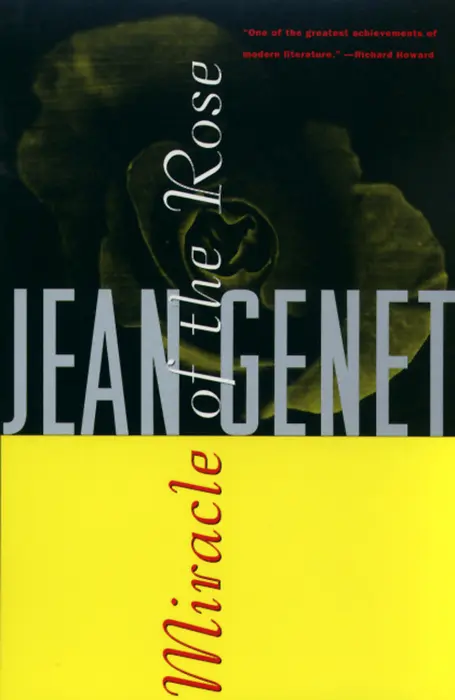
Half Title
Miracle of The Rose
Works By Jean Genet
WORKS BY JEAN GENET
Published by Grove Press
The Balcony
The Blacks
Funeral Rites
The Maids and Deathwatch
Miracle of the Rose
Our Lady of the Flowers
Querelle
The Screens
The Thief’s Journal
Title
Miracle of The Rose
by Jean Genet
Translated from the French
by Bernard Frechtman

GROVE PRESS
NEW YORK
Miracle of The Rose
Miracle of The Rose
OF ALL the state prisons of France, Fontevrault is the most disquieting. It was Fontevrault that gave me the strongest impression of anguish and affliction, and I know that convicts who have been in other prisons have, at the mere mention of its name, felt an emotion, a pang, comparable to mine. I shall not try to define the essence of its power over us: whether this power be due to its past, its abbesses of royal blood, its aspect, its walls, its ivy, to the transient presence of convicts bound for the penal colony at Cayenne, to its prisoners, who are more vicious than those elsewhere, to its name—none of this matters. But to all these reasons was added, for me, another: that it was, during my stay at the Mettray Reformatory Colony, the sanctuary to which our childhood dreams aspired. I felt that its walls preserved—the custodial preserving the bread—the very shape of the future. While the boy I was at fifteen twined in his hammock around a friend (if the rigours of life make us seek out a friendly presence, I think it is the rigours of prison that drive us toward each other in bursts of love without which we could not live; unhappiness is the enchanted potion), he knew that his final form dwelt behind them and that the convict with his thirty-year sentence was the fulfilment of himself, the last transformation, which death would make permanent. And Fontevrault still gleams (though with a very soft, a faded brilliance) with the lights emitted in its darkest heart, the dungeon, by Harcamone, who was sentenced to death.
When I left Santé Prison for Fontevrault, I already knew that Harcamone was there, awaiting execution. Upon my arrival I was therefore gripped by the mystery of one of my fellow-inmates at Mettray who had been able to pursue the adventure of all of us to its most tenuous peak: the death on the scaffold which is our glory. Harcamone had “succeeded.” And as this success was not of an earthly order, like fortune or honours, his achievement filled me with amazement and admiration (even the simplest achievement is miraculous), but also inspired the fear that overwhelms the witness of a magical operation. Harcamone’s crimes might have meant nothing to me had I not known him at close range, but my love of beauty (which desired so ardently that my life be crowned with a violent, in fact bloody death) and my aspiration to a saintliness of muted brilliance (which kept it from being heroic by men’s standards) made me secretly choose decapitation, which has the virtue of being reproved, of reproving the death that it gives and of illuminating its beneficiary with a glory more sombre and gentle than the shimmering, silvery velvet of great funerals; and Harcamone’s crimes and death revealed to me—as if taking it apart—the mechanism of that glory which had at last been attained. Such glory is not human. We have never heard of any executed criminal whose execution alone haloed him as the saints of the Church and the glories of the age are haloed, but yet we know that the purest of those who were given that death felt, within themselves and on their severed head, the placing of the amazing private crown which was studded with jewels wrested from the darkness of the heart. Each of them knew that the moment his head fell into the basket of sawdust and was taken out (by the ears) by an assistant whose role seems to me strange indeed, his heart would be garnered by fingers gloved with modesty and be carried off in a youngster’s bosom that was adorned like a spring festival. I thus aspired to heavenly glory, and Harcamone had attained it before me, quietly, as the result of murdering a little girl and, fifteen years later, a Fontevrault guard.
I arrived at the prison with my hands and feet chained. I had been prepared by a very long and rough trip in the armoured police-train. There was a hole in the seat, and when my gripes got too violent because of the jolting, I had only to unbutton. It was cold. I rode through a countryside numbed with winter. I imagined the hard fields, the hoar-frost, the impure daylight. My arrest had taken place in mid-summer, and my most haunting memory of Paris is of a city completely empty, abandoned by the population which was fleeing from the invasion, a kind of Pompeii, without policemen at the crossings, a city such as the burglar dares dream of when he is tired of inventing ruses.
Four travelling-guards were playing cards in the corridor of the train. Orléans . . . Blois . . . Tours . . . Saumur. The car was detached and switched to another track, and we were at Fontevrault. There were thirty of us, because the police-car had only thirty cells. Half of the convoy was composed of men of about thirty. The rest ranged from eighteen to sixty.
While the passengers looked on, we were attached in pairs, and with our hands and feet chained we got into the Black Marias that were waiting for us at the station. I had time to note the sadness of the crop-headed young men who watched the girls go by. My chain-mate and I entered one of the narrow cells, a vertical coffin. I noticed that the Black Maria was divested of its charm, that air of haughty misfortune which, the first few times I had taken it, had made it a vehicle of exile, a conveyance fraught with grandeur, slowly fleeing, as it carried me off, between the ranks of a people bowed with respect. It is no longer a vehicle of royal misfortune. I have had a clear vision of it, of a thing which, beyond happiness or unhappiness, is splendid.
It was there, upon entering the prison-wagon, that I felt I had become a true, disenchanted visionary.
The wagons drove to the prison. I cannot tell how it looked from the outside—I can tell this about few prisons, since those which I know, I know only from the inside. The cells of the wagon were closed, but from a jolt of the vehicle as it mounted a paved slope I gathered that we had gone through a gate and that I was in the domain of Harcamone. I know that the prison is at the bottom of a valley, of an infernal gorge from which a miraculous fountain gushes, but nothing stops us from thinking that it is at the top of a high mountain; here, in this place, everything leads me to think that it is at the top of a rock, of which the ramparts are a continuation. Although this altitude may be ideal, it is all the more real, for the isolation it grants is indestructible. Neither the walls nor the silence has anything to do with it. We shall see this in the case of Mettray Reformatory, which is as far-flung as the prison is high.
Night had fallen. We arrived amidst a mass of darkness. We got out. Eight guards, lined up like footmen, were waiting for us on the lighted steps. At the top of a flight of two stairs the wall of darkness was breached by a huge, brightly illuminated arched door. It was a holiday, Christmas perhaps. I had barely time to catch a glimpse of the yard, the black walls of which were covered with mournful ivy. We passed an iron gate. Behind it was a small inner yard lit up by four electric lamps: the bulb and shade, in the form of an Anamite hat, are the official lamp of all French prisons. At the end of this yard, where, even in the darkness, we sensed an unwonted architecture, we passed another iron gate, then went down a few steps lit by lamps of the same kind and suddenly we were in a delightful square garden adorned with shrubbery and a fountain around which ran a cloister with delicate little columns. After mounting a stairway sculpted in the wall, we found ourselves in a white corridor and then proceeded to the record office, where we remained a long time in a state of disorder before our chains were taken off.
“You there, you going to put out your wrists?”
I extended my wrist, and the chain pulled up the hand, sad as a captured animal, of the fellow to whom it was attached. The guard fumbled at the lock of the handcuffs; when he found it and inserted the key, I heard the slight click of the delicate trap that was freeing me. And that deliverance to enter captivity was to us a first affliction. The heat was stifling, but no one thought it would be so hot in the dormitories. The door of the office opened into a corridor that was lit up with cruel precision. The door was unlocked. A convict on the maintenance staff, probably a sweeper, pushed it slightly, put his smiling face in, and whispered:
“Say, boys, if any of you have butts, better let me have ‘em, because . . .”
He broke off and disappeared. Probably a guard was coming. Someone shut the door from the outside.
I listened to hear whether the voice would cry out, but I heard nothing. Nobody was being tortured. I looked at one of the fellows who were with me. We smiled. We had both recognized the whisper which would be for a long time the only tone in which we could speak. We sensed all around us, behind the walls, a stealthy, silent but zealous activity. Why in the dead of night? In winter, darkness came on quickly, and it was only five in the afternoon.
Some moments later, likewise muffled, but remote, a voice, which sounded to me like that of the inmate, cried out:
“Regards to your fanny from my dick!”
The guards in the office heard it too but didn’t bat an eyelash. Thus, as soon as I arrived I realized that no convict’s voice would be clear. It is either a murmur low enough for the guards not to hear, or else a cry muffled by a thickness of walls and anguish.
As soon as each of us gave his name, age, occupation, and distinguishing marks and signed with the print of his forefinger, he was taken by a guard to the wardrobe. It was my turn:
“Name?”
“Genet.”
“Plantagenet?”
“I said Genet.”
“What if I feel like saying Plantagenet? Do you mind?”
“. . .”
“Christian name?”
“Jean.”
“Age?”
“Thirty.”
“Occupation?”
“No occupation.”
The guard gave me a dirty look. Perhaps he despised me for not knowing that the Plantagenets were buried in Fontevrault, that their coat of arms—leopards and the Maltese Cross—is still on the stained-glass windows of the chapel.
I had barely time to wave a stealthy good-bye to a youngster who had been in the convoy and whom I had singled out. It is less than fifty days since I left him, but though I would like to adorn my grief with the memory of him, to linger over his face, he flees me. In the Black Maria that took us from the station to the prison, he managed to get into the same narrow cell (the guards made us enter in pairs) as a tough-looking pimp. In order to be chained to the pimp, he had resorted to a trick that made me jealous of both of them and that still bothers and, owing to a deep mystery, attracts me, tearing a veil so that I have a luminous insight. And ever since, when time hangs heavy, I mull over this memory in my prison, but I cannot get to the heart of it. I can imagine what they did and said, what plans they made for the future, I can fabricate a very long life for their love. But I weary quickly. Developing this brief incident—the child’s manoeuvre and his entering the little cell—adds nothing to my knowledge of it, in fact destroys the charm of the lightning manoeuvre. In like manner, when Harcamone hurried past me, the beauty of his face lit me up, but when I observed it at great length, in detail, the face faded. Certain acts dazzle us and light up blurred surfaces if our eyes are keen enough to see them in a flash, for the beauty of a living thing can be grasped only fleetingly. To pursue it during its changes leads us inevitably to the moment when it ceases, for it cannot last a lifetime. And to analyze it, that is, to pursue it in time with the sight and the imagination, is to view it in its decline, for after the thrilling moment in which it reveals itself it diminishes in intensity. I have lost that child’s face.
I picked up my bundle: two shirts, two handkerchiefs, a half-loaf of bread, a song-book. And, with an already plodding gait, not saying a word to them, I left my travelling companions, crashers, pimps, hoodlums, thieves sentenced to three years, five years, ten years, and lifers, and went to join other crashers, other lifers. I walked in front of the guard through very clean, white hallways which were brightly lit and smelled of fresh paint. I passed two trusties who were carrying on a stretcher the eight monumental registers containing the names of the eleven hundred and fifty prisoners. They were followed by a young guard and a clerk. The two prisoners walked in silence, their arms straining beneath the weight of the giant volumes which could have been reduced to a small notebook. In shuffling along on their selvaged slippers, they bore the full weight imparted by so much sadness and thus seemed to be thudding the floor, lumberingly, with rubber boots. The two guards observed the same silence and walked with equally solemn steps. I almost saluted, not the jailers, but the books which contained the so illustrious name of Harcamone.
“Hey, you going to salute?”
This was said by the turnkey who was escorting me, and he added:
“Unless you already feel like getting the works.”
Prisoners are required to salute the guards. As I neared them I ventured, with difficulty, the ridiculous salute which is so incompatible with our flabby, gliding gait on heelless slippers. We passed other guards, who didn’t even look at us. The prison lived like a cathedral at midnight of Christmas eve. We were carrying on the tradition of the monks who went about their business at night, in silence. We belonged to the Middle Ages. A door was open at the left. I entered the wardrobe. When I took off my clothes, I felt that the brown homespun prison outfit was a robe of innocence which I was putting on in order to live near, in fact under the very roof of the murderer. Trembling like a thief, I lived for days on end in a state of wonder which none of the lowliest daily pre-occupations was able to destroy: neither the crappers nor the stew nor the work nor the confusion of the senses.
After assigning me to a dormitory, Number 5, they assigned me to the workshop where camouflage nets were being made for the German army which was then occupying France. I had made up my mind to keep out of the intrigues of the big shots, of the guys who pay for larceny, who pay for murder, but in the wardrobe I was given a pair of trousers that had belonged to a bruiser—or an inmate who must have acted like one. He had made two slits in it for false pockets, which were forbidden. They were waist-high and cut on the bias, like those of sailors. When I walked, or was inactive, that was where, in spite of myself, I put my hands. My gait became what I hadn’t wanted it to be, that of a big shot. The outfit included a brown homespun jacket without collar or pockets (though a convict had pierced the linng and thus made a kind of inner pocket). It had button-holes, but all the buttons were missing. The jacket was very threadbare, but less than the trousers, which had been mended with nine patches, all more or less worn with age. There were thus nine different shades of brown. The two false pockets had been cut diagonally at stomach-level with, I imagine, a paring-knife from the shoemaking shop. The trousers were supposed to be held up by the buttons alone, without belt or braces, but the buttons were all missing, which made the outfit look as sad as a wrecked house. In the shop, two hours after my arrival, I made myself a raffia belt in the form of a rope, and, as it was confiscated every evening by a guard, I would make another the following day. There are inmates who make a new one every single morning, that is, say, for ten years, three thousand times. The trousers were too short for me. They reached only to my calves, so that my long underpants and pale white legs were visible. The underpants were white and the letters A.P., which stand for administration pénitentiaire, were stamped on them in thick ink. The undershirt was made of homespun, also brown, and had a small pocket on the right side. The coarse linen shirt was collarless. The sleeves had no cuffs. Nor buttons either. There were rust spots on the shirt which I feared were shit-stains. It was stamped A.P. We changed shirts every two weeks. The slippers were made of brown homespun. They would get stiff with sweat. The flat forage cap was made of brown homespun. The handkerchief had blue and white stripes.
I add the fact that Rasseneur, whom I had met in another prison, recognized me and, without consulting me, got me into a mob. Apart from him, I recognized no one from Santé or the other prisons. Harcamone was the only one who had been with me at Mettray, but he remained invisible in the death-cell.
The Story Continues on BooksBarbecue!
Enjoyed this preview? ❤️ Do not stop here!
Read the complete book free online → 🔗
Continue reading now on BooksBarbecue and discover every page!
Love reading? Bookmark BooksBarbecue.com for more amazing books!
Happy Reading!